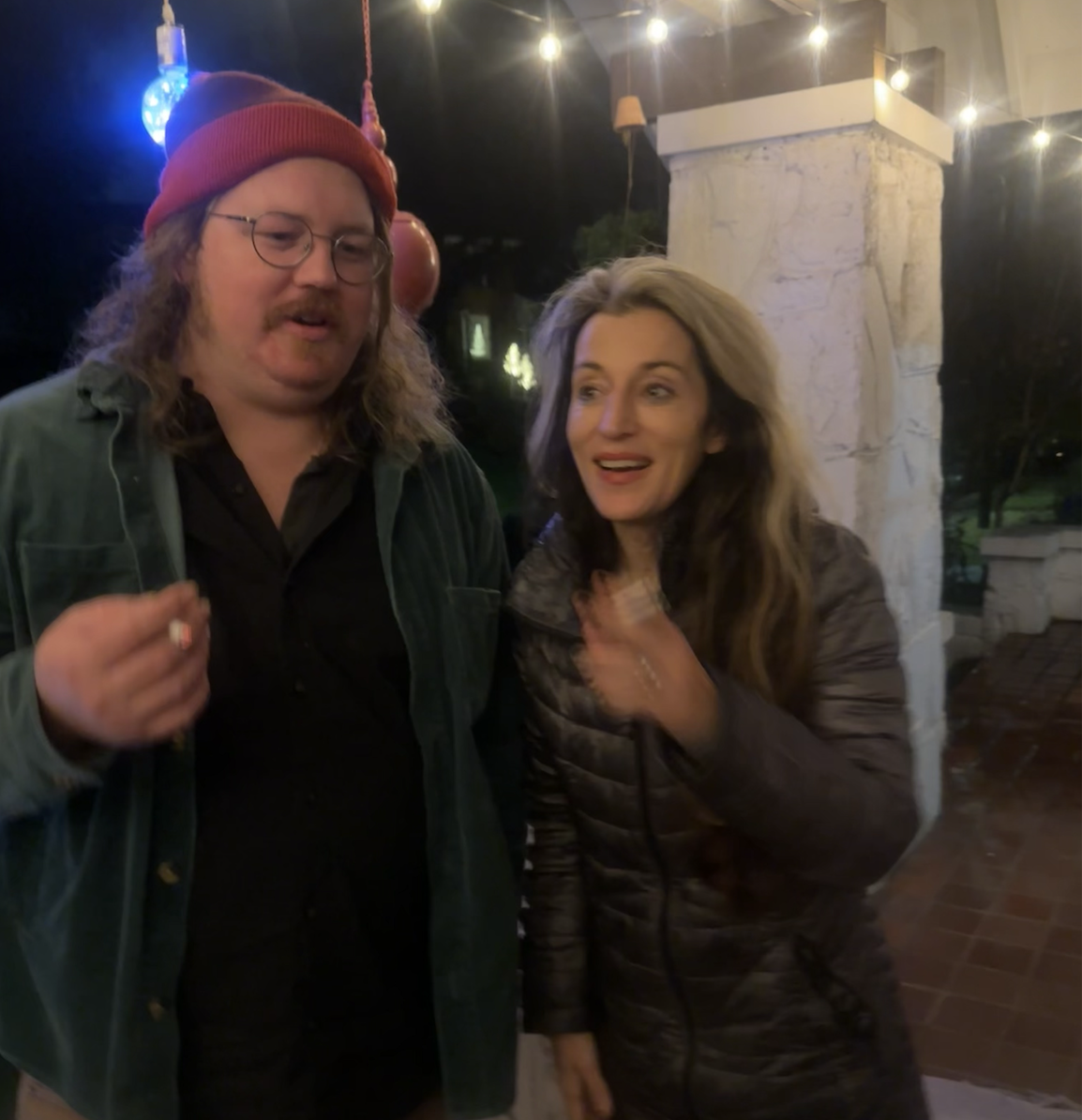
Nate and Alina, with respect to earaches.

ALINA STEFANESCU AND NATHAN KNAPP IN CONVERSATION 
12/14/2004

A One-Act Play That Is Categorically Opposed to So-Called ‘Autofiction” & Anything Resembling the Metaphysics of Earache


SCENE [Alina’s porch. A cool December night in the darkest depths of Alabamania. A party just ended. Whiskey in two glasses and wine in one. The smoke of many cigarettes mingled with rising woodsmoke. A’s man has just stoked up the fire in the outdoor porch chimney. Those remaining gird up their loins, settle into outdoor chairs.]

NATE: All right, getting into serious literary conversation now.

ALINA: I loved your tweet awhile back that mentioned that three words that you never use are trauma, traumatic, and creative. It made me think of Parul Seghal’s essay on the trauma plot—

NATE: Are we recording now? That sounded like it was your serious voice.

ALINA: I was curious about why you mentioned those three words. 

NATE: Such an easy question. Right off the bat. 

ALINA: That's all I've got. 

NATE: I don't know, I try to avoid using the word trauma because it feels like it has had all the edges worn off of it in our culture. One of my best friends is a therapist, my wife is a therapist. I live in that sort of intellectual milieu a lot of the time. Trauma comes up so easily that it doesn't seem to have much if any meaning anymore, as a word. A lot of the students that I encounter where I teach, which is close to a military base, have served tours of duty in Iraq or Afghanistan or both, and when they talk about PTSD, a lot of the time they're talking about something very different than the way that the word gets thrown around these days. As far as my dislike of the use of “creative,” I was talking about how it makes me angry when it gets used as a noun, not as an adjective. I feel like the idea of “the creative” is just another way to devalue actually making art. Maybe this is a bad answer to the question.

ALINA: [stares at a moth moving in circles and tracing an aureole in the space above Nate’s head] Amazing.  

NATE: Maybe I’m too aware of the fact of being recorded to actually give a proper answer—

ALINA: —because I'm holding the recorder up to you. [Alina puts down the recorder.] So now it doesn't feel like you’re on trial!

NATE: It infuriates me when language is used as a mask for reality. When language is used as a mask for what is actually being talked about. I think I mentioned this on twitter too recently, the way that AI use is talked about as this alternate to doing your own writing when it's really just a new version of plagiarism. But while there’s no profit in the word plagiarism, there may be in this new thing called “AI use.”

ALINA: I’m hearing the word “creative”  as a rebrand here?  

NATE: Yeah, it's a rebranding. You know you can fire everybody who used to actually be creative and replace that person with a creative. This is also how a university can replace everybody who actually has the kind of job where they teach a couple of classes, and then have enough time do their own artistic work. To get around actually having to fucking deal with real artists, who are increasingly a kind of anathema in our culture, you instead prioritize creatives, who as a rule aren’t interested in this thing called art. The creative serves capital and that’s it. I've been reading Chateaubriand’s memoirs lately, and could help noticing how he mentions the word casualties being used about people killed in the French Revolution. I may be remembering this incorrectly, but it inspired me to go look at where that word came from. Casualty, a word for a killed or wounded person with the word casual buried in it. I wanted to know how we got from killed to casual-ty.

ALINA: Right— ‘collateral damage.’
NATE:  It's much easier to say we suffered eighty-nine casualties today than we had eighty-nine people were fucking ripped apart and killed today. Easier to say eight Gazans died yesterday of malnutrition or a so-called accidental so-called airstrike than to say four babies and their mothers were slaughtered in their beds by the Israeli war machine. This kind of debasement of language both covers over and leads to the debasement of humanity. It’s disturbing. On a much different note but in the same ballpark when it comes to the use of language, it’s easier for a university president to use the term AI use than it is to talk about how plagiarism is running rampant on college campuses. A creative can benefit from AI use—potentially—but an artist can’t. If they have any self-respect, they know it.

ALINA: In my late teens, I visited the Vietnam Memorial to DC.  A few men were sitting in lawn chairs next to a sign: Vietnam Vets Against the War. The vets led me to Howard Zinn. Those names on the wall trembled, shifted, became lacunae about empire. Each name had a person buried inside it. Nobody spoke of them as people who had put themselves in a position where the only thing they could do without being declared a traitor or an enemy of a nation was to keep going forward. Among the stone monuments, I felt the power of systems, and heroism, exemplarity, resume-building . . .  What we construct as “success’ became horrifying. To love the world, I had to become a pesso-optimist. 

NATE: What you're saying about these names and the power of names and naming reminds me of something I write about in my novel. One of the scenes in Daybook is about going with my kid to the Confederate cemetery at the battlefield in Franklin for the Confederate dead. Instead of proper headstones with names and dates—in part because such a spectacular amount of Confederate soldiers were killed in that battle in the space of little over an hour, well over a thousand men just absolutely mowed down like grass facing a lawnmower blade, this necessitated first burying them where they fell and then reburying them later a few hundred yards away—this particular cemetery just has blocks in the ground with initials on them, grouped around the various states that the soldiers were from. There are no names, and the starkness of that is striking when you walk through that cemetery. I don’t write about this particular aspect in the book, but I later learned that one of the soldiers buried there was a Chinese immigrant who fought for the south. Not the kind of Confederate soldier that first comes to mind. But he was a person, a person caught up in an enormous and doomed fight that is usually framed in the popular imagination as being a pitched conflict between two very clear ideological perspectives, one based on enslaving black people and one based on the idea that all people should be free. While there is definitely some truth in that way of looking at the war as a war, to do so ignores the fact that individuals took all the risks for one reason or another. A Chinese immigrant would seem to make a very unlikely Confederate soldier—but for one reason or another, he was one. 

ALINA: You know, we have a powerful need the belong. When I was young, my parents would put up the flag a day earlier and take it down a day later than everyone in the neighborhood for the Fourth of July. 

NATE: Why?

ALINA: Because they were defectors and they needed to prove that they were American enough. And when you mentioned these immigrant names,I think about the longing to be “of”, the hunger for belonging. We seek validation through this idea that we can belong to a group. And when we talk about nationalism  or Trumpism or ethnostate ideologies–  we open the darkest box of the human heart. How do we as writers—your book is so much about the loneliness of the writer—well, what's up with us? 

NATE: I’d much rather you answer.

ALINA:  I’ll pass on this dildo, to paraphrase William Gass.

NATE: I don't know about this dildo. Can you rephrase the question? What's up with us in which sense?

ALINA: How do we resist the urge to belong? Like, what is it about in your book when I read…when I read the desire, your book? And this is related to the difference between minor literature versus the mainstream, because I think bestsellers want to belong and do belong and create the conditions for belonging and mimic the terms of belonging—

NATE: Sure, but about the dildo—

ALINA: —whether religion or sports team or fan culture or  whatever sense. Your book doesn't give us a solution for belonging, doesn't ever belong, the speaker doesn't ever belong, and I'm interested in what it is that enables or creates the capacity in a human being to give up on that. 

NATE: I don't know. I don't really feel like I ever have belonged. Not that I think I’m special in that sense. Almost everybody feels this lack on some some level—and I’m curious, too, about some of the ways in which you talk about this in My Heresies, like the poem where you talk about the rapture/Left Behind craze and how someone tells one of your kids the antichrist will be Romanian. 

ALINA: Ha ha. Poetry is a constellating medium of thought for me. I was thinking about how Tim LaHaye and Jerry whatever, the authors of the Left Behind series, really testified to literature’s capacity to shape social change and ‘revelate’ new interpretations of scriptures in the novel. Left Behinders believe they are “chosen” – and this idea of chosenness is the source of every originary ethno-supremacist myth in the Balkans – so you have one group that has been chosen to occupy a particular geographic land by some transcendent being. . .  and who can argue with a god? No evidence or reality can challenge that fiction. Social conditions aren’t simply reflected in culture representations. Social conditions are also developed and normalized by those fictive representations. The dynamic between facts and representations isn’t cold or set: it’s hot. It keeps moving. So, how do specific social representations become influential and internalized? Publishers, academics, patrons, and institutions pad the influence pathways. The media monetizes the performatives and passes the new myth along. The story is absorbed until that description becomes a usable fiction, one that finds recognition more broadly and becomes heritable. The birth of the national “self-image” competes with the religious icon in art. Look, your antichrist is the story you tell about the story that makes you feel “safe.” But feeling ‘safe’ isn’t compatible with thinking. Since Dante, the poet has been tasked with describing the inferno. I pledged myself to describe the corridors of the present through the eschatological hunger that constructs hell? 

 NATE: Are “the corridors of the present” where the dildo went?

ALINA: What dildo?

NATE: The one that you said belonged to William Gass.

ALINA: No, it is in New York now—paving the way for vital new work in the so-called corridors of the present. 

NATE: That is a tough one. Let us hope so.

ALINA: Yes. But you were talking about resisting the urge to belong.

NATE: Right. I’ve never been interested in it. The people that raised me weren't joiners and I’ve never been one either. Most of the people involved in any particular group or pursuit or scene are either profoundly mediocre in any case. As the old cliché goes, I wouldn't want to belong to any club that would have me, and I've always lived for the most part outside of the so-called literary community. For a long time I felt really angry about the fact that I couldn't sell my books even after I got an agent. It felt like New York wouldn't have me. 

ALINA: But was that anger good for you? As a writer?

NATE: Yeah it was, it was because it was like, okay, I'm going to do my own thing. 

ALINA: You gave up, you stopped trying—

NATE: Exactly. Stopped caring about it, stopped trying. But even in towns where I've lived—not the Capital L Literary Community, but the smaller ones, I've never really wanted to be a part of them either. No interest in being part of a group. And I think that goes back to the fact that I was raised in this very, very insular version of Christianity, where I was part of the group, and even that never felt good. 

ALINA: Do you think it's because you were aware of the conditions of being part of that group? 

NATE: Yeah, that they’re de-humanizing. The conditions to be a part of a group are always dehumanizing.

ALINA: [nods]

NATE: Which is the thing that brings me back to Gombrowicz over and over again because that's what he talks about. To be with other people in a group setting–to fit in–is to give up who you are. To deny who you are. Can’t avoid the suspicion, which definitely comes from my childhood in evangelicalism, that to truly become a functioning part of a scene or something would mean to cease to be myself. 

ALINA: This makes me think of my favorite book by Thomas Bernhard, My Prizes

NATE: I adore that book.

ALINA: The reason I love My Prizes even more than I love his memoir, which I love so much—

NATE: Gathering Evidence is my favorite of his!

ALINA:  When I read the memoirs about how much he loved his anarchist grandfather, I understood Bernhard completely, in some way. That said, My Prizes does an incredible job of pointing out exactly what it is in literary "community” that asks us to accede, to give up, to in a way to, um, to perjure ourselves, right? I think we forge—

NATE: Perjure?

ALINA: Yes. 

NATE: That’s an interesting word—

ALINA: I think we forge…hold on, let’s go back to your last name. Knapp. What did you say [before the play began] that it means in English? I think you said it refers to a blacksmith?

NATE: Sort of—it means to work with stone. 

ALINA: So to work with stone, to forge something, but to forge something also means to fake something. 

NATE: Well, in the original old English sense the sense is not to forge, but to make a tool. 

ALINA: To make a tool, right. My dad is a metallurgist, and he talked about forging steel a lot. I used to wonder if he knew it also meant forgery, or faking it? For me, as a child there was this physical love of language that gave me goosebumps when my dad said, “I forged this steel.” As a writer, were there moments in your young days when you recognized that your relationship to language was different from other people’s? 

NATE: Not my relationship to language, that came later. But my relationship to stories and the fun that could be had with them—that was very early on. That and the deliciousness of being in another person’s world, inside another person’s head, another person’s life. But my relationship to language in terms of being conscious of language itself came a lot later. But I say that in terms of a writer’s conscious relationship to language. My people on the mom's side where I grew up, in far southeastern Oklahoma, have one of the most particular ways of using the language that I know of, they speak in a dialect and accent that exists outside of the norm even for southern-leaning English speakers. When I first brought my to-be wife, who’s from the pacific northwest, to meet my grandfather, she could barely understand him.

ALINA: Wow. 

NATE: It's very particular. Or maybe I mean peculiar. It’s a variety of southern accent, I can imitate it later [thankfully, he did not –ed.], but I was aware early on of there being something interesting in the relationships that obtain in the sounds of words, because my dad, who came from a different part of the state, didn't speak with an accent and I don't speak with an accent—or at least for the most part no longer do. In any case, paying attention to language as a writer came a lot later. Long after my interest in storytelling, which is a bit odd to me now because I don’t particularly care about storytelling anymore except in the sense that one’s use of language in telling the story influences that story and vice versa. The one influences the other but language tends to arrive first.

ALINA: The wind is blowing in your hair. There’s no way the interview can convey the way the wind is blowing your hair right now. 

NATE: If you want it to be in the interview, you’re going to have to put it in [laughs]. Like at the beginning of the piece you could say something about the wind blowing—

ALINA: Like it was like a Bon Jovi video, but not—

NATE: I think if you describe it that way in the published interview I would come back down here to Birmingham and kill myself. In your house.

ALINA: [Laughs.]
ALINA:  Okay, but back in the 1900’s, there was a roundtable: Grace Paley talking to Donald Barthelme and Walker Percy, all three yapping about modern literature, or what it means to be modern, with  Donald and Walker complimenting each other. (Grace didn’t get to say much.) At one point, Percy said, um I really don't know anything at all, and Barthelme was like, yeah, me neither, and there was this moment where you could almost hear the audience’s horror that we were in the twentieth century and writers were failing to tell  us how to live the future. Does your writing aim to teach us how to live? 

NATE: No. 

ALINA: Why bother then? 

NATE: I am hostile to this question because I feel like it will show up in the interview. 

ALINA: It will. I promise.

NATE: Ugh.

ALINA: [waits].

NATE: I write because I have to. And because I become extremely unpleasant to my family if I don't. 

ALINA: Tell me more about that unpleasant part. Why are we like that? Why are we shitheads if we don't write, and also when it's not going well. What is wrong with us? 

NATE: I think maybe it's just the only really good part of us. I don't know if that's not true either. None of that stuff is true. 

ALINA: Will our kids hate us for it?

NATE: Probably. Hopefully. If we do it correctly, maybe, I don't know. But I feel like I'm giving bad answers. Do you think they will?

ALINA: I hope so. Part of me hopes so. But how can we know? And how can a “right” answer exist given the construction of good, which is pure pop and easy product for the Self-Help Industrial Complex. . You mentioned your wife was a therapist, which fascinated me because—

NATE: She was a therapist before she died. Yes. 

ALINA: What?

NATE: I said that because you mentioned her in the past tense. 

ALINA: Are you fucking with me here? 

NATE: [bahfaws…]

ALINA: What the pseudo did you just do?

NATE: [lights cigarette]

ALINA: Your wife is a therapist, Nate!

NATE: She is, that’s true.

ALINA: And that fascinated me because your writing in so many ways to me—or what I appreciate about it—is the way that it really debunks the value of the therapy both in this room [gestures around porch] and/or or history. I don't mean to start anything here.

NATE: Sure. 

ALINA: But as someone who has been told many times that she needs therapy [laughs maniacally]. Sorry [chuckles maniacally .] There’s no way to describe that laugh in an interview, is there?

NATE: Not unless we go to New York to find our friend.

ALINA: It is, alas, too far.

NATE: We don’t do this—writing, that is—to actually make ourselves feel better. Because it doesn't. And if there is any value in therapy or the kind of art that results in therapy, wouldn’t it make you feel better, at least eventually? The therapists in my life would probably hate that answer. I think that part of the trouble with therapy or the art that attempts to act therapeutically, is that both lead you to a set of easy answers about who you are and how you are, and I think the interesting thing about art is that, if it's any good, it leads you to places where you don't know the answers to those questions, and so you ask another question, and if the art is any good, it leads you to another question and it continues to befuddle you. So if there's anything that's wrong with the culture of therapy or art as therapy, it's that—the pursuit of and eventual arrival at answers. And so I think that good therapy if it exists, and I hope that it does, and good art, if it exists, and you can put that in italics [I did—ed.] and I hope that it does, if it is leading us anywhere, it's leading us into a further set of questions. I should also say that I think that my friend who’s a therapist would say that that’s exactly what they’re trying to do in therapy, though. 

ALINA: Which reminds me that Freud wanted psychoanalysis to be something that opened more doors than it closed. Reading Freud is like reading a story of someone who suddenly became beguiled by power, or proving that what he was doing was a science. And when he decided that it needed to be a science in order to be authoritative is when he stopped settling for questions. There is a relationship between closure and the articulation of definition, the urge to be definitive.  And this reminds me of what we see in narrativity, in the context of literature and life—this consistent discomfort with an incapacity for us to generate closure. There is no closure that isn’t a coffin. Closure is death. 

NATE: Well, life is run by idiots and so is literature. So, that makes a lot of sense. 

ALINA: You put “life” in quotation marks. In scare quotes.

NATE: I put life in quotes, because life is ultimately lived in the individual sense we talked about earlier. But not literature. Literature, in the publishing sense, really is run by idiots, don’t you think?

ALINA: Right. That’s why minor literature matters more. Because it risks more. It risks the lack of closure, and — in some cases — makes insatiability the condition of the text. There are so many levels of address within a single work, and that experience of polyphony in an echo-chamber thrills me. It massacres my brand! To live the selves one writes as a possibility, or as a foreclosure of expectation. We are never ‘finished,’ so to speak. Minor divines differently. 

NATE: I don't know, I write major literature. 

ALINA: You say that. What I love about minor literature is that it has no pretension to being major. Something happens when we want to become read by many. There is something that happens to the monumental arc, something that riddles the narrative, something that steps in the same river twice and hides the river in the flood of language. John Ashbery alluded to it in Three Poems, when he said “As soon as it was not looked at it ceased to exist.”

NATE: You write in My Heresies—this is one of my favorite pairs of lines in the book—that “Near the cost of knowing lies the sin / of being known.” I think part of what we’re doing when we write relates to this desire to be known and yet there’s a massive distance between the writer and the reader. And in some cases maybe we write not so much out of our desire to be known but rather out of our fear of being known. And you even call it, here, the sin of being known. Can you talk about how this relates to who you are as a poet and writer?

ALINA: You mean the fictions or the facts? There is a cicada near your sneaker and maybe I’m the orange notebook that tries to make Leo Bersani’s critique of “the culture of redemption” go to a drive-in movie with Heather Love’s insistence on maintaining “the imaginative function of criticism” alongside its critical function in order to resist the temptations of emptiness presented by politics of optimism. [picks up her orange notebook and starts flipping through it as Nate tries not to fall asleep] There, at the drive-in, when the culture of redemption goes to relieve itself in a Port-a-Potty, I am the Jesus that appears in that tomb for piss. “Noli me tangere” Jesus says to Mary Magdalene as she stands in the presence of his resurrected body. And what does Mary do with this secret? What did she feel in that moment when death unlooms itself from the world of evidence? According to my notebook self, Mary said: [reading directly from her notebook now as Nate plays with a dog toy] “Don’t touch me because I cannot be what you need. Don’t touch me because this touch will render me no longer real to you. Don’t touch because asking for verification of what you know as I stand here before you in my impossibility– which is also the truest form of me, the form that constitutes me– would be a betrayal of everything that exists between us, namely, the intimate relationship that makes it possible for you to see me now, a relationship permeated by longing and extraordinary trust. All beauty and tenderness inherent to longing is built on this unstable, impossible trust in the Other’s alterity.” [looks up from the notebook and cringes] But when the movie ends and I am no longer the notebook, then I’m simply another human in Alabama who can’t sleep because she desires Mary Magdalene and wants to be close to her, to be unsettled by her, and to feel more alive in this desire that hinges on encountering an Other so different and external to myself. This is what it would mean to eroticize historical alterity. The sin of being known is tangled in the sin of being and desiring and imagining. I just want to be the pen ruining the paper at the impossible drive-in.   

NATE: There are only two things that I want to do as an artist. I want to make people feel really bad—

ALINA: —Cheers. You did that for me. I felt awful. Let’s re-enter the river that began when I started recording this and you worried about giving a “bad answer.” 

NATE: And then I want to make them laugh about how bad they feel. That’s it. I don't want to teach anybody anything. 

ALINA: Don’t be sad, Nate. I learned things from Daybook, felt horrible, loved it. I can’t wait to stand by the ocean with Jesus and the philosophers in that scene from the forthcoming thing. It would be fabulous if it won a prize. 

[Glasses are refilled. New smokes lit. End scene.]
*
Emile Habiby, The Secret Life of Saeed: The Pessoptimist (t. by Trevor LeGassick and Salma Khadra Jayyusi)
François-Réne de Chateaubriand, Memoirs from Beyond the Grave: 1815–1830 (t. by Alex Andriesse)
John Ashbery, Three Poems
Parul Seghal, “The Case Against the Trauma Plot
Nathan Knapp, Daybook
Thomas Bernhard, My Prizes: An Accounting (t. by Carol Janeway)
Thomas Bernhard, Gathering Evidence: A Memoir including My Prizes
The Weird Show on “The new wave of collage
Tim LaHaye and Jerry B. Jenkins, The Left Behind Series
Witold Gombrowicz, Diary (t. by Lillian Vallee)
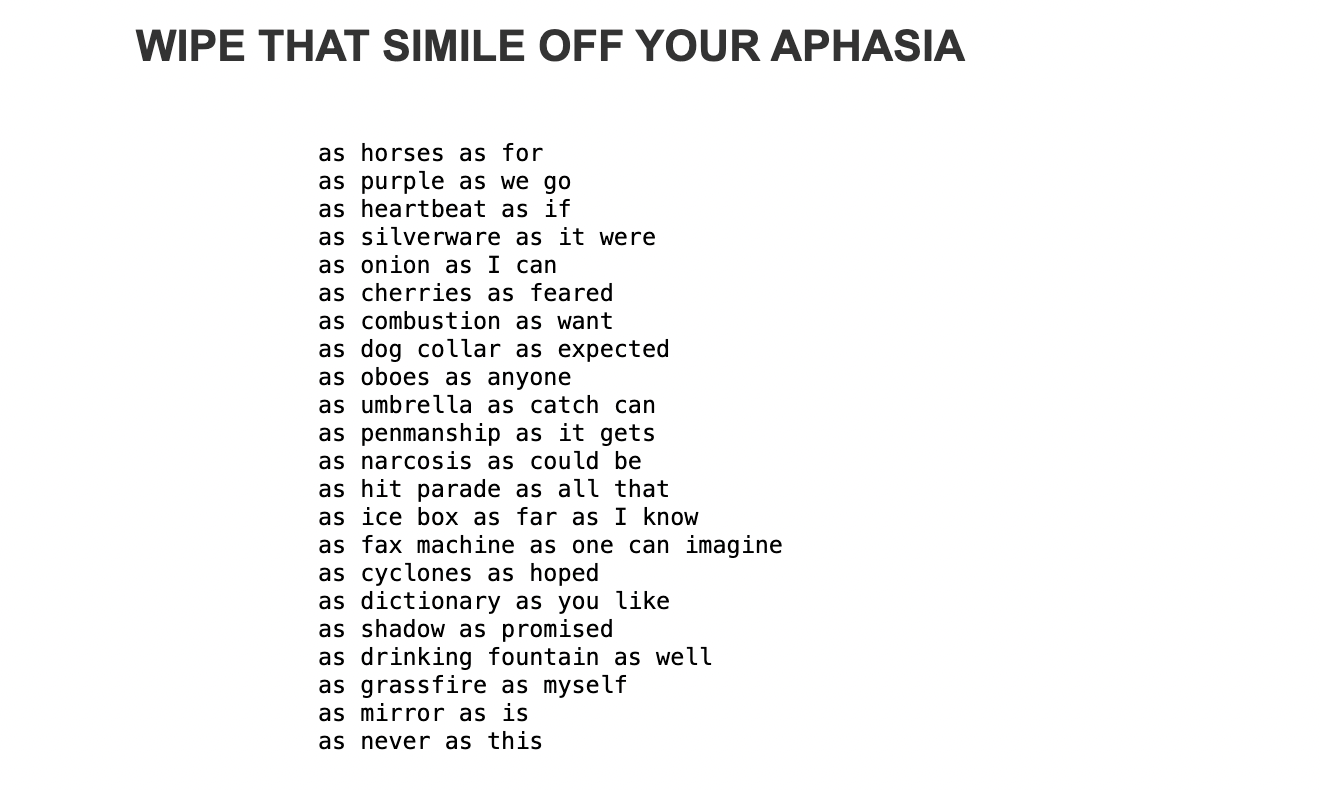
40 ways of looking at similes.

“Something is absent, offered to you, perchance. A hole made in a poem; a poem made whole by a cut.”

– McKenzie Wark in a letter to Cybele


Boris Tishchenko, Requiem (1966), after Anna Akhmatova, for soprano, tenor and orchestra


1 - OFFICIALLY.

A simile is a figure of speech in which one thing is likened to another, in such a way as to clarify and enhance an image. It is an explicit comparison (as opposed to the metaphor, where the comparison is implicit) recognizable by the use of the words ‘like’ or ‘as.’

2 - ETYMOLOGICALLY.

“Simile” comes to English from the Latin similis, meaning like.

3 - NOTATIONALLY.

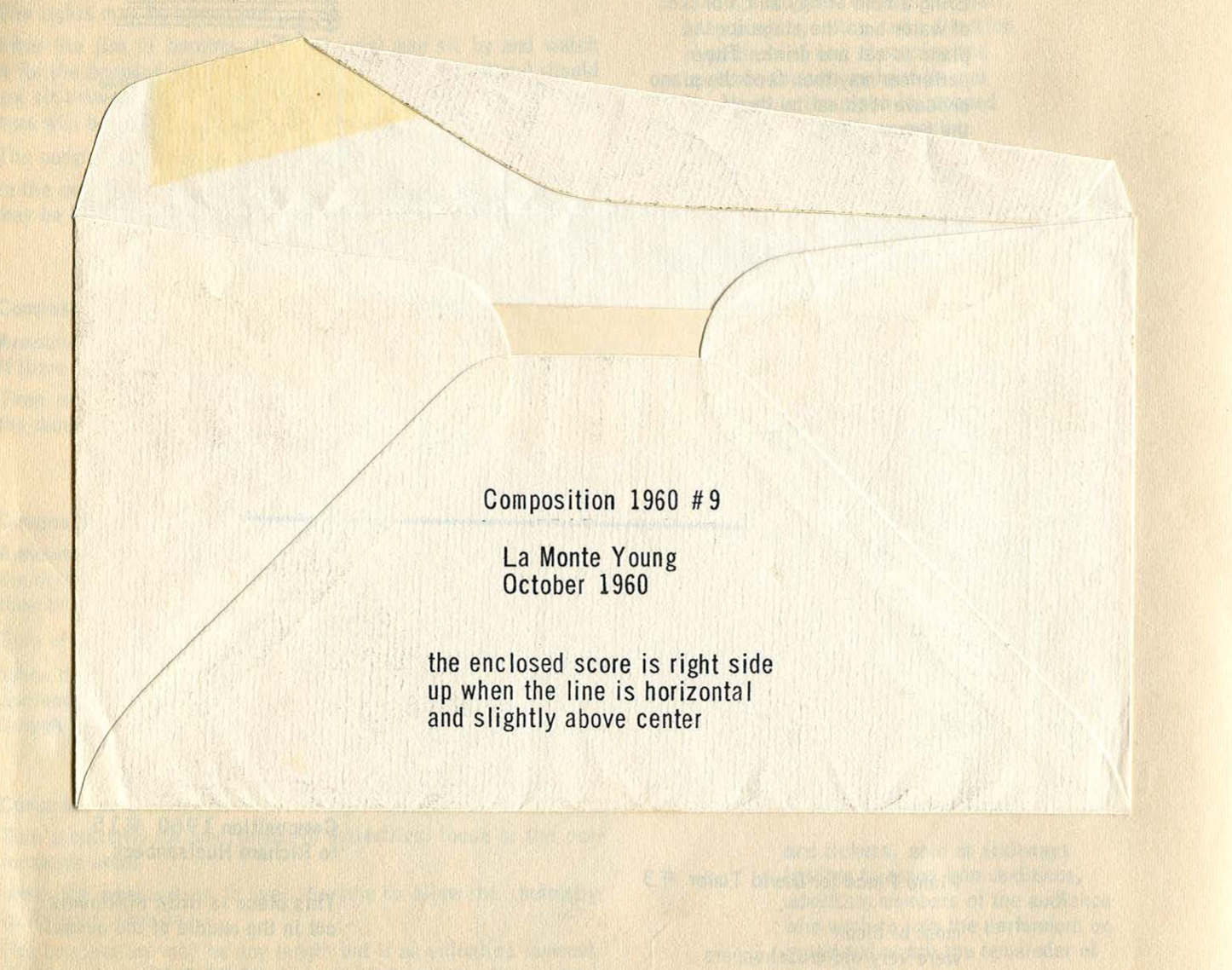
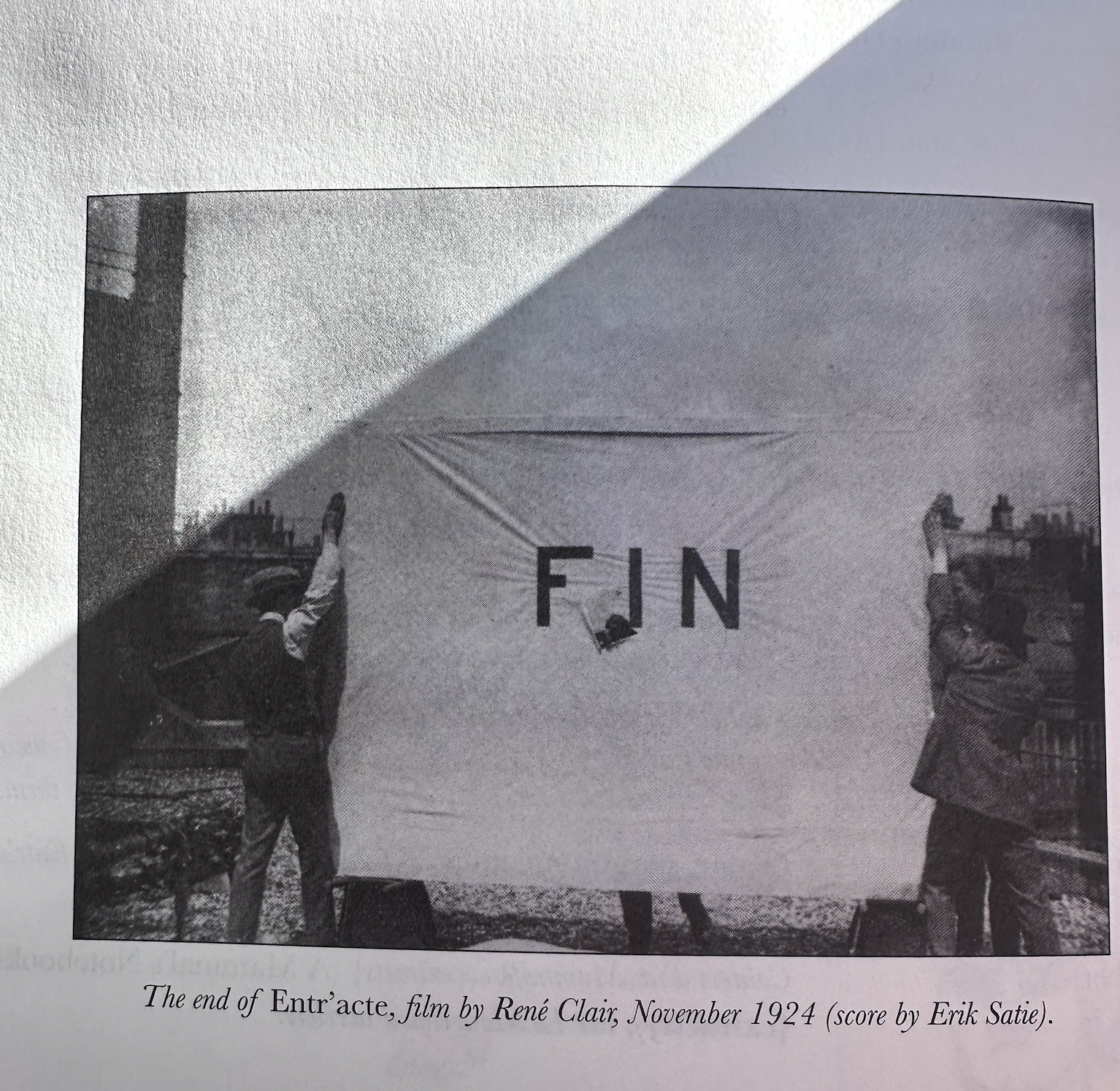
See Boris Tishchenko’s Requiem after Anna Akhmatova, for soprano, tenor and orchestra (1966), pictured above.

4 - COMPARATIVELY.

“Dreams resemble poems in their crucial mechanisms: compression, condensation, preference for metaphor to simile, and in how little time they take,” said William Matthews of the being shared by poems and dreams.

5 - PROVISIONALLY.

“A good simile refreshes the intellect,” said Ludwig Wittgenstein in the year 1929.

6 - ESOTERICALLY.

A “simile reveals more than what is already in that for which it has been chosen,” as Hans Blumenberg put it.

7 - TITULARLY.

Similes may glimmer as with Stephanie Burt’s “Like: A Speculative Essay About Poetry, Simile, Artificial Intelligence, Mourning, Sex, Rock and Roll, Grammar, Romantic Love”. Other similes may toot their poem’s horns brazenly, as with Albert Goldbarth’s “How Simile Works.”

8 - APPETITIVELY.

“Like that unpocketed peppermint which has, from fingering, become unwrapped, we always plate our sexual subjects first. It is the original reason we read…the only reason we write.” So wrote William Gass in On Being Blue.

9 - HALF-HEARTEDLY.

“But I shall leave my simile and I shall return my subject,” wrote Heinrich Kleist in an essay titled “On the gradual formation of thoughts in the process of speech”.

10 - REVERBISHLY.

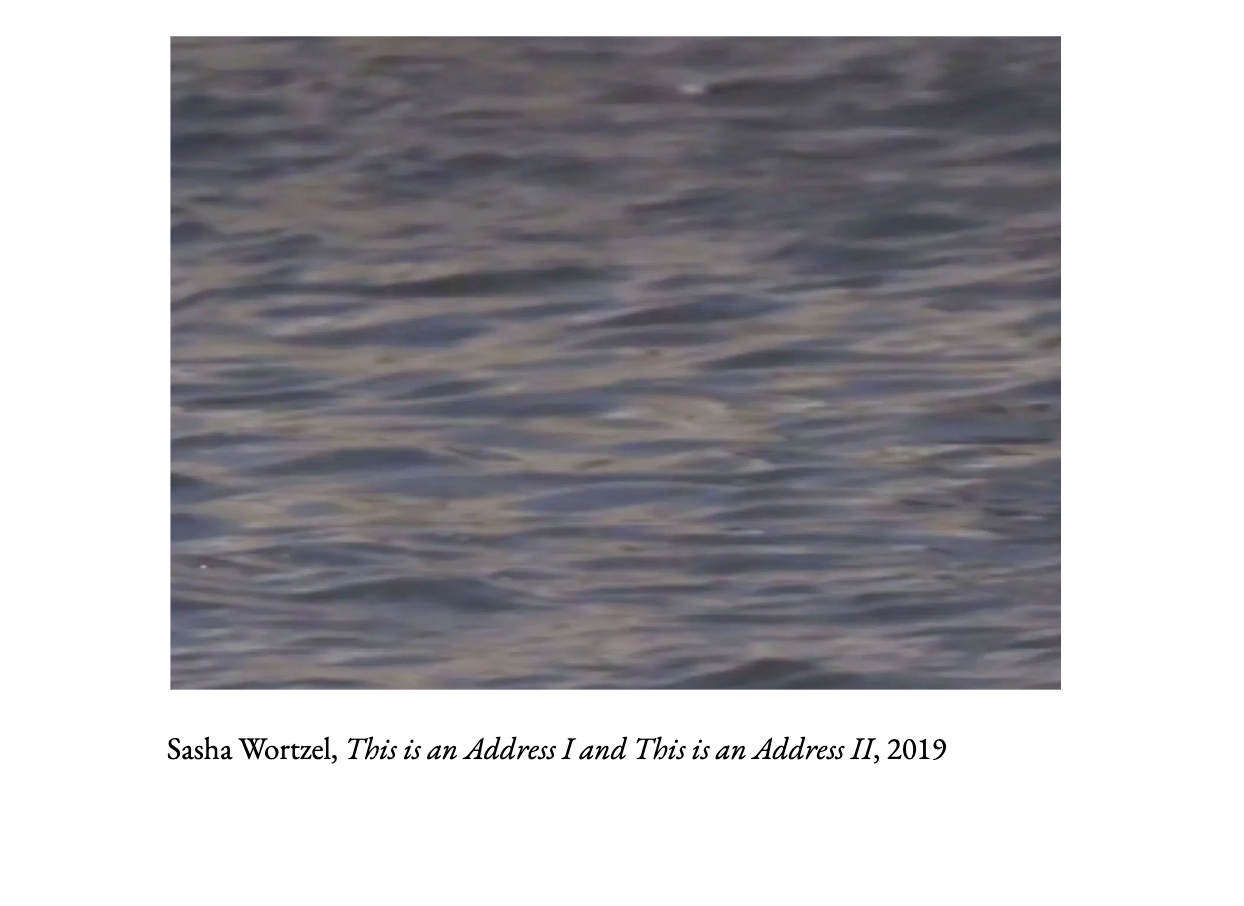
Similitudes in Olivia Giovetti’s brief on graphic scores and Kurdi forms of notation that admit indeterminacy.

11 - IMPULSIVELY.

As If Only. This was the title of a small, limited edition sonnet corona I printed and passed out at a reading in Tuscaloosa, on the spur of the spur of the moment.

12 - DIEGETICALLY.

As if I had become happy,” Mahmoud Darwish begins, in Fady Joudah’s translation.

13 - WITH AN EYE TO THE EXIT.

A simile may appear when a poem prepares to take leave of the reader. I’m thinking of how Sara Teasdale ended her poem, “The River,” where simile seals a final image that attests to the change the poem describes: “And I who was fresh as the rainfall / Am bitter as the sea”

14 - INVOKING ORAL TRADITION.

In an interview with Barbara Guest, Haryette Mullen cited the lines “hip chicks ad glib/flip the script” as a reference to the performance of female rappers Salt N Pepa who used rap as AIDS education through their song, “Let’s Talk About Sex.” Mullen told Guest: “When I sought a line to complete the quatrain that fit the rhythmic and phonemic patterning of the other three lines I’d written, ‘tighter than Dick’s hat band’ popped into my head, as an automatic simile that I’d heard throughout my childhood whether my mother or grandmother referred to tight clothing, or tight situations. But it was only in the context of the lines about female rappers, whose tight distichs (couplets) inform my own improvisational approach to rhythm and rhyme in this poem, that I grasped, for the first time, the origin of this folk simile: a metaphorical description of a condom. I saw a continuum, in terms of oral tradition or verbal performance style from my own matrilineal heritage—in a religious, lower middle class family that spoke of sexuality through metaphor, circumlocution, and euphemism— to the bold public style of today’s women rappers. The poem embraces all of that, while also using language as verbal scat. Print and electronic media, as well as orality, provide my materials.”

15 - AS A WAY INTO “IMAGINATIVE CRITICISM”.

Similes are central to critique in Geoff Dyer’s But Beautiful, a book that pays tribute to the jazz musicians Dyer adored. The preface tells us how the piece will be played, namely by allowing the writing to be “animated by the defining characteristic of its subject.” All Dyer’s attention goes to his subjects; form and content do the work of co-creating a shape that deserves to be studied on its own terms, as an object that works in its own way, which may or may not be recognizable. Moving into his subject without invoking an authoritative elitism, Dyer practices what he calls “imaginative criticism,” a speculative telling that admits its debt to fiction. “Even the briefest simile introduces a hint of the fictive,” Dyer reminds us, since a good simile becomes emblematic to the reader. Associations build across paragraphs, and Dyer doesn’t try to tame them. His metaphors bloom into “episodes and scenes” with dialogue and action. Asserting his loyalty to the “improvisational prerogatives of the form” itself, as seen in his improvisation around the jazz standards and his use of quotation cribbed from the way quoting functions in music, Dyer speculates data and information into scenes.

Generally, musical scores don’t cite their quotations. That labor is left to the performer or the listener. Reading voraciously expands the field of possible recognition. This goes for music as well: the more you listen to, the more you can recognize. At a jazz performance (or a classical one), music-lovers are more likely to “overhear” conversations between the performer/composer and the quoted source. Although musicologists help listeners decipher the quotes, the composer's responsibility doesn’t include citation. Dyer, to his credit, applies the composer's expectation of his audience to the text. He doesn't bother with fastidious citations because this is jazz. This is music. The quotes blend in.

16 - INTERROGATIVELY.

“My pain is like . . . — what is my pain like?” asks Albert Goldbarth in “Like”. Ricard Selzer’s essay, “The Language of Pain”, circles the simile-despair that strikes us when attempting to describe pain.

17 - ASPIRATIONALLY.

Once upon a time, Friedrich Schlegel imagined a fragment that didn't aspire to wholeness, a fragment capable of standing as a smaller work of art divided from its surroundings. “It must be complete in and of itself, just like a hedgehog,” wrote Schlegel. But this simile flattens me. No matter how one looks at the hedgehog, the simile feels fruitless. What is uniquely complete about the hedgehog? The hedgehog is completed by our description of it, and this hedgehog, once it exists, is already tangled with its life, the conditions of its livingness, its food sources, its ecological niche, its particular habitat.

18 - SINUOUSLY.

“Shadows rise like water / white fences comb through their hair” as in Denise Levertov’s “Images for Odette”

19 - WONDROUSLY.

Srikanth Reddy’s “On Wonder” touches the simile beautifully.

20 - DISCURSIVELY.

Sometimes a gap entertains the possibility of a simile, perhaps because the simile agrees on its own transience.

21 - FOUNDATIONALLY.

“Despite those who say that poetry makes nothing happen, humanity continues to be built on the literary device of the simile: Love thy neighbor as thyself,” Mark Yakich wrote somewhere.

22 - INTERLUDICALLY.

Trying to eat while reading Dan Albergotti’s poem, “Listening to ‘Twin Peaks Theme’ while Thumbing a Smooth Stone Nine Months after Angelo Badalamenti’s Death” — and admiring his similes.

23 - SCORNFULLY.

Daniil Kharms actively denounced the simile, setting his mind against the “like” and the likening, opting for a more esoteric, mystic-inflected space which may have been influenced by his father’s pacifist spirituality, or the man his father became after decades of prison. Kharms et. al traded the simile for apophatic speech (using the language to negate itself). Apophasis is found in the writing of Christian mystics including the Philokalia, which Kharms read in 1926, alongside Gregory the Theologian.

24 - POSITIONALLY.

Denis Donoghue looked down on the simile’s feebleness when comparing it to the metaphor.

25 - ATHELETICALLY.

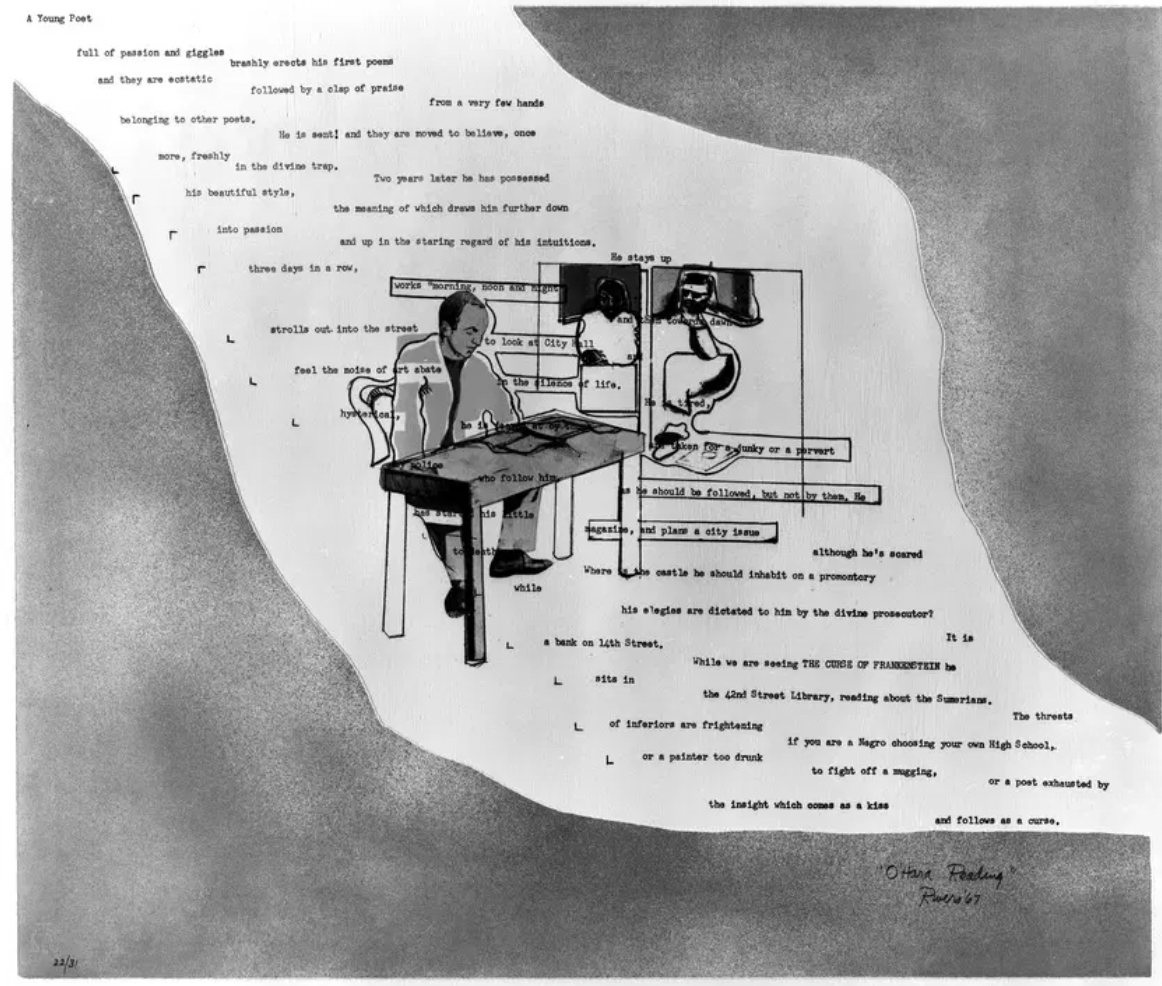
Robert Rauschenberg’s etchings of Dante’s Cantos leaned heavily on images of athletes engaged in physical activities. He used these images to map Dante and Virgil's journey through hell, to suggest movement, or to picture the characters' actions. In Canto XV, for example, an athlete running gives visual form to Dante's simile in the famous final lines in which Ser Brunetto, running to rejoin his band, is compared to the winning runner for the green cloth in Verona."

26 - OMINOUSLY.

“As the world grows more terrible, its poetry grows more terrible,” said Larry Levis, quoting Wallace Stevens.

27 - BRILLIANTLY.

A. E. Stallings said many wonderful things under the title “Shipwreck Is Everywhere”.

28 - DARKLY.

“Grieved like, pined like... Why must there always be a simile? Why must you drive always to first questions, way beyond the goalposts every time. Well, what do you keep sacking our quarterback for, when it comes to that.”

— Renata Adler, Pitch Dark

29. DOUBLY.

Haryette Mullen

30 - CONVERSATIONALLY.

One night in 1908, as Hans Richter journeyed home from anatomy class, the sculptor Max Krause, unexpectedly asked him what was his “special credo” might be. Although surprised, Richter replied without hesitation: “Cosmos seen from a charmed star, looking like a melody of forms and colors.”


31 - INTERTEXTUALLY.

Shortly before Krause asked this question, Richter had been reading Schopenhauer, who said that “the cosmos, looked at from a blessed star, should appear like a solved geometrical problem,” in Richter’s interpretation.


32 - COSMOLOGICALLY.

Hans Lichternberg’s desire to use the mineral ball a simile of the Earth had long been preceded by his seeing in the terrestrial body "a miniature tourmaline" 17—one of a long series of ideas that use miniaturization as an optical means to grasp the whole: a higher being might perhaps think the tree and plant cover of the earth a mold. The human optic on the universe could thus have arisen from the exaggeration of the incidental, and the preponderance of emptiness in the universe could be more exactly captured through a reversed telescope, because in that perspective "the most beautiful starry sky" would simply vanish.

Magnification also produces speculative analogies, above all with Lichtenberg's repeated fascinated viewings of the planet Saturn, which he regarded not as the exception but as the norm of planetary eidos. It leads to the forecast that Jupiter is also in the process of acquiring a system of rings, and to the still bolder speculation that the Earth is already like Saturn. The whole anthroposphere unfolds on the surface of the outermost ring, conceived as a solidified shell; it also supplies another explanation of the Earth's magnetism.


33 - DISLOYALLY.

Tristan Tzara’s poem, “Maison Flake” (from of our birds), gives us the chair that “is soft and comfortable like an archbishop,“ a figuration of speech in the form of the simile Tzara had repudiated in a dada manifesto. He was never faithful to himself, I think. That’s why he wanted to banish the weight of personhood, this idea of a voice, a language, a nation, a construction that could be faithful. Tzara preferred loyalty to fidelity.


34 - APOSTROPHICALLY.

TO HÖLDERLIN

We are not permitted to linger, even with what is most
intimate. From images that are full, the spirit
plunges on to others thar suddenly must be filled:
there are no lakes till eternity. Here,
falling is best. To fall from the mastered emotion
into the guessed-at, and onward.

To you, O majestic poet, to you the compelling image,
O caster of spells, was a life, entire; when you uttered it
a line snapped shut like fate, there was a death
even in the mildest, and you walked straight into it; but
the god who preceded you led you out and beyond it.

O wandering spirit, most wandering of all! How snugly
the others live in their heated poems and stay,
content, in their narrow similes. Taking part. Only you
move like the moon. And underneath brightens and darkens
the nocturnal landscape, the holy, the terrified landscape,
which you feel in departures. No one
gave it away more sublimely, gave it back
more fully to the universe, without any need to hold on.
Thus for years that you no longer counted, holy, you played
with infinite joy, as though it were not inside you,
but lay, belonging to no one, all around
on the gentle lawns of the earth, where the godlike children had left it.
Ah, what the greatest have longed for: you built it, free of desire,
stone upon stone, till it stood. And when it collapsed,
even then you weren't bewildered.

Why, after such an eternal life, do we still
mistrust the earthly? Instead of patiently learning from transience
the emotions for what future
slopes of the heart, in pure space?

Rainer Maria Rilke (translated by Stephen Mitchell)


35 - POLYPHONICALLY.

From Paul Klee’s notebooks dated July 1881:

Thoughts at the open window of the payroll department. That everything is transitory is merely a simile. Everything we see is a proposal, a possibility, an expedient. The real truth, to begin with, remains invisible beneath the surface. The colors that captivate us are not lighting, but light. The graphic universe consists of light and shadow. The diffused clarity of slightly overcast weather is richer in phenomena than a sunny day. A thin stratum of cloud just before the stars break through. It is difficult to catch and represent this, because the moment is so fleeting. It has to penetrate into our soul. The formal has to fuse with the Weltanschauung.

Simple motion strikes us as banal. The time element must be eliminated.

Yesterday and tomorrow as simultaneous. In music, polyphony helped to some extent to satisfy this need. A quintet as in Don Giovanni is closer to s than the epic motion in Tristan. Mozart and Bach are more modern than the nineteenth century. If, in music, the time element could be overcome by a retrograde motion that would penetrate consciousness, then a renaissance might still be thinkable.

We investigate the formal for the sake of expression and of the insights into our soul which are thereby provided. Philosophy, so they say, has a taste for art; at the beginning I was amazed at how much they saw. For I had only been thinking about form, the rest of it had followed by itself. An awakened awareness of "the rest of it" has helped me greatly since then and provided me with greater variability in creation. I was even able to become an illustrator of ideas again, now that I had fought my way through formal problems. And now I no longer saw any abstract art. Only abstraction from the transitory remained. The world was my subject, even though it was not the visible world.

Polyphonic painting is superior to music in that, here, the time element becomes a spatial element. The notion of simultaneity stands out even more richly. To illustrate the retrograde motion which I am thinking up for music, I remember the mirror image in the windows of the moving trolley. Delaunay strove to shift the accent in art onto the time element, after the fashion of a fugue, by choosing formats that could not be encompassed in one glance.


36 - HOMERICALLY.

Among the techniques Homer used in The Aeneid, we find invocation to the Muse, the expanded simile, the conventional or repeated epithet, and the use of the supernatural to influence events. Vergil would borrow these, as would many others.


37 - HOPEFULLY.

And to you, reader—let us here recall together William Carlos Williams's famous lines— “It is difficult / to get the news from poems / yet men die Miserably every day / for lack / of what is found there.” Let us embrace the good news, which is that we do not have to be like these miserable men. There is so much crazy shit we can stuff into our mouths, with or without the simile.

— Maggie Nelson, Like Love


38 - AS PART OF “A SINGLE SEMANTIC STREAM”.

[In 1933] Mandelstam read the essay [Conversation about Dante], read his poems, and talked copiously about poetry and about painting. We were struck by the remarkable affinities between the essay, the poems, and the table talk. Here was a single semantic system, a single stream of similes and juxtapositions. The image-bearing matrix from which Mandelstam's poems emerged became strangely tangible.

— Lidiya Ginzburg, “Poetika Osipa Mandelstama” in Izvestia Akademia Nauk SSR, July-August 1972, translated by Sona Hoisington in Twentieth Century Russian Criticism, New Haven: Yale University Press, 1975


39 - FIRST-CONFESSIONALLY.

The Catholic Church understood Freud's concept of the superego centuries before he articulated it in 1940. The cathedral on a hill is its palpable and visible representation, or, in Freud's simile, the superego is “like a garrison above a captured town.” In the case of the church, it is a garrison so effective that it doesn't even need soldiers. Its windows are beautiful. Its frescoes and painting and sculptures, depicting absence in enormous detail, are priceless. It enabled Dante to imagine hell, and it was at least the stepmother to a ninety-year period of Italian art, a period of corruption, betrayal, incest, assassination, intrigue, and unsurpassable art. The church knew beautv and evil were sleeping together, and gave doth allowances to do it. Iwo thousand years of stolid, industrious virtue and Swiss peace perfected the cuckoo clock and the dairy cow. I suspect the Swiss dairyman had a good deal of placid self-esteem. Michelangelo hated himself. And a later figure, Caravaggio, was mean-tempered, an inadvertent murderer whose self-portrait, as Goliath, is full of self-contempt and despair.

In the Age of Therapy, First Confessions could be seen as a ritualized form of child abuse, psychological in method, permanent in effect. But you can't take the Vatican to court. The painting on the chapel's ceiling doesn't respond to a summons and is tricky evidence.

In my case, I would lie awake as a child, full of vague yearnings which were sexual, which I did not know were entirely normal. I was never abused nor molested nor violated as a child. I simply felt that I was a violation, that I was guilty of being alive.

But if it was a violation, it was a pleasure. Besides, how guilty can anyone feel, at seven or eight? I was a boy like other boys. I didn't rebel against guilt, I forgot about it.

— Larry Levis, “First Confession”


40 - EVENTUALLY.

The final day of notes for Roland Barthes’ projected work, Vita Nova, was September 2nd, 1979. In these notes, Barthes referred to “Account of my evenings ( endless, futile diachrony)”,  and quotes Pascal’s Pensees again, “Fragments: like the remains of an Apology for something.”

Eavan Boland's Eurydice.

static range is a mountain of voices: piled on top of each other, they are sometimes cacophonous, sometimes polyphonous.

— Himali Singh Soin


Now you all have seen hundreds of poems about roses and you know in your bones that the rose is not there.

Gertrude Stein


For * spring is dangerous like love and love survives the lovers *, Himali Singh Soin and Kostas Stasinopoulos asked friends to share messages, traces and transmissions of love.

The gallery description reads: “Inspired by a letter that a nuclear-powered spy device —installed during the Cold War and as yet missing— addresses to the patron mountain of the Indian Himalayas, Nanda Devi, this valley of notes makes transcontinental, cosmic trajectories in search of love. What it finds: loss.”

*

Eavan Boland’s Eurydice opens her silence in song, a counter-song if you will, to that of Orpheus’ lament, a lyric that gives us reason to believe that knowing one another is fundamentally impossible. The lovers lament different things.

Euridyce Speaks

How will I know you in the underworld?
How will we find each other?

We lived for so long on the physical earth
Our skies littered with actual stars,
Practical tides in our bay —
What will we do with the loneliness of the mythical?

Walking beside ditches brimming with dactyls,
By a ferryman whose feet are scanned for him
On the shore of a river written and re-written
As elegy, epic, epode.

Remember the thin air of our earthly winters?
The gas ring burned blue flowers.
Frost was an iron, underhand descent.
Dusk was always in session

And no one needed to write down
Or re-state, or make a record of, of ever would,
And never will,
The plainspoken music of recognition,

Nor mark how I stood at the window —
The hills darkening all around, saying,
As a shadow became a stride
And a raincoat was woven out of streetlight

I would know you anywhere.

Boland’s poem reminded of a wonderful essay by Jack Foley on Gertrude Stein’s portraits, and how he notes that time “is not only a subject but a condition of the piece,” a text which was also a portrait.

Foley thinks Stein deploys palindromes as a sort of mirror for which “the line runs out and then runs back.” The idea of recognition that Boland’s poem engages aligns somehow with Foley’s description of Stein’s palindromic relationality:

The first half is identical to the second half—except that the second half is backwards. She has a phrase in still another portrait, “A Valentine to Sherwood Anderson”: “Idem the Same.” The word “Idem” is Latin and means “the same,” so the two halves of the phrase are saying the same thing—but they are saying them in two different languages. Stein’s relationship to the people she makes portraits of is like that. She and Picasso are “Idem the Same”—the same but different; they are like words which mean the same thing but exist in two different languages. Together, they constitute a kind of palindrome; they are full of the same elements, but one of them is running one way and the other is reversing that movement.

Similitude meets me in my daily life as a lyric of resonating surfaces, or patches of sound that connect the world across languages, linking the experience of being as I apprehend it in the fluidity of Romanian and the more rigid, consonant-heavy textures of English.

An aside on miracles is due. For the word “miracle” comes to us from Old French and the Late Latin, miraculum, which means “a wonder, marvel” as well as mirari , which means “to wonder at.” And Foley adds that “the old Latin root is mir-, to look (at), esp. with astonishment.” It is this monosyllabic little root that leads goosebumps to pebble across my arms, mirroring one of my favorite verbs in Romanian, where mir appears usually in conversation as mă mir, drawing on the verb a se mira.

One of the valences of this verb is how it elicits a middle voice, a being that neither acts nor is acted upon. If it isn’t yet obvious, I should add that the Romanian word for “wonder” is mirare (see also minune, uimire, admiraţie, surprindere, miracol, surpriză, uluială).

There is a gap I love in this wondering. A gap like a tabernacle holding its secret intact as the sacred. This gap appears between the verb mir and the noun mir, which gets transformed away from the verb in Romanian. The noun mir refers to "holy oil, chrism, unction,” as used in the context of Eastern Orthodox blessings and rituals. There is no mir that means, simply, astonishment.

To resonate — once more — and inscribe this repetition with its root, when I searched for Eavan Boland’s poem online earlier this week, I found it on a wordpress blog run by someone who speaks Romanian. And maybe I, too, would know you anywhere.

“Miracles play. […] Let me recite what history teaches. History teaches.”

— Gertrude Stein, “If I Told Him”

*

Eavan Boland, “Eurydice Speaks” (poetry will save me)
Himali Singh Soin and Kostas Stasinopoulos, * spring is dangerous like love and love survives the lovers * (Serpentine Gallery)
Jack Foley, “‘If I Told Him’: Gertrude Stein and Performance” (Exacting Clam)
Patricia Meyerowitz, Gertrude Stein: Writing and Lectures 1909-1945
Spiritualized, “200 Bars”

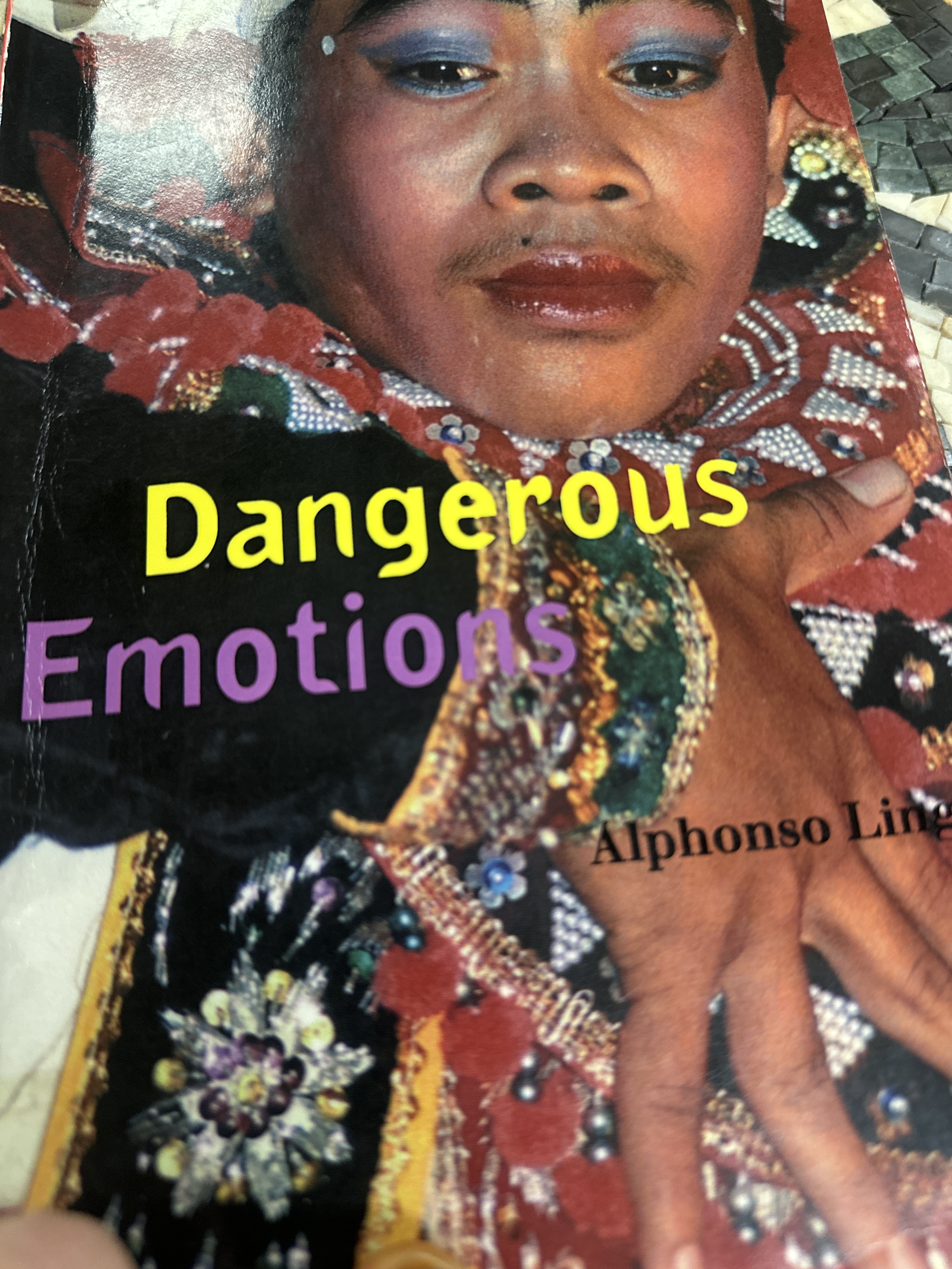
Alphonso Lingis on the "dangerous emotions" of being.

(Language ripples our lips) 

– Susan Howe, “Pythagorean Silence”

the ground which is an absence of ground

– Michel Foucault, “Distance, Aspect, Origin”

A few excerpts from this book by Alphonso Lingis that I am currently enjoying —

OF TORPOR AND SUBLIMITY

People who shut themselves off from the universe shut themselves up not in themselves but within the walls of their private property. They do not feel volcanic, oceanic, hyperborean, and celestial feelings, but only the torpor closed behind the doors of their apartment or suburban ranch house, the hysteria of the traffic, and the agitations of the currency on the stretch of turf they find for themselves on the twentieth floor of some multinational corporation building. 

If one person regards a thunderstorm over the mountains or the ocean waves breaking against the cliffs as dangerous and another as sublime, the reason is not, as Immanuel Kant wrote, that the first clings to feeling the vulnerability of his small body, while the second initially verifies that his vantage point is safe and then forms the intellectual concept of infinity, which concept exalts his mind. And it is not simply, as Nietzsche wrote, that the first cramps his weak emotional energies back upon himself, resenting what threatens his security, while the second has a vitality whose excessive energies have to be released outside. It is that the first draws his emotional energies from the forces that hold walls together and closed. 


OF “GREAT” CIVILIZATIONS (AND GREATNESS AESTHETICS)

About halfway through grade school I brought up a linguistic problem to the teacher. She and the text-book called the Roman civilization a great civilization. It was said to be at its greatest when its military dominated the greatest number of lands and peoples. When its empire shrank, it was said to be in decline. This terminology persisted in history class after history class throughout my schooling, and in museum after museum I have visited since. The great religions are the world religions. Civilization advances with military and economic expansionism.

A euphemism is competition: without competition there is no artistic, literary, or religious advance. (Without grades, prizes, honors, there is no philosophical achievement.) My first trip was to Florence, where I was beset by the evidence that its grand artistic, literary, and musical achievements coincided with its richest and most rapacious century . . .

OF ANEMONES AND US

Sea anemones are animated chrysanthemums made of tentacles. Without sense organs, without a nervous system, they are all skin, with but one orifice that serves as mouth, anus, and vagina. Inside, their skin contains little marshes of algae, ocean plantlets of a species that has come to live only in them. The tentacles of the anemone place inside the orifice bits of floating nourishment, but the anemone cannot absorb them until they are first broken down by its inner algae garden. When did those algae cease to live in the open ocean and come to live inside sea anemones?

Hermit crabs do not secrete shells for themselves but instead lodge their bodies in the shells they find vacated by the death of other crustaceans. The shells of one species of hermit crab are covered with a species of sea anemone. The tentacles of the sea anemones grab the scraps the crab tears loose when it eats. The sea anemones protect the crab from predator octopods, which are very sensitive to sea anemone stings. When the hermit crab outgrows its shell, it locates another empty one. The sea anemones then leave the old shell and go to attach themselves onto the new one. The crab waits. How do sea anemones, blind, without sense organs, know it is time to move?

How myopic is the notion that a form is the principle of individuation, or that a substance occupying a place to the exclusion of other substances makes an individual, or that the inner organization, or the self-positing identity of a subject is an entity's principle of individuation! A season, a summer, a wind, a fog, a swarm, an intensity of white at high noon have perfect individuality, though they are neither substances nor subjects. The climate, the wind, a season have a nature and an individuality no different from the bodies that populate them, follow them, sleep and awaken in them.

Let us liberate ourselves from the notion that our body is constituted by the form that makes it an object of observation and manipulation for an outside observer!

Let us dissolve the conceptual crust that holds it as a subsisting substance. Let us turn away from the anatomical and physiological mirrors that project it before us as a set of organs and a set of biological or pragmatic functions.

Let us see through the simplemindedness that conceives of the activities of its parts as functionally integrated and conceives it as a discrete unit of life. Let us cease to identify our body with the grammatical concept of a subject or the juridical concept of a subject of decisions and initiatives.

The form and the substance of our bodies are not clay shaped by Jehovah and then driven by his breath; they are coral reefs full of polyps, sponges, gorgonians . . . A pack of wolves, a cacophonous assemblage of starlings in a maple tree when evening falls, a marsh throbbing with frogs, a whole night fizzling with fireflies exert a primal fascination on us. What is fascinated is the multiplicity in us— the human form and the nonhuman, vertebrate and invertebrate, animal and vegetable, the conscious and unconscious movements and intensities in us.

(Italics are mine.)

*

Alphonso Lingis, Dangerous Emotions (University of California Press)
Arnold Schoenberg, Notturno for Strings and Harp (1895-96)
Eugène Delacroix, The Duke of Orleans showing his Lover, ca. 1825 - 1826

"Museums" by Dan Beachy-Quick

For love of all asterisks — those fallen stars of punctuation — I give you Dan Beachy-Quick’s:


Museum

Must I, in this question I am asking, include myself
Asking it? Must I include my face—
My face that I cannot see—through which I speak
This question about my eyes, about the field
Of vision, in which my hands press down these letters
Unattached to my arms? The sunlight
Comes in the window and lights up my hands
As they work. The world is not being kind
But there is the sensation of kindness.
There is an appeal to a rule when we realize a term
Behaves uncomfortably. God falls down
Into grammar and says I am but the words are spoken
From a bush on fire. God is included in this grammar
Philosophy offers to the fly stuck in the bottle—
There it is on the table, walking in circles within the empty
Bottle, pausing only to rub its forelegs together,
In anticipation or prayer. I remember
Walking into the glass-walled museum and seeing myself
Reflected in the head and in the belly of the metal rabbit’s
Mirror-like skin. This was not long ago, this experience
Of the ancient world, reason simultaneous with appetite,
Watching myself think, seeing my eyes thinking,
My body a body that contained this thinking
That I write in the margins of the books I read, a script
That over time appears less legible, a form
Of cuneiform I cannot read myself what I wrote
In the margins. There is a fragment that floats in the air
Floating in my mind, spoken by a voice not mine:
To study circumcises the heart and calms,
The book steadies the heart [many words are missing
Or illegible
] if not, to turn away,
Fire courses through the veins [many words are
Missing or illegible
] then
Anger, anger. Leaning back in the tall grass,
Putting my book aside, my toe covers the sun.
I am imagining this world but I’m inviting you in
So I can join you. In the old language, the language
No one ever spoke, the language whose words
In the scholarly papers are marked by stars,
Asterisks that say this word exists by not existing,
The imaginary root pushing down from the sky
Into our heads, the root of the tongue;
In this language “I” meant “here,” it did not mean “me,”
It meant a location in which this body I am
Was not an expression of love but a word of
Presence. Here I am. Voice in a boundary.
In this place I am I once had a dream.
Cylindrical seals rolled across the earth
Printing in the mud the image of a woman braiding
Her hair was loose and then her hair was bound.
These roads end at the horizon where I also end,
Present in this world as the alphabet is present
In this poem. *I. *I. Sometimes *I like to stutter.
*I like to think the sky is blue. *I see sometimes it’s red.
More soon on the nature of impossible constructions.  
The man in the moon. The sea rose. The living room.


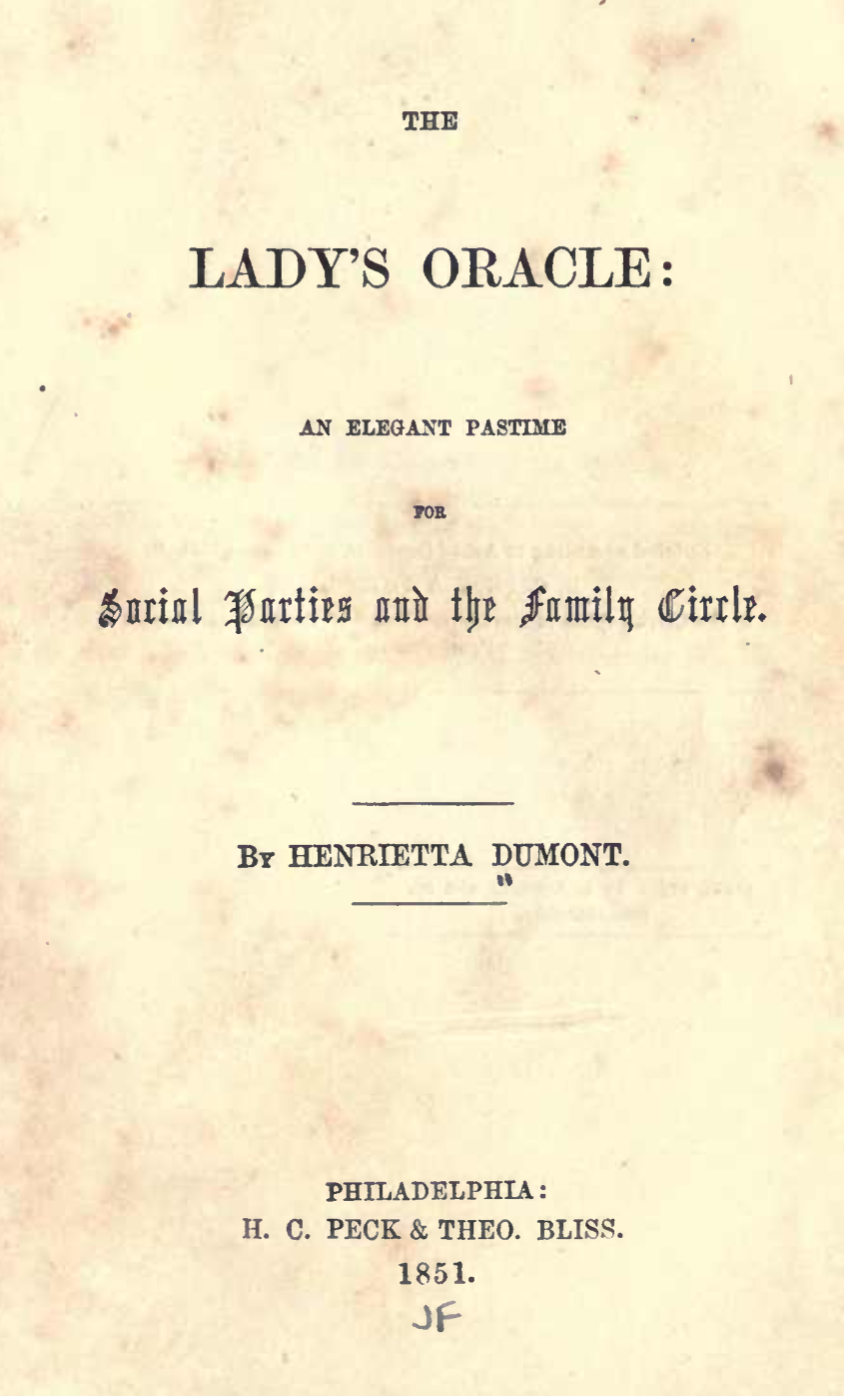
The Lady's Oracle.

But the writing of the poem, the work of it, also asks permission to enter—asks, oddly enough, permission to trespass.

Sometimes I can feel that every poem I’ve ever read is linked to every other poem.

Curious thresholds demand offerings before they will open.

To write a poem may be to make just such an offering.

— Dan Beachy-Quick

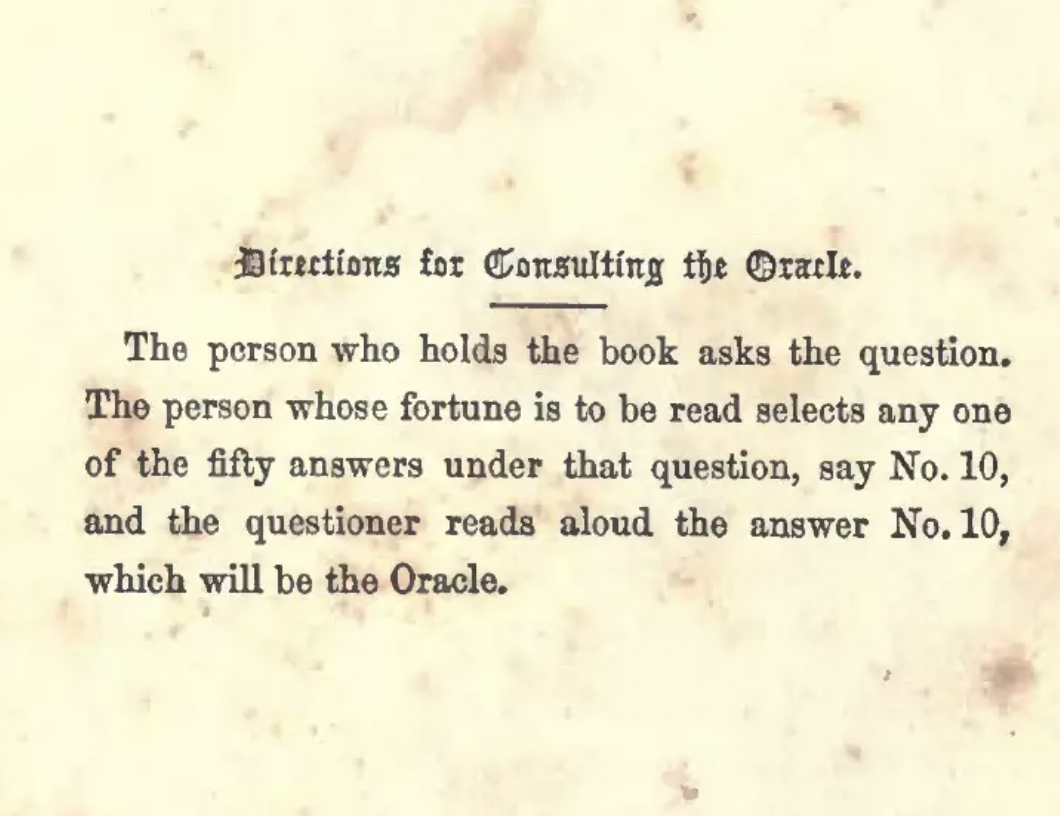
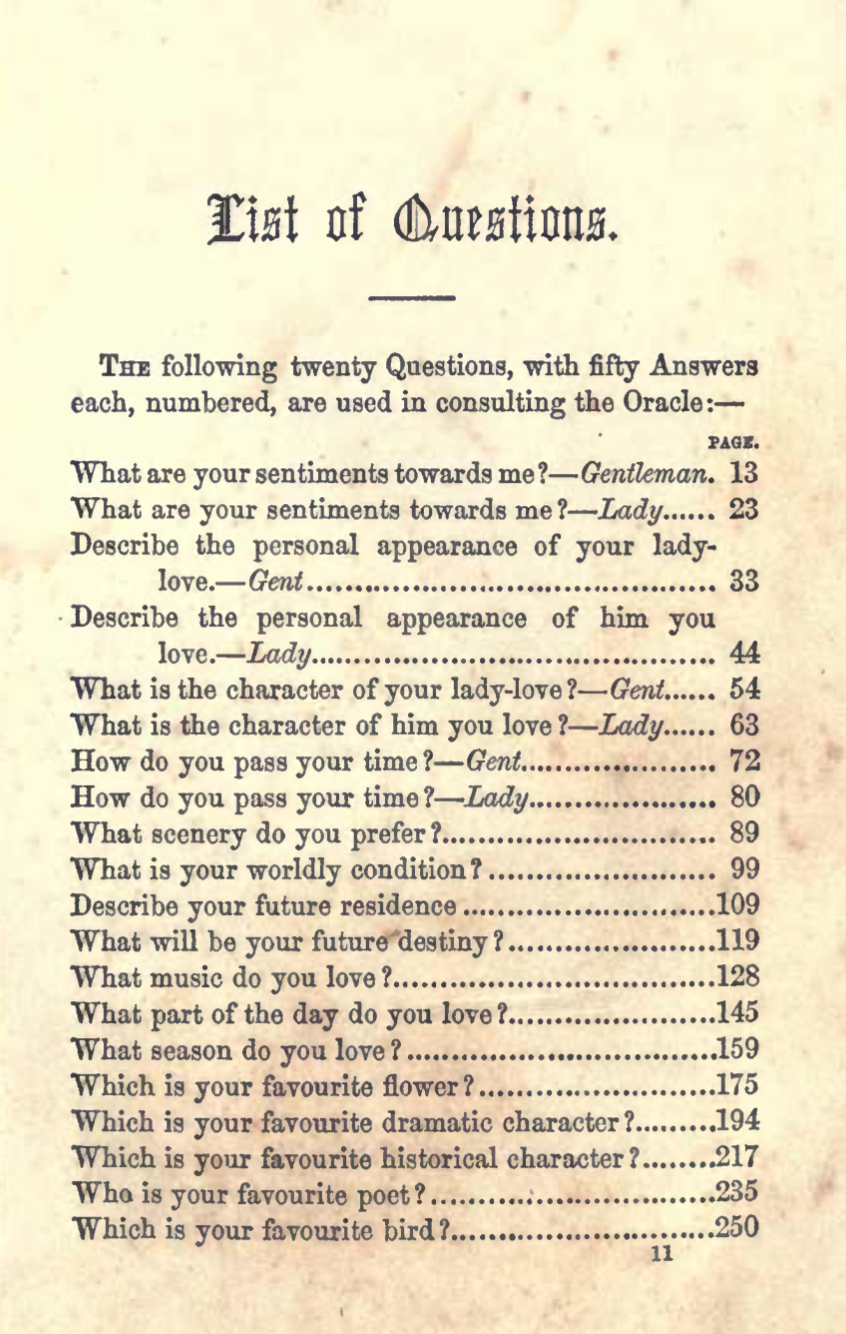
Speaking of oracular voices and gendered repetitions via citational practice, The Lady's Oracle: An Elegant Pastime for Social Parties & the Family Circle, written by Henrietta Dumont, details a 19th-century game involving questions and answers “between a lady and gentleman intended to provide amusement for social gatherings.”

The rules of the game are simple enough. Two players, presumably of different genders, take turns asking one another a question from the list of questions. After asking a question, the other player responds by selecting a random number corresponding to one of fifty ‘answers’ included under that section heading in the book. The author tells us that these ‘answers’ are “quotes from poets to avoid any appearance of personality.”

The game promises to “provide entertainment for an entire evening” and encourages innocent recreation to relax the mind from worldly cares. While some view leisure as wasted time, the brief introduction attempts to build the case for leisure as a means of self-improvement, a practice that leads to more health and happiness.

If you’d like a glimpse at some of the answers (hint: lots of Burns, Shakespeare, etc.), here is your gander.

I would only agree to play this game given different Social Conditions than those presumed by The Rules.

I would, however, agree to play by The Rules if permitted to revise the Social Conditions so that I might play the “gentleman” to someone else’s “lady.”

Hell's bells are sublime.

DELAHAYE: Are you still interested in literature?

RIMBAUD: I don’t think about that anymore.

— dialogue between Rimbaud and his friend in 1879, from Peter Weiss’ notes for “Rimbaud”

1. 23. 26

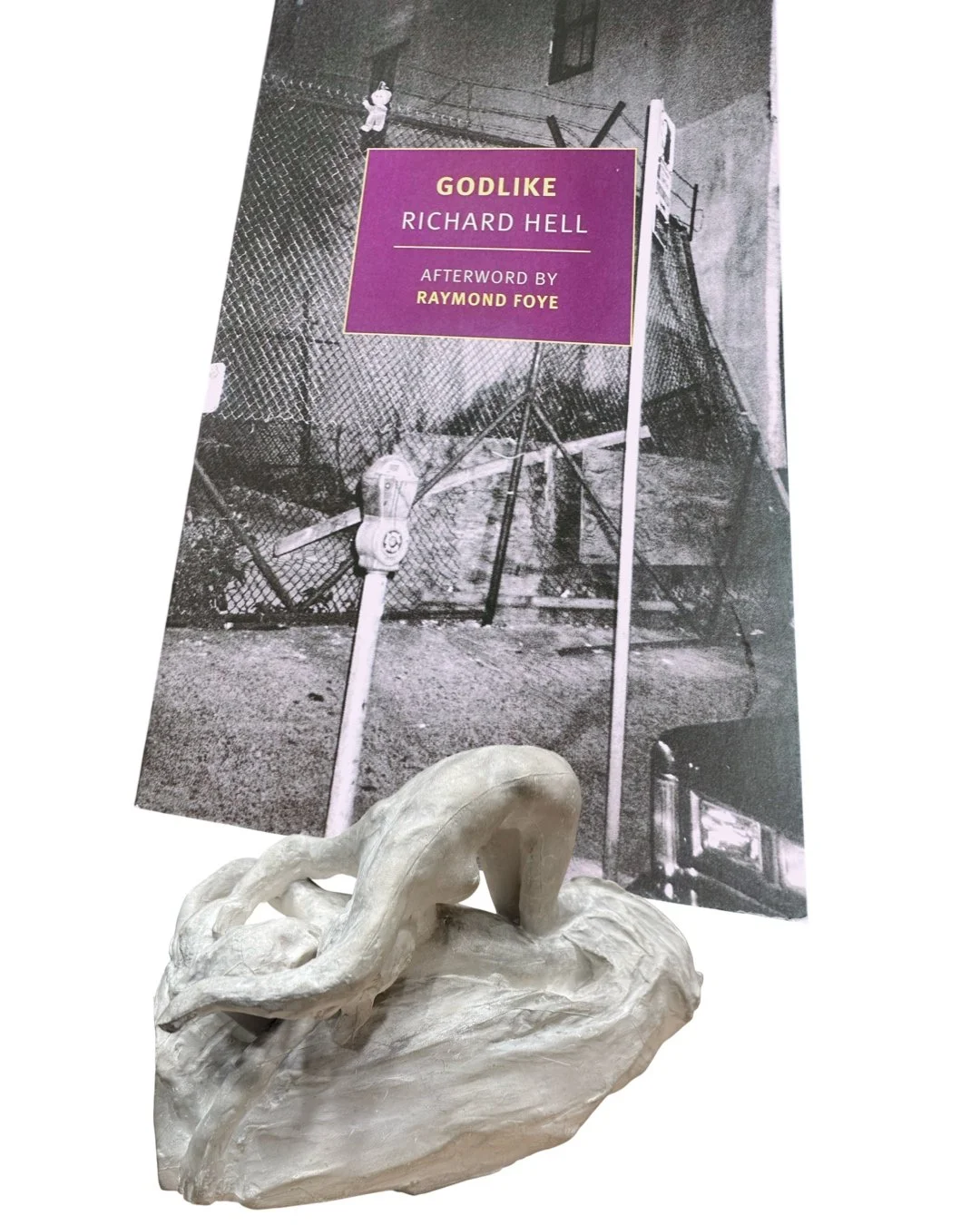
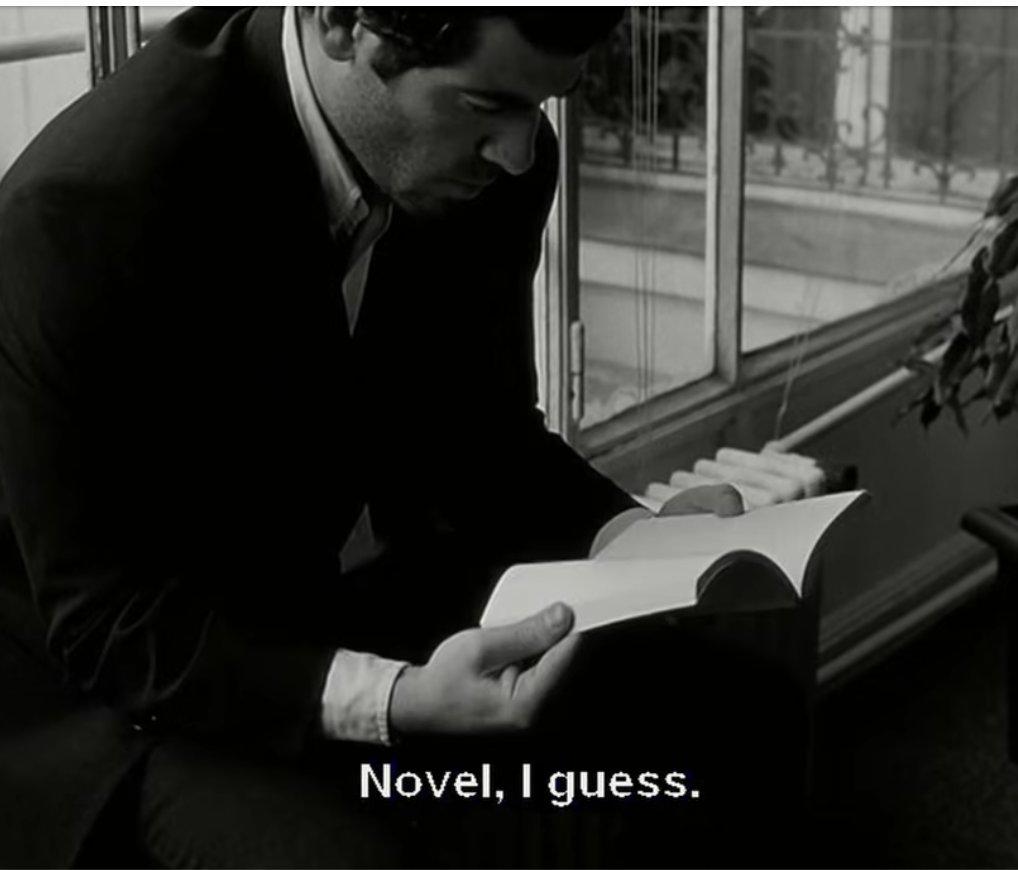
It was sitting on the doorstep in a cardboard envelope. Godlike by Richard Hell. A book that begins in the key of Verlaine meeting Rimbaud, transposed into New York City, lodged in the small studios that held various bodies that wrote from immediacy. An affect that lives somewhere between New Narrative’s practices of promiscuous citation and 19th century decadent self-fashioning. An aura of Proustian wistfulness. An intensified description of events involving scatology and sexuality. An urge to shift into poesie when the moment demands it. An iconic portrait of the Rimbaud we poets channeled and sought from so many midnights. A set piece in the mythography of the American punk scene. “A novel, I guess,” to quote Godard’s In Praise of Love.

Godlike begins in the key of spring: “It was March and the weather was like a pornographic high-fashion magazine.”

1.24.26

The book’s full title is Godlike: The Hospital Notebooks of Paul Vaughn incorporating his memoir-novelette of R. T. Wode. And there is an introduction written by “Paul Vaughn,” dated 2004, that describes the narrator’s reason for writing “in the form of a novel.” The scenes feel familiar, like reading Rimbaud again for the first time at 18. And then again at 23. And then reading him in multiple translations in your mid-30’s. And then obsessing over him when you turned 40.

Leaving these multiple (personal) encounters aside, Hell describes the “tedium” of the older married man and his young poet lover as they loaf towards writing:

They spent the greatest amount of their time together reading and writing and sometimes talking in T's apartment. These were probably their best times too despite being experienced largely as tedium. They preferred the times of thrills, bur the thrills grew out of the tension; and the mild, mildly restless, half-frustrated times of the many nights and late afternoons of doing almost nothing in T's apartment, or walking the streets without direction, were their true lives.

T's room was like some kind of glum office in its lack of daylight and its featurelessness, but with the little pictures now tacked on the walls, and the typewriter and sheets of paper, and the drugs, it got some character. He'd picked up a few stray pieces of furniture on the streers, including a table and three chairs, crates for shelves, and a bear-up old oriental rug. There was a secondhand portable record player too and a few albums.

They drank coffee and beer and sometimes codeine cough syrup and sometimes smoked some grass or snorted a little THC or mescaline and every once in a while a tiny bit of heroin, but mostly they lay around and lazily, impatiently goofed and wrote and complained, goading each other. Sometimes in the middle of the night one of them would go out for a container of fresh ice cream from Gem Spa. They'd go to a movie sometimes, or wander the rows of used bookstores on Fourth Avenue, or drink in a bar, but most of the time was spent in the dim back apartment.

The days and nights were as endless as wallpaper patterns. Boredom and irritation were normal and lengthened out into sometimes-mean giggles and into pages of writing. Writing was their pay. Books were reality. The room was a cruder dimension-poor annex to the pages of writing. The writing, as casual as it was—smeared eraseable typing-pages with revisions scribbled on and crumpled pages of rejected tries—was the brightly lit and wildly littered universe erupting out from the dark, poor, inexpressive room.

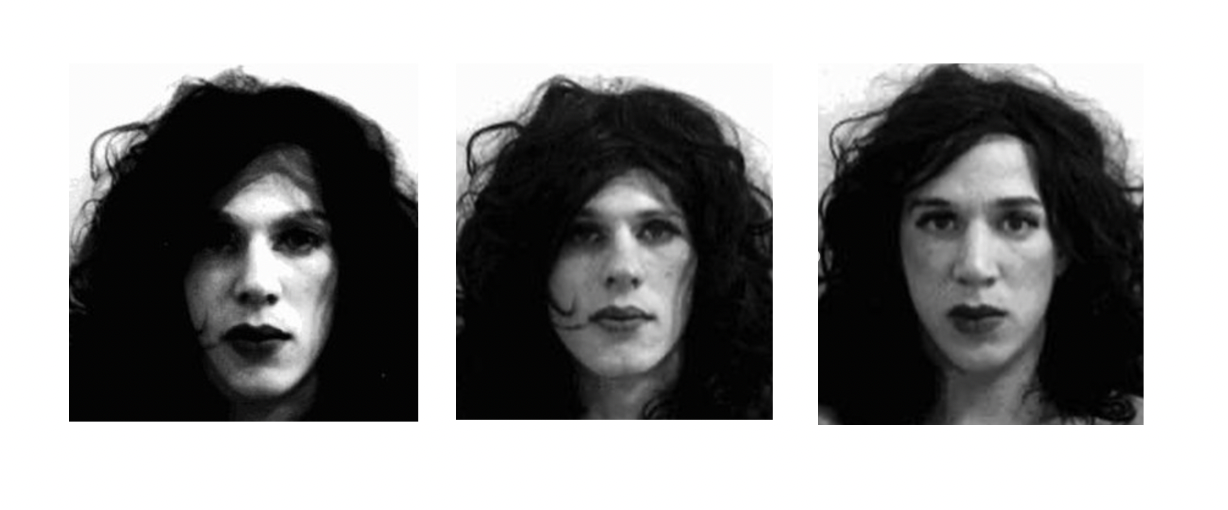
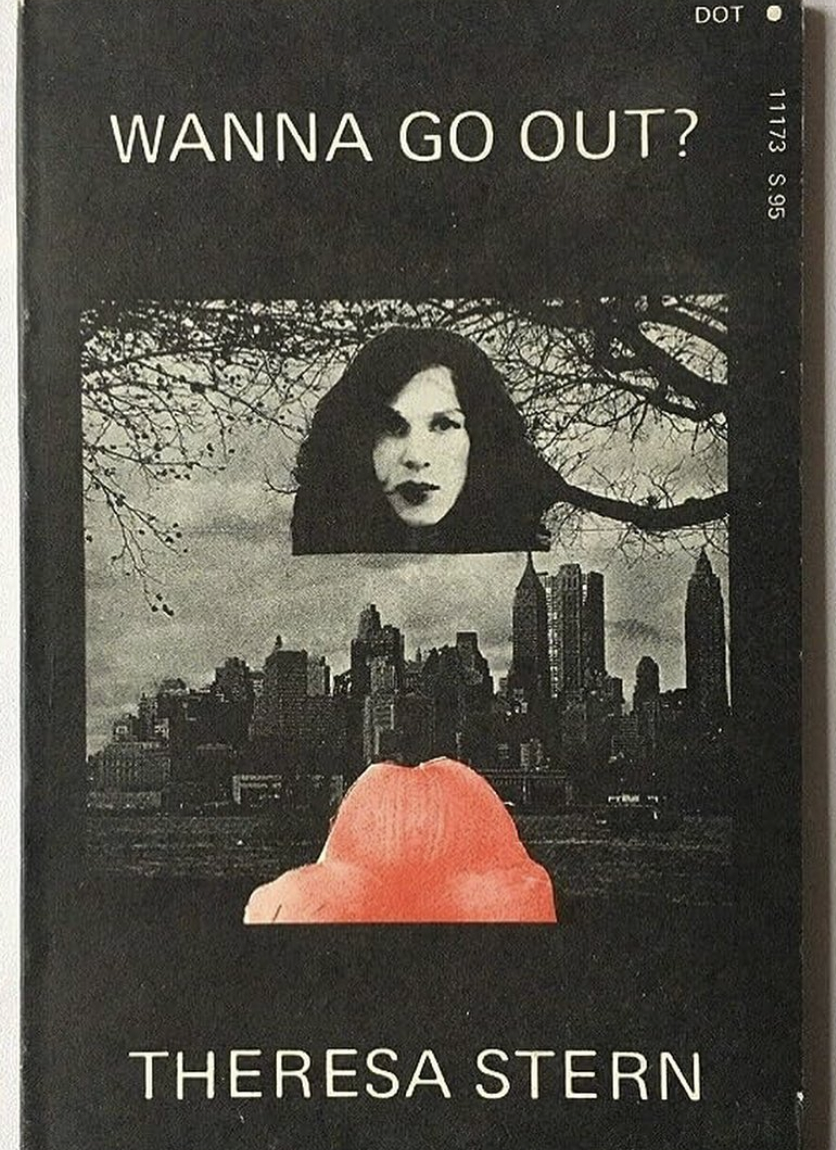
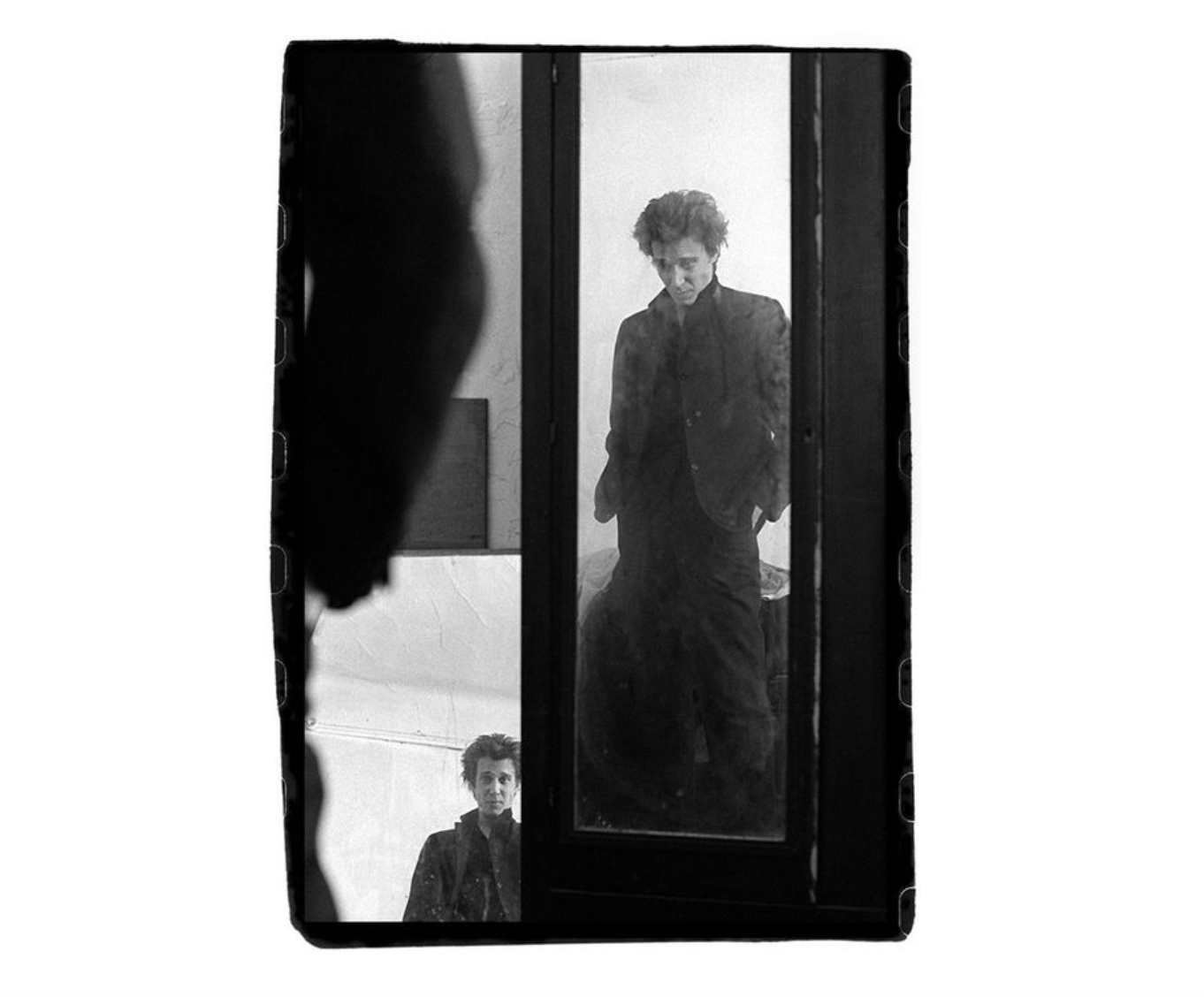
Part of the description matches what what we know of Arthur Rimbaud and Paul Verlaine’s love affair, but Hell also had personal experiences to draw upon. In 1973, Tom Verlaine and Richard Hell published a collaborative poetry book titled Wanna Go Out? under the pseudonym “Theresa Stern.” The photo on the book’s jacket is a composite of Tom and Richard dressed in drag (flip through the slides below to see it).

Hell’s Godlike puts flesh on punk’s philosopher-poets. Punk has always been committed to crossing lines, dirtying the parlor, waxing scatalogically about the skyline, transgressing boundaries of decency, gentility, and propriety. The fascist skin-heads on punk scenes are a sort of incoherence, since purity-driven punk grabs is meaningless. It follows from nothing. At its least interesting, punk flirts with nihilism. But any notion of hygiene in punk is ridiculous. And fascism thrives on hygiene. Fascism would not exist without the ministry of social hygiene stomping through our heads. Fascism fears anything queer or trans—anything transformative, really. Any process of transformation that reveals our inherent fluidity is anathema to fascists.


1.25.26

I micro-dosed Hell’s Godlike over the course of a weekend to keep it from ending too quickly.

Between doses, I re-grazed Alan Badiou’s In Defense of Love, a text based on a conversation that continues to provoke and inspire me. Love, as Badiou sees it, cannot be rendered riskless: it always asks more than we are capable of imagining or knowing. It cannot offer the sort of obliging transcendence enshrined by Romanticism and Goethe. “At the end of Faust, Goethe was already asserting that ‘the eternal feminine takes us Above’,” says Badiou, who finds this reliance on the eternal feminine “rather obscene”.

Badiou can speak for himself, of course, in this extended quote:

Love doesn't take me “above” or indeed “below”. It is an existential project: to construct a world from a decentred point of view other than that of my mere impulse to survive or re-affirm my own identity. Here, I am opposing “construction” to “experience”. When I lean on the shoulder of the woman I love, and can see, let's say, the peace of twilight over a mountain landscape, gold-green fields, the shadow of trees, black-nosed sheep motionless behind hedges and the sun about to disappear behind craggy peaks, and know - not from the expression on her face, but from within the world as it is - that the woman I love is seeing the same world, and that this convergence is part of the world and that love constitutes precisely, at that very moment, the paradox of an identical difference, then love exists, and promises to continue to exist. The fact is she and I are now incorporated into this unique Subject, the Subject of love that views the panorama of the world through the prism of our difference, so this world can be conceived, be born, and not simply represent what fills my own individual gaze. Love is always the possibility of being present at the birth of the world.

And Hell can speak for himself in this recent memory:

And I could speak for hours about the places where Alain Badiou’s words meet those of Richard Hell in the godly and godlike, but instead I shall let the wonderful Badiou (again) speak for himself, in the hands (and the head) of William Williamson:

1.26.26

Badiou’s praise of love chimes alongside that of Jean-Luc Godard, whose 2021 movie consists entirely of conversations and dialogues and monologues on Godard’s favorite subject.

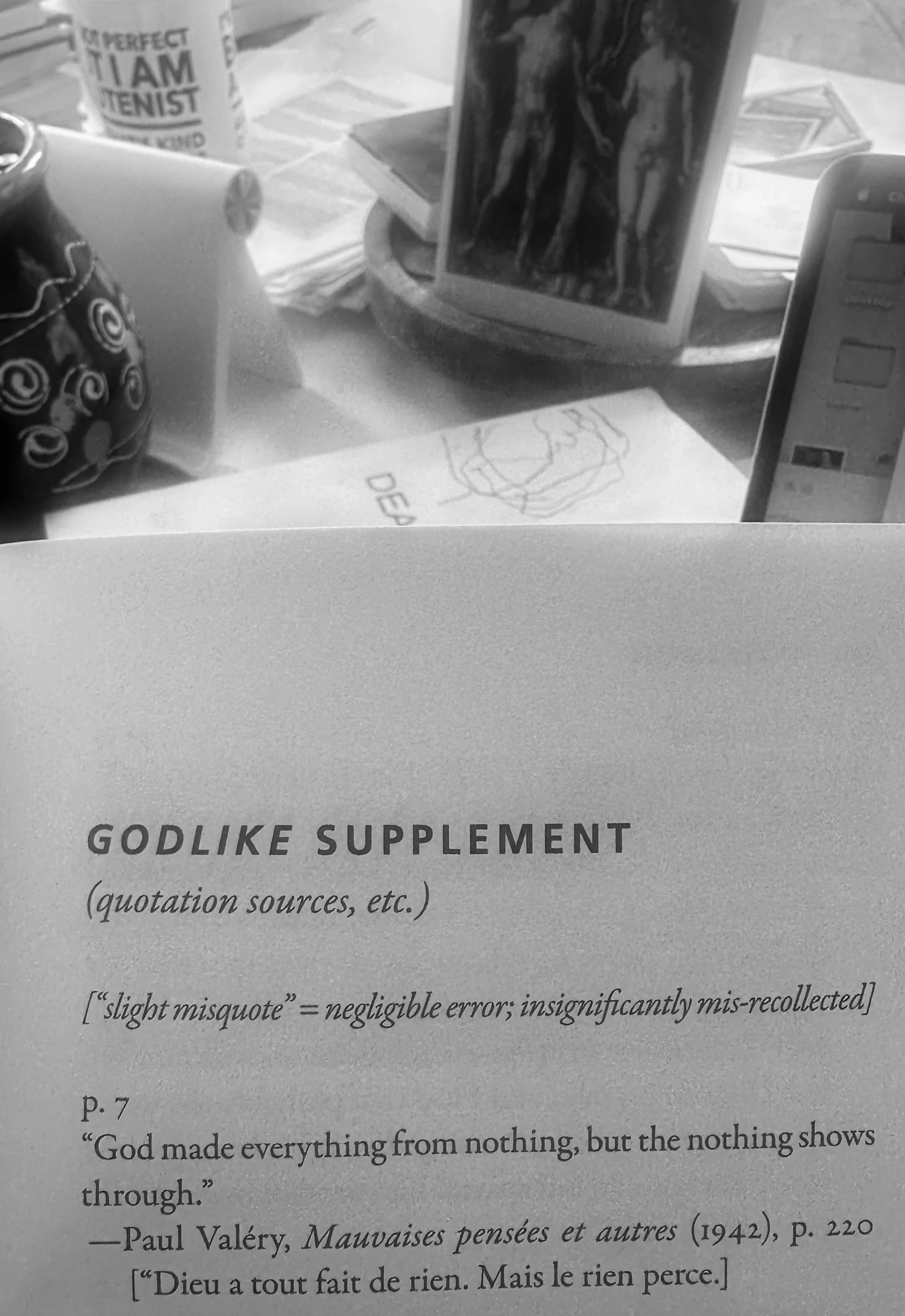
There is an interesting slippage between what Godard does in curating and transposing these images and texts and what Richard Hell does in his translations — as cited in the apparatus titled “Godlike Supplement” at the end of Godlike, where the note lists “R. Hell” as the translator of Frank O’Hara.

I am greedy for this sort of pluck and punk in translation theory. Greedy for the play of “I am the only one who can say,” to quote Hell’s quotation of Bill Knott.

PAST LIFE really is a text, a work, a novel. The things you think happened aren't any more true than a book. Lives differ as much in their complexity as books or movies. Books and movies are better though because their characters don't have feelings. So let's Ay, my darlings, into the leaning heights of folded linen. It's all smudged and smeared. Those bony boy's buttocks of his, I didn't have much to compare them to; to me they were the rear view of his hardon, or what his cock was hidden by, or the way to his cock. I haven't seen too many men's behinds and I never had that gay thing about boys' butts really (while I do like women's) ... Meanwhile, an Other's perception of the "same" events is so unlike one's own. Yes, we do operate in these scarcely overlapping fields, calling to each other from great distances, colors and sounds and smells and tastes incommunicable. Butting up against each other: only touch, touch which is to stimulate the sense receptors of another with one's own same class of sense receptors. Though this is true also in a limited way of the senses of taste and smell, which perhaps is why to kiss is the most intimate: tongue tasting tongue, nose smelling nose, face feeling face. Prostitutes often don't allow kissing. To kiss is to share the world most completely.

— Richard Hell, Godlike


1.27.26

In 1969, Peter Weiss drafted a skit titled “Rimbaud.” And I began this post with an excerpt from Hunter Bolin’s translation of it.

Paternity comes up in Weiss’ skit, when Rimbaud — who didn’t know who his biological father had been — answers a friend’s question by saying: “Just as there was no dick from whence I eddied into the egg, so there is also no world there that would receive someone like me.”

On that note, I encourage you to read this reprint of Godlike — the “Afterword” by Raymond Foye illuminates hell so well.

I leave off where I started in a sense, which is to say — with a grin that spreads like a Cheshire cat over Hell’s last words, as appended to the section titled “Supplement”:

excerpted from the section titled “Supplement” in  Richard Hell’s Godlike (NYRB Classics, 2026), pp. 158-159

“It's funny to be living in an imaginary place, but I love the past of blaze and haze. We know that there's a sense in which everything's brilliant and I'll pretend to it.”

— Richard Hell, Godlike

*

Alain Badiou with Nicholas Truong, In Praise of Love translated by Peter Bush
Jean-Luc Godard, In Praise of Love (2021)
Peter Weiss, Rimbaud (Tripwire Pamphlet #11, 2021) translated by Hunter Bolin
Richard Hell, Godlike (NYRB Classics)
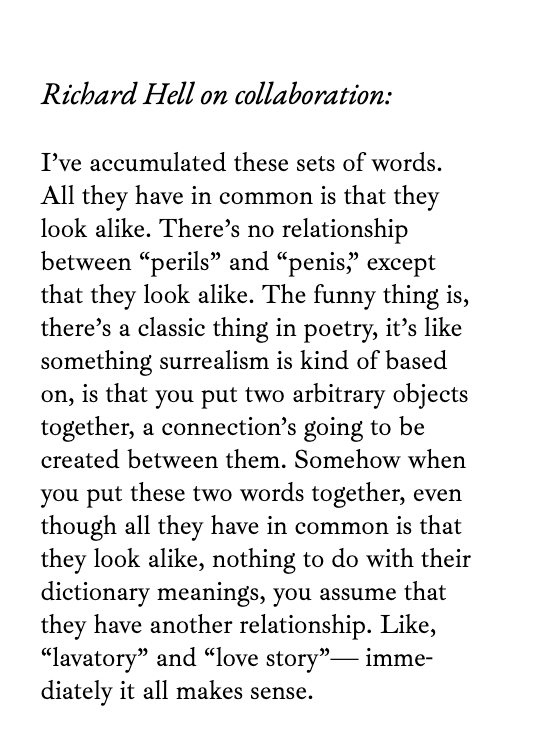
Richard Hell on collaboration
Richard Williams on Verlaine, Hell, Eno, and Television
Richard Hell playing live At Bunky's on March 28, 1985
Richard Hell reading poetry and Baudelaire-ing at Frieze Poetry Marathon 2009
Television’s Ork Loft Tapes from 1974
Television, “Marquis Moon
Tom Verlaine, “Bomb
William Williamson, “Lovesick: The Question of Love” a film about Badiou’s philosophy

Richard Hell, New York City, by Stephanie Chernikowski

"To comprehend is to complicate.

To comprehend is not to clarify, simplify, or reduce things to a perfectly clear logical scheme. To comprehend is to complicate, to augment in depth. It is to widen on all sides. It is to vivify.

— Lucien Febvre

The irreverent refuses transitional states; there is no between but like a quantum always here and there, such a perfect waitress. One if by whirlpool, two if by monster. 

— Dean Young

A poetics of ongoingness

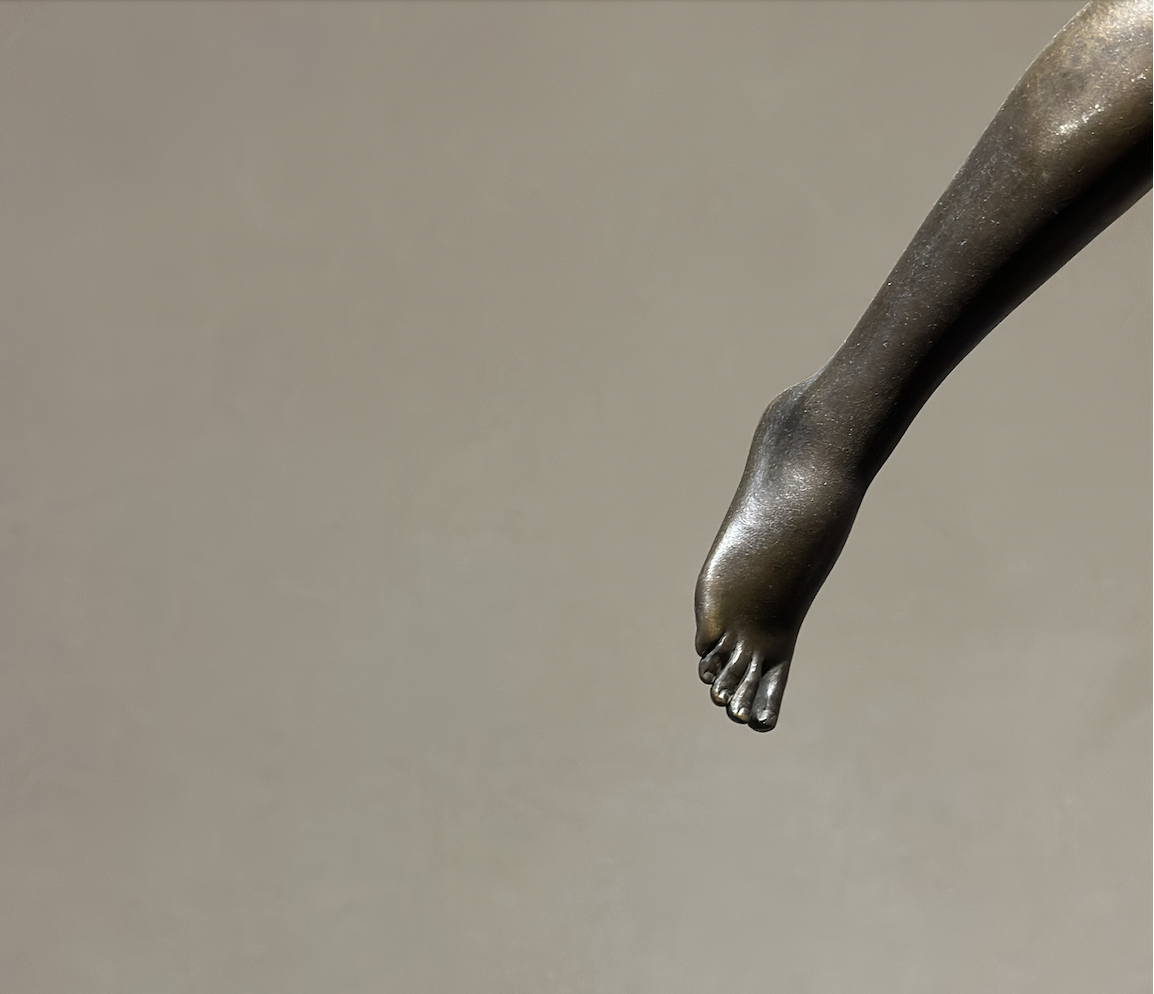
Like the foot of the statue in a museum, detached from the conditions of its existence, my poems are heedless and clumsy in their ongoingness. Rather than settle for the whole’s solidity, they loose their sandals in stanzas and then limp into couplets unshod, seeking the shadow of a willow in the ego of Max Brod.

On a recent roadtrip, I returned to Dean Young’s book on poetics, The Art of Recklessness, and frolicked a bit in his wrecks— for kicks and pretzels — or just to wrap my mind around his paradoxical lightness.

He made the following distinction between “ecstatic subjectivity” and “pathological subjectivity”:

Ecstatic subjectivity as articulated and extended from Surrealism (although not exclusive to it) takes the fragmentation of self as an opportunity for energetic release as well as a vehicle for new, usually temporary reformation. For the surrealists, change in consciousness did not have a static, finalizable goal; it was not achieved so much as ongoing, an increased volatility and receptivity, the making of instability into a positive trait, a ready resource constantly renewing the possibilities of life, self as fluidly imaginative. Disjunction signals psychic tectonics in which the destructive, the desecrating, is inseparable from the generative.

And then he enacted it in the next paragraph:

The blood may be fake but the bleeding's real. My self is constantly disrupted, constantly re-centering, regrouping with each experience, when I meet one person's eyes, when I meet another's, how else account for that voltage in those eyes meeting? Rather than seeing that process as brittle, as cause for crack-up, it may be conducted as music, as lightning if we are limber and cultivate a nimble awareness and receptivity that welcome and exploit such occasions: an act of the imagination. The self is always under construction, it too is an aesthetic creation, and the world is always offering up materials for garden and blast. If there is divinity in us, it is in the process of allowing ourselves to unmake and remake ourselves.

Like others inclined towards surrealities, Young drew from quantum mechanics and particle physics for his figurations and poetic cosmologies:

A cartoon by Saul Steinberg shows a man at a drawing table. The line that his pencil is paused at the end of loops back and is, in fact, the line of the drawer's body: the drawing creates the artist who draws it.

Every poem creates the poet to write it. A poem is written by somebody who's not the poet and addressed to somebody who's not the reader. Who the poet is as opposed to his usual self is sort of interesting. Because the usual self is very often just the usual self. 

Poetry is a transference of energy between poles. Poetry's task, if it has one (we must be suspicious of any claim of task), IS to mitigate but to mitigate by way of accelerant: it too becomes primary in a range from rivaling the world to near exclusion and/or creation of it, to a humble transparency that adds nothing but clarity, the way a very clean window can add luster to a gray day it looks out on and frames. Some impurities can make water clearer.

Poetry is no more a thing than fire is; rather it is a conversion that reveals itself in the instance of its occasion. Poetry mitigates just as fire does, by witnessing its own necessary recklessness and senses of the sacred, its ability to combust the ancillary, to grow and make everything itself even as it confronts us with the outcome of its conjugations, with ash, with death.

Let us not forget that the punishment for the god who gave us fire in a hollow reed (already fire was singing) is eternal evisceration. Aesthetic positions are often drawn toward their own extinction, be it through the impossibilities of their aims or the ruination brought about by their success.

Signed by spitbite

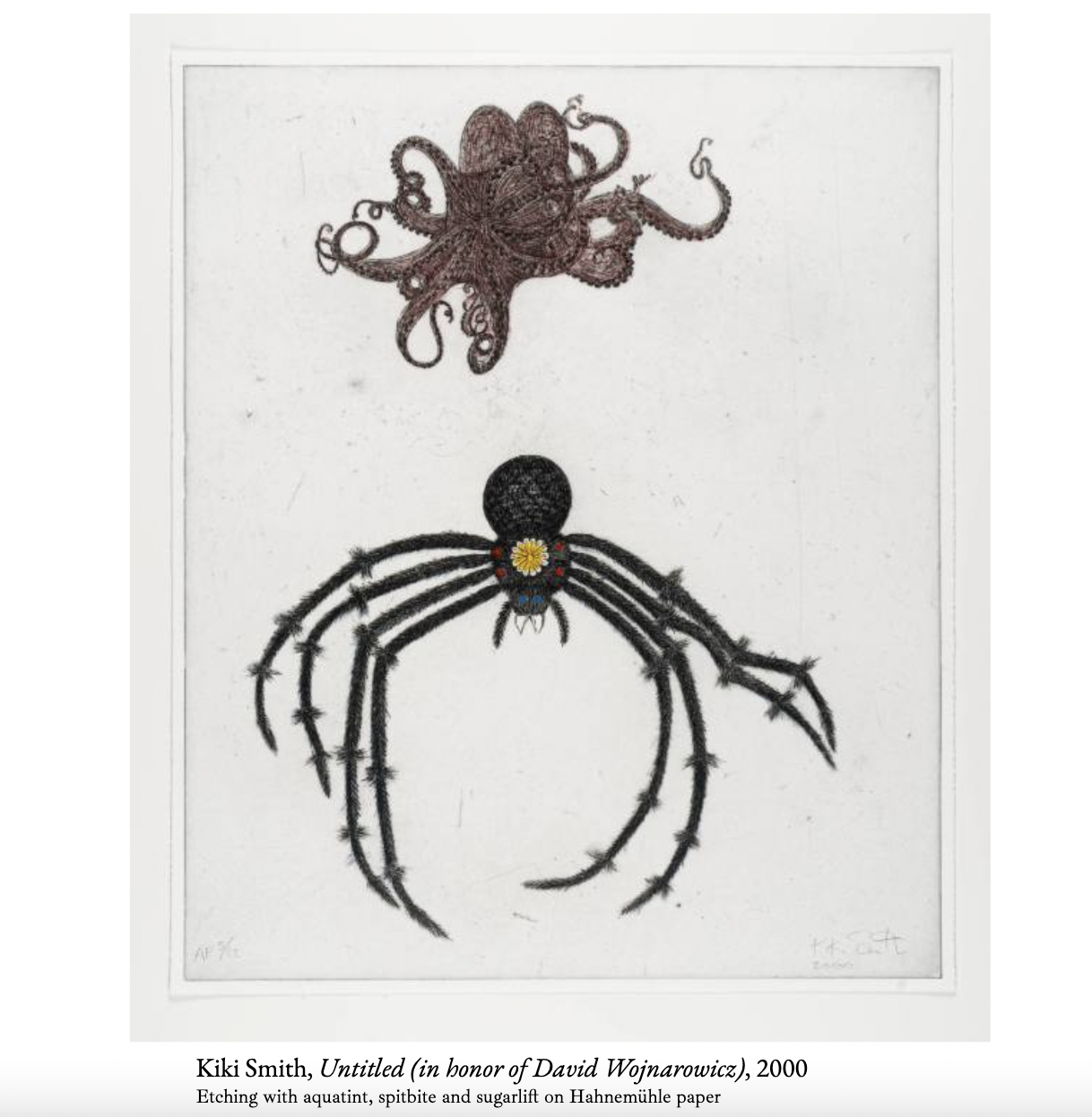
Speaking of fire singing, I love how Kiki Smith’s etching honoring David Wojnarowicz was aquatinted with spitbite, a tender and personal touch resembling that of the gods who allegedly created man to stand upright by mixing his saliva with dirt and dust. Tenderness and beauty in the curling arms of the octopus hovering like arabesques above the dangerous and yet cheery spider.

Kiki Smith plays as she grieves, and keeps alive the shadow of the trickster in her homage to David.

Like Kiki, Dean was a connoisseur of errors who drew on the importance of play for situationists, noting how the “de-tours, undermines authority with laughter, deranges the claims of advertising to monkey business” and “opens itself to the glimpsing of mortal messages that are not exempt from the anarchy of life. Instead of the ideal, we have the body”:

In “Preface to a Modern Mythology” in 1926, Louis Aragon states that “Certainty is not reality,” arguing that every certainty bases itself upon the error of some previous certainty. All we know for sure is this steady progression of errors so that we “elaborate a changing and always evident truth” yet ask ourselves “why it never seems to satisfy.” Error, however, “with its unknown characteristics.. demands that a person contemplate it for its own sake before rewarding him with the evidence about fugitive reality that it alone could give.”

“There is always eros in errors,” Dean added. And so he embraced profanation as a possibility. And he urged irreverence as a means into the thing we have reified. Irreverence is simply the mixing of things that convention prefers to keep separate. Like Frank O’Hara, Dean relished mixing his rhetorical registers and dictions.

What we need is recklessness and an owl-shit outburst and a good smack upside the head every now and then. I, too, am a creature of electrified lint; give me a doily and I'll blow my nose on it, and I mean that in the best possible way. The poem is here to be defied. I almost typed “deified”. When I typed “good student” in a letter of recommendation, it was very very hard to change. The irreverent welcomes its own desecration; it has no obligation to the truth (because there are too many to be obligated to), only to clear a possible space where new truth may appear.

Sweeping, sweeping the temple steps is all you can do when hoping the god will appear. An onslaught of severalness within the asylum of singularity. He was driven crazy by the way people drive. 

The irreverent is the irrelevant's revenge. Inclusions are always the greatest risk. Skirmish of daffodils and dragonflies. The giraffes go knock-kneed to drink. Consistency is the triumph of insects. The irreverent is cracked in the plinth and therefore can sustain no monument, no argument, no politics. Surprisingly, some ducks have bigger penises than gorillas, and how do you think that goes over in the ape house? Do you doubt for an instant the ancient Greeks would have availed themselves of rhinoplasty and liposuction? The antidote to venom is venom, it's just a matter of context. Under the shroud, the thong.

The irreverent can never be maintained, it's always its own debacle, in crisis of its own discovery and obsolescence. Stop me if you've heard this one. Can I get you a number of drinks? Inclusion is always the biggest risk.

Coyote trots on the edge of the abyss. What can't be made more beautiful by an out-of-order sign? Finally, you can only trust yourself and you can't trust that nitwit either.

“The problem with being comprehensible”

“Life is not a dialectical idea, it’s a lived contradiction,” said film-maker Agnès Varda.

“When the man and the woman lie on their backs, with one of the woman's legs across the man's belly, it is the broken mirror,” wrote André Breton and Paul Eluard in (or of) “Love”.

“Most reckless things are beautiful in some way, and recklessness is what makes experimental art beautiful, just as religions are beautiful because of the strong possibility that they are founded on nothing,” John Ashbery mused in “The Invisible Avant-Garde”.

“I didn’t know how alone I was until they brought out more chairs,” Dean Young said, in a section titled “The problem with being comprehensible.”

He touches on wiring:

The poem must do more than complete or fulfill: it must defy the given order that makes us feel comfortable. Or secure.

More than anything, we want to feel safe, and secure in that feeling.

Our sense of security warms its feet by a fire that thinks it knows what needs to be known. Warmed by prediction and the coziness of predictability, we reify contingent things as if they are known and graspable. But what exists is always in dialogue with what may be otherwise. Poetry knows this better than prose, I think.

To quote Dean again:

To be only comprehensible is to be fully known is to be already seen, predictable. The next poem must shake us, must wake us, must entice us toward the denied, the disallowed. It is what wasn't. Someone had erased a YES out of the charcoal Nos. The new is always scrawled over the old. Anything fully known offers us no site of entry, no site of escape, no site of desire. In the morning we mistook the roofers on the hill for flames. Desecration is the mix of opposites, that field of contact, the tear that draws us. [...] Some of them chased each other, some of them fell to the ground. Coyote vanished into the smoke. The clash of the seen with the unseen, the broken seam, the unmasked with the masking that amazes us, sticky-out red thing, outrages and liberates us, embodies possibility.

This possibility inheres in each word. Increasingly, the word “content” appears as noun that designates slop or world-salad spliced by the energy of bots. I miss the gist of light happiness of in it, miss the absence of contentedness as a cultural frame of reference, miss the slower pace of time prior to the hustle-economy.

And I was made even more of this missing in Washington DC last week, with only a few hours to spend exploring the National Gallery of Art, trying to find a place to squat and scribble notes in my notebook.

 “I think one could spend one's life having this desire to be in and outside at the same time,” said Willem de Kooning, “content as a glimpse.”

Content as a glimpse— yes. This is the content I dearly miss.

The idea must be unfixed from its iconostasis. One must unhinge it a bit.

In my re-bumbling through translations of Paul Valéry, I came across this elegy from a notebook dated 1932, a year when Paul was close to Renée Vautier, the sculptress who also prompted him to write one of his unforgettable dialogues, namely, “L'idée fixe.”

Elegy

And I too have made something from little nothings:

From your silence, a pain….        a creature
an eterno dolor a secret wound

From your smile, a dawn.

And why not set it up to pace circles around the stuttering ice of winter.

Why not offer a silent film enjambed by a flurry of stills, the sound of crystals softening, melting into each other, doing their snowflake-like thing, wrapping their legs around the labor of snow-fakes and snow-stakes.

Tis the season, after all.

Postlude on what form knows

“What I know about form couldn't fill a thimble. What form knows about me will be my end.”

So Dean Young concluded.

On that note, I leave you with his gorgeous play on a form, this “Scherzo”:

“How sad it is when a luxurious imagination is obliged in self defense to deaden its delicacy in vulgarity, and riot in things attainable that it may not have leisure to go mad after things that are not?”

— John Keats on July 7th in the year of all lords who sign themselves as 1818

*

Agnes Obel, ”The Curse
Charles Ives, “The Unanswered Question
Christophe, “Aline
Damien Rice, “Cheers darlin
Dave Brubeck, “Golden Brown
Dean Young, The Art of Recklessness: Poetry as Assertive Force and Contradiction (Graywolf Press)
Dean Young, “Rothko’s Yellow
Dean Young, “Scribblers Everywhere
Dimitri Kirsanoff, Menilmontant (1926) with score by Paul Mercer
Frank Black, “I Burn Today
Joe Henry, ”The Man I Keep Hid
Keith Jarrett, “Köln, January 24, 1975, Part I
Kiki Smith, Untitled (in honor of David Wojnarowicz), 2000
Kitty Grady, “The Cultural References Behind Agnès Varda’s Greatest Films” (AnOther Magazine)
Max Richter, “Shadow Journal
Paolo Conte, “Via Con Me
The Cure, “Homesick
The Walkmen, “Bows + Arrows
The Walkmen, “Love You Love

A few by William Heyen.

Maybe this is what is behind what W.S. Merwin wrote me a couple years ago (I’ve just dug out his letter): “What I wanted, most of my life to write was something that we would want to remember in a time of threat and crisis, to take into great peril.”

William Heyen

Sad is the man who is asked for a story
and can't come up with one.

— Li Young-Lee, “A Story”

I wanted to share a few of William Heyen’s poems without much ado about bio. Without an interpretive synopsis. Without systematic study. Not even a gloss or a ganglia. Simply a few poems by Heyen, a few emblematic images, and links to the thoughts of others.

There are many turtles who trundle across the stanzas of Heyen’s poems. One of my favorites is the mutilated turtle crawling out of the mud in “Matrix”:

Matrix

When I was a boy,
I found a mutilated turtle
emerging from mud.
Something, when it was young,
had broken its shell
almost in half,
but the shell,
as though welded with glossy solder,
had mended;
something had chewed
its back legs to the joints,
but its stumps were hard.
How did you survive,
I asked it,
but it was mute, still half adream
from its winter sleep.
I spoke to it,
warmed it in my boy's hands,
but it boxed itself up. . . .

For some time
after her mastectomy,
weeks of hospital and chemotherapy,
my wife woke toward me
in slow spirals,
as though from ether,
unsure of where we were
or how we'd live
in our new matrix
of scar and fear.
But it was April, again.
In windows before us,
as we changed her dressings,
the days rained, and warmed.
One morning, I pressed my lips
to her chest until, at last,
she believed,
and opened up to me,
our answers so slow to come
that came.

William Heyen

Sometimes Heyen blurs the boundaries between interior and exterior very openly, playing with symbols and “lit” interiors. “Wish” does something wonderful with the ampersand and the impossible either/or that seeks to end with an “end”:

Wish

In my dream, my car is an aquarium.
I'm on the hood, prone, looking in,
wondering how I could ever drive again. 

It's evening, my interior lit with tropical fish
& desire for a new life. I didn't know 
I was this tired. I place my forehead 

against windshield, close my eyes, & wish
for you know what. In the beginning, friend,
each word was a dreaming plant or animal 

until our traffic changed everything, but something
seems to be happening for the better, now,
if only it's not too late. I fall asleep 

against this glass until I wake, a few
guppies & angels convulsing in the drying soul
of the world until our ecstasy, &/or our end.


Something about “the drying soul / of the world” made me think of an oil painting by Donald Roller Wilson that pulls us into the room ghosted by its inhabitants. There is always a tinge of ghostliness in representational art that seeks to depict an interior.

Donald Roller Wilson, Mrs. Jenkins' Late Night Dinner in Her Room, Alone (While, Out in the Hall Leading to Her Room, Her Small Friends were Sleeping), 1984

Wilson wrote a poem to accompany (or enhance) (or revision) (or animate) his painting. Reading it adds tones the scene a bit: many of the actions — peeked inside, seen the light, we fooled, it seemed, she was inside — play the idea of seeing against the materiality of the sight. I treasure the way Wilson keeps the whole lettering of “all” in the closing portmanteau word. Moving back and forth between the image and text, one has the sense of being populated by the voices in Mrs. Jenkins’ “interior,” looking for verbs inside the shadows and left- open drawers.

Mrs. Jenkins’ late night dinner in her room, alone (While, out in the hall leading to her room, her small friends were sleeping)

Mrs. Jenkins set her table
Made it look like two
Had dined together in her room last night
And in the morning—through her keyhole
Most who peeked inside
Had seen the plates but none had seen the light
And very few who saw caught on
For most were fooled—it seemed
And those who knew had tried to be polite
They knew that though she played her tricks
Down deep, she was inside
And, in the end, that she would be allright

Donald Roller Wilson, 6:32 p.m., Saturday evening, July 14


Heyen again. This time chasing the crow in a parking lot covered with snow:

The Crow

Snow crystals
swirl up from gravel
almost to beautiful white-out.
In the parking lot, high

in a lone tree over the store
in whose diamonds
still break to blue-
white desire in my mind,

a crow,
black intricate jewel,
cries out for all my life
that I am still a fool.

And the way this poem writes itself entirely by the Bowie Song, with dashes of blackbirds and a temporality or affective palette modified by song lyrics. I have written so many poems in this way, and never once submitted them. Maybe it feels too intimate? Too bound by my own relationship to the song, and the response to it. Some poems we write exist entirely in that response, in the shades and velocity of that responsiveness. Heyen’s “Slow Burn” is an elegy as well, and the word “awe” crumbles inside it:

Slow Burn

Listening to David Bowie while
looking up outside my window red-
winged blackbirds streaking from beneath 

as though hearing him   slow burn, slow burn
revealing spring
honeysuckle bursting clouds racing    slow

burn, burn   these vivid days since
September when the two towers when
arterial city & Townshend's guitar 

the ears of our eyes redwings Bowie's
slow burn   marsh reeds swaying
blackbirds crying out warning flaring 

do not forget never not forgetting
in this awe of ours black sheen & blood con­
gealed in dust & bone    slow   slow burn    burn


Rather than speaking to a song and a memorial feeling, Heyen responds to his friend, James Wright, in this poem titled “While We Are Still Alive.” The word terminal heralds an undercurrent of fear (my ear often harkens upon the terminal diagnosis which may be connoted in it). A repetitive circling of questions about “home” — Where is it? How do we know when we’ve landed? How long does it last? A bit of canned Muzak and airport-food in the metaphysical yearning expressed by the poem’s first-person speaker. I don’t know why I like it, but I do.

First published in Southern Humanities Review.

It is the poetry of the privileged class.

It inherits portfolios.

It was born in the Ivy League, & inbred there.

Its parents filled its homes with bubbling Bach, silver & crystal brightnesses               
for its surfaces.

It does not hear the cheap & natural music of the cow. 

 — William Heyen, “The New American Poetry”

*

Donald Roller Wilson, Mrs. Jenkins' Late Night Dinner in Her Room, Alone (While, Out in the Hall Leading to Her Room, Her Small Friends were Sleeping), 1984 (Blanton Museum of Art)
Georges Cziffra, Liszt: Études d'exécution transcendante, S.139, No. 10 "Appassionata" in F minor
John R. Read, “Barometric Readings (William Heyen, Geoffrey Hill, William Matthews, Ben Howard, Brian Swann, Reginald Gibbons, and others)” (Ontario Review, 1980)
Philip Brady, “A Conversation With William Heyen” (Artful Dodge Magazine, 27 December 2001)
Robert Farnsworth, “Music for Piano and Electrical Storm” (Poetry Magazine)
Tess Gallagher, “The Poem As a Reservoir for Grief” (Syracuse Scholar, Spring 1984)
Tom Cipullo, Crickets a song after William Hyen’s poem (Songs of America)
William Heyen, “Blackberries
William Heyen, “Mustard
William Heyen, “The Coffin”
William Heyen, “The Crow
William Heyen, “The New American Poetry”

Bruno Caruso. Natura Morta, Lithograph on wove paper.

Gnostic rerum.

Poems who are my closest friends, my softest family.

Poems that are as solid and constant as trees to me.

THE BALLOON OF THE MIND

Hands, do what you’re bid:
Bring the balloon of the mind
That bellies and drags in the wind
Into its narrow shed.

(W. B. Yeats)

Poems whose sinews map the otherwise in my own.

GNOSTICISM III

First line has to make your brain race that’s how Homer does it,
that’s how Frank O’Hara does it, why
at such a pace
Muses
slam through the house— there goes one (fainting) up the rungs
of your strange BULLFIGHT, buttered
almost in a nearness
to skyblue
Thy pang — Pollock yourself!
Just to hang on to life is why

(Anne Carson)

Poems that aim to do what music does with the light— but differently.

Poems that hide in strange bathrooms to laugh at what language does to them.


Poems that stammer between marks made by chestnut trees on sidewalks in Paris.

Go blind now, today:
eternity also is fully of eyes —
in them
drowns what helped images down
the way they came,
in them
fades what took you out of language,
lifted you with a gesture
which you allowed to happen like
the dance of the words made of
autumn and silk and nothingness.

(Paul Celan translated by Michael Hamburger)


Poems that own me.

Poems that know what they have known since they were children.


LANGUAGE MY COUNTRY

Language: my country
where night
rhymes with light, death
with breath—

And from childhood on the gift
of seeing world the way
the dying see

it: things shining

in the light of their imminent disappearance.

(Franz Wright)

Surface angles.

For my co-creators in the Conscious Writers Collective

“Evaluation is creation,” as Nietzsche noted.

MIRROR IMAGES

The concave mirror, the convex mirror: variations on visibility.

The shadow’s relation the self as a sheer, a texture that speaks to the density of a physical body in relation to light.

A poem by Cole Swensen titled “Connote” . . . in its entirety:

I wonder if you can use words in such a way that only their connotations and not their denotations get activated. To connotate as one might cogitate or contemplate a state chosen for its particular relation to thought so that its not the definition (always restrictive) of the word that comes into play, but its fields of association, its overtones and undertones, those always expansive, radiating zones of suggestion and implication, in the middle of which gapes the strangely blinding blind spot of the impossibility of precise literal meaning, suggesting, in turn, that language, at heart, is always an absence.

An excerpt from Nicholas Delbanco’s short story, “What We Carry”:

The sky is of a bright whiteness, and she wears dark glasses. There is what might be a boat in the background, or a structure that evokes one; water blends with the horizon so that he is not certain if she stands by an inlet, a river, or the sea. There is a brown shingled wall to the left.

It is her smile he examines, however, the mouth both expansive and pinched. She is smiling at Simon— from the pleasure of the occasion, perhaps, or the beauty of place, or because of something someone said. It would not have been Simon, however; this is a smile of assent at something more amusing than a request that she smile. Kenneth grows certain, suddenly, that there was a third party present— someone at the edge of things, beyond the lens or range of his remembrance, some business associate of Simon's with a camera, or someone passing through who made his mother laugh. A gull preens on a railing by the wall.

The photo introduces a third party; a presence is always in dialogue with an absence.


TWO BY NAN GOLDIN

Both images come from her book, The Ballad of Sexual Dependency, titled after a song in Bertolt Brecht’s The Threepenny Opera.  Both photos are held in collections at the Museum of Contemporary Art in Los Angeles.  Both are cibachrome prints.  Both are shot in public spaces and present ways of thinking about spacing and relationality. Both provoke us to consider how dimension implicates its subjects.

The first image places us on Coney Island, likely in the fall or early spring. Two humans on a bench with a large gap between them. Sometimes a gap implies an erotic possibility. In this photo, the sun seems to have set behind the camera— the sky is pink near the horizon where it meets a harder, dark edge, a deep blue that is the ocean, a blue that snags the blue sweater of the woman on the bench. 

The woman, Suzanne, is looking towards the man, Brian, and he seems to be looking downwards, perhaps at his hands— but not up towards the beach or the water, and not diagonally towards the other person. The brightest part of this image is Brian’s white tshirt. We can read the muscles in his back beneath it; Brian is more available to us as a human body than Suzanne. But Suzanne’s face is more available to us as a figuration of feeling. 

If I stand back a bit, I notice the vastness, and how vastness is emphasized by the presence of the horizon. And how the horizons multiply, giving us the metal bars along the walkaway as well as thick horizontal slats of the bench. Three horizons, and one of them is inhabited by two humans sitting. The space between them seems insurmountable. They share the same space but live in different planes, this is what the direction of the gaze suggests.

(What is Brian holding? I can’t stop wondering about this…)

The second image is a park in New York City. (I keep looking for birds— pigeons, the peckpeckpeck of convivial urban life. Entanglement.) A portrait of entanglement: the subjects’ faces held back from us by the angle. Two people on a bench, though the bench is facing us. The park is sparsely populated and yet it feels full; the shadows of the tree leaves ornament the sidewalks and surfaces. A conspiracy of intimacy in which the space colludes with the lovers and seems to hold them close. Their outfits match: both are wearing white shirts and jeans. Trash under his boot, the way sunlight colludes with the shaping of shoulders.

A/SIDE ON CONEY ISLAND

Not a gull or horizon in sight.

Aside on the isle of Coney. What’s in a name? What does Coney Island carry?

Space, this locus of potential in which things can influence each other, is our reality.

TRAIN BETWEEN

Returning to Suzanne and Phillipe as the subjects of a photo by Nan Goldin… the way green smudges the seen.

Afterimages matter. Afterimages are material.

I’m thinking of a moment in Rainer Maria Rilke’s The Notebooks of Malte Laurids Brigge, that calls upon the images of childhood. In that novel, the afterimages reconnect Malte to the beloved red crayon of his childhood. He remembers seeing the crayon on the table and reaching towards it, watching in dismay as it rolls off the table and falls into the thick fur of the carpet below. Undeterred, with a reading lamp shining straight into his eyes, the young Malte runs his fingers blindly through the carpet looking for the crayon. 

Not looking — the light makes it impossible to see –  but seeking.

Seeking the crayon.

Looking and not looking.

Seeing a strange blur when a series of afterimages appear on his retina. The afterimages dissipate, enabling him to perceive his own hand, its fingers outstretched, its trunk stirring as if disconnected from his body and scurrying quietly across an ocean floor. Then, the wall at the rear of the room secretes a much larger hand —  a hand with long slender fingers also seeking something from the floor. 

Malte watches the two hands move ominously across the carpet as if driven to meet, or driven to encounter each other accidentally. Fascination morphs to fear as Malte wills the hand that he considers his own, the hand he claims and feels responsible for, to withdraw from its search. Still shaken, he sits alone in the armchair, shivering, pallid, estranged from the room's familiar quietude and safety. When his companion looks up from her reading, Malte says nothing. He is white as a ghost. His companion kneels near his knees and begins shaking him desperately, calling out his name. Malte: the most familiar author of all. His lips tremble: he cannot find a single word. 

Perhaps the sole comfort of this nameless event lies in Rilke’s decision to describe it. For, as William Gass observed, “that description will bide its time,” those “ghostwords will wait their moment –  and they will return, forcing him to relive the fall of the crayon, and his vision of two hands blindly searching the carpet for it, as if the color belonged to both crayon and account, and was therefore equally missed.” 

As if the absence of one is tied to the other. 

SPECTRAL “LIKE-NESS”

“These photos, in which the bodies are absent, and the eroticism is only represented by the abandoned clothes, were a reminder of my possible, permanent absence,” Annie Ernaux said the book she co-wrote with her lover, Marc Marie, a book that they titled The Use of Photography.

Hélène Amouzou, Autoportrait (2009)

The layers in Hélène Amouzou’s “Autoportrait” – a term that sidles alongside “autofiction” somehow, as if to suggest the image wants to enact a theory of representation that includes absences. The wallpaper peeling from the wood surface, blurring the line between paper and fabric. The part of the wallpaper visible through the subject’s right calf. This idea of sheerness in a person challenges how I think about “visibility” or what it means to be seen. The suitcase as a story of origin.

The spectral blur in Christina Sharpe’s “Note 139”:

Ghosts are the most faithful beings in the universe: they don’t believe in time or impossibility.

Ghosts don’t give a damn about the conditions we have set on their existence. I admire this a lot in them.

In the sidereal: Marcel Proust’s “spectral” magic lantern in Jean Santeiul.


COSMOLOGIES

“It all begins with a photo I found one day of three men on a roof.”

— Ian Penman, Erik Satie Three Pieces Suite

Penman accounts for the origin of the obsession that turned into a book on Erik Satie.

Larry Rivers, O'Hara Reading, 1967

The story of origins is the light that brings us to the page with the hope of illumination. The cosmology creates the conditions of possibility for the world we are inventing or writing.

“The poet’s metaphorical activity puts him in a contrafactual relation to the world of other people and ordinary speech,” Anne Carson observed in Economy of the Unlost.

Unequivocally.

VARYING TERMS OF ADDRESS

When I listen to music, gardens open out around me, and the melody becomes a flower I hear with my eyes.

— Mahmoud Darwish, as translated by Catherine Cobham

*

Annie Ernaux and Marc Marie, The Use of Photography trans. by Alison Strayer (Seven Stories Press)
Brian Eno, A Year with Swollen Appendices
Brian Eno and David Byrne, My Life in the Bush of Ghosts
Christina Sharpe, Ordinary Notes (Farrar, Straus and Giroux)
Cole SwensEn, AND AND AND (Free Poetry Press)
Collin Marshall, “When Erik Satie Took a Picture of Debussy & Stravinsky June 1910” (Open Culture)
Hélène Amouzou, Autoportrait (2009)
Ian Penman, Erik Satie Three Piece Suite (Semiotexte)
Marcel Proust, “Chardin: The Essence of Things
Nan Goldin, The Ballad of Sexual Dependency at MOMA
Nan Goldin, “Suzanne and Brian on the bench, Coney Island, 1982” at MOCA
Nan Goldin, “Suzanne and Philippe on the bench, Tompkins Square Park, New York City, 1983” at MOCA
Nan Goldin, “Suzanne and Philippe on the train, Long Island, 1985” at MOCA
Nicholas Delbanco, Reprise: The Collected Short Stories of Nicholas Delbanco (Dalkey Archive)
Rainer Maria Rilke, The Notebooks of Malte Laurids Brigge
Vivian Maier’s gallery of self-portraits

James Tate


The challenge is always to find the ultimate in the ordinary horseshit.

— James Tate, “South Bend”

People read poems like newspapers, look at paintings as though they were excavations in the City Center, listen to music as if it were rush hour condensed. They don't even know who's invaded whom, what's going to be built there (when, if ever). They get home. That's all that matters to them. They get home. They get home alive.

— James Tate, “Read the Great Poets”

Harold Feinstein, Piano Still Life, 1974.
Vintage gelatin silver print; photo taken by Anne MacDougall.


The titular framing fueled the fire. An unexpected kindling got starred by a spark. I remember being drawn to “The Whole World’s Sadly Talking To Itself”, a poem by James Tate titled (perhaps) after phrasing from a poem by W. B. Yeats. Or by an ekphrastic urge, I’d read poems by Tate prior to this one and felt missed by them; none left a mark until I entered the building Tate assembled beneath Yeats’ awning—

What about this poem reached out to me? Which part of my existence felt apprehended in (or by) its being?

An elegance in the stanzaic construction. An intertextual friskiness in the speaker’s engagement of motifs and phrases hatched while marveling over the work of another. An alluring ghost-presence of images from Yeats’ poem, “The Sorrow of Love”, with its repeated conjunctions:

And then you came with those red mournful lips,
And with you came the whole of the world’s tears
And all the trouble of her labouring ships,
And all the trouble of her myriad years.

Or maybe a gist of Yeats’ “Broken Dreams” — though it seems too dedicated, too intent on cherishing what has aged rather than what was empty.

I can’t remember.

The way I imagine it has nothing to do with its reality, or with Tate’s realization. And I like that in a poem. I value being being strung out on a line, trying to locate my affective response on a range between disappointment and fascination. Two friends chew over edits in their overly-meaningful poems. They go out for drinks and leave each other with words. Riddling words that want definition. Poems excel at riddling the definitive parts of language, and — in my imagination — Tate writes “Two for Charles Simic” in dialogue with the possibility of defining the sky or nothing.

But here’s how it actually happened:


Two for Charles Simic

1.      The Sky

What is the sky?
A week later
I reply: I don't know

why don't you ask 
your only friend. 
Another week passes. 
He doesn't call.

He must be up to something, 
he must know
what the hell it is.

I look at my bankbook,
it's forty-seven below. 
Can you give me a clue?

I blurt at him.
Those few shining masterpieces 
are lost, electric piercing

bouquets
lost in a fantastic fire. 
What is the sky?

What is the sky. 
The sky is a door, 
a very small door

that opens for an inchworm
an inch above his rock,
and keeps his heart from flying off.

2.      Nothing

It is a tiny obscure lighthouse 
for serious travellers of the night 
whose only vocation
is to gradually discover a spot
to root their lonely wardrobes.

It is a dignified fifth columnist 
inspiring unheard of wind 
slightly ajar:
if you haven't got any you'll die.

It's not going to improve your posture. 
Take an overdose and you won't even faint.
It helps you make it through the day.
You can take it with you and that's all.

Notice the thing that happens between the sixth and seventh stanzas of the Sky section in the prior poem. . . I’m highlighting the repetition across the stanza break —

What is the sky?

What is the sky. 

— because this punctuation of a questing statement with a period is precisely how Tate opens “Read the Great Poets.”

“What good is life without music.”

Maybe a species of rhetoric that resembles a musing.

The same being “The Masters. The Thieves.”

Another sameness sluiced from the repetition of phrases — like “They get home” at the close of the fourth stanza — that reinforces the claim at the end of the third stanza: “We are playing the same song and no one has ever heard anything.”

Speaking of actual happenings, Simic interviewed Tate for The Paris Review in 2006. This is where I learned that Tate was four months old when his father’s plane was shot down in Europe, a tragedy that his mother steadfastly refused to believe. Serving his eggs deadpan, Tate plays on the surreality of circumstance:

This is pretty unfair to the very nice man she was married to for the last thirty-four years of her life—but she was always in love with my father. It was a high-school love affair, they married young, and she never got over it. She came to visit me in Spain in 1976 and she was really crazy. She had never been abroad and it just rattled her to the core. Shortly after she got off the plane she said, I’m really hoping I’ll meet your father.

In the same interview, Tate said he loved taking a poem “that starts with something seemingly frivolous or inconsequential and then grows in gravity until by the end it’s something very serious.” And this is visible across his work. You can see it “Very Late, But Not Too Late,” and how it opens on that see-saw of Tate-style scandal:

I was the last one to leave the party. I
said goodnight to Stephanie and Jared. They were
already in bed. In fact, they were making love, but
they stopped and thanked me for coming.

You can also glean it from the first lines of the cheeky portrait titled “The Chaste Stranger”:

All the sexually active people in Westport
look so clean and certain, I wonder
if they’re dead. Their lives are tennis
without end, the avocado-green Mercedes

Frequently, Tate’s titles work against the loom of their promise. Humans who rarely laugh at disappointment may find Tate too glib. But I kept reading him over the years, bonding with his affinity for absurdity, the drift of that “cuppa” pitched in the invitation elaborated at the outset of “You Are My Destination and My Desire, Fading” —

Something wistful in the slope of “our initials rising” after the strenuous obit-reading mingled with the “fissures” and the fossil record. Something suggestive of absence.

Something displaced in the chaos beneath the foggy day that unfurls with “my cockatoo” and continues with the “some poky guy” amid the flourish of alliteration that sounds out the poem Tate tited “Editor.”

Something bluer than midnight in the disorder of “the plump and dusky woman with something on a leash” setting the scene for the absurdity of luck and pennies offered to “The Condemned Man.”

Something resembling a response to the horrible luck of his childhood’s inheritance.

Something Tate said to Simic evokes it:

My mother got married. It was a brief and very unfortunate marriage to a dangerous lunatic who shot holes in our house with a .45 automatic. He slit his wrists—all kinds of stuff. It was only years later, when I happened upon the one and only photograph that I had of him, that I realized that he bore a considerable resemblance to my father. She had married him from the gut—like, oh, he’s like Vincent. And he was. He was a nice-looking man, with the same exact curly hair and very similar features. It was that simple. She married him after knowing him two weeks. I hadn’t even met the guy. She came home and said, We’re moving out of here. I’m married!

The marriage may have been a disaster but Marriage, as an institution, survived its dissolution: Tate’s mother remarried a traveling salesman who sold shock absorbers. Tate’s second stepfather was a man with “a who-knows-how-many-state area, maybe five states” who “was gone pretty much all week, thank God.” In Tate’s words:

I really don’t remember him doing anything to me, but he used to beat the shit out of my mother. Really badly—black-and-blue—and I would be in the house watching. Eventually, toward the end of it, I drew a gun and stuck it to his head. His own gun. He had told me where he hid it. To protect the house, you know? He told me where it was, and I finally went and got it. It really was time to do it. I was probably sixteen.

He left his job as a dishwasher in New York city after being held up at gunpoint. But he knew its nocturnes well enough to compose them “In New York,” where:

you sometimes know the secret, if anything,
not asking for anyone to take you home
you are, for one second, the only one that's not alone and

There is something worth returning for in “the blue-black plumes of the foundation” of “City At Night”.

There is more: the aunt “stroking the back of a standing raccoon” in “Demigoddess”; “this crap about a cougar” in “Half-Eaten”; “Millie, O Millie, do you remember me?” . . .

“Dear Gene, I made it at least this far,” Tate wrote in a 1969 letter addressed to his friend Gene DeGruson — followed by a juicy inventory of details from the “writhing” life:

The infinite details involved in moving from one place to no-place wrought a maniacal kind of SS effiency upon me those last 2 weeks. I sold my car and much of my “furniture,” as it was. And I do have three readings in Pennsylvania before departing the continent; plus one charity reading at Yale.

It’s good to be away from Kansas City: as you know, I had no real stimulating friends there, just a few drinking partners and a nice girl, which is enough to get by on for a while, but not nine months, for me. I attended a wild party and poetry event last night at Saint Mark’s Church on the Bowery—LSD punch (really!) pot birthday cake, plus 350 joints circulating for the special occasion, plus wine, a small conciliation. I abstained from the punch, but indulged in the cake and joints. The wildest thing was this: good old Ingrid Superstar herself picked me as her evenings entertainmnet, Warhol’s debutante. Cosmic mindlessness! I was absolutely giddy with the whole thing, couldn’t stop beaming at the ridiculousness of it. Since she was the big catch at the event, everyone had their eyes on us to see what would come of it (I think she had vaguely heard of me, though I couldn’t tell for sure, and I made no effort to inform of my literary inclinations because nothing could have been more irrelevant to her designs.) Well, I blew it. It was too much, I walked her to her apartment, listening to her gobbledegook about the eclipse in China that night and how she was a scorpio, and how many pills she had taken that day and her last bad trip and her next movie in Rome, etc etc., and finally stole a big kiss goodnight and slithered back down 10th to the Church where the party was still writhing. All the East Village poets were there—Ron Padgett, Michael Brownstein, Peter Schjeldahl, Anne Waldman, Gerard Malanga, Lewis Warsh, and more, plus a few friends of mine, Charles Simic and Nathan Whiting, both of the latter being very good poets—the former six being extremely suspect though much celebrated in this part of the world, thanks to their dial-a-poem innovation.

There are as always many plays and movies and poetry events buzzing here: and you keep thinking you’ll take them all in but when the clock says it’s time to go you sink deeper in your chair at the thought of three subway transfers and you end up reading a book and drinking a bottle of wine. I don’t know where I’ll live when it’s Columbia teaching time next year.

The City is in a mess in so many ways. Lindsey is in fact a baboon. Norman Mailer is going to be running with Jimmy Breslin as city counsel chairman. He might even win. The schools are hopeless, much money has been cut for all budgets, there is no housing, rents are skyrocketing, etcetera. Aguh. Oh for the prairies. You can’t win.

Let me know what you’re up to, now and in the summer ahead.

“Adieu, Yours, Jim.”

Some He might win but You definitely can’t. Not in a Tate poem. Not in a Tate-world. If you’re patient and willing to watch, you can bard over the terrors in silly-string. Imagine them otherwise. Refuse to be bound by their steam.

In Memory, Dorothea Lasky describes how fear and art linked up for her as a child. “I used to draw a picture of the scariest thing I could think of on a piece of paper and then cover it up,” she writes. “Then I'd test myself to see if I was brave enough to look at it. I'd cover and uncover the page quickly, letting the image wash over me, without really forcing myself to look directly at its hellish stare. Even now I feel scared of finding one of those pages somewhere (or it finding me).”

On that note, “Coda” deserves to be read them. Tate’s descriptive restraint reinforces his refusal to take up horizontal space on the page, pulling the poem down as if compelled by gravity. Here it goes.

Coda

Love is not worth so much;
I regret everything.
Now, on our backs,
in Fayetteville, Arkansas,
the stars are falling
into our cracked eyes.

With my good arm,
I reach for the sky
and let the air out of the moon.
It goes whizzing off
to shrivel and sink
in the ocean.

You cannot weep;
I cannot do anything
that once held an ounce
of meaning for us.
I cover you
with pine needles.

When morning comes,
I will build a cathedral
around our bodies.
And the crickets,
who sing with their knees,
will come there
in the night to be sad
when they can sing no more.

*

Charles Simic, “James Tate, The Art of Poetry No. 92” (Paris Review)
Ferruccio Busoni, Piano Concerto (1878)
Harold Feinstein, Piano Still Life, 1974.
James Tate, “Editor”
James Tate, “Fuck the Astronauts
James Tate, “Poem to Some of My Recent Poems
James Tate, “The Condemned Man”
James Tate, “The Expert” (PDF)
Jeffrey Gleaves, “Cosmic Mindlessness” (Paris Review)
W. B. Yeats, “Broken Dreams” (PDF)

PAN.

ARTHUR: But isn’t it necessary to believe a beautiful mask more than reality?

(Arthur Breisky, Střepy zrcadel)

DURTAL: Good God, what a mess! And to think that this nineteenth century of ours gives itself such airs and graces! There is only one word in everyone’s mouth: progress. Progress for what?

(J. K. Huysmans, La-Bas)

CYRIL: Ahem! Another cigarette, please.

(Oscar Wilde, “The Decay of Lying”)

Molto meno.

There is a moment in Michael Clune’s unforgettable PAN when the young protagonist Nicholas lifts a copy of Oscar Wilde’s collected works from a library table and finds himself inside Wilde’s Salome, encountering “a third kind of oldness” he can neither describe nor place.

“Under the play’s name was an ornate image of a thin woman holding a man’s head on a plate.”

This image of Salome may be the one drawn by Aubrey Beardsley in the illustrated copy of Wilde’s Salome I purchased at the Salon de Refusees reading in L. A.

The language is anachronistic, psalmodic, like nothing Nicholas has met yet. (In his notebooks, W. Somerset Maugham acknowledged Oscar Wilder's Salome as spurring him towards heavier, more baroque language. Like “an old actor watching a part which he himself had created,” Maugham said, “I look at my past self with astonishment and with a certain contemptuous amusement.”)

By the end of the play’s first page, Nicholas feels “excitement rising” within him, a sensation so consuming that he can’t distinguish it from panic. Nor can he determine if this excitement partakes of the aura prior to panic. Nicholas glimpses “the shadow of [his] thought” in “the warp across the page.” As words combine, the room dissolves. The reader finds himself “inside the book,” a moment that Clune marks by quoting a passage from Wilde’s play:

You are always looking at her. You look at her too much. It is dangerous to look at people in such a fashion. Something terrible may happen.

Now the tingling extremities of panic set in. Nicholas feels as if he understands the book, feels himself implicated by this understanding that appears in a quotation. Unable to resist reading further, he continues. Salome is speaking, lamenting the possible consequences of having kissed Jokanaan (or John the Baptist). She addresses him directly:

“I have kissed thy mouth. There was a bitter taste on thy lips. Is it the taste of blood? But perchance it is the taste of love!”

Time is suspended for Nicholas, who cannot stop reading. By the time he leaves the world of the play, the world of the library is closing. The lights have dimmed. “Feeling could keep the shape these sentences gave them,” he thinks, applying what he discovers in Wilde’s text to his own feelings for Sarah, the girl who believes in thresholds. While Salome’s sentences are “open to feeling,” they are also “closed” — they close behind him, delivering him to the world where time is suspended. This temporal suspense is what good literature does, I think, when it delivers us to a world we can’t resist.

Molto meno mosso.

Salome’s dance, Herod’s demands, the beseeching gazes, “The headless lover”: Nicholas feels as if the play’s secret meaning has been revealed to him. Like actual human encounters, myths lends themselves to multiple interpretations. In Wilde’s play, Herod misreads the scene: jealousy drives him to order Salome’s death when he sees her kiss the decapitated head. The charge of “perversion” (and the implication of necrophilia) makes it easier for Herod to avoid confronting the jealousy that motivates his act. Like many kings, Herod cannot exist within life, among others: he needs to be singular, the monotheos, the one that eliminates the need for any others.

The first page of Oscar Wilde’s Salome, in the Dover Editions version I picked up at a bookstore between readings in Los Angeles earlier this year.

Nicholas’ interpretation reads Wilde against the grain of prominent critics. Salome is not the story of a gorgeous woman and a man who dies when she orders him to be decapitated. Instead, it is “a true story.” It is a “story of the love between a beautiful woman and a living, headless man.” And he, Nicholas, the protagonist (who gives meaning to the “struggle” buried inside this word’s etymology), shares this interpretation with the only person he believes can understand. Sarah, who knows he lives in a continuous struggle with panic and anxiety. Sarah —- who pauses and asks if “the word panic had anything to do with the Greek god Pan.” Sarah — who looks for meaning in his experiences of self-dissolution. Sarah —- who takes him to the high school library during lunch and looks up the word in an encyclopedia: “The word panic is derived from the god Pan, and originally referred to a sudden fear aroused by the presence of a god.”

A book can be an experience, a risk, a damnation that led to the first kiss between Paolo and Francesca. We blame literature for the ruse of being human, and mistake the sap for sop.

— [Alas, I don’t have time to type up all my notes on Pan… so there is a large chunk of 3 pages that should exist here, which I deliver as a blank instead.] —-

… and Nicholas’ performance of critique on Salome “to understand panic” enriches this moment when he sits on the library floor with Sarah, dazzled by temporal correspondence. A nun interrupts them. The two glance up at her:

A camera clicked. Sarah, with her wild smile and open legs. Me, with my round glasses full of blank light, with my face like a mask.

This photographic double-portrait frames the visual to match the textual; we look-back at the moment from his college days with him. Since the image isn’t available, I imagined it as a yearbook picture, located under one of those mortifying sections titled “Comings and Goings” in the later pages of yearbooks, featuring random photos of students “in the classroom setting” with terrible captions like You can’t keep Nicholas and Sarah away from the library!

It staggers into the space of “wildness” which shares resonances with Proust’s involuntary memory as well as the flashback sequence in film that overturns chronological time.

As a literary movement, one might say that Decadence abandoned the possibility of transcendent truth for the ecstasy of immediate sensual experience. Decadent heroes inhabit an aristocracy of the senses, surrounding themselves with sumptuous material objects, blitzing their consciousness with drugs, devoting themselves to accumulation of luxurious excess. Gustave' Flaubert’s Saint Anthony could not resist the Tantalus of horrifying images and agony, as if to indicate that we are consumed by what we consume, and co-created by our darkest desires. “You know, the more I think about it, the more I realize that literature only exists for one reason: it saves writers from being disgusted with life,” Durtal says when asked if he will ever finish his book on Satanism. And perhaps this is true…or just another way in which my words return to me from a long-ago galley:

A long-ago galley

In his passion for the ballet Mr. Lumley once applied to Heinrich Heine for a new work, and the result was that Mephistophela, of which the libretto, written out in great detail, is to be found in Heine's complete works. The temptation of Faust by a female Mephistopheles is the subject of this strange production, which was quite unfitted for the English stage, and which Mr. Lumley, though he duly paid for it, never thought of producing. In one of the principal scenes of Mephistophela the temptress exhibits to her victim the most celebrated danseuses of antiquity, including Salome the daughter of Herodias. King David too dances a pas seul before the [. . .]

— George Grove, Dictionary of Music and Musicians

*


Oscar Wilde. “The Decay of Lying.” (1889)
J. A. “Max Nordau’s Degeneration.” (The Sewanee Review, 1985)
Jane Ford, Kim Edwards Keates, Patricia Pulham, eds. Economies of Desire at the Victorian Fin de Siècle: Libidinal Lives. (Taylor & Francis, 2015)
Michael Clune, PAN (Penguin Random House)
Peter Bugge. “Naked Masks: Arthur Breisky or How to Be a Czech Decadent.” (2016)
Will Rees. Hypochondria. (Coachhouse Books, March 2025)

“See twelve-tone music where reversal of the pitch looks backward. See Salome holding a man's head on a platter. See me, a little in love with the word itself, it's composured character, but not Lot's wife.” (Retrograde)

"Blue, yellow, beautiful"


The common assumption is that there are real people and there are others who are pretending to be something they're not. There is also an assumption that there's something morally wrong with pretending. My assumptions about culture as a place where you can take psychological risks without incurring physical penalties make me think that pretending is the most important thing we do. It's the way we make our thought experiments, find out what it would be like to be otherwise.

— Brian Eno on being “pretentious”

Memory, as Proust knew, rewrites itself in that involuntary mode, or what Paul Westerberg elicits in his demarcation of “every once in a while, forever.” No art or creation can exist without it. Memory is our meaning-making forge, the metallurgy of being and feeling and living and divining sense from what is given.

“Givenness” gave me pause as I absorbed a poem by Delmore Schwartz — “What Is To Be Given” — superbly wrought from suppleness and the ghosts of the stumbled-upon, whether shells or scallops or the swoop of strange colors. The speaker is indistinguishable from the poem itself, or the act of the poem-ing; he hovers in “spirit, yet animal” holding that “blue, yellow, beautiful” in its hand — and then taking leave of it like magic.


What Is To Be Given

What is to be given,
Is spirit, yet animal,
Colored, like heaven,
Blue, yellow, beautiful.
The blood is checkered by
So many stains and wishes,
Between it and the sky
You could not choose, for riches.
Yet let me now be careful
Not to give too much
To one so shy and fearful
For like a gun is touch.

Delmore Schwartz


. . . and music, too, fills this space of the unchoosable for me. Music inclines the mind to sidereals and fathomless temporalities. It navigates the possibilities of the present by committing the moment to recognition of the buoys past. Being human is not like an ocean but existing as a human being may yet resemble the ways of being and having-been across the boats and vessels of a life.

Hark! I playlist myself.

… and there is always a book in the margins. Yesterday and today, that book testified to its own appendix-issues in the titling. A Year with Swollen Appendices by Brian Eno. A logbook of interiors and impressions recorded in the year of no lords, namely, 1995. Immersed in the details — music, art, distortion, the genocide in Bosnia drumming through the background of Eno’s interiors and motifs — I am looking for “what a difference / a little difference would make” (to quote Fugazi).

A few excerpts from the final month, the first and last breath of that December, in Eno’s telling —- with my brief, contextualizing notes softened by italics.

1 DECEMBER 1995

Note from Elvis C. [Costello] asking if I knew of an artist who worked with glass boxes making tiny theatre sets' with leaves and natural objects. I thought of [Jospeh] Cornell, but when I asked Jenny and Tony at the Todd Gallery they suggested Jane England, who's had several group shows called 'Art in Boxes’. Sent the catalogues to him. Lunch with Jenny.

Working all day on Koan pieces. It's a different kind of work now - since I am trying to replicate Discreet Music as accurately as possible (in order to make a 'Discreet Mutating Music'). This is actually very hard - trying to duplicate the complicated analogue conditions of the original: a synth that never stayed properly in tune, variable waveform mixes and pulse-widths, variable filter frequency and Q, plus probably something like 30 audible generations of long-delay repeat, with all the interesting sonic degradation that introduced. Digital is too deterministic. At the purely electronic level, there are very few molecules involved, and their behaviour is amplified. The closer you get to 'real' instruments - including physical devices such as tapeheads, tape, loudspeaker cones, old echo units, analogue synths - the more molecules are involved, and the closer you get to a 'probabilistic condition. This is an argument for strapping a lot of old junk on to the end of your digital signal path - valves, amplifiers, weird speakers, distortion units, old compressors, EQs, etc. - in the hope that you reintroduce some of the sonic complexity of real' instruments. There's nothing wrong with the pristine formica surfaces of digital: it's just that one would like to be able to use other textures as well. Think Haim Steinbach.

Anyway, my attempts to replicate Discreet Music result in interesting failure after interesting failure. On the route to it I get diverted. What comes out instead is another good piece of music that isn't actually anything like Discreet Music. This is a kind of argument for life-drawing and other academic pursuits: the act of trying to make something in reference to an external standard makes you attempt things with the medium that you wouldn't have thought to otherwise. Perhaps it's also an argument for the trainspotterish Photoshoppers trying to make their glistening photographic daffodils ...

6 DECEMBER

[Eno is thinking about the absence of “harmonic drama” in a recent production experience, and how vocals require something more interesting than a harmonic plateau. He replays a conversation from earlier in the day on this subject…]

I said I thought that we had learned three things from African music. The first was pushed rhythm, which doesn't occur in traditional Western music much; the second was flattened scales; and the third was call-and-response.

Unfortunately people don't recognize the importance of call-and-response. This is because most songs are now written by the people who plan to sing them, and for them the picture is normally complete when they're in it (and uninteresting to them if they're not). But a listener likes more than this. The backing vocals, the response, are the voices of society: whether gossiping (as in ‘Is she really going out with him?’ ‘I don't know - let's ask her!') or affirming (as in ‘Amen!’ and ‘Yeah, yeah, yeah’) or warning (‘Foolish little girl..’). Even songs that are “personal” - where one doesn't want to invoke the conspiracy implied by group singing - can use the voices of conscience or of the various alter-egos. They turn monologue into conversation. Interesting to speculate on what other roles backing vocals could play: the voice of speculation ('what would happen if...)? of precise measurement? of disagreement? of doubt? of alternative ways of saying something (like shadow possibilities, parallel stories)?

15 DECEMBER

[Eno musing on shifting relations between culture and temporality, and the role of errancy in discovering new modes or ways of being. There are many sections in his diaries where the importance of just fucking around with sound becomes evident and he works this into his ontology.]

Think of distortion, for instance - all the things that technology does which we didn't want it to do. Think of how we learn to read 'distortion' as resonant with new types of meaning - so the grain of 8mm film comes to mean urgency, amateurishness, the invaluable unrehearsed moment caught. The overload of a guitar comes to connote the idea of breaking the frame of the equipment, doing something that can't be contained - and this adds a whole new side to one's expressive palette, because one can now juxtapose things that can be contained against things that ‘can't’ (inverted commas because of course such a usage is an artifice now - as all these usages become). And the artifice part is another interesting transition - when something moves away from being 'byproduct' or 'spin-off' or 'accidental side-effect' and becomes instead part of the available vocabulary, but still retaining some of the resonances of its accidental origins.

All of these processes add value. In fact they create value by conferring it where it has never been before. This seems to me an essentially human attempt to not take the world for granted - to try to look at everything as though it exists for purposes that we might not yet have discovered or noticed.

My friend Peter Schmidt used to talk about 'not doing the things that nobody had ever thought of not doing, which is an inverse process - where you leave out an assumption that everybody has always made and see what happens (e.g. music has to be made of intentionally produced sounds was the assumption that [John] Cage left out). In that version of this process, you discover a value in the absence of something - in fact you discover that the absence of something is the revelation of something else (Buñuel, the filmmaker, said, 'Every object conceals another' - a message that I often relay in the studio when overdubbing starts).

19 DECEMBER

[This excerpt follows Eno’s rant about the western states’ silence and complacency on the genocide in Bosnia and the obvious efforts to eliminate Muslim communities from Europe. Kosovo looms on the horizon as Eno parses the connection between political action and art in the neoliberal world.]

'CHANGE THE CONVERSATION - LEAVE OUT THE TORIES'

Whatever you now find weird, ugly, uncomfortable and nasty about a new medium will surely become its signature. CD distortion, the jitteriness of digital video, the crap sound of 8-bit - all these will be cherished and emulated as soon as they can be avoided.

It's the sound of failure: so much of modern art is the sound of things going out of control, of a medium pushing to its limits and breaking apart. The distorted guitar is the sound of something too loud for the medium is posed to carry it. The blues singer with the cracked voice is the sound of an emotional cry too powerful for the throat that releases it. The excitement of a grainy film, of bleached-out black and white, is the excitement of witnessing events too momentous for the medium assigned to record them.

Note to the artist: when the medium fails conspicuously, and especially if it fails in new ways, the listener believes something is happening beyond its limits.

Tim Cole, Jon Pettigrew, Jameos, Anthea, Rob Partridge for meeting about release of Koan. 'GENERATIVE MUSIC' name agreed.

31 DECEMBER

The last day of the year.

Picture frames that have to be switched on to open up - so you choose to see a picture, and it has duration.

Talking with Elvis Costello in the steam-room about the difference between scored and played music. When music is generated by a group of people playing, everyone tends to play most of the time. With scoring, you're likely to use instruments when you need them. No one feels bad about standing round for three-quarters of an hour and then going bong' on a timp if that's what the score demands. This is why scored music is more coloristic and contoured than most pop —- whole sections come and go; the dynamic and timbral ranges are very broad.

Anthea's new unthinkable future: that nuclear radiation, in small doses, will be found to be good for you (this to be discovered when, 30 years hence, the inhabitants of Mururoa atoll are all in outstandingly vigorous good health).

Tomorrow I can go to sleep without having to write this diary.

[…]

“Of such a kind was the only picture that adorned, and then but for a brief space, Jean's room. A spectral picture, composed of shadows; a phantom picture, a picture which did not last for long and, therefore, struck his imagination far more powerfully than would have done a motionless picture hung for him to look at all day long.”

— Marcel Proust, Jean Santeuil

*

A Year with Swollen Appendices by Brian Eno (PDF)

"a tangle, my impatience, your wildness"

κλέω/κλείω

. . . meaning “to recount”, “to make famous” or “to celebrate.” The etymology of the name, Clio, comes us to from ancient Greek, just as Clio comes from the ancient Greek culture that named her as the muse of history and storytelling, and held her responsible for preserving memory and our relation to the knowledge of the past.

For the Greeks, history could be preserved and passed along in multiple mediums, as Clio demonstrated across representations, where she holds scrolls, stone tablets, trumpets or lyres. To her, we owe chronology, or the obsession with keeping time and telling stories in chronological order. 

Speaking of devices, in order to ensure that she never “lost track of time,” Clio carried an hourglass with her — beneath her robe.

Clio on an antique fresco from Pompeii, Mount Olympus

“Lustration-water”

According to Simonides’ “Fragment 577”, as recorded by Plutarch, “there was a shrine of the Muses here [south of Apollon's temple at Delphi] where the spring wells up, and that is why they used this water for libation and lustrations, as Simonides says: ‘where the holy water of the lovely-haired Muses is drawn from below for lustration. Overseer of the holy lustration-water, golden Clio, who give the water-drawers from the ambrosial cave the fragrant lovely water sought with many prayers.’”

Pindar mentions Clio in his Nemean Ode 3. 10 & 82, invoking her lyre and supplicating her for guidance over his own writing. “Of song grant, of my skill, full measure,” said Pindar. “Strike, O daughter of the lord of cloud-capped heaven, chords to his honor; mine to wed them with the youthful voices and with the lyre . . . In your honor then, if high-throned Clio wills, for your proud spirit of conquest.”

Aside on lustråtion

Lustration, for me, tends to evoke the politics of Secret Police and surveillance files in former Iron Bloc states, as well as the political purges of former Party members carried out in the 1990’s and early 2000’s by the American “development officials” of what would later become the Hedge Fund Class before burgeoning into the absolutely unforgivable Real-Estate-Development Complex currently investing billions of US tax dollars in the unremitting genocide of Palestinians ….

Clio’s demise

A man, of course. Clio had the misfortune to fall in love with Adonis, the mortal man who also happened to be Aphrodite’s crush. In a fit of perhaps moralism that provided excellent cover to her own self-loathing, Clio openly rebuked the goddess Aphrodite for loving the mortal Adonis and thereby entangling human history in the work of the gods.

And so the fire was set: Aphrodite felt the rage burning outwards from the center of her being, leaving no surface untouched by humiliation. “Dishonor.” “Disrespect.”

The Olympians couldn’t bear the slights of “dis” — and so Aphrodite avenged herself by cursing Clio to fall head over heels for another mortal, a man named Pieros.

And Clio fell. . .

Somewhere between the earth and Olympus, Clio gave birth to two sons, both of whom remained unaware of their fathers. One son was named Hymenaeus. The other son, Hyakinthus, was the fruit of Clio’s love affair with Pieros. Later, Hyakinthus became the lover of Apollo and got killed by a jealous Zephyrus.

"Moreover Clio the Muse fell in love with a man, according to Likymnios, and some think Hymenaeus was her son."

— Licymnius, Fragment 768A (from Philodemus, On Piety)

To the Muse

Dear Cleo, I can’t complain about your absence
Nor excuse my failure to call you sooner
I mistook you for your sister and
Now I thank you both, you one Lady
              who changes before my eyes

           QUEEN LIONESS OF HEAVEN IN THE SUN

              …tangle of a dream, a history
                          waiting while I sleep I grind my teeth
              or waking I watch your closed eyes
              film of gold hair across your cheek
                             a mystery

a tangle, my impatience, your wildness
this persistence of vision centered in my own chest
(the print of your ear on my skin)

Your presence… 
I’m high! My brains foam
I can’t hear what you say
Quietly happily out of my mind

               Madrones blossom on our mountain
               Deer in thicket watch me pass:
               Fawns and does,

Tawny and grey
Bless me as I walk along the fire-road

Who are the brilliance of that day
The glory of this night.

Philip Whalen
 

Pierre Claude François Delorme, Zephyr and Psyche (c. 1820)

“Clio . . . to thee, O Muse, has been vouchsafed the power to know the hearts of the gods and the ways by which things come to be.”

— Valerius Flaccus, Argonautica 3. 15 ff (trans. Mozley) (Roman epic c. 1st A.D.)

“Begin thou, unforgetting Clio, for all the ages are in thy keeping, and all the storied annals of the past.

— Greek lyric from the 5th century BCE offers various glimpses of Clio

*

Clio on an antique fresco from Pompeii, Mount Olympus (Wikipedia)
Pierre Claude François Delorme, Zephyr and Psyche (c. 1820)
Pindar, Nemean Ode 3. 10 & 82
Zephyr carrying Psyche to an enchanted palace, from "The Story of Cupid and Psyche as told by Apuleius" (Met)

For Lynne.

“Poetry is older than skillfully elaborated prose speech. It is the original presentation of the truth, a knowing which does not yet separate the universal from its living existence in the individual ... but which grasps the one only in and through the other.”

— Hegel, Lectures on the Fine Arts

“Poetry protects language from serving any master. One can do it better from the periphery than the center.”

— Anne Lauterbach

speaking of inventories and alphabetical orderings—

A

  • Alibi, or different ways of conceiving the poem’s speaker.

  • “Alibi and alias: everyone generates their own, is their own. We have names and some sort of permanence and halos left behind like salt rings in a sauna.” ( Ander Monson, “Index for X and the Origin of Fires”)

  • Amaranthine means “immortal” or “undying”; it also refers to a deep purple-red color.

B

  • Burning bushes, or “talk about burning bushes,” or the way Frank O’Hara does so in “How Roses Get Black.”

How Roses Get Black

First you took Arthur's porcelain
pony from the mantel and! dashed
it against the radiator! Oh it was

vile! we were listening to Sibelius.
And then with lighter fluid you wet
each pretty pink floored rose, tossed

your leonine head, set them on fire.
Laughing maniacally from the bath-
room. Talk about burning bushes! I, 

who can cut with a word, was quite
amused. Upon reflection I am not.
Send me your head to soak in tallow!

You are no myth unless I choose to 
speak. I breathed those ashes secretly.
Heroes alone destroy, as I destroy

you. Know now that I am the roses
and it is of them I choose to speak.

Frank O’Hara

C

  • Complete passenger manifest for the Lusitania.

  • Cledonism refers to circumlocution used to avoid speaking unlucky words

D

  • Deadly cargo” on the Lusitania

  • Demean, as in to humiliate or degrade—- and the strange way it links up with this idea of the polished “demeanor,” as if the proper demeanor can be protective against being demeaned.  

  • ditchlily (see H)

  • Claude Debussy’s Deux Arabesques for Harp, L. 66

  • Dualisms, or the what Christian Wiman calls “the little dualisms that define and derange us” (see T)

E

  • Ecstasy, or the poem of (as translated by Paul Amrod)

  • Erotic and domestic, or “Lust: The Pitfalls of Modern Intimacy,” a conversation between Esther Perel and Laura Kipnis as “instigated” by Paul Holdengraber. Notably, Paul uses this word, instigated, to describe his role in the conversation, and I think that’s a fabulous way of describing the labor of difficult or uncomfortable conversations (especially when the speaker may be lured away from the challenge of speaking by an interior dialogue with socialization and shame).

F

  • Fondness in leavetaking, or how to exit a room that hurt us without holding ourselves in a simple relationship to the hurt, a challenge that makes me think of how David Roderick takes leave of the formative suburbs in “Dear Suburb”:

Though you live
inside me, though you laid eggs
in the moisture at the corners
of my eyes, I still dream about
your sinking empire twenty feet above
sea level, and the many things
you never see: beautiful bleached
gas can, tomato posts bent into art,
how half of a butterfly, cut crosswise,
still looks like a butterfly, etc.

G

  • “Good for it” — an expression that hinges on one’s ability to pay out, and how this is used in dating discourse as it pertains to women. In this expression, there is also the implication that one (you, me, she, etc.) is the limited condition of its saying.

  • “Goods” — as in items on a list. But also the “good” in things.

H

  • Hemerocallis fulva, the orange daylily— also called ditch lily, railroad daylily, roadside daylily, outhouse lily, track lily, and wash-house lily. Or fulvous lily. The genius name Hemerocallis means literally, “beautiful [for a] day” in ancient Greek, where it referred to the martagon lily and the daily opening of its flower.

  • Haydn and cellos.

  • Husband-stitch, or variations on threading.

  • Household, per Jim Dine’s “Household Piece” as a mixed-media assemblage that includes mattress stuffing.

I

J

  • Jean Paul mentioned that his “favorite instrument for play” was sand because of all the possibilities it embodies as “the purest of toys,” to quote Paul Fleming: “The Promise of Childhoood…” in Goethe Yearbook 14.

  • Jeux, or game in French. The long-J in play.

  • Joy and play: words that end in “y”. An upbeat sound? Thinking about how we use the sound of particular to lift sentences or colour the words in proximity to them.


K

  • “Katy” (see T)


L

  • Language may be working best when language is failing, per Susan Tichy.

  • Listings, listing, different ways of naming and ordering the world we are given.

  • Love and the art of writing about others. In Delmore Schwartz’s story, “The World Is a Wedding,” there is a moment when the protagonist, Jacob, thinks something during the course of an interior monologue that can be applied to poetry as well as fiction, namely: “You have to love human beings . . .if you want to write stories about them. Or at least you have to want to love them. Or at least you have to imagine the possibility that you might be able to love them.” Drawing that out a bit, I would argue that this pursuit of the imaginary conditions (whether accidental or contrived) for loving others that shapes our choices about speakers in poems.


M

  • Maps made by women, or ways of articulating interiority, as with the carte de tendre, a sort of map created by women at a time when they were not permitted to circumnavigate the seas on Spanish galleons and use maps to colonize other places. This alternate geography that maps interior spaces while also gesturing towards the conventions of a “a woman’s place”.

  • Manifesto, as in Tristan Tzara’s “Dada Manifesto on Bitter and Feeble Love” or Mary Ann Caws’ century of -isms for a survey of manifesto forms

  • Meline is a canary yellow color

  • Misdemeanor, in counterpoint to the demeanor I mentioned earlier. Misdemeaning as an error of manners or presentation.

  • “the misdemeanor of the mist” in Austin Smith’s poem, “The Witness Tree”


N

O

  • On the Nature of Daylight” by Max Richter, from The Blue Notebooks. With Dinah Washington’s voice carried into the song.


P

  • Pearls in poems. “Sometimes, I just place a title at the top of the undisturbed, blank page and that name becomes something like a piece of sand that happened into the delicate flesh of an oyster, blank itself and closed off from the world…. The result, eventually, is a pearl,” said Lucy Brock-Broido in a 2013 interview. Per naming and claiming or disclaiming.

  • Parallel poems. A parallel poem is an original poem that uses the same lines structures as another poem, but focuses on a completely different topic. Some words from the original poem are retained, but some words are replaced with new words.

  • Picasso’s young ladies or maidens of Avignon, as a figuration

Q

  • “Quest” sits quietly inside the “question” or the act of questioning. Thinking about the heroic epic (as challenged by Alice Notley) but also the idea of the journey and the heroic male’s questing.

  • The Quiet World” by Jeffrey McDaniel


R

  • Rediscovered things, as mentioned by Rainer Maria Rilke in a passage I quote extensively: “The incomparable value of these rediscovered Things lies in the fact that you can look at them as if they were completely unknown. No one knows what their intention is and (at least for the unscientific) no subject matter is attached to them, no irrelevant voice interrupts the silence of their concentrated reality, and their duration is without retrospect or fear. The masters from whom they originate are nothing; no misunderstood fame colors their pure forms, no history casts a shadow over their naked clarity: they are. That is all. This is how I see ancient art. The little tiger at Rodin's is like that, and the many fragments and broken pieces in the museums (which you pass by many times without paying attention, until one day one of them reveals itself to you, and shines like a first star ...)”

  • Reds: that palette. Thinking, too, of how Francis Bacon loved the color of blood. How he savored Antioch-red, paintbox bright red, or cherry red — and hoped to “make the human scream into something which would have the intensity and beauty of a Monet sunset.”

  • Revenge” by Salim Barakat

S

  • “She can take the dark out of the nighttime / And paint the daytime black” — per looking back

  • Star, or first star (per Rilke) and final star and stars as places or sites for the poems

  • Swallow, or words related to the verb.


T

  • Traces as places where themes are held. Rachel Richardson defines a “trace” as “an act of imitation in which you choose your own subject (locale, weather, objects, etc.)” and then apply it to the master poem that you are tracing so that you ultimately rewrite this poem with different objects. In tracing, the poet tries to stay as close as possible to the master poem’s parts of speech, sentence structure, and stylistic elements. What you’re jamming with is the metaphors—the images.

  • The tune of things, as written by Christian Wiman.

  • Themes make me think of “some day I’ll love” thread in poetics, as started by Frank O’Hara and carried forward by Roger Reeves

U, V, W

  • Understanding as a position in relation to knowledge that announces itself “under” the standing.

  • Vibratiuncle is a tiny vibration. The tiniest sort of vibe.

  • Wallpaper, as a site for juxtapositions.


X, Y, Z

  • X-ed out. The lines that are visibly erased.

  • Yowling and yellows.

  • Zither, the instrument of dithering, which is certainly where I find myself when adding these parting words from Rilke’s January 1922 letter to Ilse Blumenthal-Weiss: “And for that matter, even in the experiencing itself, where is the boundary to what is one's own? He who trains his senses to the purest and most inward participation in the world, what, in the end, will he not have been? Isn't it best and richest to see it thus? I obey the page which dictates my closing and make use of its little, last space for many good wishes for you.”

A passage on tinnitus.

Two passages in Jente Posthuma’s What I’d Rather Not Think About made me think about a thing I’d rather not think about, namely, the months I spent inside chatrooms for tinnitus, disguised as a man, talking to similarly-afflicted men in the hope of discovering a way to end the ringing in my right ear.

There was so much shame in those veteran-filled chatrooms— self-annihilating shame bridled by the fear of telling loved ones why Iraq kept returning after fireworks or rock shows. Years after erasing my Tinnitus-Chat identity, those comments continue to haunt me. Comments like . . . “I don’t want to keep my son from watching cartoons”: “I don’t want to tell my wife”; “I’m losing my mind and can’t concentrate on anything”; “I feel like I have to protect myself from the world and hold it at a distance”; “I can’t live in my body it makes me crazy”; “Is this my punishment”; “If my wife knew, she’d think I was pathetic”; “I hate myself”; “I don’t want to live if this doesn’t end”; “I can’t keep living like this”; “It’s torture, you know, it is an invisible torture I had to leave the IMAX with my girlfriend”; “I can’t go to a sports bar anymore because it gets worse after all those tvs are screaming at once”; “I feel like I’ve failed my family”. . . etc etc.

What follows is the first passage from Posthuma’s book that led me back to the surreal time when I thought the tinnitus could end— the time when I had hope, as they say, of resuming a life unmarred by the ringing.

The day the ringing started. I know exactly when it was, the day my brother was going to help my mother plant a rosebush. I'd driven him to the village and we were singing along to a Ween song, the one about friends being so close but so far away but then I noticed I was singing alone. I looked over and say my brother pressing his index fingers against his ears. I thought he was playing an old game of ours, the one where he'd quickly press his ears open and closed, making everything sound like a skipping CD, so I continued singing extra loudly. Then I stopped.

My ears are ringing, he said.

He took his hands away from his ears.

I'll stop, I said. At the same moment, he said: It won't stop.

The ringing continued for the entire day. I joked it was because of my singing and he laughed but looked worried. He'd once read something about people whose ears started ringing and continued to ring for the rest of their lives. It can just randomly happen to you, he said. Like cancer.

A few days later, the ringing was still there. It wasn't a comforting sound, he said. It didn't sound like rushing water.

Sometimes it turned into a beeping noise.

I wondered if something in his ears had ruptured and suggested that he should see a doctor. He nodded absently.

Don't complain if you aren't going to do anything about it, I said.

When he went to the doctor she said: There's nothing you can do about it. Sometimes it stops on its own.

See I told you so, I said. 

And there is another passage from the book that recalled some of the veterans I met in those chatrooms— recollections which make me shudder with fury at our socialization. I will never find words to bury my loathing for the normative masculinity that crushes what is human in us, and (in my opinion) cultivates the unfortunate relationship between tinnitus and death by suicide. I will never, ever forgive us.

Here is the passage from Posthuma:

We were standing in front of the highest apartment building in the city, a building many people had thrown themselves off. My brother told me what happened to your body when you jump from a great height and smack onto the pavement. If you want to have any chance of surviving, then it's best to land on the balls of your feet, he said, with your knees slightly bent. And you should fall on your side rather than your back, and if that doesn't work, fall forwards with your arms covering your face. I's just that there are very few people who can survive a fall of more than thirty metres, so it's always better not to fall at all.

Promise me you'll never jump off a building, I said.

He promised.

*

Goran Bregovic featuring Eugene Hütz, “Quantum Utopia
Jente Posthuma, What I’d Rather Not Think About (translated by Sarah Timmer Harvey)
William Orpen, Blown Up (1917)

A natural history in frottages.

They are, it seems, savage and impenetrable, black and russet, extravagant, secular, swarming, diametrical, negligent, ferocious, fervent, and likeable, without yesterday or tomorrow. . . . Naked, they dress only in their majesty and their mystery.

— Max Ernst on the forests of Oceania (t. by E. Childs)

Frotter, meaning “to rub.”

Ernst’s first frottage, Animal, emerged from rubbing a pencil over the back of a telegram. But frottages didn’t become a systematic part of his work until he executed the Histoire Naturelle series in 1925. This conception of frottage as an archeological practice that creates art/efacts reminds me of rubbing lead over white paper in graveyards, back in the days when I collected epitaphs from tombstones and grave markers. There is a relational aspect to this rubbing— a sort of effort to rub life up from the traces, or to create an image that can’t resist its eternity.

The uneveness of a surface is what makes frottage possible. The lead picks up the traces of dips and blips. I always thought of radio waves as I did it. In a sense, frottage is all about riding the glitch and agreeing to dabble in the hauntological.


Frottage, the art of rubbing an uneven surface for relief.

And how Max Ernst described it:


Ernst’s first frottages came from an interest in grain. He dropped pieces of paper at random on floor boards and rubbed them with pencil or chalk, thus transferring the design of the wood grain to the paper.

Max Ernest, Les coups de fouet ou ficelles de lave (1025)

Number 11 from Ernst’s Natural History series is titled Les coups de fouet ou ficelles de lave (“Whip lashes or lava threads”). It has enchanted me through this vicious little migraine that perches above my right eye and tries to punish every glimmering light ray. I forgive even the migraine for the sake of Ernst’s whip lashes and lava threads.

*

According to Elizabeth Childs, Ernst adapted his frottage technique to oil painting by “scraping paint from prepared canvases laid over materials such as wire mesh, chair caning, leaves, buttons, or twine. His repertory of objects closely parallels that used by Man Ray in his experiments with Rayograms during the same period. Using his grattage (scraping) technique, Ernst covered his canvases completely with pattern and then interpreted the images that emerged, thus allowing texture to suggest composition in a spontaneous fashion.”

Childs suggests that theThe Forest was likely created when Ernst placed the canvas “over a rough surface (perhaps wood), scraped oil paint over the canvas, and then rubbed, scraped, and overpainted the area of the trees.” He returned to these dense, eerie forests as subjects throughout the late 1920’s and early 1930’s, including theThe Quiet Forest (1927), presenting the viewer with “a wall of trees, a solar disk, and an apparition of a bird hovering amid the foliage.”

“Ernst’s attitude toward the forest as the sublime embodiment of both enchantment and terror can be traced to his experiences in the German forest as a child,” says Childs, foraging his essay “Les Mystères de la forêt,” published in Minotaure in 1934, for the artist’s intrigue with forests and trees.

*

Making animals with Max Ernst (a rubbing activity from MOMA)
Max Ernst, The Fugitive (L’Évadé), 1926
Max Ernst, The Forest (La forêt), 1927-1928
Max Ernst and His Experimental Art Techniques” (Max Ernst Museum)

Max Ernst, Sacra Conversazione, 1921. Photography of a collage. (Source)

Guston and allegory.

Only fiction will accommodate the facts of life...Our choice, insofar as we have one, is not between fiction and fact, but between good and bad fiction…If it's a matter of words, if it's a function of language, if it's concerned with what it's like or not like to be human, it will prove to be some sort of fiction.

—Wright Morris, Time Pieces

1

In 1977, Philip Guston read an essay that changed how he understood his art’s relationship to allegory. This classic Benjaminian moment was described by Guston’s close friend, Ross Feld, one of the three men that the painter selected to perform his posthumous kaddish. Feld admits that “Philip Guston had a nearly limitless appetite for talk.” Their friendship blooms from this loquaciousness:

Once, when I visited him upstate, the first words out of his mouth as he met me on the train platform at Rhinecliff were: “So—about Brancusi..” It wasn't surprising, then, to hear him begin telling me one day over lunch in the Village in 1977 about something he'd been reading a few days before that had excited him greatly. He'd read an essay by Charles Rosen that had appeared in The New York Review of Books, a piece that concerned Walter Benjamin's 1928 book, The Origins of German Tragic Drama. This had been Benjamin's first and only completed longer work, his doctoral thesis (though rejected); and Rosen's discussion of one of Benjamin's signature ideas there—the notion of art as ruin— seemed to have enveloped Guston in a blaze of sparks.

The enthusiasm, coming from a painter whose father had for a time peddled junk— and who himself for forty years had been picturing garbage cans, middens, old pots, and crumbling walls—was understandable. Yet on that 1977 midday Guston seemed to me unusually wound up. His talk leapfrogged here and there. When we hadn't seen each other for a few weeks I tended to be more conversationally correct, spending some time tugging Guston back to earth a little when his kite seemed headed for a tree. But this idea of art as finished not only in a practical, immediate sense but in an elongatedly temporal sense—as something dead and in its very essence decaying—was something Guston clearly responded to on the deepest level, and there was no stopping him.

Not that many months later Guston would bring up Benjamin again, this time at a public “discussion” the two of us had together at Boston University. Guston was a University Professor there during the seventies [...]

After noting the “schmoozing” that characterizes this event, Feld tells us that Guston kept drawing the panel discussion back to Benjamin’s book on the Trauerspiel. “Not fifteen minutes into it, Guston again was back on the Benjamin book, this time recommending as ‘very very interesting’ Benjamin’s analysis of Baroque allegory as outlined in the Roten essay,” Feld noted:

Guston then went on to refer to his own current paintings as allegories, which made me cringe a little. An unusually articulate man, he was hardly someone to use words he didn't mean—-but Allegory? So trampositional. So obvious. Besides, modernity had effectively neutered the whole category. Guston patiently granted that allegory was, yes, all that, modern and certainly obvious. But then, with a small mischievous smile, he said: “That's why I think I like the whole idea.” And more than simply liking it, he reminded me, he also had lately gone ahead and happily used the armature. For what else would I call a painting such as one he'd done a year before, Pit (1976) — a sulfurous sinkhole in Hades abrim with the heads of the grossly (and yet somehow happily) damned – other than an allegory?

I still wasn't convinced. Neither was Joseph Ablow, who was in the audience that night. Between us we came up with lots of reasons why allegory was merely a curiosity, why Guston's interest in the subject was somewhat perverse. Guston was good-naturedly unmoved by all of this. “Well, I still think I'm making allegories.”

2

We spent 8 hours in the car over the past 24 hours, only one of these hours involving any shard of sunlight. I tried to catch up on my reading. Heaven forbid there should be allegory at work in any of this.

3

Ben Lerner describes one of his dreams involving Keith Waldrop. In this dream, Ben is an undergrad “trying to impress Keith by saying something about Olson’s ‘Projective Verse.’ When I finish my little speech Keith is quiet for a moment and then says: “It’s always seemed to me that lines of poetry are broken less by the way a poet breathes than by the way a poet blinks his eyes.”

4

Excerpts from Philip Guston’s letter to Ross Feld, dated September 1978:

Sunday-Sept. '78

Thoughts (or Advice to myself)

Ross,— So it is truly a bitter comedy that is being played out now—A ‘Painting’ which is like ‘real’ life—as it is lived from hour to hour, day to day, cannot be a picture! It is an impossibility! Feelings change—keep shifting— it is a fantasy the mind makes, the attempt to fix—it could be like accepting a dogma of some kind— of belief. But it won't stay still—remains docile. One cannot tame anything into docility with oneself as the master—be a lion tamer?—that is razzle-dazzle, that's circus. Fool the eye.

Sometimes I spread out all over the canvas, the rectangle of action, and try to fix—make the momentary ‘balance & unbalance’ into a form that I can look at— ‘live with’ —and because of its very instability and precarious condition I can. I did this last week. Now, this week, in reverse, I made a huge & TOWERING vast rock with platforms—ledges, for my forms to be on—and to play out their private drama. A Theater— maybe? A STAGE?

This will remain for a while—this series.— Of course they needed platforms— steps—to act it out. But then the rock itself became precarious, shaky and wouldn't stay still-it, too, participates in the changing instability of everything. So even when I want & need to make something solid-just there—like a Pyramid—it starts shaking and the whole thing—-the rock as well as the forms are swarming– moving in all directions at once— As if there were ne possibility of any kind of order— that we know of, or have seen before. If we are weak, we distrust it?

So, if things are moving, changing so rapidly, it is folly to hold—to fix—Yet the attempt must exist—& be made. Why?

If I think of the forms as on a surface, on a flat plane—if I give in to the limitations of the plane, its restrictions, and accept its orders, OBEY, and follow through to a fixation, one inevitably ends with a ‘nothing’—an emptiness, which is similar, I think, to the flatness of a belief. A PURITY. This is a fantasy I cannot believe in, for I then become tedious and boring to myself-reminding myself, remembering what I thought or felt yesterday, what the rules are, or were— Here is where it all tumbles and collapses! The image then becomes ‘a picture’ —a sign—an icon—and even though it can be a "significant" and deeply felt "nothing" (OR A THOUGHT) it does soon pall. 

[...]

What, then, is there to do—where, then, is there to move?

Only the most feared is left. To create a living thing— as it lives–and to see it! Impossible! (It is somehow evil to make a Golem, but to make a living ‘thing?’) That is a far greater evil —(also ‘unnecessary’). So, to abandon yourself to the unknown of the doing— is all that's left, only the reflection of the passing of time—-but sharply visible made so– as this act of making is lived out.— And— then you move into the next, like a strange and new clock, warping Time into becoming a frightening new other place, a land in which there is no rock and no ‘nothing.’ What is there– then? There is only the next doing which leads only to the next doing. A lifetime of doing?

Nerves. The nervousness of the maker is what one has—very little else—— and even the "else" is rancid, —like old G dried seaweed clinging on. 


Advice to myself —
Do not make laws.
Do not form habits.
You do not possess a way.
You do not possess a style.
You have nothing finally but some ‘mysterious’ urge—to use the stuff—-the matter.

5

“The scenery, when it is truly seen, reacts on the life of the seer. How to live. How to get the most life. How to extract its honey from the flower of the world.”

These four sentences were written by Henry David Thoreau long ago.

“This is the religious equivalent of that, especially in music and applied fields, long meadows,” wrote Ben Lerner in “The Media” — which happened to be published in the New Yorker on my birthday a few years ago.

6

Livened by Feld’s depiction of Guston’s reckless relationship to the act of creation, my mind wandered back to passage by Helen Vendler, a passage about poetics which parses Wallace Stevens’ formal feelings within his inchoate hungers:

Since feeling— to use Wordsworthian terms— is the organizing principle of poetry (both narratively, insofar as poetry is a history of feeling, and structurally, insofar as poetry is a science or analysis of feeling), without feeling the world of the poet is a chaos. As we know, as the poet knows, the absence of feeling is itself—since the poet is still alive— a mask for feelings too powerful to make themselves felt: these manifest themselves in this poem (“Chaos in Motion and Not in Motion”) as that paradoxical ‘desire without an object of desire,’ libido unfocused and therefore churning in all directions— like a wind, as the last line of the poem says, ‘that lashes at everything at once.’ Unfocused and chaotic libido does not provide a channel along which thought can move. Once there is an object of desire, the mind can exert all its familiar diversions— decoration, analysis, speculation, fantasy, drama, and so on. But with no beloved object, the mind is at a loss; the hero of the poem has ‘lost the whole in which he was contained.../ He knows he has nothing more to think about!’ The landscape is the objective correlative to this state of mind: ‘There is lightning and the thickest thunder.’

There is also Guston’s The Line, painted in 1978, the year flush with correspondence between himself and Ross Feld. I love how the cloud resembles the frothy lace at the wrist of an 18th-century sleeve . . . . and how the line is drawn by the sun’s shadow rather than a finger in sand. It is as if Guston wished to work an oppositional idiom (contra ‘line in the sand’) and give us the lightning of a god whose stylus arrives by other means. I think this painting in particular demands that allegorical mode.

*

Ben Lerner, “I don’t want to go to Heaven, I want to go where Keith goes” (Poetry Project Newsletter, Summer 2023)
Helen Vendler, Poets Thinking: Words Chosen Out of Desire
Henning Kraggerund, La melancolie (arranged by H. Kraggerud for Razumovsky Symphony Orchestra)
Maurice Ravel, Miroirs: II. Oiseaux tristes (performed by André Laplante)
Philip Guston, The Pit (1976)
Philip Guston, Departure (1963)
Philip Guston, The Line (1978)
Ross Feld, Guston in Time: Remembering Philip Guston (NYRB Classics)