κλέω/κλείω
. . . meaning “to recount”, “to make famous” or “to celebrate.” The etymology of the name, Clio, comes us to from ancient Greek, just as Clio comes from the ancient Greek culture that named her as the muse of history and storytelling, and held her responsible for preserving memory and our relation to the knowledge of the past.
For the Greeks, history could be preserved and passed along in multiple mediums, as Clio demonstrated across representations, where she holds scrolls, stone tablets, trumpets or lyres. To her, we owe chronology, or the obsession with keeping time and telling stories in chronological order.
Speaking of devices, in order to ensure that she never “lost track of time,” Clio carried an hourglass with her — beneath her robe.
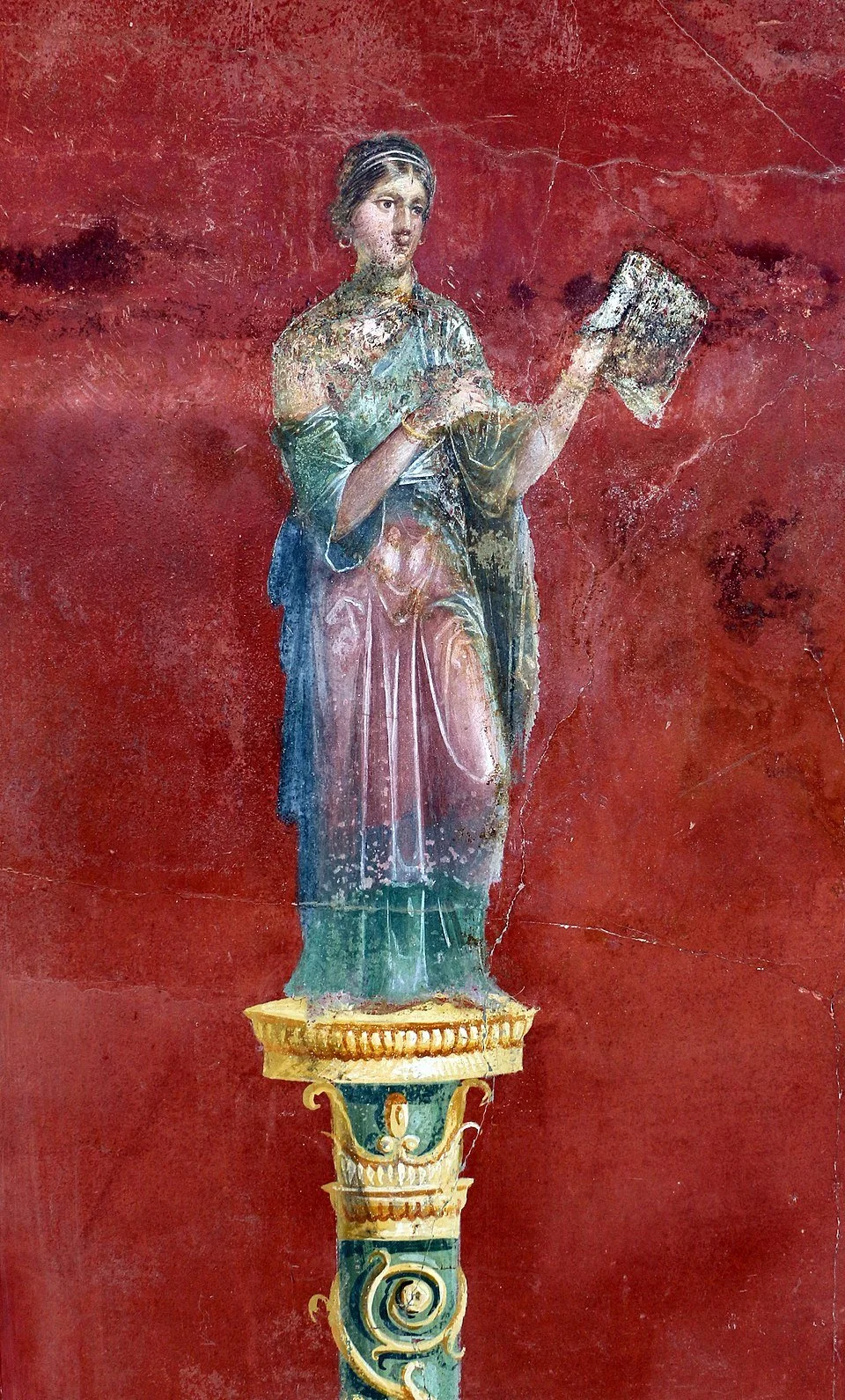
Clio on an antique fresco from Pompeii, Mount Olympus
“Lustration-water”
According to Simonides’ “Fragment 577”, as recorded by Plutarch, “there was a shrine of the Muses here [south of Apollon's temple at Delphi] where the spring wells up, and that is why they used this water for libation and lustrations, as Simonides says: ‘where the holy water of the lovely-haired Muses is drawn from below for lustration. Overseer of the holy lustration-water, golden Clio, who give the water-drawers from the ambrosial cave the fragrant lovely water sought with many prayers.’”
Pindar mentions Clio in his Nemean Ode 3. 10 & 82, invoking her lyre and supplicating her for guidance over his own writing. “Of song grant, of my skill, full measure,” said Pindar. “Strike, O daughter of the lord of cloud-capped heaven, chords to his honor; mine to wed them with the youthful voices and with the lyre . . . In your honor then, if high-throned Clio wills, for your proud spirit of conquest.”
Aside on lustråtion
Lustration, for me, tends to evoke the politics of Secret Police and surveillance files in former Iron Bloc states, as well as the political purges of former Party members carried out in the 1990’s and early 2000’s by the American “development officials” of what would later become the Hedge Fund Class before burgeoning into the absolutely unforgivable Real-Estate-Development Complex currently investing billions of US tax dollars in the unremitting genocide of Palestinians ….
Clio’s demise
A man, of course. Clio had the misfortune to fall in love with Adonis, the mortal man who also happened to be Aphrodite’s crush. In a fit of perhaps moralism that provided excellent cover to her own self-loathing, Clio openly rebuked the goddess Aphrodite for loving the mortal Adonis and thereby entangling human history in the work of the gods.
And so the fire was set: Aphrodite felt the rage burning outwards from the center of her being, leaving no surface untouched by humiliation. “Dishonor.” “Disrespect.”
The Olympians couldn’t bear the slights of “dis” — and so Aphrodite avenged herself by cursing Clio to fall head over heels for another mortal, a man named Pieros.
And Clio fell. . .
Somewhere between the earth and Olympus, Clio gave birth to two sons, both of whom remained unaware of their fathers. One son was named Hymenaeus. The other son, Hyakinthus, was the fruit of Clio’s love affair with Pieros. Later, Hyakinthus became the lover of Apollo and got killed by a jealous Zephyrus.
"Moreover Clio the Muse fell in love with a man, according to Likymnios, and some think Hymenaeus was her son."
— Licymnius, Fragment 768A (from Philodemus, On Piety)
To the Muse
Dear Cleo, I can’t complain about your absence
Nor excuse my failure to call you sooner
I mistook you for your sister and
Now I thank you both, you one Lady
who changes before my eyes
QUEEN LIONESS OF HEAVEN IN THE SUN
…tangle of a dream, a history
waiting while I sleep I grind my teeth
or waking I watch your closed eyes
film of gold hair across your cheek
a mystery
a tangle, my impatience, your wildness
this persistence of vision centered in my own chest
(the print of your ear on my skin)
Your presence…
I’m high! My brains foam
I can’t hear what you say
Quietly happily out of my mind
Madrones blossom on our mountain
Deer in thicket watch me pass:
Fawns and does,
Tawny and grey
Bless me as I walk along the fire-road
Who are the brilliance of that day
The glory of this night.
Philip Whalen
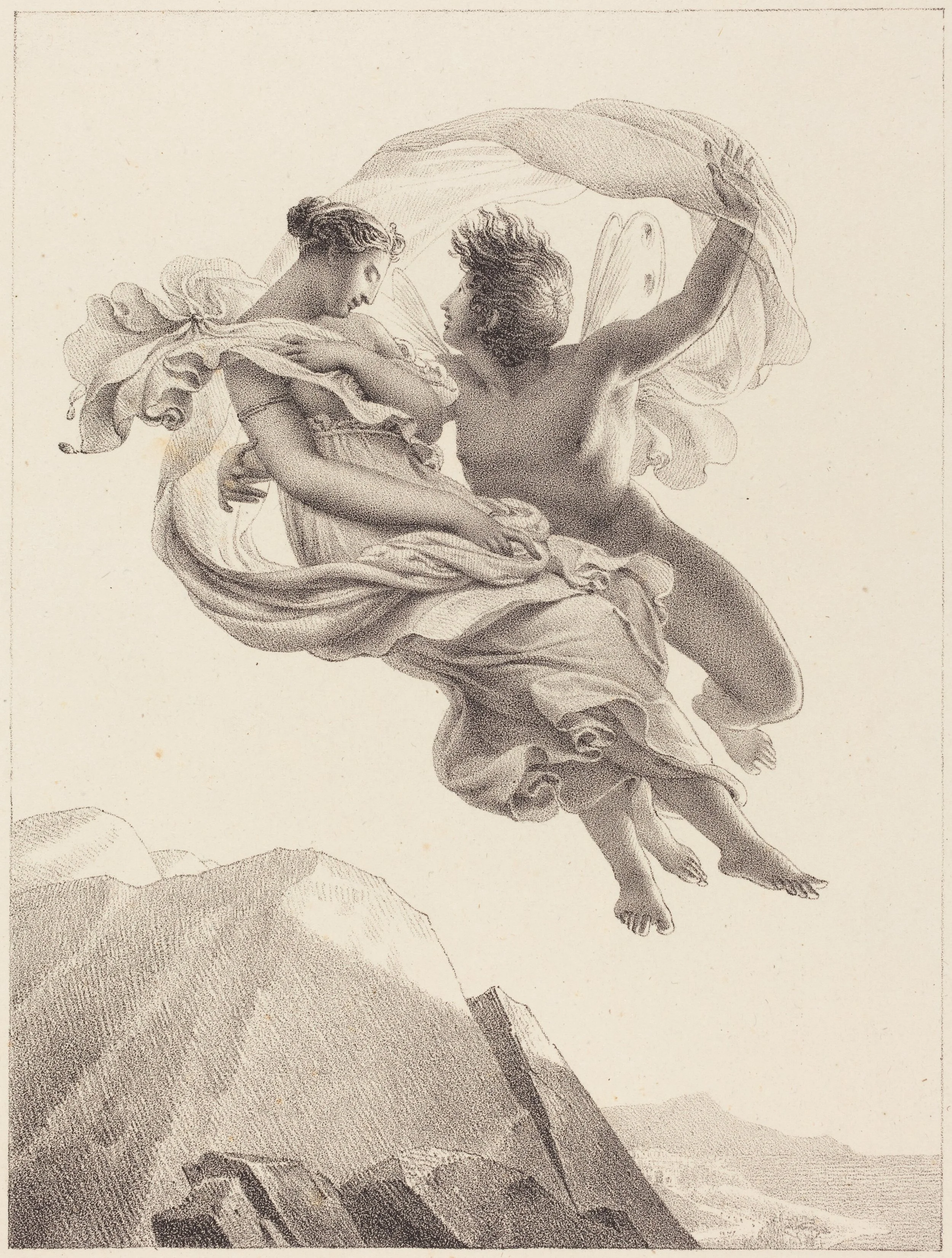
Pierre Claude François Delorme, Zephyr and Psyche (c. 1820)
“Clio . . . to thee, O Muse, has been vouchsafed the power to know the hearts of the gods and the ways by which things come to be.”
— Valerius Flaccus, Argonautica 3. 15 ff (trans. Mozley) (Roman epic c. 1st A.D.)
“Begin thou, unforgetting Clio, for all the ages are in thy keeping, and all the storied annals of the past.
— Greek lyric from the 5th century BCE offers various glimpses of Clio
*
Clio on an antique fresco from Pompeii, Mount Olympus (Wikipedia)
Pierre Claude François Delorme, Zephyr and Psyche (c. 1820)
Pindar, Nemean Ode 3. 10 & 82
Zephyr carrying Psyche to an enchanted palace, from "The Story of Cupid and Psyche as told by Apuleius" (Met)