static range is a mountain of voices: piled on top of each other, they are sometimes cacophonous, sometimes polyphonous.
— Himali Singh Soin
Now you all have seen hundreds of poems about roses and you know in your bones that the rose is not there.
— Gertrude Stein
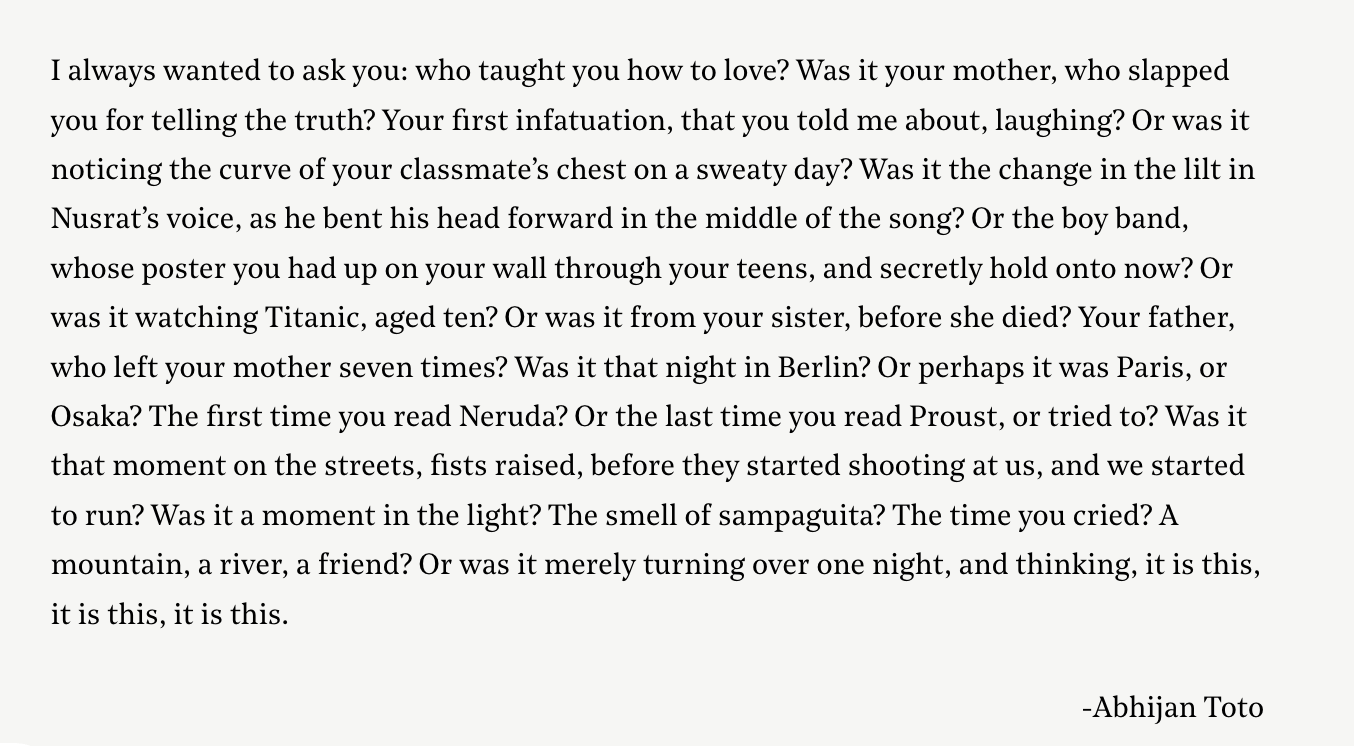
For * spring is dangerous like love and love survives the lovers *, Himali Singh Soin and Kostas Stasinopoulos asked friends to share messages, traces and transmissions of love.
The gallery description reads: “Inspired by a letter that a nuclear-powered spy device —installed during the Cold War and as yet missing— addresses to the patron mountain of the Indian Himalayas, Nanda Devi, this valley of notes makes transcontinental, cosmic trajectories in search of love. What it finds: loss.”
*
Eavan Boland’s Eurydice opens her silence in song, a counter-song if you will, to that of Orpheus’ lament, a lyric that gives us reason to believe that knowing one another is fundamentally impossible. The lovers lament different things.
Euridyce Speaks
How will I know you in the underworld?
How will we find each other?
We lived for so long on the physical earth
Our skies littered with actual stars,
Practical tides in our bay —
What will we do with the loneliness of the mythical?
Walking beside ditches brimming with dactyls,
By a ferryman whose feet are scanned for him
On the shore of a river written and re-written
As elegy, epic, epode.
Remember the thin air of our earthly winters?
The gas ring burned blue flowers.
Frost was an iron, underhand descent.
Dusk was always in session
And no one needed to write down
Or re-state, or make a record of, of ever would,
And never will,
The plainspoken music of recognition,
Nor mark how I stood at the window —
The hills darkening all around, saying,
As a shadow became a stride
And a raincoat was woven out of streetlight
I would know you anywhere.
Boland’s poem reminded of a wonderful essay by Jack Foley on Gertrude Stein’s portraits, and how he notes that time “is not only a subject but a condition of the piece,” a text which was also a portrait.
Foley thinks Stein deploys palindromes as a sort of mirror for which “the line runs out and then runs back.” The idea of recognition that Boland’s poem engages aligns somehow with Foley’s description of Stein’s palindromic relationality:
The first half is identical to the second half—except that the second half is backwards. She has a phrase in still another portrait, “A Valentine to Sherwood Anderson”: “Idem the Same.” The word “Idem” is Latin and means “the same,” so the two halves of the phrase are saying the same thing—but they are saying them in two different languages. Stein’s relationship to the people she makes portraits of is like that. She and Picasso are “Idem the Same”—the same but different; they are like words which mean the same thing but exist in two different languages. Together, they constitute a kind of palindrome; they are full of the same elements, but one of them is running one way and the other is reversing that movement.
Similitude meets me in my daily life as a lyric of resonating surfaces, or patches of sound that connect the world across languages, linking the experience of being as I apprehend it in the fluidity of Romanian and the more rigid, consonant-heavy textures of English.
An aside on miracles is due. For the word “miracle” comes to us from Old French and the Late Latin, miraculum, which means “a wonder, marvel” as well as mirari , which means “to wonder at.” And Foley adds that “the old Latin root is mir-, to look (at), esp. with astonishment.” It is this monosyllabic little root that leads goosebumps to pebble across my arms, mirroring one of my favorite verbs in Romanian, where mir appears usually in conversation as mă mir, drawing on the verb a se mira.
One of the valences of this verb is how it elicits a middle voice, a being that neither acts nor is acted upon. If it isn’t yet obvious, I should add that the Romanian word for “wonder” is mirare (see also minune, uimire, admiraţie, surprindere, miracol, surpriză, uluială).
There is a gap I love in this wondering. A gap like a tabernacle holding its secret intact as the sacred. This gap appears between the verb mir and the noun mir, which gets transformed away from the verb in Romanian. The noun mir refers to "holy oil, chrism, unction,” as used in the context of Eastern Orthodox blessings and rituals. There is no mir that means, simply, astonishment.
To resonate — once more — and inscribe this repetition with its root, when I searched for Eavan Boland’s poem online earlier this week, I found it on a wordpress blog run by someone who speaks Romanian. And maybe I, too, would know you anywhere.
“Miracles play. […] Let me recite what history teaches. History teaches.”
— Gertrude Stein, “If I Told Him”
*
Eavan Boland, “Eurydice Speaks” (poetry will save me)
Himali Singh Soin and Kostas Stasinopoulos, * spring is dangerous like love and love survives the lovers * (Serpentine Gallery)
Jack Foley, “‘If I Told Him’: Gertrude Stein and Performance” (Exacting Clam)
Patricia Meyerowitz, Gertrude Stein: Writing and Lectures 1909-1945
Spiritualized, “200 Bars”