ALINA STEFANESCU AND NATHAN KNAPP IN CONVERSATION
12/14/2004
A One-Act Play That Is Categorically Opposed to So-Called ‘Autofiction” & Anything Resembling the Metaphysics of Earache
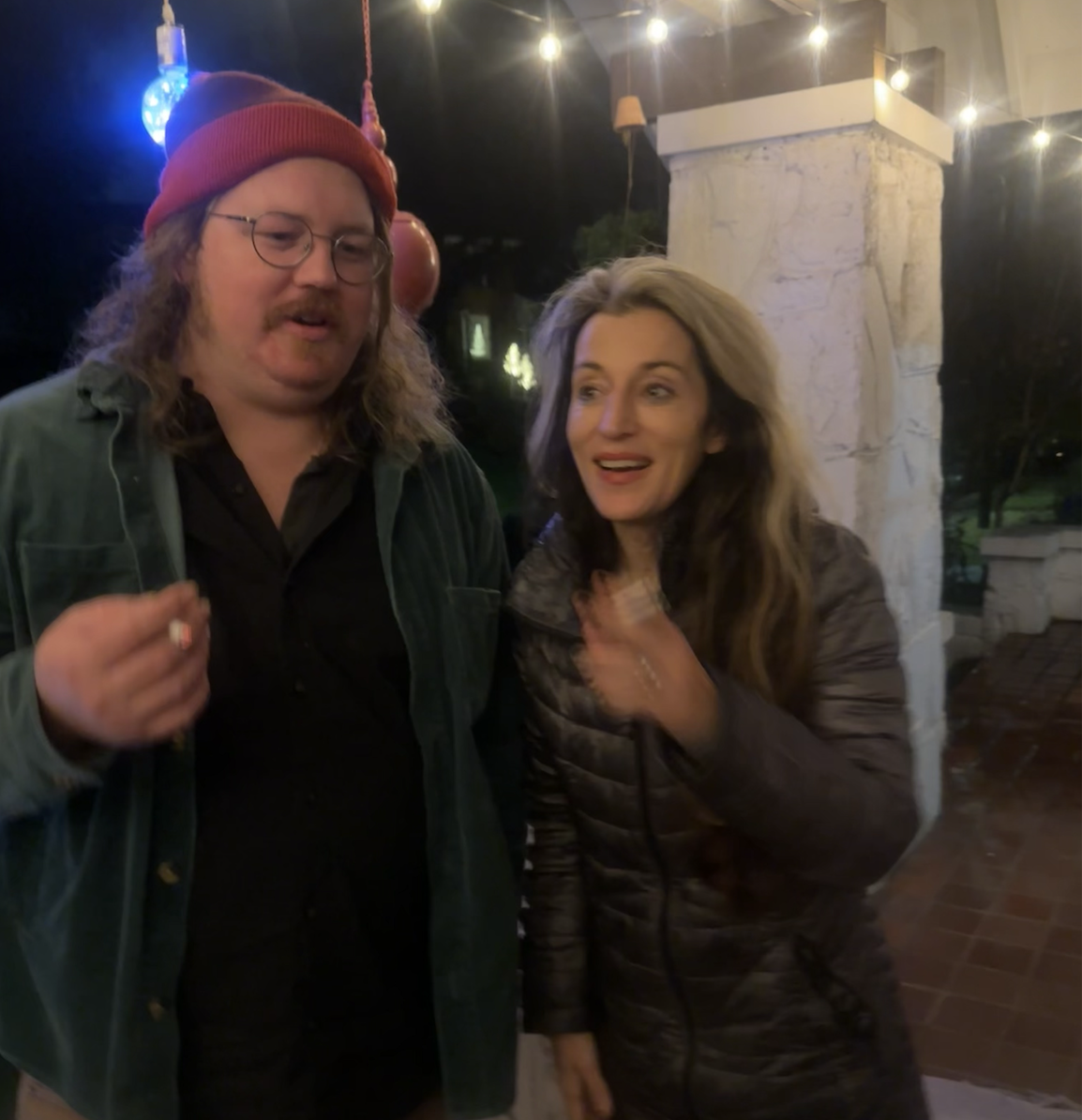
SCENE [Alina’s porch. A cool December night in the darkest depths of Alabamania. A party just ended. Whiskey in two glasses and wine in one. The smoke of many cigarettes mingled with rising woodsmoke. A’s man has just stoked up the fire in the outdoor porch chimney. Those remaining gird up their loins, settle into outdoor chairs.]
NATE: All right, getting into serious literary conversation now.
ALINA: I loved your tweet awhile back that mentioned that three words that you never use are trauma, traumatic, and creative. It made me think of Parul Seghal’s essay on the trauma plot—
NATE: Are we recording now? That sounded like it was your serious voice.
ALINA: I was curious about why you mentioned those three words.
NATE: Such an easy question. Right off the bat.
ALINA: That's all I've got.
NATE: I don't know, I try to avoid using the word trauma because it feels like it has had all the edges worn off of it in our culture. One of my best friends is a therapist, my wife is a therapist. I live in that sort of intellectual milieu a lot of the time. Trauma comes up so easily that it doesn't seem to have much if any meaning anymore, as a word. A lot of the students that I encounter where I teach, which is close to a military base, have served tours of duty in Iraq or Afghanistan or both, and when they talk about PTSD, a lot of the time they're talking about something very different than the way that the word gets thrown around these days. As far as my dislike of the use of “creative,” I was talking about how it makes me angry when it gets used as a noun, not as an adjective. I feel like the idea of “the creative” is just another way to devalue actually making art. Maybe this is a bad answer to the question.
ALINA: [stares at a moth moving in circles and tracing an aureole in the space above Nate’s head] Amazing.
NATE: Maybe I’m too aware of the fact of being recorded to actually give a proper answer—
ALINA: —because I'm holding the recorder up to you. [Alina puts down the recorder.] So now it doesn't feel like you’re on trial!
NATE: It infuriates me when language is used as a mask for reality. When language is used as a mask for what is actually being talked about. I think I mentioned this on twitter too recently, the way that AI use is talked about as this alternate to doing your own writing when it's really just a new version of plagiarism. But while there’s no profit in the word plagiarism, there may be in this new thing called “AI use.”
ALINA: I’m hearing the word “creative” as a rebrand here?
NATE: Yeah, it's a rebranding. You know you can fire everybody who used to actually be creative and replace that person with a creative. This is also how a university can replace everybody who actually has the kind of job where they teach a couple of classes, and then have enough time do their own artistic work. To get around actually having to fucking deal with real artists, who are increasingly a kind of anathema in our culture, you instead prioritize creatives, who as a rule aren’t interested in this thing called art. The creative serves capital and that’s it. I've been reading Chateaubriand’s memoirs lately, and could help noticing how he mentions the word casualties being used about people killed in the French Revolution. I may be remembering this incorrectly, but it inspired me to go look at where that word came from. Casualty, a word for a killed or wounded person with the word casual buried in it. I wanted to know how we got from killed to casual-ty.
ALINA: Right— ‘collateral damage.’
NATE: It's much easier to say we suffered eighty-nine casualties today than we had eighty-nine people were fucking ripped apart and killed today. Easier to say eight Gazans died yesterday of malnutrition or a so-called accidental so-called airstrike than to say four babies and their mothers were slaughtered in their beds by the Israeli war machine. This kind of debasement of language both covers over and leads to the debasement of humanity. It’s disturbing. On a much different note but in the same ballpark when it comes to the use of language, it’s easier for a university president to use the term AI use than it is to talk about how plagiarism is running rampant on college campuses. A creative can benefit from AI use—potentially—but an artist can’t. If they have any self-respect, they know it.
ALINA: In my late teens, I visited the Vietnam Memorial to DC. A few men were sitting in lawn chairs next to a sign: Vietnam Vets Against the War. The vets led me to Howard Zinn. Those names on the wall trembled, shifted, became lacunae about empire. Each name had a person buried inside it. Nobody spoke of them as people who had put themselves in a position where the only thing they could do without being declared a traitor or an enemy of a nation was to keep going forward. Among the stone monuments, I felt the power of systems, and heroism, exemplarity, resume-building . . . What we construct as “success’ became horrifying. To love the world, I had to become a pesso-optimist.
NATE: What you're saying about these names and the power of names and naming reminds me of something I write about in my novel. One of the scenes in Daybook is about going with my kid to the Confederate cemetery at the battlefield in Franklin for the Confederate dead. Instead of proper headstones with names and dates—in part because such a spectacular amount of Confederate soldiers were killed in that battle in the space of little over an hour, well over a thousand men just absolutely mowed down like grass facing a lawnmower blade, this necessitated first burying them where they fell and then reburying them later a few hundred yards away—this particular cemetery just has blocks in the ground with initials on them, grouped around the various states that the soldiers were from. There are no names, and the starkness of that is striking when you walk through that cemetery. I don’t write about this particular aspect in the book, but I later learned that one of the soldiers buried there was a Chinese immigrant who fought for the south. Not the kind of Confederate soldier that first comes to mind. But he was a person, a person caught up in an enormous and doomed fight that is usually framed in the popular imagination as being a pitched conflict between two very clear ideological perspectives, one based on enslaving black people and one based on the idea that all people should be free. While there is definitely some truth in that way of looking at the war as a war, to do so ignores the fact that individuals took all the risks for one reason or another. A Chinese immigrant would seem to make a very unlikely Confederate soldier—but for one reason or another, he was one.
ALINA: You know, we have a powerful need the belong. When I was young, my parents would put up the flag a day earlier and take it down a day later than everyone in the neighborhood for the Fourth of July.
NATE: Why?
ALINA: Because they were defectors and they needed to prove that they were American enough. And when you mentioned these immigrant names,I think about the longing to be “of”, the hunger for belonging. We seek validation through this idea that we can belong to a group. And when we talk about nationalism or Trumpism or ethnostate ideologies– we open the darkest box of the human heart. How do we as writers—your book is so much about the loneliness of the writer—well, what's up with us?
NATE: I’d much rather you answer.
ALINA: I’ll pass on this dildo, to paraphrase William Gass.
NATE: I don't know about this dildo. Can you rephrase the question? What's up with us in which sense?
ALINA: How do we resist the urge to belong? Like, what is it about in your book when I read…when I read the desire, your book? And this is related to the difference between minor literature versus the mainstream, because I think bestsellers want to belong and do belong and create the conditions for belonging and mimic the terms of belonging—
NATE: Sure, but about the dildo—
ALINA: —whether religion or sports team or fan culture or whatever sense. Your book doesn't give us a solution for belonging, doesn't ever belong, the speaker doesn't ever belong, and I'm interested in what it is that enables or creates the capacity in a human being to give up on that.
NATE: I don't know. I don't really feel like I ever have belonged. Not that I think I’m special in that sense. Almost everybody feels this lack on some some level—and I’m curious, too, about some of the ways in which you talk about this in My Heresies, like the poem where you talk about the rapture/Left Behind craze and how someone tells one of your kids the antichrist will be Romanian.
ALINA: Ha ha. Poetry is a constellating medium of thought for me. I was thinking about how Tim LaHaye and Jerry whatever, the authors of the Left Behind series, really testified to literature’s capacity to shape social change and ‘revelate’ new interpretations of scriptures in the novel. Left Behinders believe they are “chosen” – and this idea of chosenness is the source of every originary ethno-supremacist myth in the Balkans – so you have one group that has been chosen to occupy a particular geographic land by some transcendent being. . . and who can argue with a god? No evidence or reality can challenge that fiction. Social conditions aren’t simply reflected in culture representations. Social conditions are also developed and normalized by those fictive representations. The dynamic between facts and representations isn’t cold or set: it’s hot. It keeps moving. So, how do specific social representations become influential and internalized? Publishers, academics, patrons, and institutions pad the influence pathways. The media monetizes the performatives and passes the new myth along. The story is absorbed until that description becomes a usable fiction, one that finds recognition more broadly and becomes heritable. The birth of the national “self-image” competes with the religious icon in art. Look, your antichrist is the story you tell about the story that makes you feel “safe.” But feeling ‘safe’ isn’t compatible with thinking. Since Dante, the poet has been tasked with describing the inferno. I pledged myself to describe the corridors of the present through the eschatological hunger that constructs hell?
NATE: Are “the corridors of the present” where the dildo went?
ALINA: What dildo?
NATE: The one that you said belonged to William Gass.
ALINA: No, it is in New York now—paving the way for vital new work in the so-called corridors of the present.
NATE: That is a tough one. Let us hope so.
ALINA: Yes. But you were talking about resisting the urge to belong.
NATE: Right. I’ve never been interested in it. The people that raised me weren't joiners and I’ve never been one either. Most of the people involved in any particular group or pursuit or scene are either profoundly mediocre in any case. As the old cliché goes, I wouldn't want to belong to any club that would have me, and I've always lived for the most part outside of the so-called literary community. For a long time I felt really angry about the fact that I couldn't sell my books even after I got an agent. It felt like New York wouldn't have me.
ALINA: But was that anger good for you? As a writer?
NATE: Yeah it was, it was because it was like, okay, I'm going to do my own thing.
ALINA: You gave up, you stopped trying—
NATE: Exactly. Stopped caring about it, stopped trying. But even in towns where I've lived—not the Capital L Literary Community, but the smaller ones, I've never really wanted to be a part of them either. No interest in being part of a group. And I think that goes back to the fact that I was raised in this very, very insular version of Christianity, where I was part of the group, and even that never felt good.
ALINA: Do you think it's because you were aware of the conditions of being part of that group?
NATE: Yeah, that they’re de-humanizing. The conditions to be a part of a group are always dehumanizing.
ALINA: [nods]
NATE: Which is the thing that brings me back to Gombrowicz over and over again because that's what he talks about. To be with other people in a group setting–to fit in–is to give up who you are. To deny who you are. Can’t avoid the suspicion, which definitely comes from my childhood in evangelicalism, that to truly become a functioning part of a scene or something would mean to cease to be myself.
ALINA: This makes me think of my favorite book by Thomas Bernhard, My Prizes.
NATE: I adore that book.
ALINA: The reason I love My Prizes even more than I love his memoir, which I love so much—
NATE: Gathering Evidence is my favorite of his!
ALINA: When I read the memoirs about how much he loved his anarchist grandfather, I understood Bernhard completely, in some way. That said, My Prizes does an incredible job of pointing out exactly what it is in literary "community” that asks us to accede, to give up, to in a way to, um, to perjure ourselves, right? I think we forge—
NATE: Perjure?
ALINA: Yes.
NATE: That’s an interesting word—
ALINA: I think we forge…hold on, let’s go back to your last name. Knapp. What did you say [before the play began] that it means in English? I think you said it refers to a blacksmith?
NATE: Sort of—it means to work with stone.
ALINA: So to work with stone, to forge something, but to forge something also means to fake something.
NATE: Well, in the original old English sense the sense is not to forge, but to make a tool.
ALINA: To make a tool, right. My dad is a metallurgist, and he talked about forging steel a lot. I used to wonder if he knew it also meant forgery, or faking it? For me, as a child there was this physical love of language that gave me goosebumps when my dad said, “I forged this steel.” As a writer, were there moments in your young days when you recognized that your relationship to language was different from other people’s?
NATE: Not my relationship to language, that came later. But my relationship to stories and the fun that could be had with them—that was very early on. That and the deliciousness of being in another person’s world, inside another person’s head, another person’s life. But my relationship to language in terms of being conscious of language itself came a lot later. But I say that in terms of a writer’s conscious relationship to language. My people on the mom's side where I grew up, in far southeastern Oklahoma, have one of the most particular ways of using the language that I know of, they speak in a dialect and accent that exists outside of the norm even for southern-leaning English speakers. When I first brought my to-be wife, who’s from the pacific northwest, to meet my grandfather, she could barely understand him.
ALINA: Wow.
NATE: It's very particular. Or maybe I mean peculiar. It’s a variety of southern accent, I can imitate it later [thankfully, he did not –ed.], but I was aware early on of there being something interesting in the relationships that obtain in the sounds of words, because my dad, who came from a different part of the state, didn't speak with an accent and I don't speak with an accent—or at least for the most part no longer do. In any case, paying attention to language as a writer came a lot later. Long after my interest in storytelling, which is a bit odd to me now because I don’t particularly care about storytelling anymore except in the sense that one’s use of language in telling the story influences that story and vice versa. The one influences the other but language tends to arrive first.
ALINA: The wind is blowing in your hair. There’s no way the interview can convey the way the wind is blowing your hair right now.
NATE: If you want it to be in the interview, you’re going to have to put it in [laughs]. Like at the beginning of the piece you could say something about the wind blowing—
ALINA: Like it was like a Bon Jovi video, but not—
NATE: I think if you describe it that way in the published interview I would come back down here to Birmingham and kill myself. In your house.
ALINA: [Laughs.]
ALINA: Okay, but back in the 1900’s, there was a roundtable: Grace Paley talking to Donald Barthelme and Walker Percy, all three yapping about modern literature, or what it means to be modern, with Donald and Walker complimenting each other. (Grace didn’t get to say much.) At one point, Percy said, um I really don't know anything at all, and Barthelme was like, yeah, me neither, and there was this moment where you could almost hear the audience’s horror that we were in the twentieth century and writers were failing to tell us how to live the future. Does your writing aim to teach us how to live?
NATE: No.
ALINA: Why bother then?
NATE: I am hostile to this question because I feel like it will show up in the interview.
ALINA: It will. I promise.
NATE: Ugh.
ALINA: [waits].
NATE: I write because I have to. And because I become extremely unpleasant to my family if I don't.
ALINA: Tell me more about that unpleasant part. Why are we like that? Why are we shitheads if we don't write, and also when it's not going well. What is wrong with us?
NATE: I think maybe it's just the only really good part of us. I don't know if that's not true either. None of that stuff is true.
ALINA: Will our kids hate us for it?
NATE: Probably. Hopefully. If we do it correctly, maybe, I don't know. But I feel like I'm giving bad answers. Do you think they will?
ALINA: I hope so. Part of me hopes so. But how can we know? And how can a “right” answer exist given the construction of good, which is pure pop and easy product for the Self-Help Industrial Complex. . You mentioned your wife was a therapist, which fascinated me because—
NATE: She was a therapist before she died. Yes.
ALINA: What?
NATE: I said that because you mentioned her in the past tense.
ALINA: Are you fucking with me here?
NATE: [bahfaws…]
ALINA: What the pseudo did you just do?
NATE: [lights cigarette]
ALINA: Your wife is a therapist, Nate!
NATE: She is, that’s true.
ALINA: And that fascinated me because your writing in so many ways to me—or what I appreciate about it—is the way that it really debunks the value of the therapy both in this room [gestures around porch] and/or or history. I don't mean to start anything here.
NATE: Sure.
ALINA: But as someone who has been told many times that she needs therapy [laughs maniacally]. Sorry [chuckles maniacally .] There’s no way to describe that laugh in an interview, is there?
NATE: Not unless we go to New York to find our friend.
ALINA: It is, alas, too far.
NATE: We don’t do this—writing, that is—to actually make ourselves feel better. Because it doesn't. And if there is any value in therapy or the kind of art that results in therapy, wouldn’t it make you feel better, at least eventually? The therapists in my life would probably hate that answer. I think that part of the trouble with therapy or the art that attempts to act therapeutically, is that both lead you to a set of easy answers about who you are and how you are, and I think the interesting thing about art is that, if it's any good, it leads you to places where you don't know the answers to those questions, and so you ask another question, and if the art is any good, it leads you to another question and it continues to befuddle you. So if there's anything that's wrong with the culture of therapy or art as therapy, it's that—the pursuit of and eventual arrival at answers. And so I think that good therapy if it exists, and I hope that it does, and good art, if it exists, and you can put that in italics [I did—ed.] and I hope that it does, if it is leading us anywhere, it's leading us into a further set of questions. I should also say that I think that my friend who’s a therapist would say that that’s exactly what they’re trying to do in therapy, though.
ALINA: Which reminds me that Freud wanted psychoanalysis to be something that opened more doors than it closed. Reading Freud is like reading a story of someone who suddenly became beguiled by power, or proving that what he was doing was a science. And when he decided that it needed to be a science in order to be authoritative is when he stopped settling for questions. There is a relationship between closure and the articulation of definition, the urge to be definitive. And this reminds me of what we see in narrativity, in the context of literature and life—this consistent discomfort with an incapacity for us to generate closure. There is no closure that isn’t a coffin. Closure is death.
NATE: Well, life is run by idiots and so is literature. So, that makes a lot of sense.
ALINA: You put “life” in quotation marks. In scare quotes.
NATE: I put life in quotes, because life is ultimately lived in the individual sense we talked about earlier. But not literature. Literature, in the publishing sense, really is run by idiots, don’t you think?
ALINA: Right. That’s why minor literature matters more. Because it risks more. It risks the lack of closure, and — in some cases — makes insatiability the condition of the text. There are so many levels of address within a single work, and that experience of polyphony in an echo-chamber thrills me. It massacres my brand! To live the selves one writes as a possibility, or as a foreclosure of expectation. We are never ‘finished,’ so to speak. Minor divines differently.
NATE: I don't know, I write major literature.
ALINA: You say that. What I love about minor literature is that it has no pretension to being major. Something happens when we want to become read by many. There is something that happens to the monumental arc, something that riddles the narrative, something that steps in the same river twice and hides the river in the flood of language. John Ashbery alluded to it in Three Poems, when he said “As soon as it was not looked at it ceased to exist.”
NATE: You write in My Heresies—this is one of my favorite pairs of lines in the book—that “Near the cost of knowing lies the sin / of being known.” I think part of what we’re doing when we write relates to this desire to be known and yet there’s a massive distance between the writer and the reader. And in some cases maybe we write not so much out of our desire to be known but rather out of our fear of being known. And you even call it, here, the sin of being known. Can you talk about how this relates to who you are as a poet and writer?
ALINA: You mean the fictions or the facts? There is a cicada near your sneaker and maybe I’m the orange notebook that tries to make Leo Bersani’s critique of “the culture of redemption” go to a drive-in movie with Heather Love’s insistence on maintaining “the imaginative function of criticism” alongside its critical function in order to resist the temptations of emptiness presented by politics of optimism. [picks up her orange notebook and starts flipping through it as Nate tries not to fall asleep] There, at the drive-in, when the culture of redemption goes to relieve itself in a Port-a-Potty, I am the Jesus that appears in that tomb for piss. “Noli me tangere” Jesus says to Mary Magdalene as she stands in the presence of his resurrected body. And what does Mary do with this secret? What did she feel in that moment when death unlooms itself from the world of evidence? According to my notebook self, Mary said: [reading directly from her notebook now as Nate plays with a dog toy] “Don’t touch me because I cannot be what you need. Don’t touch me because this touch will render me no longer real to you. Don’t touch because asking for verification of what you know as I stand here before you in my impossibility– which is also the truest form of me, the form that constitutes me– would be a betrayal of everything that exists between us, namely, the intimate relationship that makes it possible for you to see me now, a relationship permeated by longing and extraordinary trust. All beauty and tenderness inherent to longing is built on this unstable, impossible trust in the Other’s alterity.” [looks up from the notebook and cringes] But when the movie ends and I am no longer the notebook, then I’m simply another human in Alabama who can’t sleep because she desires Mary Magdalene and wants to be close to her, to be unsettled by her, and to feel more alive in this desire that hinges on encountering an Other so different and external to myself. This is what it would mean to eroticize historical alterity. The sin of being known is tangled in the sin of being and desiring and imagining. I just want to be the pen ruining the paper at the impossible drive-in.
NATE: There are only two things that I want to do as an artist. I want to make people feel really bad—
ALINA: —Cheers. You did that for me. I felt awful. Let’s re-enter the river that began when I started recording this and you worried about giving a “bad answer.”
NATE: And then I want to make them laugh about how bad they feel. That’s it. I don't want to teach anybody anything.
ALINA: Don’t be sad, Nate. I learned things from Daybook, felt horrible, loved it. I can’t wait to stand by the ocean with Jesus and the philosophers in that scene from the forthcoming thing. It would be fabulous if it won a prize.
[Glasses are refilled. New smokes lit. End scene.]
*
Emile Habiby, The Secret Life of Saeed: The Pessoptimist (t. by Trevor LeGassick and Salma Khadra Jayyusi)
François-Réne de Chateaubriand, Memoirs from Beyond the Grave: 1815–1830 (t. by Alex Andriesse)
John Ashbery, Three Poems
Parul Seghal, “The Case Against the Trauma Plot”
Nathan Knapp, Daybook
Thomas Bernhard, My Prizes: An Accounting (t. by Carol Janeway)
Thomas Bernhard, Gathering Evidence: A Memoir including My Prizes
The Weird Show on “The new wave of collage”
Tim LaHaye and Jerry B. Jenkins, The Left Behind Series
Witold Gombrowicz, Diary (t. by Lillian Vallee)