To comprehend is not to clarify, simplify, or reduce things to a perfectly clear logical scheme. To comprehend is to complicate, to augment in depth. It is to widen on all sides. It is to vivify.
— Lucien Febvre
The irreverent refuses transitional states; there is no between but like a quantum always here and there, such a perfect waitress. One if by whirlpool, two if by monster.
— Dean Young
A poetics of ongoingness
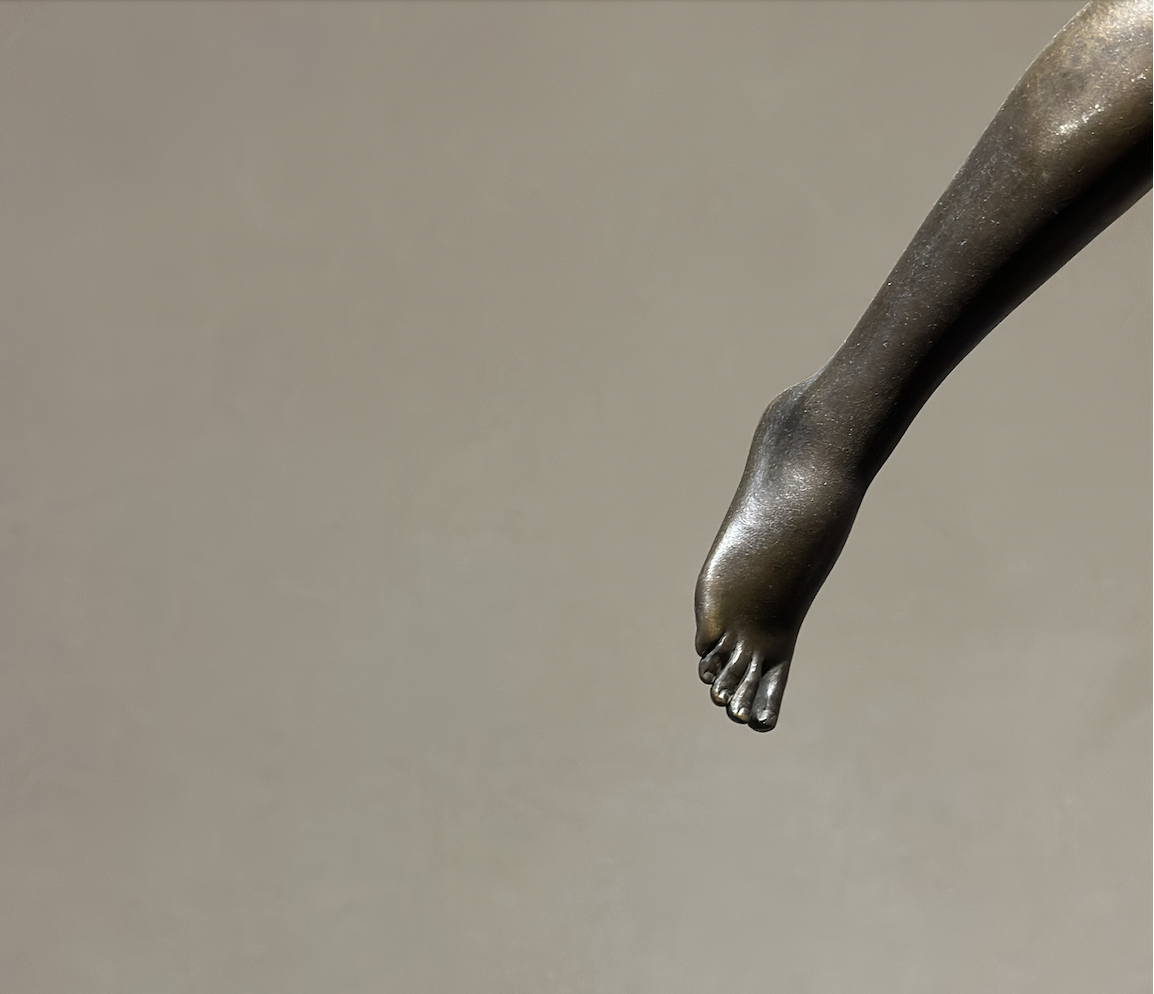
Like the foot of the statue in a museum, detached from the conditions of its existence, my poems are heedless and clumsy in their ongoingness. Rather than settle for the whole’s solidity, they loose their sandals in stanzas and then limp into couplets unshod, seeking the shadow of a willow in the ego of Max Brod.
On a recent roadtrip, I returned to Dean Young’s book on poetics, The Art of Recklessness, and frolicked a bit in his wrecks— for kicks and pretzels — or just to wrap my mind around his paradoxical lightness.
He made the following distinction between “ecstatic subjectivity” and “pathological subjectivity”:
Ecstatic subjectivity as articulated and extended from Surrealism (although not exclusive to it) takes the fragmentation of self as an opportunity for energetic release as well as a vehicle for new, usually temporary reformation. For the surrealists, change in consciousness did not have a static, finalizable goal; it was not achieved so much as ongoing, an increased volatility and receptivity, the making of instability into a positive trait, a ready resource constantly renewing the possibilities of life, self as fluidly imaginative. Disjunction signals psychic tectonics in which the destructive, the desecrating, is inseparable from the generative.
And then he enacted it in the next paragraph:
The blood may be fake but the bleeding's real. My self is constantly disrupted, constantly re-centering, regrouping with each experience, when I meet one person's eyes, when I meet another's, how else account for that voltage in those eyes meeting? Rather than seeing that process as brittle, as cause for crack-up, it may be conducted as music, as lightning if we are limber and cultivate a nimble awareness and receptivity that welcome and exploit such occasions: an act of the imagination. The self is always under construction, it too is an aesthetic creation, and the world is always offering up materials for garden and blast. If there is divinity in us, it is in the process of allowing ourselves to unmake and remake ourselves.
Like others inclined towards surrealities, Young drew from quantum mechanics and particle physics for his figurations and poetic cosmologies:
A cartoon by Saul Steinberg shows a man at a drawing table. The line that his pencil is paused at the end of loops back and is, in fact, the line of the drawer's body: the drawing creates the artist who draws it.
Every poem creates the poet to write it. A poem is written by somebody who's not the poet and addressed to somebody who's not the reader. Who the poet is as opposed to his usual self is sort of interesting. Because the usual self is very often just the usual self.
Poetry is a transference of energy between poles. Poetry's task, if it has one (we must be suspicious of any claim of task), IS to mitigate but to mitigate by way of accelerant: it too becomes primary in a range from rivaling the world to near exclusion and/or creation of it, to a humble transparency that adds nothing but clarity, the way a very clean window can add luster to a gray day it looks out on and frames. Some impurities can make water clearer.
Poetry is no more a thing than fire is; rather it is a conversion that reveals itself in the instance of its occasion. Poetry mitigates just as fire does, by witnessing its own necessary recklessness and senses of the sacred, its ability to combust the ancillary, to grow and make everything itself even as it confronts us with the outcome of its conjugations, with ash, with death.
Let us not forget that the punishment for the god who gave us fire in a hollow reed (already fire was singing) is eternal evisceration. Aesthetic positions are often drawn toward their own extinction, be it through the impossibilities of their aims or the ruination brought about by their success.
Signed by spitbite
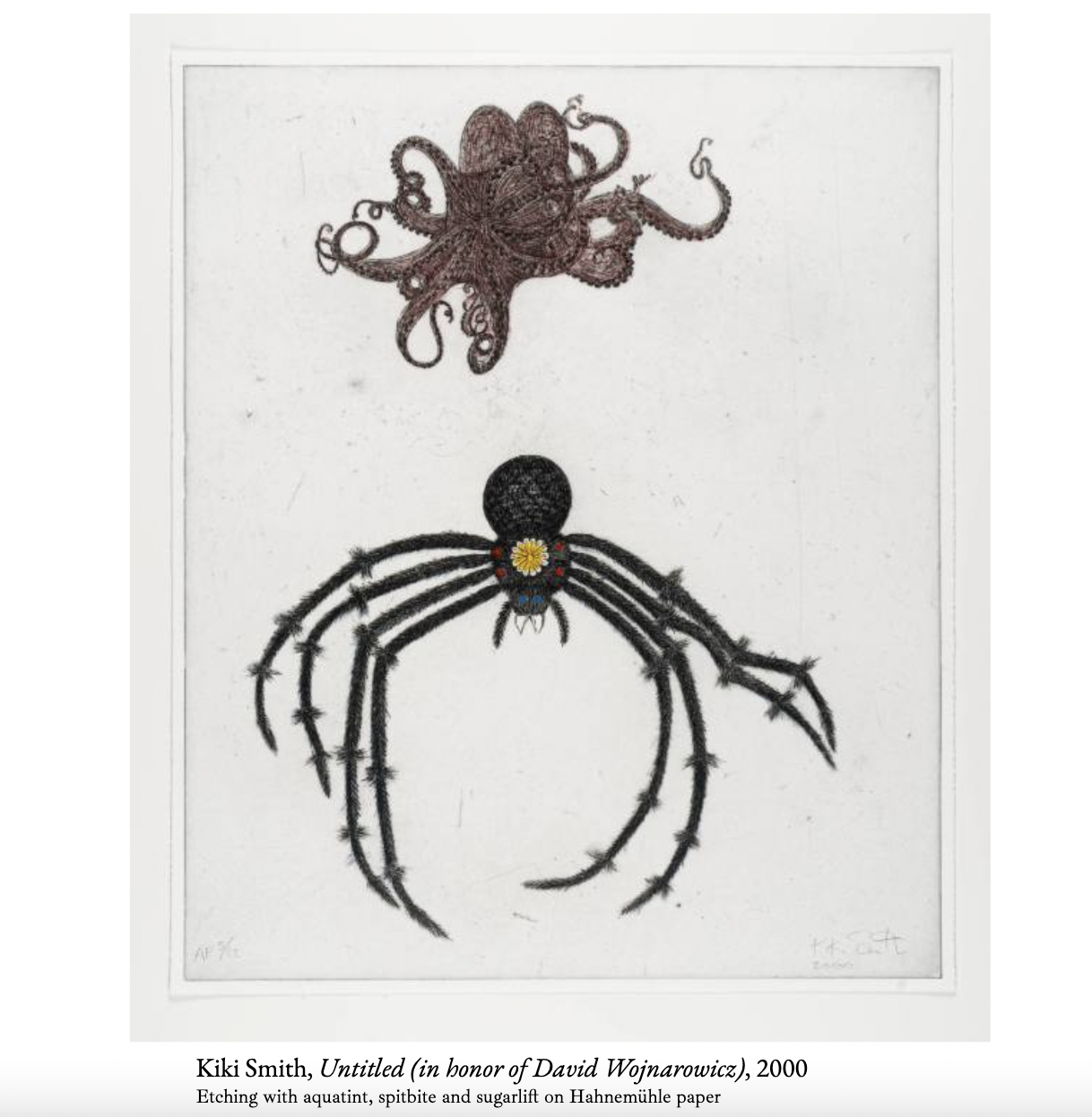
Speaking of fire singing, I love how Kiki Smith’s etching honoring David Wojnarowicz was aquatinted with spitbite, a tender and personal touch resembling that of the gods who allegedly created man to stand upright by mixing his saliva with dirt and dust. Tenderness and beauty in the curling arms of the octopus hovering like arabesques above the dangerous and yet cheery spider.
Source: Blanton Museum of Art
Kiki Smith plays as she grieves, and keeps alive the shadow of the trickster in her homage to David.
Like Kiki, Dean was a connoisseur of errors who drew on the importance of play for situationists, noting how the “de-tours, undermines authority with laughter, deranges the claims of advertising to monkey business” and “opens itself to the glimpsing of mortal messages that are not exempt from the anarchy of life. Instead of the ideal, we have the body”:
In “Preface to a Modern Mythology” in 1926, Louis Aragon states that “Certainty is not reality,” arguing that every certainty bases itself upon the error of some previous certainty. All we know for sure is this steady progression of errors so that we “elaborate a changing and always evident truth” yet ask ourselves “why it never seems to satisfy.” Error, however, “with its unknown characteristics.. demands that a person contemplate it for its own sake before rewarding him with the evidence about fugitive reality that it alone could give.”
“There is always eros in errors,” Dean added. And so he embraced profanation as a possibility. And he urged irreverence as a means into the thing we have reified. Irreverence is simply the mixing of things that convention prefers to keep separate. Like Frank O’Hara, Dean relished mixing his rhetorical registers and dictions.
What we need is recklessness and an owl-shit outburst and a good smack upside the head every now and then. I, too, am a creature of electrified lint; give me a doily and I'll blow my nose on it, and I mean that in the best possible way. The poem is here to be defied. I almost typed “deified”. When I typed “good student” in a letter of recommendation, it was very very hard to change. The irreverent welcomes its own desecration; it has no obligation to the truth (because there are too many to be obligated to), only to clear a possible space where new truth may appear.
Sweeping, sweeping the temple steps is all you can do when hoping the god will appear. An onslaught of severalness within the asylum of singularity. He was driven crazy by the way people drive.
The irreverent is the irrelevant's revenge. Inclusions are always the greatest risk. Skirmish of daffodils and dragonflies. The giraffes go knock-kneed to drink. Consistency is the triumph of insects. The irreverent is cracked in the plinth and therefore can sustain no monument, no argument, no politics. Surprisingly, some ducks have bigger penises than gorillas, and how do you think that goes over in the ape house? Do you doubt for an instant the ancient Greeks would have availed themselves of rhinoplasty and liposuction? The antidote to venom is venom, it's just a matter of context. Under the shroud, the thong.
The irreverent can never be maintained, it's always its own debacle, in crisis of its own discovery and obsolescence. Stop me if you've heard this one. Can I get you a number of drinks? Inclusion is always the biggest risk.
Coyote trots on the edge of the abyss. What can't be made more beautiful by an out-of-order sign? Finally, you can only trust yourself and you can't trust that nitwit either.
“The problem with being comprehensible”
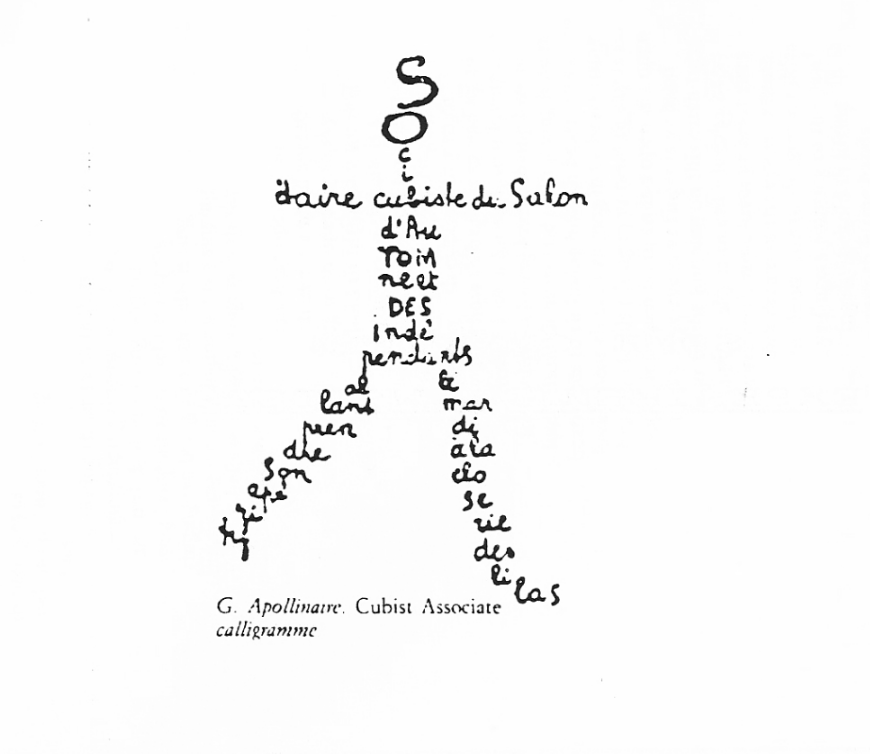
“Life is not a dialectical idea, it’s a lived contradiction,” said film-maker Agnès Varda.
“When the man and the woman lie on their backs, with one of the woman's legs across the man's belly, it is the broken mirror,” wrote André Breton and Paul Eluard in (or of) “Love”.
“Most reckless things are beautiful in some way, and recklessness is what makes experimental art beautiful, just as religions are beautiful because of the strong possibility that they are founded on nothing,” John Ashbery mused in “The Invisible Avant-Garde”.
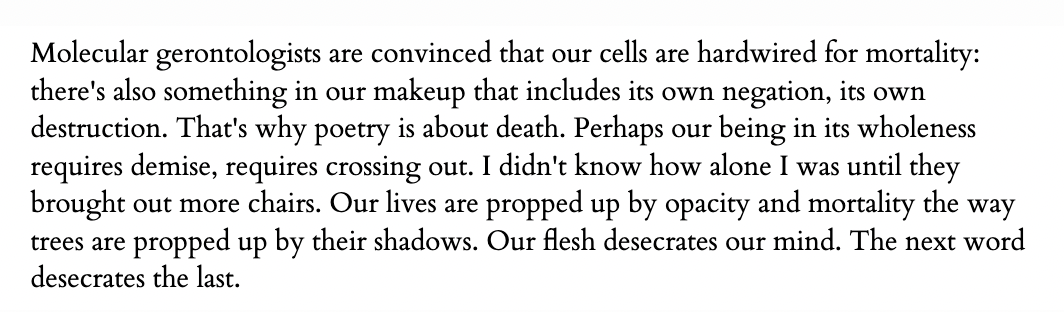
“I didn’t know how alone I was until they brought out more chairs,” Dean Young said, in a section titled “The problem with being comprehensible.”
He touches on wiring:
The poem must do more than complete or fulfill: it must defy the given order that makes us feel comfortable. Or secure.
More than anything, we want to feel safe, and secure in that feeling.
Our sense of security warms its feet by a fire that thinks it knows what needs to be known. Warmed by prediction and the coziness of predictability, we reify contingent things as if they are known and graspable. But what exists is always in dialogue with what may be otherwise. Poetry knows this better than prose, I think.
To quote Dean again:
To be only comprehensible is to be fully known is to be already seen, predictable. The next poem must shake us, must wake us, must entice us toward the denied, the disallowed. It is what wasn't. Someone had erased a YES out of the charcoal Nos. The new is always scrawled over the old. Anything fully known offers us no site of entry, no site of escape, no site of desire. In the morning we mistook the roofers on the hill for flames. Desecration is the mix of opposites, that field of contact, the tear that draws us. [...] Some of them chased each other, some of them fell to the ground. Coyote vanished into the smoke. The clash of the seen with the unseen, the broken seam, the unmasked with the masking that amazes us, sticky-out red thing, outrages and liberates us, embodies possibility.
This possibility inheres in each word. Increasingly, the word “content” appears as noun that designates slop or world-salad spliced by the energy of bots. I miss the gist of light happiness of in it, miss the absence of contentedness as a cultural frame of reference, miss the slower pace of time prior to the hustle-economy.
And I was made even more of this missing in Washington DC last week, with only a few hours to spend exploring the National Gallery of Art, trying to find a place to squat and scribble notes in my notebook.
“I think one could spend one's life having this desire to be in and outside at the same time,” said Willem de Kooning, “content as a glimpse.”
Content as a glimpse— yes. This is the content I dearly miss.
The idea must be unfixed from its iconostasis. One must unhinge it a bit.
In my re-bumbling through translations of Paul Valéry, I came across this elegy from a notebook dated 1932, a year when Paul was close to Renée Vautier, the sculptress who also prompted him to write one of his unforgettable dialogues, namely, “L'idée fixe.”
Elegy
And I too have made something from little nothings:
From your silence, a pain…. a creature
an eterno dolor a secret wound
From your smile, a dawn.
And why not set it up to pace circles around the stuttering ice of winter.
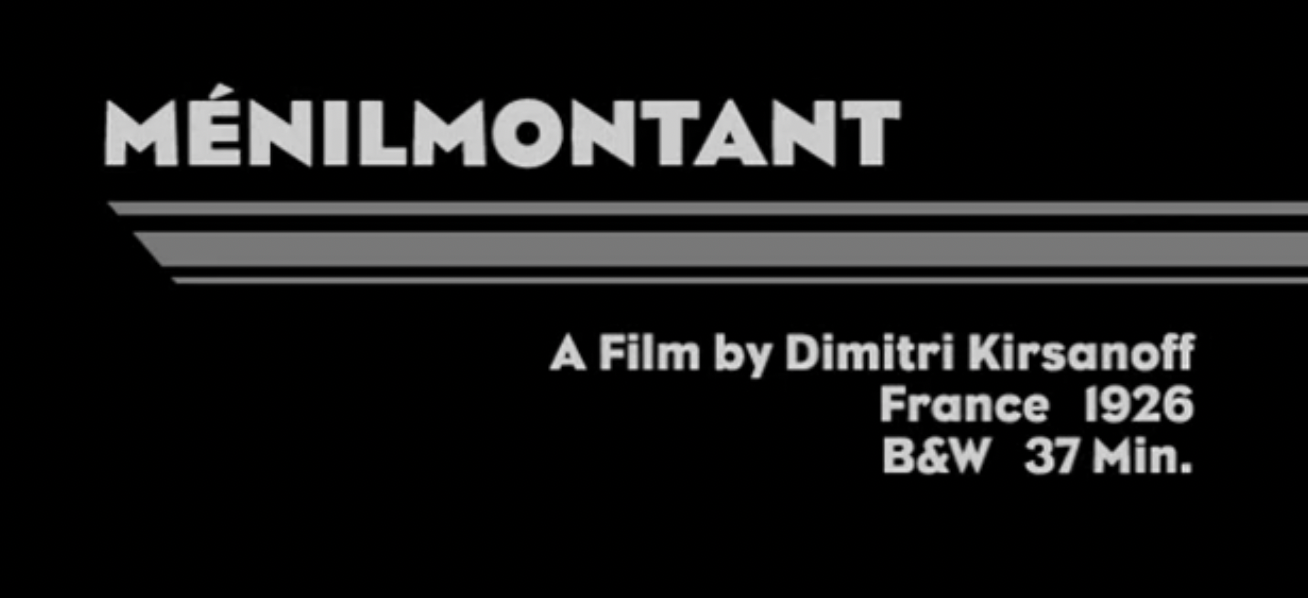
Why not offer a silent film enjambed by a flurry of stills, the sound of crystals softening, melting into each other, doing their snowflake-like thing, wrapping their legs around the labor of snow-fakes and snow-stakes.
Tis the season, after all.
Postlude on what form knows
“What I know about form couldn't fill a thimble. What form knows about me will be my end.”
So Dean Young concluded.
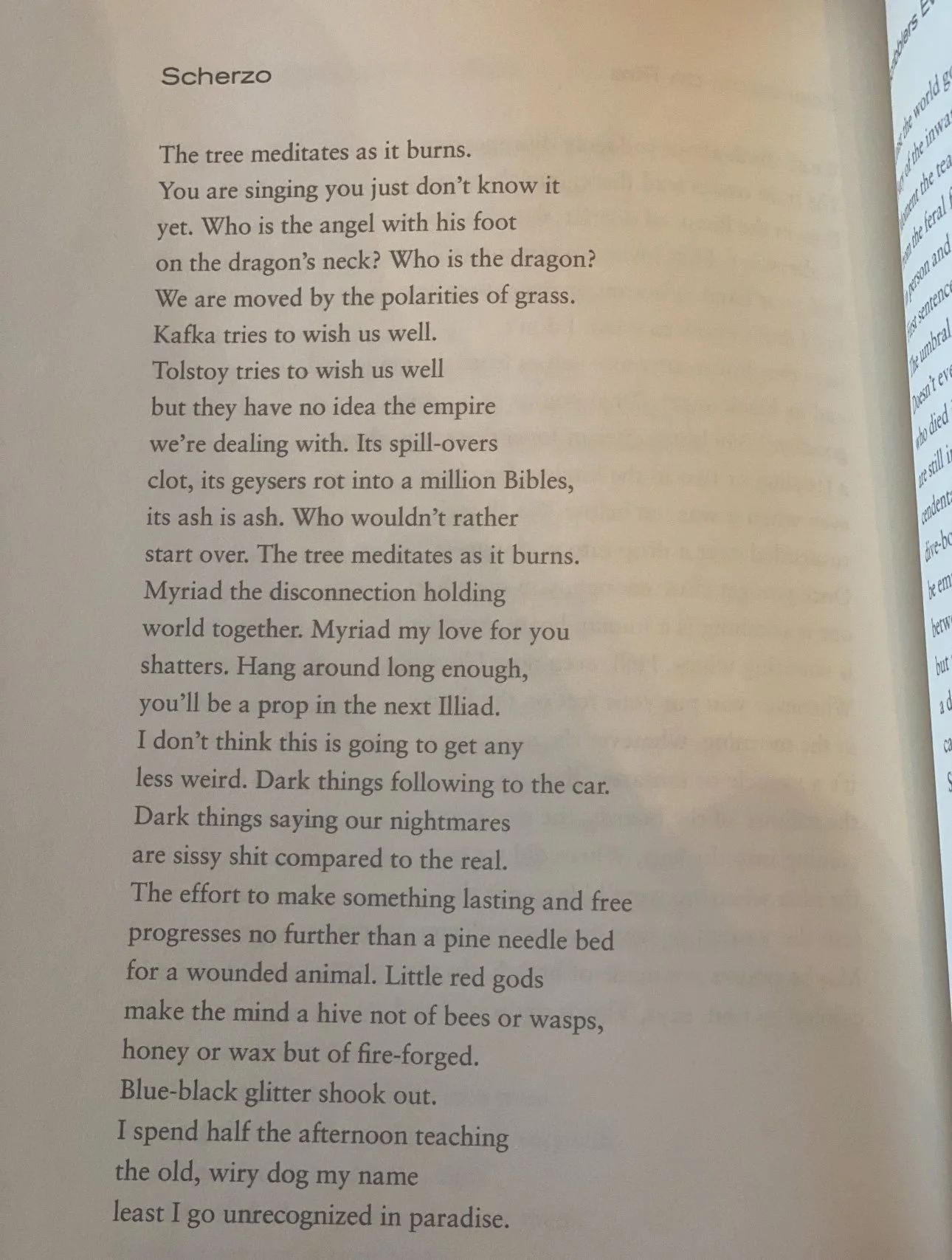
On that note, I leave you with his gorgeous play on a form, this “Scherzo”:
“How sad it is when a luxurious imagination is obliged in self defense to deaden its delicacy in vulgarity, and riot in things attainable that it may not have leisure to go mad after things that are not?”
— John Keats on July 7th in the year of all lords who sign themselves as 1818
*
Agnes Obel, ”The Curse”
Charles Ives, “The Unanswered Question”
Christophe, “Aline”
Damien Rice, “Cheers darlin”
Dave Brubeck, “Golden Brown”
Dean Young, The Art of Recklessness: Poetry as Assertive Force and Contradiction (Graywolf Press)
Dean Young, “Rothko’s Yellow”
Dean Young, “Scribblers Everywhere”
Dimitri Kirsanoff, Menilmontant (1926) with score by Paul Mercer
Frank Black, “I Burn Today”
Joe Henry, ”The Man I Keep Hid”
Keith Jarrett, “Köln, January 24, 1975, Part I”
Kiki Smith, Untitled (in honor of David Wojnarowicz), 2000
Kitty Grady, “The Cultural References Behind Agnès Varda’s Greatest Films” (AnOther Magazine)
Max Richter, “Shadow Journal”
Paolo Conte, “Via Con Me”
The Cure, “Homesick”
The Walkmen, “Bows + Arrows”
The Walkmen, “Love You Love”