“Poetry is older than skillfully elaborated prose speech. It is the original presentation of the truth, a knowing which does not yet separate the universal from its living existence in the individual ... but which grasps the one only in and through the other.”
— Hegel, Lectures on the Fine Arts
“Poetry protects language from serving any master. One can do it better from the periphery than the center.”
— Anne Lauterbach
speaking of inventories and alphabetical orderings—
A
Alibi, or different ways of conceiving the poem’s speaker.
“Alibi and alias: everyone generates their own, is their own. We have names and some sort of permanence and halos left behind like salt rings in a sauna.” ( Ander Monson, “Index for X and the Origin of Fires”)
Amaranthine means “immortal” or “undying”; it also refers to a deep purple-red color.
B
Burning bushes, or “talk about burning bushes,” or the way Frank O’Hara does so in “How Roses Get Black.”
How Roses Get Black
First you took Arthur's porcelain
pony from the mantel and! dashed
it against the radiator! Oh it was
vile! we were listening to Sibelius.
And then with lighter fluid you wet
each pretty pink floored rose, tossed
your leonine head, set them on fire.
Laughing maniacally from the bath-
room. Talk about burning bushes! I,
who can cut with a word, was quite
amused. Upon reflection I am not.
Send me your head to soak in tallow!
You are no myth unless I choose to
speak. I breathed those ashes secretly.
Heroes alone destroy, as I destroy
you. Know now that I am the roses
and it is of them I choose to speak.
Frank O’Hara
C
Complete passenger manifest for the Lusitania.
Cledonism refers to circumlocution used to avoid speaking unlucky words
D
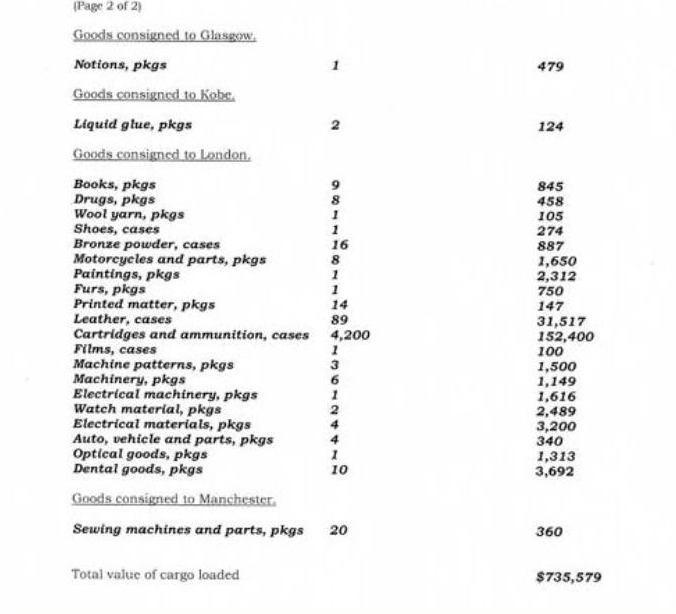
“Deadly cargo” on the Lusitania
Demean, as in to humiliate or degrade—- and the strange way it links up with this idea of the polished “demeanor,” as if the proper demeanor can be protective against being demeaned.
ditchlily (see H)
Claude Debussy’s Deux Arabesques for Harp, L. 66
Dualisms, or the what Christian Wiman calls “the little dualisms that define and derange us” (see T)
E
Ecstasy, or the poem of (as translated by Paul Amrod)
Erotic and domestic, or “Lust: The Pitfalls of Modern Intimacy,” a conversation between Esther Perel and Laura Kipnis as “instigated” by Paul Holdengraber. Notably, Paul uses this word, instigated, to describe his role in the conversation, and I think that’s a fabulous way of describing the labor of difficult or uncomfortable conversations (especially when the speaker may be lured away from the challenge of speaking by an interior dialogue with socialization and shame).
F
Fondness in leavetaking, or how to exit a room that hurt us without holding ourselves in a simple relationship to the hurt, a challenge that makes me think of how David Roderick takes leave of the formative suburbs in “Dear Suburb”:
Though you live
inside me, though you laid eggs
in the moisture at the corners
of my eyes, I still dream about
your sinking empire twenty feet above
sea level, and the many things
you never see: beautiful bleached
gas can, tomato posts bent into art,
how half of a butterfly, cut crosswise,
still looks like a butterfly, etc.
G
“Good for it” — an expression that hinges on one’s ability to pay out, and how this is used in dating discourse as it pertains to women. In this expression, there is also the implication that one (you, me, she, etc.) is the limited condition of its saying.
“Goods” — as in items on a list. But also the “good” in things.
H
Hemerocallis fulva, the orange daylily— also called ditch lily, railroad daylily, roadside daylily, outhouse lily, track lily, and wash-house lily. Or fulvous lily. The genius name Hemerocallis means literally, “beautiful [for a] day” in ancient Greek, where it referred to the martagon lily and the daily opening of its flower.
Husband-stitch, or variations on threading.
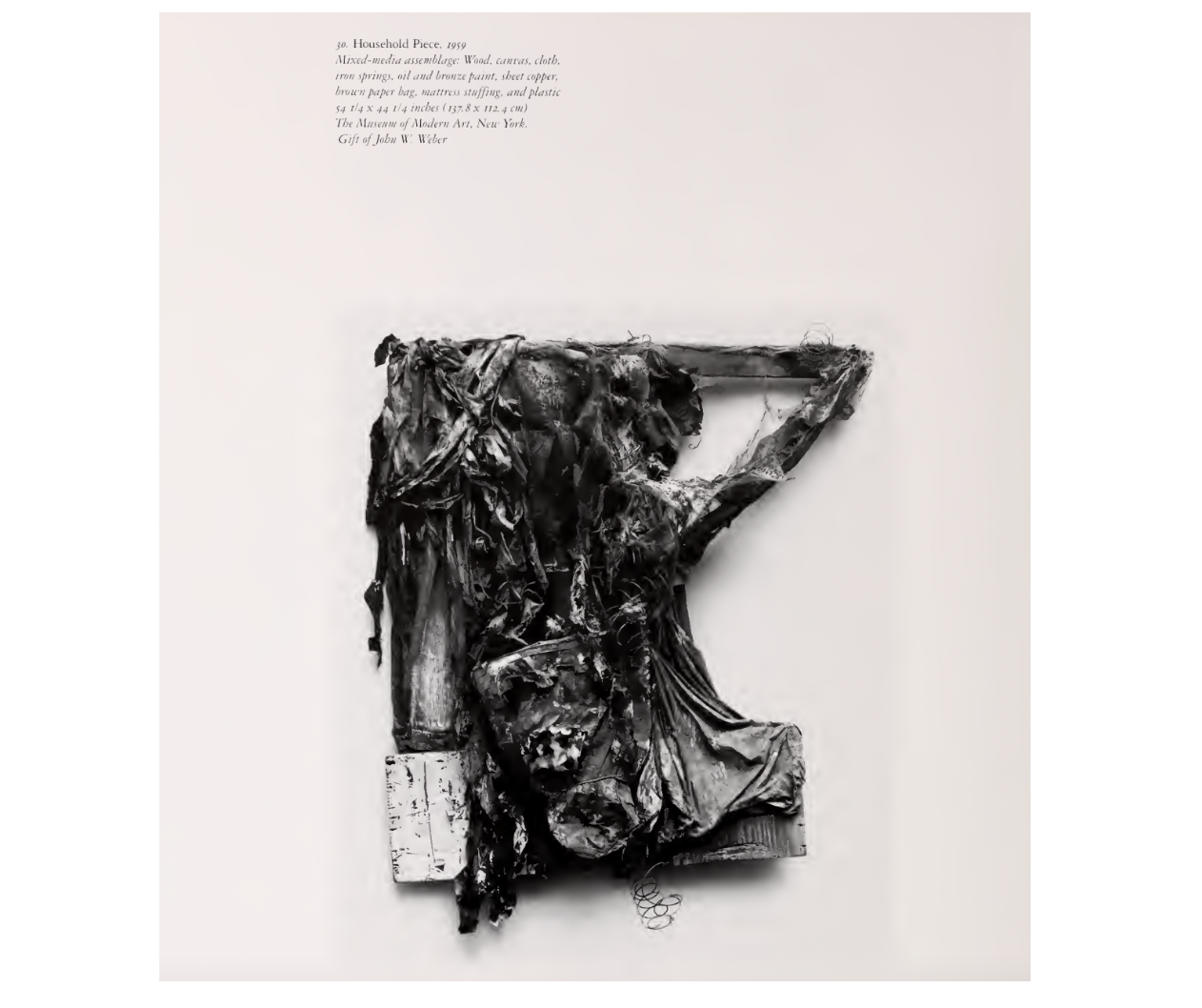
Household, per Jim Dine’s “Household Piece” as a mixed-media assemblage that includes mattress stuffing.
I
Interludes
“Improv” by Sharon Olds
J
Jean Paul mentioned that his “favorite instrument for play” was sand because of all the possibilities it embodies as “the purest of toys,” to quote Paul Fleming: “The Promise of Childhoood…” in Goethe Yearbook 14.
Jeux, or game in French. The long-J in play.
Joy and play: words that end in “y”. An upbeat sound? Thinking about how we use the sound of particular to lift sentences or colour the words in proximity to them.
K
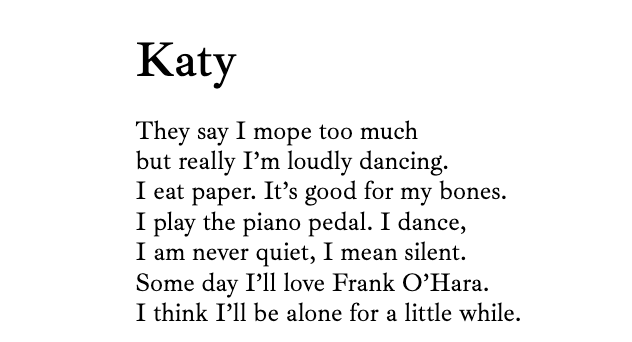
“Katy” (see T)
L
Language may be working best when language is failing, per Susan Tichy.
Listings, listing, different ways of naming and ordering the world we are given.
Love and the art of writing about others. In Delmore Schwartz’s story, “The World Is a Wedding,” there is a moment when the protagonist, Jacob, thinks something during the course of an interior monologue that can be applied to poetry as well as fiction, namely: “You have to love human beings . . .if you want to write stories about them. Or at least you have to want to love them. Or at least you have to imagine the possibility that you might be able to love them.” Drawing that out a bit, I would argue that this pursuit of the imaginary conditions (whether accidental or contrived) for loving others that shapes our choices about speakers in poems.
M
Maps made by women, or ways of articulating interiority, as with the carte de tendre, a sort of map created by women at a time when they were not permitted to circumnavigate the seas on Spanish galleons and use maps to colonize other places. This alternate geography that maps interior spaces while also gesturing towards the conventions of a “a woman’s place”.
Manifesto, as in Tristan Tzara’s “Dada Manifesto on Bitter and Feeble Love” or Mary Ann Caws’ century of -isms for a survey of manifesto forms
Meline is a canary yellow color
Misdemeanor, in counterpoint to the demeanor I mentioned earlier. Misdemeaning as an error of manners or presentation.
“the misdemeanor of the mist” in Austin Smith’s poem, “The Witness Tree”
N
Nate Wooley’s aural experiments with carte de tendre and related forms
“The Night” by Morphine
O
“On the Nature of Daylight” by Max Richter, from The Blue Notebooks. With Dinah Washington’s voice carried into the song.
P
Pearls in poems. “Sometimes, I just place a title at the top of the undisturbed, blank page and that name becomes something like a piece of sand that happened into the delicate flesh of an oyster, blank itself and closed off from the world…. The result, eventually, is a pearl,” said Lucy Brock-Broido in a 2013 interview. Per naming and claiming or disclaiming.
Parallel poems. A parallel poem is an original poem that uses the same lines structures as another poem, but focuses on a completely different topic. Some words from the original poem are retained, but some words are replaced with new words.
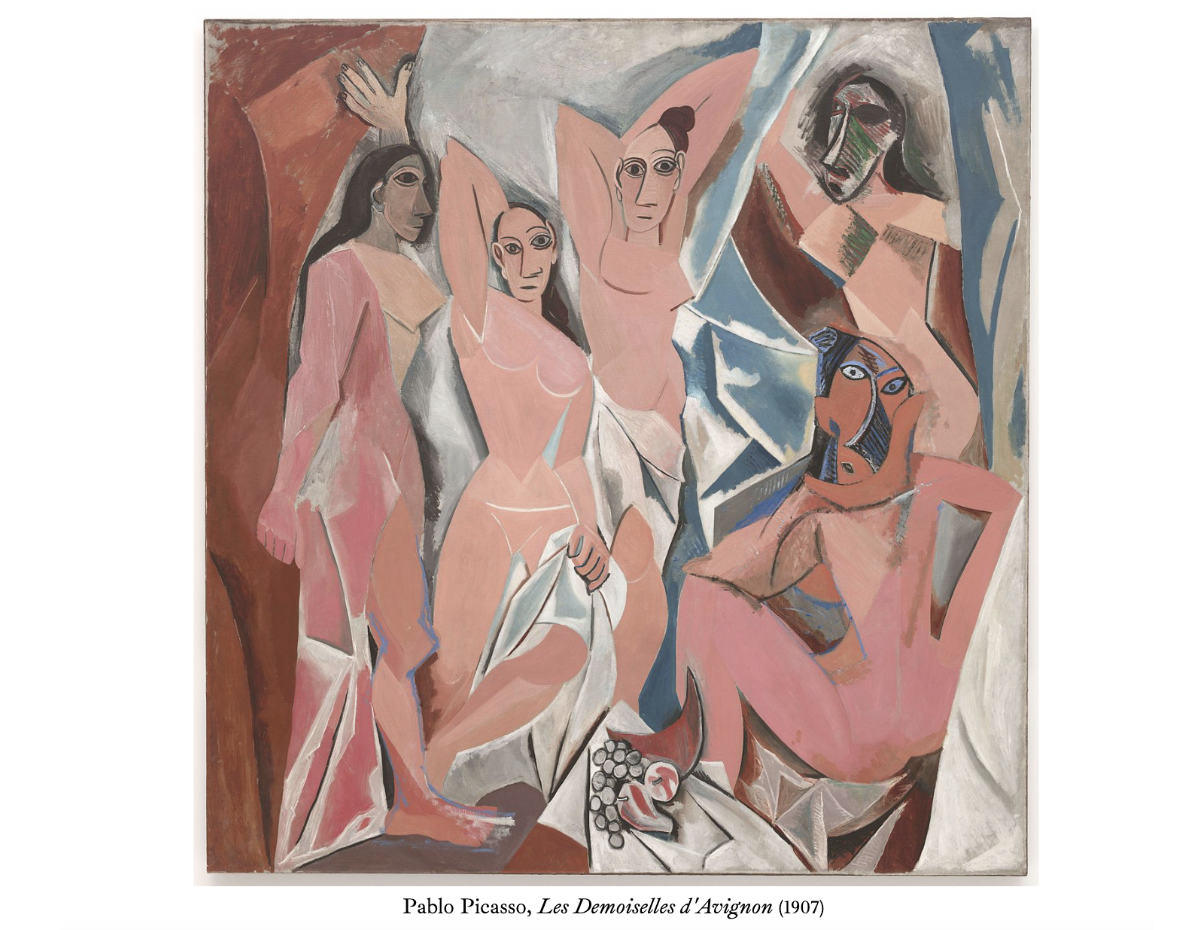
Picasso’s young ladies or maidens of Avignon, as a figuration
Q
“Quest” sits quietly inside the “question” or the act of questioning. Thinking about the heroic epic (as challenged by Alice Notley) but also the idea of the journey and the heroic male’s questing.
“The Quiet World” by Jeffrey McDaniel
R
Rediscovered things, as mentioned by Rainer Maria Rilke in a passage I quote extensively: “The incomparable value of these rediscovered Things lies in the fact that you can look at them as if they were completely unknown. No one knows what their intention is and (at least for the unscientific) no subject matter is attached to them, no irrelevant voice interrupts the silence of their concentrated reality, and their duration is without retrospect or fear. The masters from whom they originate are nothing; no misunderstood fame colors their pure forms, no history casts a shadow over their naked clarity: they are. That is all. This is how I see ancient art. The little tiger at Rodin's is like that, and the many fragments and broken pieces in the museums (which you pass by many times without paying attention, until one day one of them reveals itself to you, and shines like a first star ...)”
Reds: that palette. Thinking, too, of how Francis Bacon loved the color of blood. How he savored Antioch-red, paintbox bright red, or cherry red — and hoped to “make the human scream into something which would have the intensity and beauty of a Monet sunset.”
“Revenge” by Salim Barakat
S
“She can take the dark out of the nighttime / And paint the daytime black” — per looking back
Star, or first star (per Rilke) and final star and stars as places or sites for the poems
Swallow, or words related to the verb.
T
Traces as places where themes are held. Rachel Richardson defines a “trace” as “an act of imitation in which you choose your own subject (locale, weather, objects, etc.)” and then apply it to the master poem that you are tracing so that you ultimately rewrite this poem with different objects. In tracing, the poet tries to stay as close as possible to the master poem’s parts of speech, sentence structure, and stylistic elements. What you’re jamming with is the metaphors—the images.
The tune of things, as written by Christian Wiman.
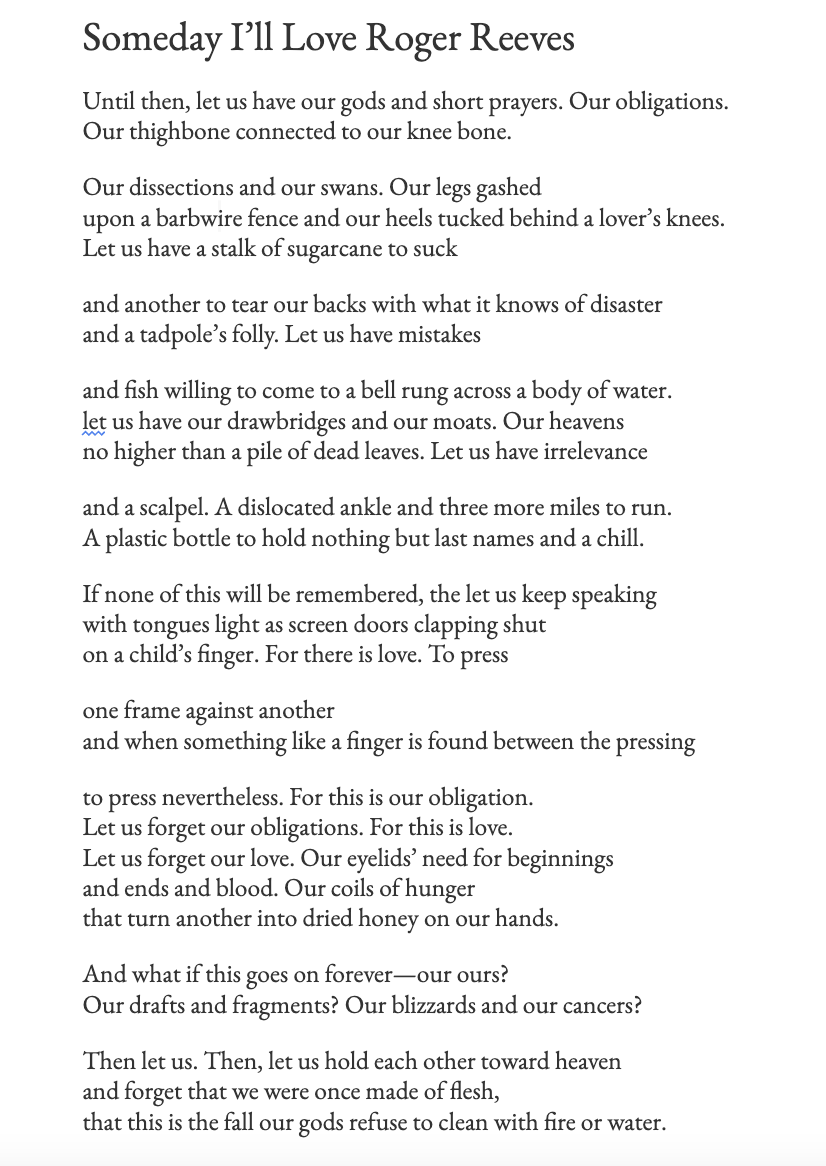
Themes make me think of “some day I’ll love” thread in poetics, as started by Frank O’Hara and carried forward by Roger Reeves
U, V, W
Understanding as a position in relation to knowledge that announces itself “under” the standing.
Vibratiuncle is a tiny vibration. The tiniest sort of vibe.
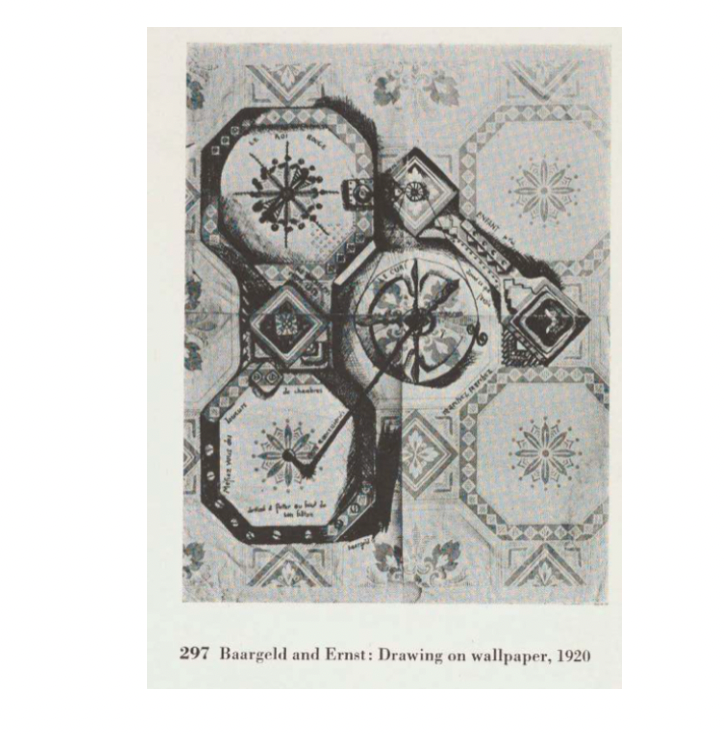
Wallpaper, as a site for juxtapositions.
X, Y, Z
X-ed out. The lines that are visibly erased.
Yowling and yellows.
Zither, the instrument of dithering, which is certainly where I find myself when adding these parting words from Rilke’s January 1922 letter to Ilse Blumenthal-Weiss: “And for that matter, even in the experiencing itself, where is the boundary to what is one's own? He who trains his senses to the purest and most inward participation in the world, what, in the end, will he not have been? Isn't it best and richest to see it thus? I obey the page which dictates my closing and make use of its little, last space for many good wishes for you.”