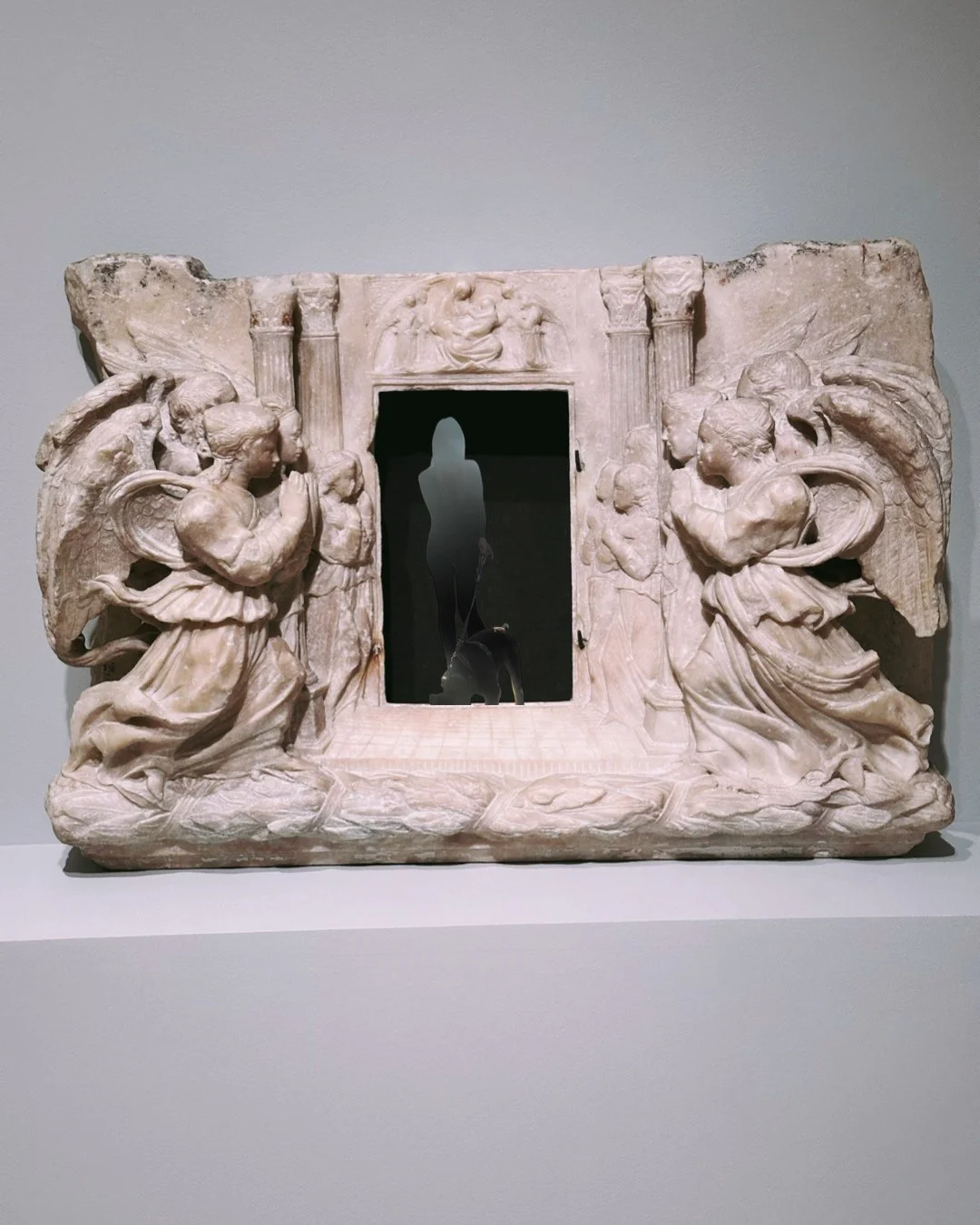
The demon, like the painter of dreams, is an artificer. Yet for the would-be skeptic, possession by a genio maligno overcomes the drawbacks of mere sleep in its total separability from reality. In this perfect nightmare, all that belongs to us— our bodies, our sensory apparatuses, as well as the colored, figured worlds they take in– can be reduced to the "mockeries of dreams." The condition of true skepticism is the condition of complete painting. Both in its total invention and in its pure illusion, possession promises to be an artifice with nothing behind it. Possession is an art of absolute fiction.
— Rene Descartes
Hey I’ve been thinking!
I been thinking about nothing, yeah . . .
— The Dandy Warhols, “Smoke It”
Maya Popa opened the envelope of my dreams this year. This is the only explanation I can devise for the fact that I am giving a lecture each month on prose-related topics that fascinate me.
The official version involves serving as the first Writer-in-Residence for the Conscious Writers Collective . . . and I keep pinching myself to see if I am real, or possibly just to amuse Radu, whose consternation and notebook-envy remains unparalleled in the Kingdom of Mammals.
As result of Maya’s nudge, many untyped notebook entries have returned to the table of my thinking— a combination of music, images, and textual encounters which have shaped (and continue shaping) themselves into one of my favorite literary forms, namely, the “lecture.” How does one thank a fellow writer for the opportunity to revisit readings and theories that sat, undeveloped, like tadpoles in an ice-cube? I don’t have an answer to that. Nor do I know what I will eventually do with these “lectures,” apart from savoring the pleasure involved in writing them and living (however briefly) in that state of co-presence with language and being that admits and explores its entanglement with the world.
Radu says I have wasted my life. “There is too much material! What is the point of collecting and saving more material than you need?” His eyes are darker than Goya’s untold secrets. One must listen to such darkness, if only to dismiss it with exculpating nouns like research. Or statements including these nouns, as with “Research, dear Radu, as you should know, given the number of pillows and cushions you have sniffed before hiding your bones in the most random corners of our home.”
As for shadows — and shadowgraphia —-
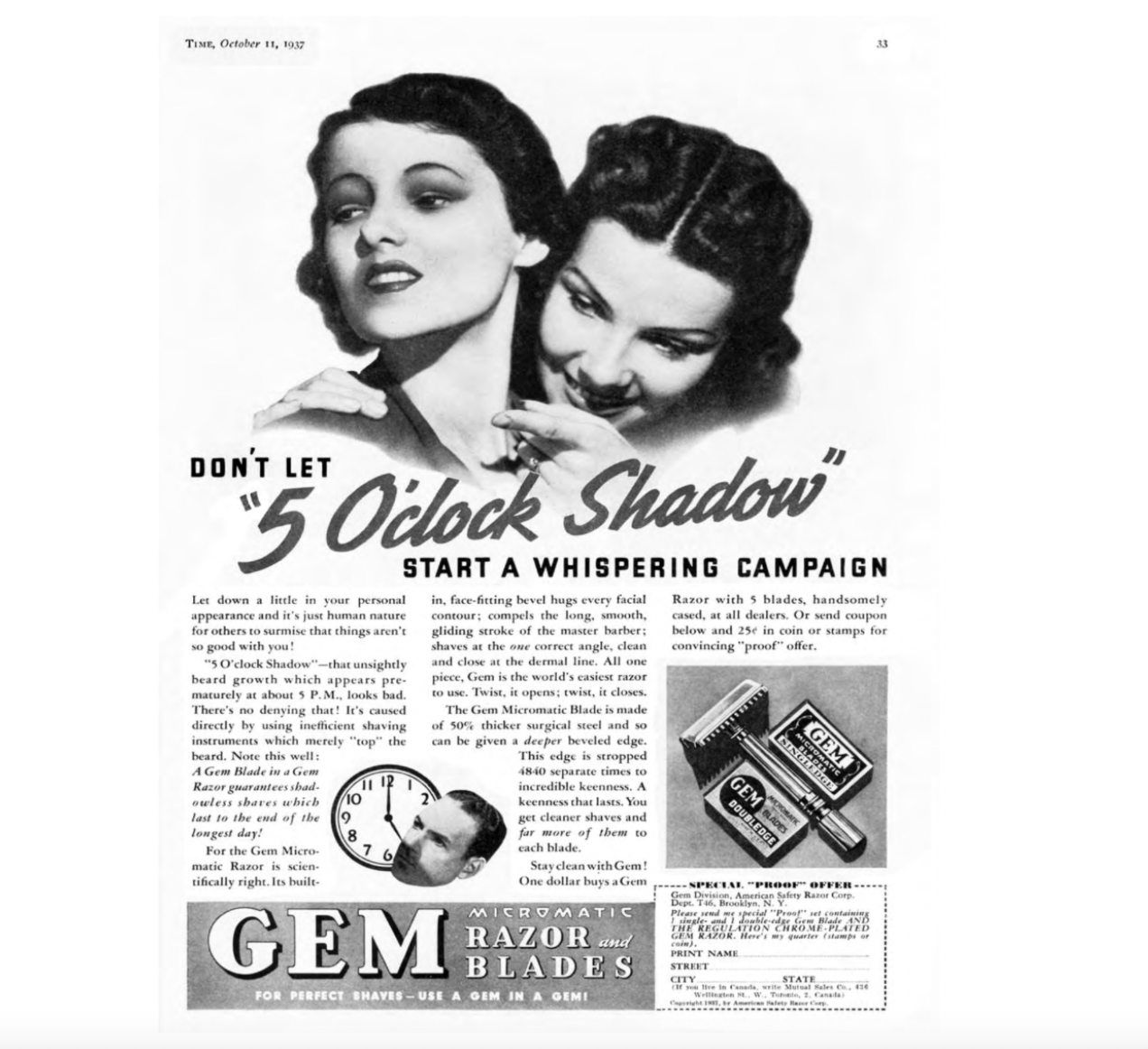
“Five o’clock shadows: a whispering campaign”: a razor blade ad
As found in Time Magazine (October 1937), the platform of Henry Luce’s New American Century as well as the medium of communication for empire’s Exceptionalism issues. The target audience for this ad is men and the women who love them. Women, here, are subtly encouraged to shame men into purchasing Gem razors that work more efficiently at reducing the grime of the five o’clock shadow.
The danger of the gendered “whispering campaign” is stated at the outset: women might think “that things aren’t good with you!” O how I love studying this bladed whisper as a set piece in the construction of gender that was central to cultural notions of “family values” propagandized by the US government after World War II.
. . . And there is a similar play on notions of social hygiene deployed by S. D. Chrowstowska in her doppelganger-dandying “Shadows”, a short story originally published in her collection, A Cage for Every Cage (Sublunary Editions).
. . . And there is the awkwardness of wanting to share the contents of my thoughts, both present and forthcoming, by tying these to the workshop titled “Shadowgraphia: The Uses of Shadow in Fiction,” that will happen at the end of this month.
. . . And there is a ceaseless stimmung of birdsong that surrounds me as I type in shadow of Radu’s critical eye— an eye which wants walking rather desperately.
. . . And there will be flowers and pollen stains on this walk, which is now my excuse for leaving, but not without adding, awkwardly, that if by some wild, April-stung perchance you are interested in this chiaroscuro (or others) here is the relevant link.
. . . And there is the official part, prior to the unofficial parting.
Shadowgraphia: The Uses of Shadows in Fiction (April 25, 12-2 EDT) “Possession is an art of absolute fiction,” declared Rene Descartes as he considered the relationship between art and demonic possession. Despite the demonic associations, fiction has always made use of shadows to develop, characterize, and complicate narrative. Lucifer was an angel whose maleficent spirit got the best of him. Witches are dangerous because they make use of “dark magic” to meet their ends. The artist who fashions his work as godlike enters the realm of “deception.” God was the first Creator, and Satan was the first actor to zealously imagine himself in God’s place. In this generative workshop, we’ll examine how authors use shadows to tell stories, from Peter Pan to Marcel Proust. Then, we’ll use shadows to tell our own stories.
Sophie Calle, Self-Framing, and Writing Through Imagined Encounters (May 23, 12-2 EDT) This session will explore how artists and writers construct intimacy, perspective, and narrative through imagined encounters. Using the work of French artist and writer Sophie Calle—known for projects that blend photography, storytelling, surveillance, and performance—we will examine how creative constraints can generate unexpected narratives. Calle often creates elaborate situations in which people unknowingly become part of a story, following strangers through cities, inviting others to interpret personal artifacts, and inventing fictional frameworks that blur the boundary between fact and imagination. These unusual narrative strategies have inspired writers such as Paul Auster, Grégoire Bouillier, and Enrique Vila-Matas, who have incorporated Calle-like devices into their own work. In this workshop, we will look closely at how intimacy is created in writing—through voice, pronouns, address, and narrative framing. We will also examine several of Calle’s staged scenarios, which rely on collaboration, chance, and invented rules, before writing our own short pieces inspired by Calle’s methods.
New Worlds On the Page: Imagining the Painting’s Infinities (June 20, 12-2 EDT)
HE: Why do you write?
ME: To trick myself into being satisfied with what exists. Writing releases me from my fear of running away. The imaginary holds me in place, pinned to the scene for an instant.
HE: But isn't it real, then? Aren’t you bringing these characters into the world of your reckoning in order to give yourself a false sense of company? I mean, do you believe in them?
ME: I do. That’s the worst part of it. I believe in them.
HE: How?
In A Treatise on Painting, Leonardo da Vinci described a new method for “awakening the mind to a series of inventions…by looking attentively at old and smeared walls, or stones and veined marbles of various colors, you may fancy that you see in them several compositions, landscapes...with an infinity of other objects.” And, so, we will look attentively at three paintings and invent worlds for them. This workshop dives into the untamed parts of our imaginations and honors the possibilities that hold us in place.