An echo is a trace of an event that reverberates through time.
— Stephen Frailey
The trilling wire in the blood sings below inveterate scars.
—T. S. Eliot, “Burnt Norton”
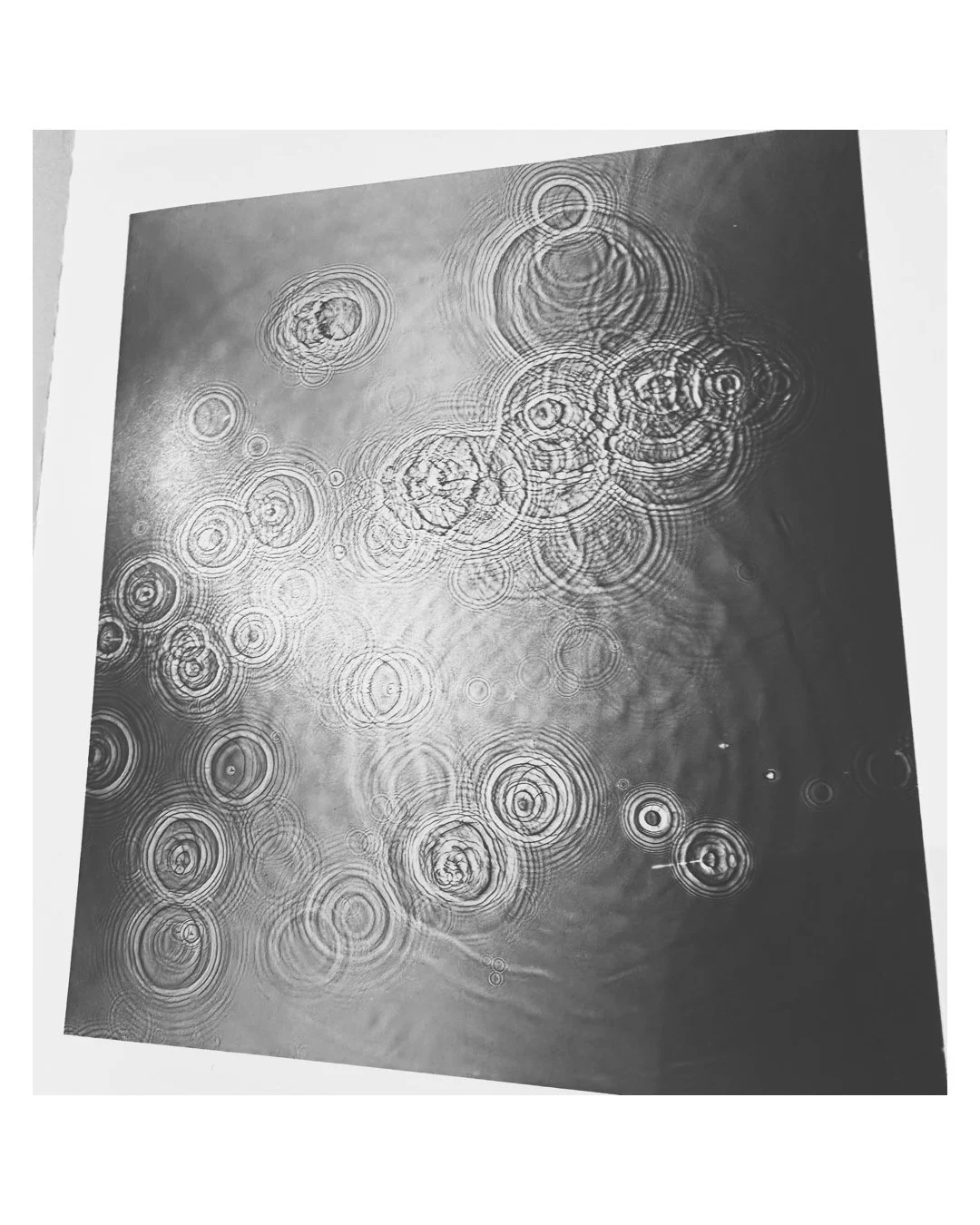
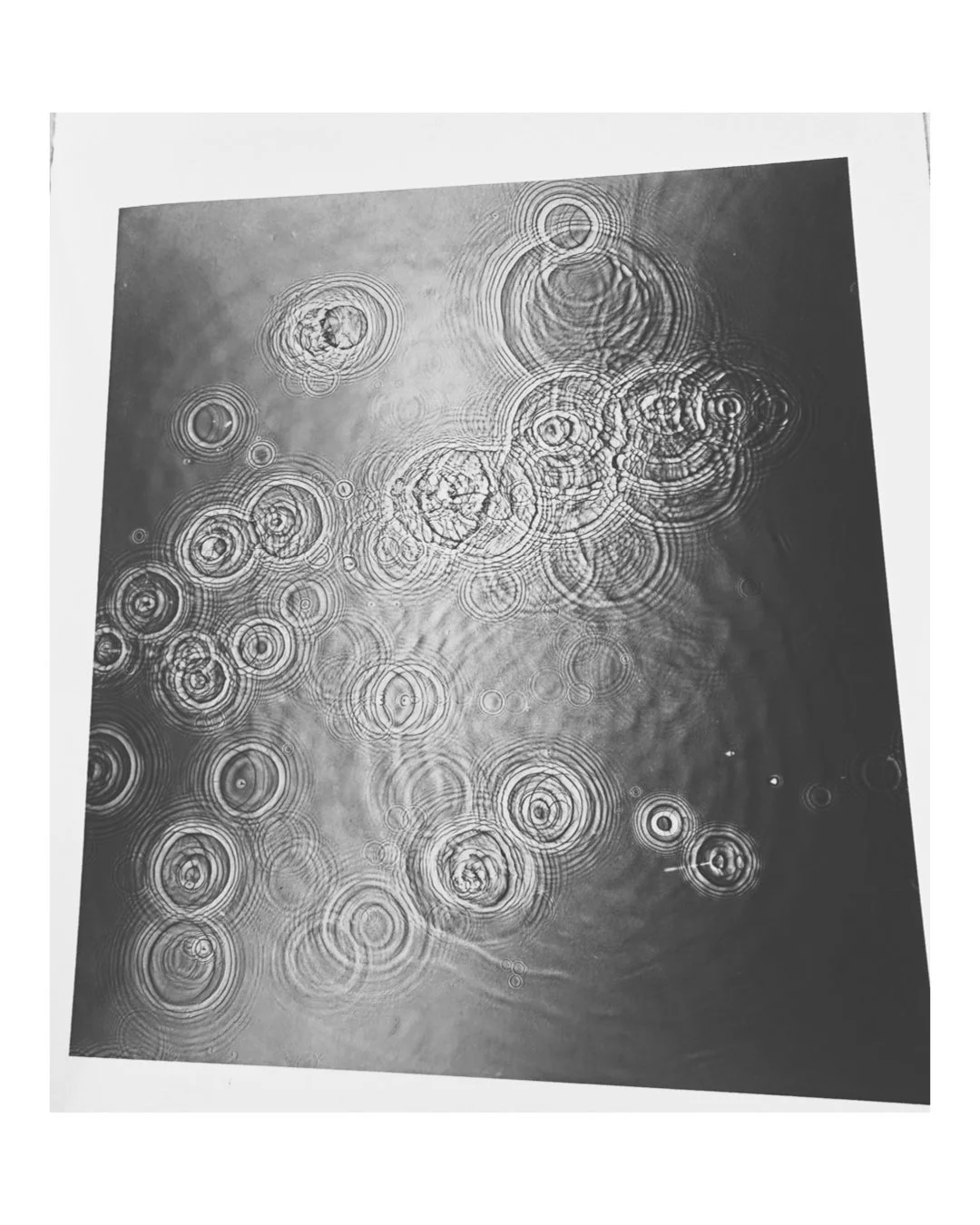
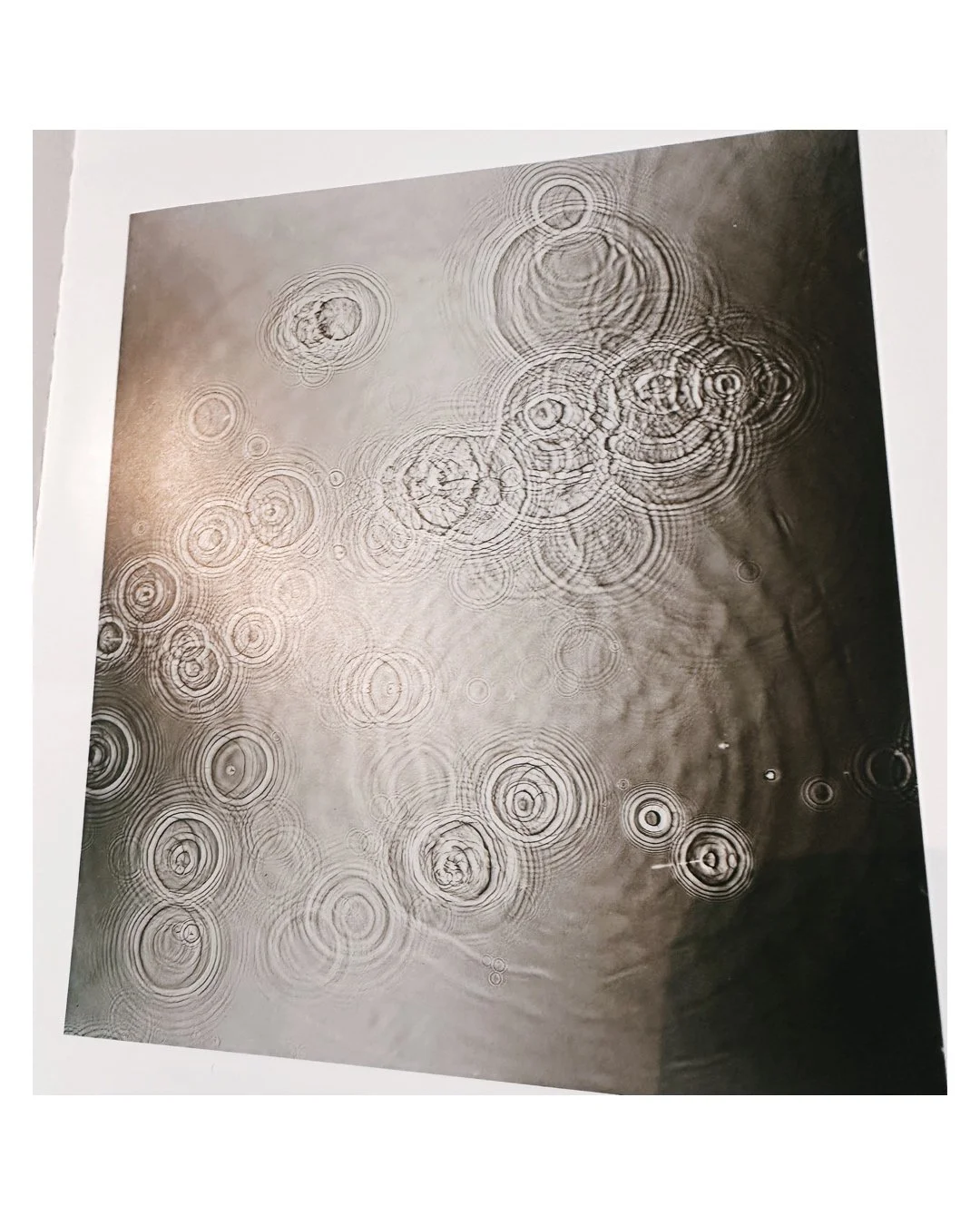
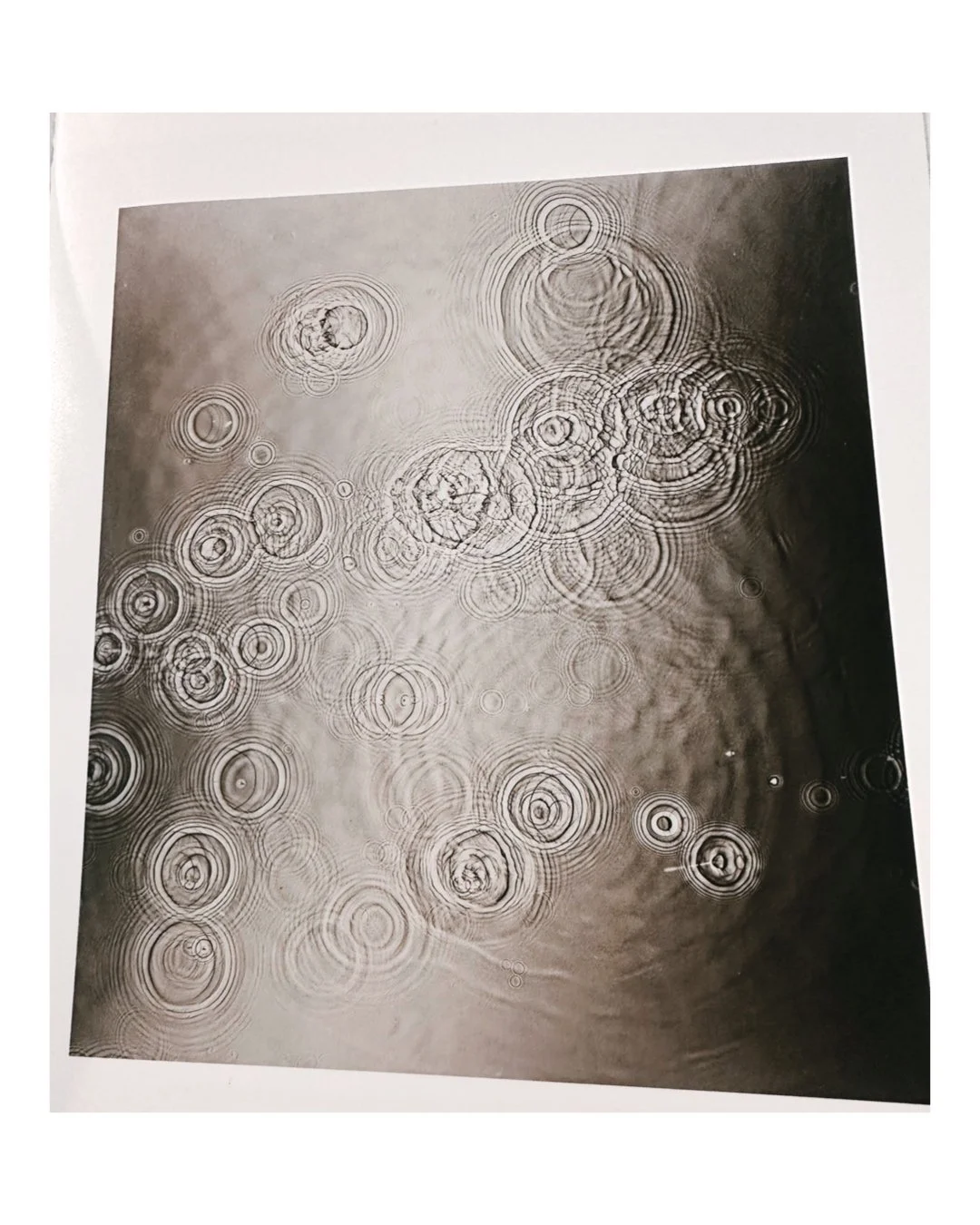
Language of Echoes (1987) by Adam Fuss. At first I thought it was a fabric, the surface of a textile spattered with self-circling stitches. I noticed the dimpling of the surface material near the larger circles — marks of impact. Tears and rumpled bedsheets. The minimalist music of rain dripping from the porch eaves into the small portion of dented cement that collects water. A series of variations in visual resonance.
*
“I work a lot in a territory which I feel is not invisible, but on the edge of perception,” said Adam Fuss.
*
In the novel, a man walks into the room carrying his wife’s notebook. His clothing is clean-cut, his figure symmetric, but face above the white shirt is blank. Something develops as he stands between the gray armchair and coffee-table, a stack of books at its feet. She is trying to read him. She is silent when he says that there is no point, he already knows what she is thinking. Her notebook in his hand, motionless. He has read it. He doesn’t look at it as he drops the notebook on the table. I’m leaving, he tells her. It is finished.
*
First impressions failed me in my reading of Language of Echoes. This became apparent as soon as the room of the book grew audible. The room of the novel and the room of the photogram are not entirely dissimilar. The distance between the faces and hands and eyes of the figures, the density of the furniture, the sonic possibilities of what is spoken, and what may be felt yet unsaid. Like the surface of that puddle in the porch corner, each word and motion falls upon given material, creating a particular circle which emanates from the points of impact. Each point has its own.
*
I imagine a slender line of small circles at the lower left edge of the image, where each circle is one of the husband’s footsteps, pausing a third of the way into the room. There is solidity and symmetry in the shapes, but even this seems accidental rather than purposive. A contour of chance and contingencies, the room creates itself from the relatings of the bodies within it. The room recreates itself continuously. Sounds and circles overlap at points of high impact. This is the set-up for a short story; so much of fiction’s staging depends on the ways sounds and gestures mingle, interact, and overlap.
*
Larger, less distinct ripples from earlier droplets are barely visible against the image’s gray background. The presence of these points of near-invisibility turns Fuss’ photogram into a record of duration in dialogue with elapsed time. Time lapses and elapses.
*
Language of Echoes is a gelatin silver print (or “photogram”) created by Adam Fuss without the use of a camera. Rather than asserting the artist’s gaze through the lens, Fuss relinquished his own perspective and laid the piece open to chance by placing a piece of photographic paper in the bottom of a tray filled with water and setting this tray in darkness, or under a safe light, while dripping water onto the still layer of water in the tray. As various droplets hit the surface, Fuss flashed a light to expose the paper and capture the shadows of the emerging wave patterns.
*
Fuss has described the faint imprints on his photograms as a “visual echo of the real object.” It is figuratively compelling, this language of echoes rippling across a medium’s surface. To “develop” the droplet . . . To see what develops from the conditions set by the process.
*
Echoes are sounds that exist in relation to their origins. An echo locates the originary sound in time-space. In a parallel fashion, Fuss’ flash-frozen droplets develop from the experimental conditions he created for their emergence. We invent games to devise ways of seeing how things play out, or how they shape the behaviors of the players.
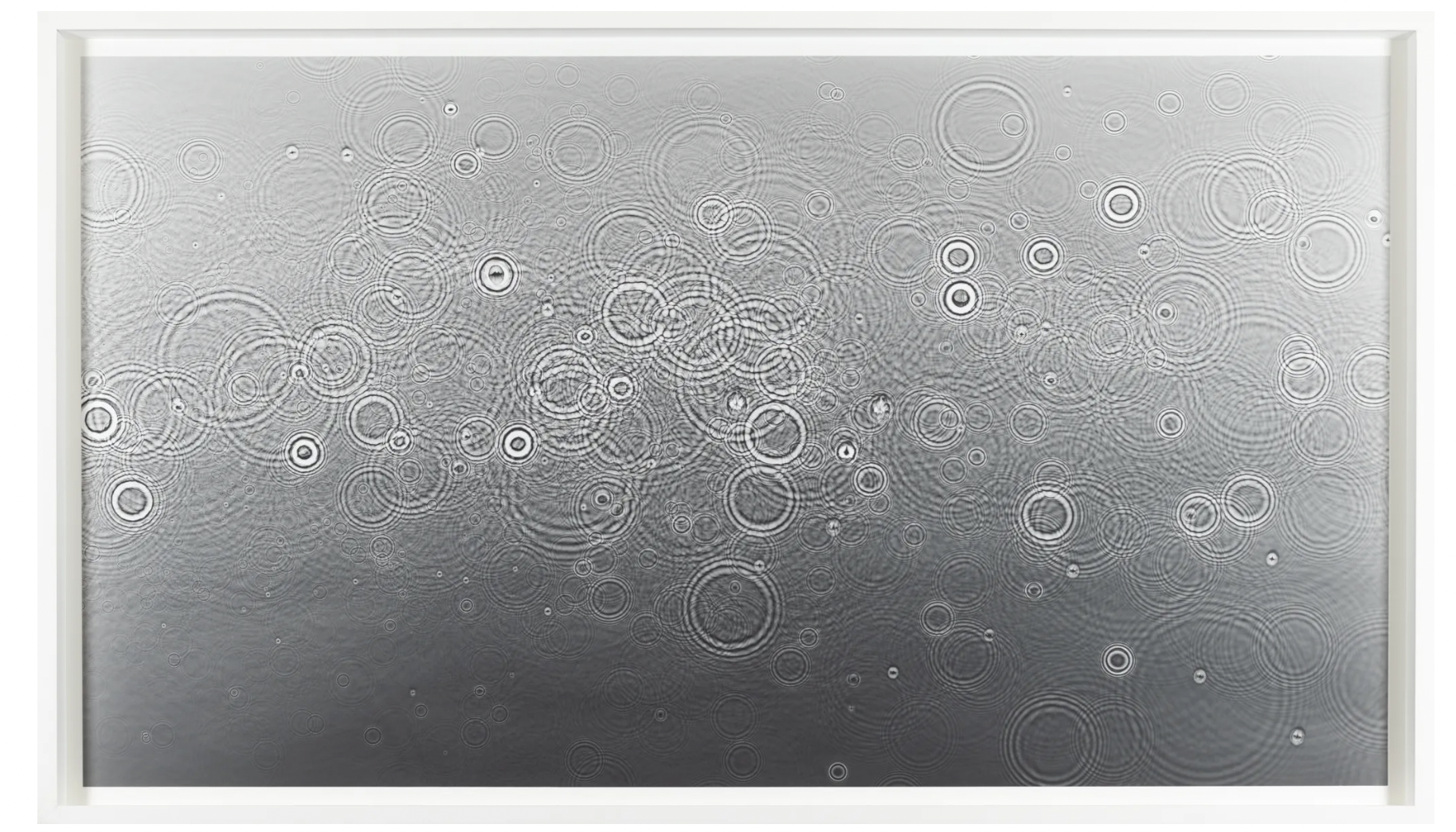
Adam Fuss, Untitled (2007) gelatin silver photogram
An echo represents a trace of an event that reverberates through time. The echo cannot carry the entire sound but instead offers a slice of it, a reduced fragment, a wisp or a trace that points us to its existence. We recognize that a larger (or louder) version must have existed in order for this insufficient copy to evoke it. Echoic traces are like tiny testaments to the unseen.
*
“Less representational than percussive, certain photographs suggest sound—a plucked string or a minute fluttering of the vocal chords, emerging from the throat in a wordless hum,” wrote Stephen Frailey of Fuss’ photograms.
*
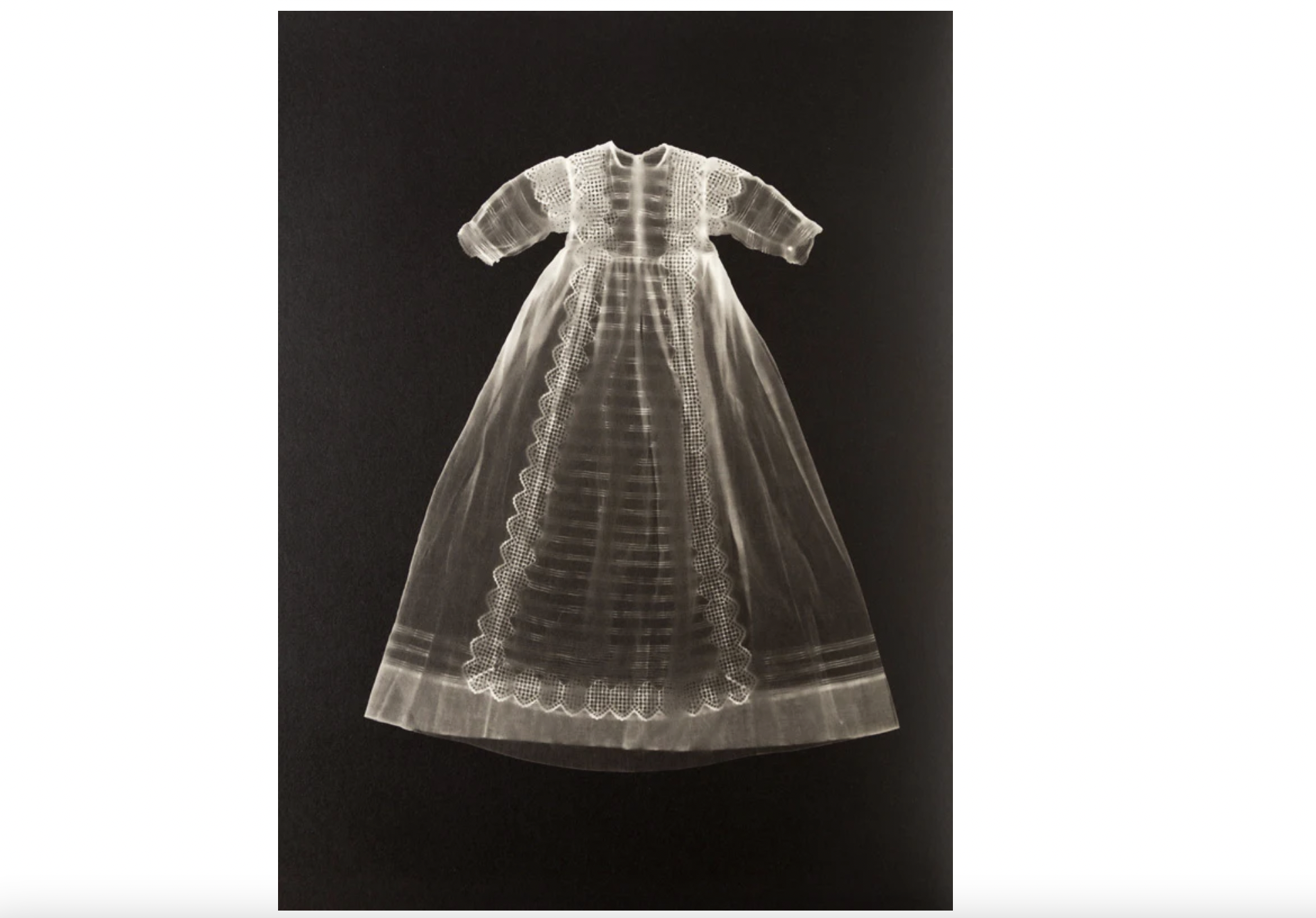
“A nineteenth-century child's dress is carefully laid out for our viewing. Perhaps, because we are aware that it is a part of lost time, our thoughts go to its missing inhabitant—an ethereal presence, intricate to the weave of the fabric before us. And then there are the birds, scattering in a grey photographic dusk, soundless. Now, the mirrored surfaces of the daguerreotypes flicker before us, never completely giving up their secrets. In this body of work the artist essays loss and its attendant ghosts.”
These are the words Neville Wakefield used to describe Adam Fuss’ My Ghosts, a book published in 2002 by Twin Palms Publishers.
*
Of his ghosts, Fuss has said that they are “not some external phenomenon but rather an emotional state or an unconscious state that acts as an intruder in the mundane or ordinary, frequently manifesting as the presence of an absence.” By nature of its being, “the ghost is neither fully physically and materially present nor completely nonexistent but in a state of ‘in between’.”
*
A few questions I posed to the language of echoes: Where are the areas of relative intensity? How do the areas of impact relate to one another? How do they interfere with the ripples’ physical tendency to move outwards? What sort of drive or urge is configured in the physics of ripple and flashbulb?
*
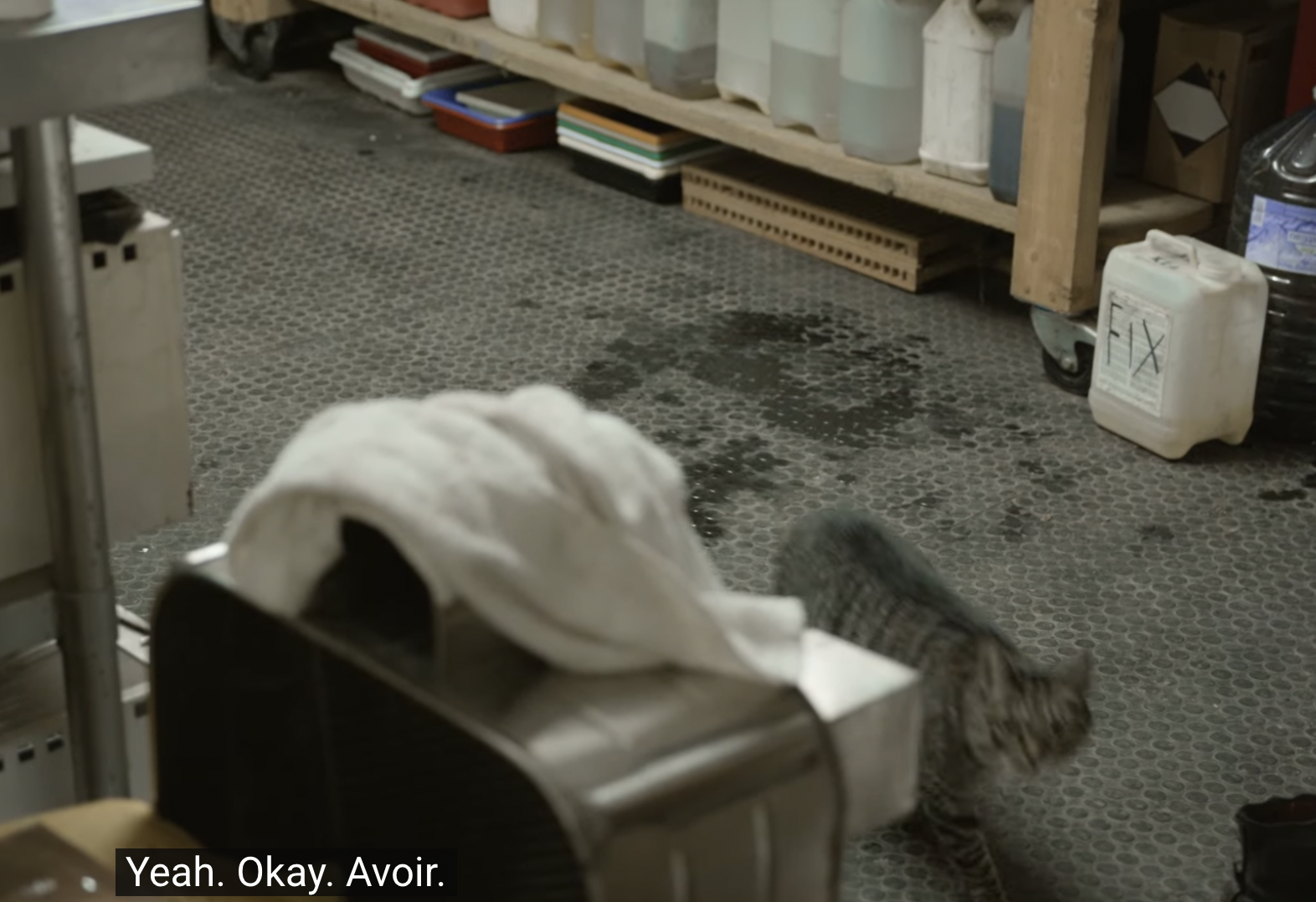
Svetlana Cemin made a film about Adam Fuss’ work. She titled it A Landscape of Imagination. A hybrid resonance or intersection of wave forms led me to think of John Cage’s “In a Landscape,” and musical figurations of landscape more generally.
*
All of this attaches itself to recent readings on unconscious resonance, as explored in conversations about cinema between Mark Fisher and John Foxx, which I may share later this week, unless spring fever and life gets the better of me.
*
“Adam Fuss: Visual Resonance”. April 25, 2025 - September 29, 2025, Buffalo AKG Art Museum.
Adam Fuss’ profile for Frankael Gallery.
Adam Fuss, “Two Photographs”. Bomb Magazine.
Adam Fuss, My Ghost. Twin Palms Publishers, March 2002. Currently out-of-print.
John Cage, “In a Landscape” performed by Alexei Lubimov
Max Richter, “Love Song (After JE)”
Stephen Frailey, “Thin Air: The Photograms of Adam Fuss”. Artforum.
Svetlana Cemin, dir. Adam Fuss: A Landscape of Imagination