Last April I copied a (beloved) poem by a Deborah Digges into my notebook titled “Love Letters Mostly.”
Today, one April later, I find myself returning to its waters in order to study how it moves, or notate the steps of its dance within (and with) language, the particulars set into motion.
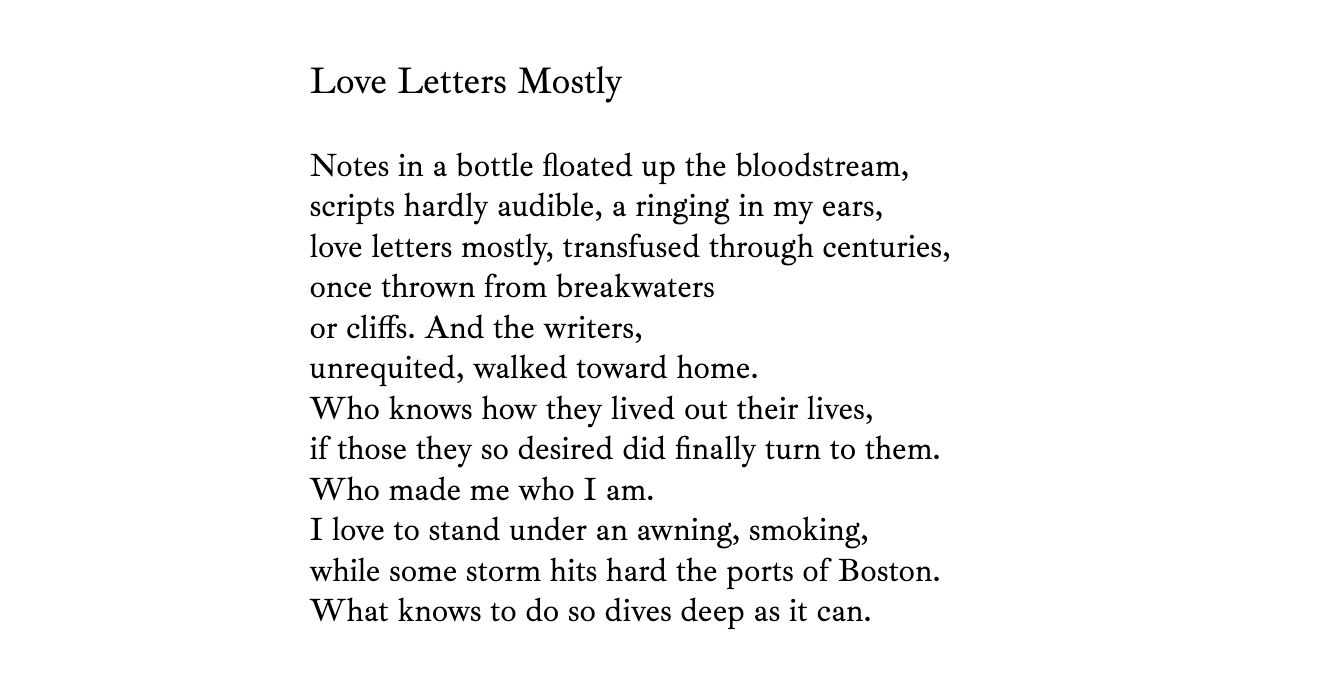
One stanza, twelve lines, ragged edges. Not a sonnet. Not stepping into the shape of a recognizable form, whether to constitute it or subvert it.
The speaker is alone, standing near a shoreline. The tone is desolate and expansive, almost as if deserted by its own vantage. It surveys the scene and asks questions, but refuses to identify the questions as such by using punctuation.
Unpunctuated questions may indicate that asking is either futile or humiliating, or perhaps too difficult an activity since the speaker reveals parts of themselves in asking the question.
What do we reveal when we ask?
I mean, what do we say about ourselves when we constitute a question that identifies itself and addresses itself to others as such?
What does the poem want when it does that while celebrating the surreptitious cigarette smoked beneath an awning during a rainstorm. What does the poem want when it asserts this singular moment against the interrogatory mode?
How did punctuation alter the atmosphere of the prior sentences?
I mean isn't it strange how the presence of a question mark indicates an openness, a disinhibition, a willingness to be read as part of a potential future dialogue?
What about the absence of punctuation inhibits the self and builds a horizon into the spoken.
I’m not sure it's because the period, itself, is a terminus. I think we say things in a landscape that may include the dead, as for example, when Digges references both Osip Mandelstam and Paul Celan by citing their view of the poem as a message in a bottle that may be on route to the reader who needs it. That is where Digges begins, in that image of the poem sallying forth:
Notes in a bottle floated up the bloodstream,
scripts hardly audible, a ringing in my ears,
love letters mostly, transfused through centuries,
once thrown from breakwaters
or cliffs.
One sentence, this motion from the notes in the bloodstream that become a ringing in the ears, a non-signifying noise similar to tinnitus —- and Digges' use of the word 'transfused' in keeping with the river of blood on which the poems of poets travel —- there is soft demarcation here of the distance between the exterior (or public) water and the interior (or private) water, and Digges does nothing to bridge that gap or explicate it.
The poems thrown from rocks or cliffs in ancient days— she calls them “love letters mostly” — are the things which return by becoming internalized. At the very least, they become internalized in the case of Digges' speaker, who then quickly picks up the next sentence without a line break, adding “And the writers,” — this is where she breaks the line, leaving us peering over the cliff near the water for the writers, suddenly present in that shimmering conjunction:
And the writers,
unrequited, walked toward home.
The 'unrequited' writers, this image of utter loneliness that infuses the poem.
And the perfection of those unmarked questions that intervene while also threading themselves into what poetry does, or what the poem asks of the poet and the world.
Who knows how they lived out their lives,
if those they so desired did finally turn to them.
Who made me who I am.
And now the turn into an image of the speaker, smoking in the rain, alone, watching the skies. The other writers have left; their ghosts barely present here:
I love to stand under an awning, smoking,
while some storm hits hard the ports of Boston.
And then the flourish of that elliptical finale. If a razor can be a flourishing thing —
What knows to do so dives deep as it can.
The poem takes it leave in the abyss, or what Heidegger called the “bottomless,” that homeland from which no one human is exempt, perhaps the originary that we build our obsessive homelands against. (Notably, Hannah Arendt references this abyss as the philosopher’s medium, in a section of The Life of the Mind titled after Valery.)
The questions posed in the poem are answered by the title—though we cannot realize this until after having read it, especially since the questions aren't indicated by punctuation.
Other small things that strike me: Digges' dispensation with ordinary forms and conventions of address; the unstable temporality that carves the fleeting moment inside the eternal; the sense that eternity, itself, is unrequited and unrequitable.
*
Aaron Copland, “Nocturne”
Deborah Digges, “Love Letters Mostly”