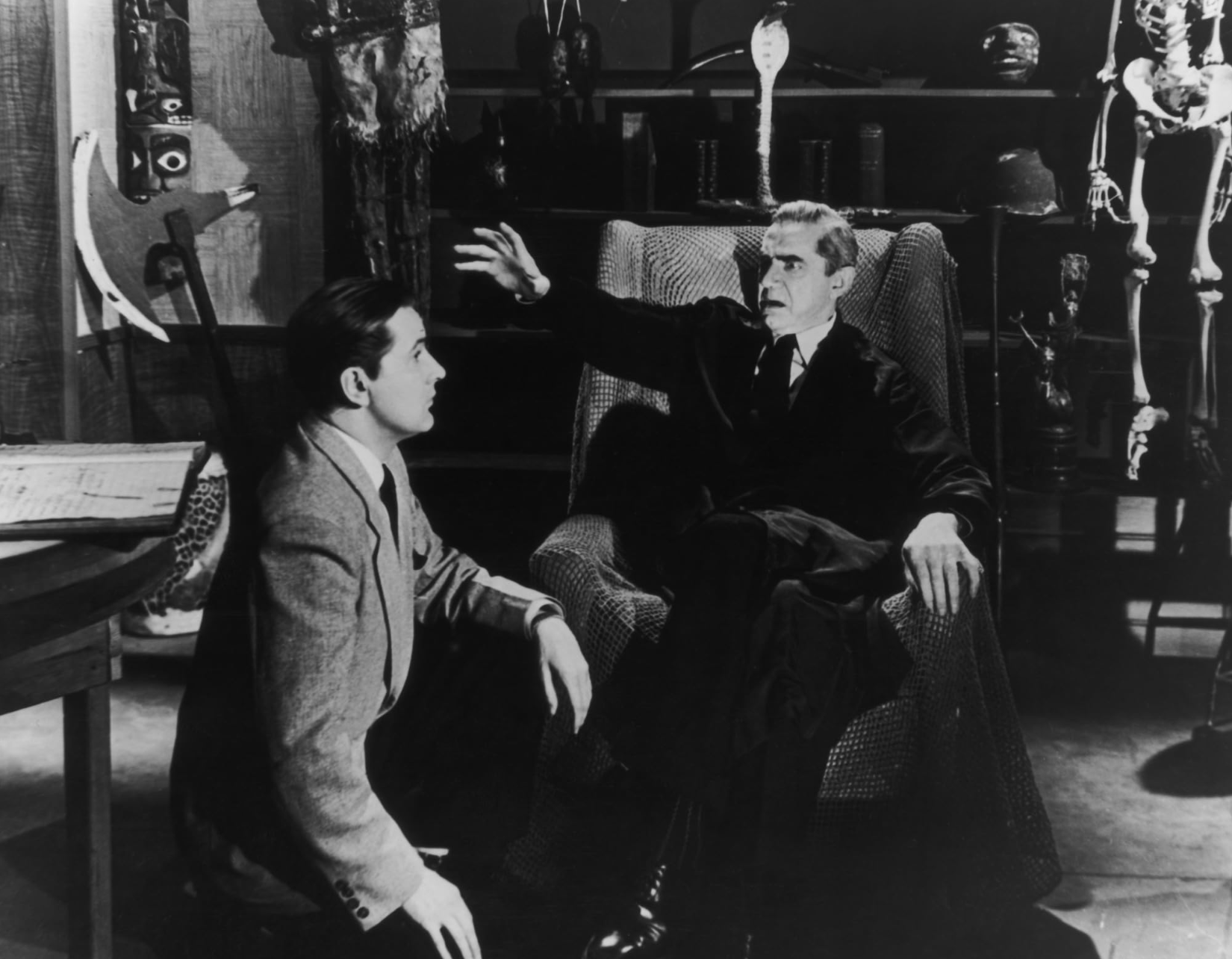
CRISWELL THE PSYCHIC:
We are all interested in the future, for that is where you and I are going to spend the rest of our lives. And remember, my friends, future events such as these will affect you in the future.
POLICEMAN:
Inspector Clay’s dead… murdered… and somebody’s responsible!
EROS THE ALIEN:
You earthmen are idiots. Stupid! Stupid!
PAULA TRENT (to her husband, who’s an airline pilot):
Don’t worry about me while you’re gone. I have your pillow to keep me company. While you’re up there, I’ll be down here. Now, off to your wild blue yonder!
— Ed Wood, Plan 9 From Outer Space (1959)
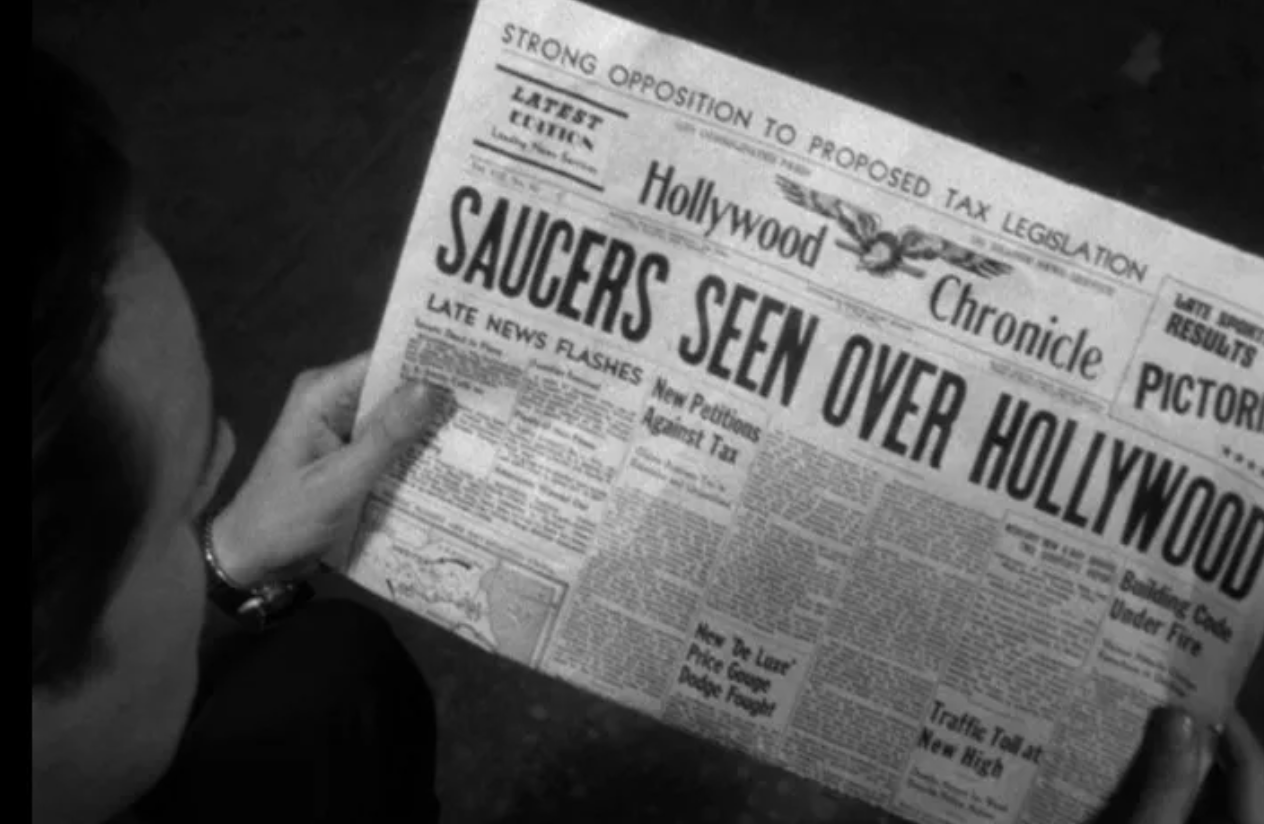
from Plan 9 From Outer Space (1959) directed by Ed Wood
1
Art as a found object draws on the surrealist attraction to chance. It fondles the frisson of contingency and the startle of accidentals while honing the juxtapositional impulse of collage and sampling.
2
On September 23, 2006, Mark Fisher spoke to John Foxx about electricity and ghosts. Foxx said he admired the films of Ed Wood, who created films “simply because he was in a place where it could be done.” Reading Wood as “a sort of advanced naive artist,” Foxx credits him with inaugurating the cut-up movie, a form that he built from fragments, including “props he came across in warehouses and stock footage he discovered in the vaults of Hollywood cutting rooms.” Wood's cut-up films are an early exercise in “inadequacy and tenderness” to Foxx.
3
At one point during his conversation with Foxx, Mark Fisher turns towards the reader, parenthetically, and says that Pop is “virile mongrel . . . capable of effortlessly demonstrating, manifesting, absorbing, remaking any sort of academic intellectual construct” and doing this so effortlessly that prior versions seem diluted, insufficient, or “even redundant.” Rock n' roll can “prefigure avant garde concepts by arriving at them from a totally different direction.”
4
The two begin discussing citational specters. Fisher asks Foxx why thanked Paul Auster in the sleeve notes for his album, Tiny Colour Movies.
Taken from John Foxx’s album, Tiny Colour Movies (2006)
Foxx says that, back in the 1980's, he wrote “this thing called The Quiet Man . . .in fact, I'm still writing it” — and then, he just so happened to read Paul Auster's New York Trilogy — which “struck so many chimes.” According to Foxx, “it was as if I had written it, or it was the book I should have written. I have to be very careful to find my way around it now.” This “occurrence” was both “rewarding and terrifying”: it suggested that there was “something in the air.” Exhilaration came with a sense of recognition: “it feels as if someone has published first, and therefore registered their claim to where you discovered gold.” And so Foxx thanked Auster in order to “acknowledge the effect, and the odd sort of encouragement of recognized themes, as well as the continuing parallel interest in the idea of lost movies and fragments.”
5
Ballard, Burroughs, Dick: Foxx listed the sci-fi writers who deployed thought experiments in order to think about “the near future.” We have entered the counterfactual space in considering the way “the unrecognized present” may have consequences and result in a world different from what we predict, know, or imagine.
What is unconscious resonance? What can resonate for us without becoming clear? Fisher and Foxx grope for words about the abstracted ‘feelings’ in Foxx’s films.
FISHER: You often use the word angelic, or angel . . .
FOXX: Yes, very perilous territory, especially since those terms have been co-opted by New Agers. [Foxx proceeds to outline a few of his “thought experiments.”] The idea … of parallel evolutions — imagine something that may have evolved alongside us, something we're not quite aware of yet, that we haven't discovered… invisible because of their proximity. 'Hiding in plain sight' . . . could give rise to situations that are tremendously moving, fragile, tender. Metaphorically very resonant. Another one.. .the concept of singularity. An event that only happens once, or once every thousand or million years. There may be rhythms which extend over tens of millions of years and are therefore unrecognizable to us; except as single unconnectable and unexplainable events.
How does resonance play into Walter Benjamin’s eerie evocation of the planetarium at the end of Berlin Childhood, his cosmos, his cosmology, his constellations?
FOXX: Another thought experiment posits the concept of Angels as a connection between things. An entity that only exists between. A sort of web or connection [that arises] . . . purely as an intrinsic, and visible, and unsuspected component of the evolution of the ecology that supports whatever they exist between. They cannot exist on their own. Many of us have these little incidents—everything from coincidences onward— things we can't explain using the references we commonly employ.
FISHER: On the LPs with Harold Budd… you get that sort of aching plateau, where you slow down so much that any perturbation has a massive effect . . . it allows an alternative ecology to emerge— one based on events that are much less frequent. And that affects their significance. You are drawn to them in a sort of smiling fascination, rather than the usual pop music method of lapel-grabbing bombardment.
The bombardment of Pop is not Alexander Kluge's angels, but Kluge's angels may nevertheless be present as a material possibility between the bombs and the ruins of the sound, particularly in the language of architecture and ‘new developments’.
FOXX: The lack of jostling allows that sort of elegant notional space to open up. Dreams are a very important component . . . not simply the image you present yourself with in a dream... also the emotional tone of the scene. You can see a cloud, but this will be accompanied by a sense of wonder or by a sense of dread, and it is that accompaniment that determines its meaning.
How is atmospherics being tied to clouds here? Why do clouds seem to pose this contrafactual role across soundscapes and visual media?
FOXX: When your parents are away for even an hour, it feels as though it goes on forever and you really deeply miss them — and the obstruction, the tone component of that just carries on through life. Gets applied to different situations. These longings . .. join the repertoire of tones we carry and apply. Some moments last forever.
FISHER: There's almost a positive side . . . an enjoyment of longing and ache.
6
At one point in the third book of Nocilla Trilogy, Agustín Fernández Mallo demonstrates his writing practice, namely, sitting down with an intention and then deviating from it. He envisions a projected work, a “cartography of the sounds in a campsite” composed of the campers’ favorite sounds. After asking various campers to share their favorite site-sounds, he would then request that they draw a map identifying the location of that sound on the campground. He would also take photos of these sounds, and caption them (i.e. “Photo of the sound of my tree” etc.). The photos and maps and descriptions would then be assembled into a catalogue.
A few pages later, the speaker meets himself, or his writing persona, who introduces himself as “Mallo” and hands him a stack of papers from a dresser drawer. The papers are titled “Our Project”; the pronoun attaches a plurality of authors to the the project. While flipping through these papers at random, the narrator finds “the same obsession that, we then found out, had its inception in Las Vegas, on those nights of mineral silence in which we had read a book called The Music of Chance by someone called Paul Auster before sparking up a Lucky Strike and listening to the sounds of thousands of waiters mixing cocktails . . .”
7
Speaking of speculative strategies, when Ed Wood had trouble financing a film titled Grave Robbers From Outer Space, he reached out to the Southern Baptist Convention and persuaded them that a successful science fiction film could provide them with a substantial cash flow. If Plan 9 did well, the money could used to finance another film that would segue with their own interests. namely, a film about the Twelve Apostles. The Baptists liked the idea of projecting the Bible onto cinema screens, but they were offended by the title Wood had originally selected for the film. So Grave Robbers From Outer Space became Plan 9 From Outer Space. The Baptists also insisted that the film entire crew be baptized before working on the project. Desperate for cash, Wood agreed. The crew took part in a baptismal ceremony. The film itself was made in five days for $20,000.
*
Agustín Fernández Mallo, Nocilla Trilogy. Fitzcarraldo Editions, 2002.
John Foxx, Tiny Colour Movies, 2006.
Mark Fisher. "Electricity and Ghosts: Interview with John Foxx." Ghosts of My Life. Zero Books: Winchester UK, 2014. pp. 160-170.