Shadows permeate our language.
Novels warn us of what is to come in foreshadowings.
The Grim Reaper reminds us of the shadow of death that stalks us.
Shadow cabinets exist in case reality dissolves the actual cabinets.
A song brings the shadow of a smile to rest on an open notebook.
The shadow of a doubt tarnishes our anticipations.
Folk idioms warn us not to mistake the shadow for the substance.
Shakespeare’s Macbeth defines life as a walking shadow.
“Shadows — hold their breath —” said Emily Dickinson, as Stephen Guy-Bray reminded me on twitter, on a March afternoon when I was thinking about how shadows sound.
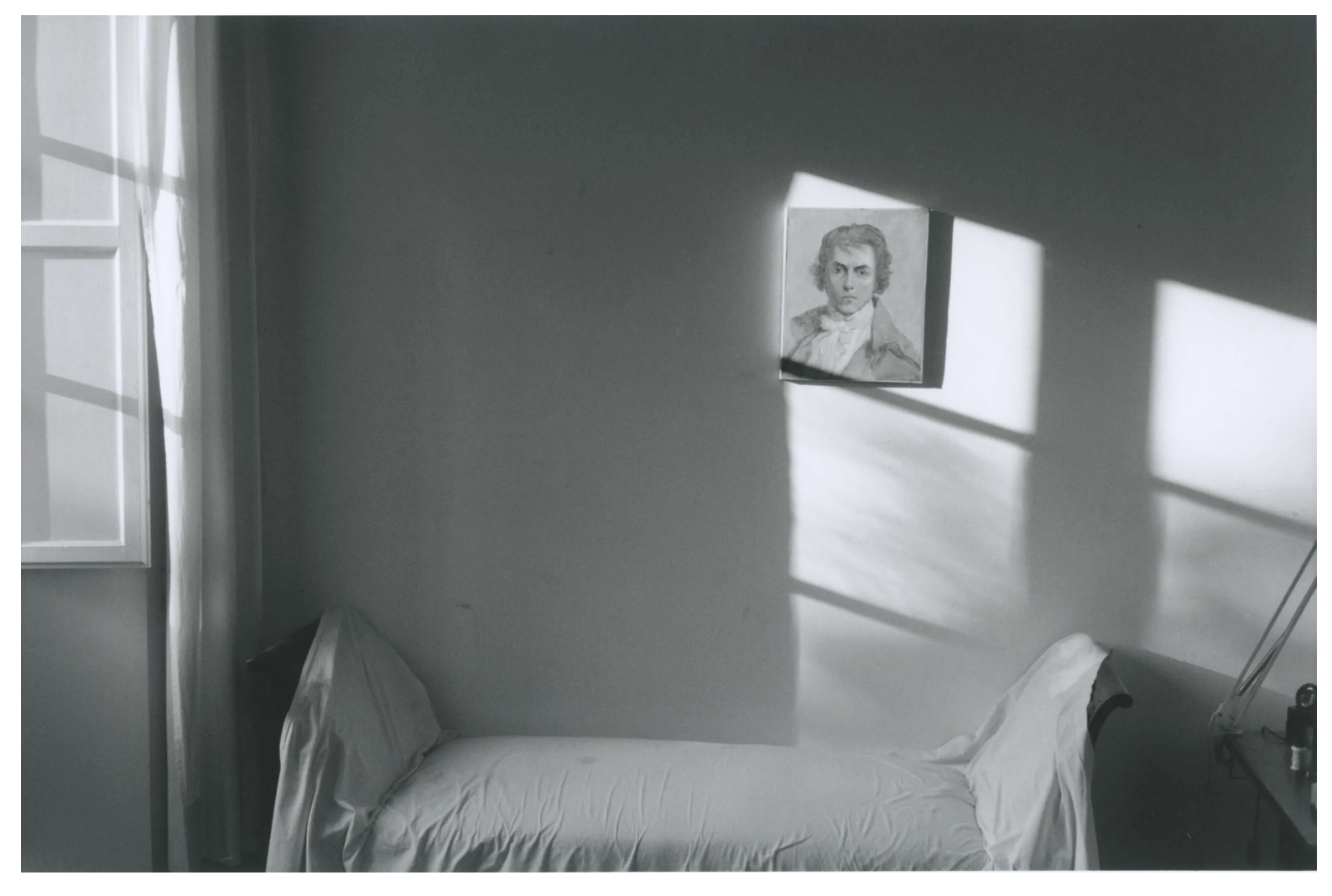
Photo by Hervé Guibert
Marcel Proust’s Jean Santeuil barely guised its autobiographical nature. I returned to it last week when preparing for a workshop that explores how writers use shadows in literature. What captured my attention was the imminently spectral nature of the magic lantern Proust depicted in this early (and, according to the author, “failed” version of what would become In Search of Lost Time). So I will start there, in the room of childhood, where Proust sets us alongside Jean, who has barricaded the door shut by pushing the chest of drawers against it.
With the door sealed off, Jean looks around. He sees “the light which, a moment before, had fallen quietly on the table, now, in the sudden darkness, produced a patch of concentrated brightness on the wall.” And then, suddenly, we are introduced to “the ghost of a window radiant with red and blue and violet” —which is “not an actual window of blue and red and violet glass” which comes “tremblingly into view, advancing and receding after the manner of phantoms or shimmering reflexions”:
But perhaps the most mysterious moment of all this fascinating experience was, for Jean, when, though he was still in his familiar room, neighboured by the washstand, the chest of drawers, the bed, he suddenly saw those marvellous shadow-forms take shape upon the grey-patterned wallpaper. For that was the moment when; the curtains having been carefully drawn, and the light of the lamp concentrated in a long beam moving obliquely across the wall to an unknown destination, his room seemed to be no longer his room, the lamp no longer his lamp. On that wall where formerly in a riot of feting colour, when a fallen log blazed suddenly in the darkness, a great light had flickered for an instant, and across which were now passing the marvellous dyes of church interiors and the characters of legend, Jean could see, a little below the mysterious band of light in which these apparitions were made visible (beyond it they vanished from view) the splash he had made that morning on the paper while he was washing. What, from behind that reflector in front of which strips of mystically coloured glass were slipped, projected the light upon the wall, what had burned his fingers when, in adjusting the reflector, he had touched the chimney, was his old familiar lamp which, in a little while now, when the chest of drawers should have been moved back into its usual place, when the chairs should have been carried away, when the reflector should have been dismounted and the shade replaced, would once again, as though roused gleefully from a fantastic dream, spread its globular, its soft and honest radiance on his book, leaving the wall in a half-light where the mysterious spot, the invisible trap-door whence ghosts had emerged to play their parts, should once more have merged in the general surface, a friendly half-light with which, one felt, phantoms, apparitions and the sliding movement as of impalpable windows of stained-glass had nothing to do, and in which, most certainly, they would not show themselves. Of such a kind was the only picture that adorned, and then for a brief space, Jean's room. A spectral picture, composed of shadows; a phantom picture, a picture which did not last for long and, therefore, struck his imagination far more powerfully than would have done a motionless picture hung for him to look at all day long.
Reviewing the spectral components of this passage, one notices the privileging of the inexplicable as something positive — not a futility to be explained away but rather a means of perceiving the world. For Jean, “the most mysterious moment” occurs while he sits there, “ in his familiar room” and “suddenly” glimpses “those marvelous shadow-forms take shape upon the grey-patterned wallpaper.”
The motion of the light beam “moving obliquely across the wall to an unknown destination” defamiliarizes Jean’s room: it is “no longer his room, the lamp no longer his lamp.” (Nothing really belongs to the child, does it? The child does not exist in an ownership of possession vis a vis objects and persons yet.) Old and new mingle as imaginary figures from books, paintings, and legends are “made visible” on the wall, just above “the splash” Jean “made that morning on the paper while he was washing.” But this condition (or way of seeing) only continues as long as Jean agrees to it— for it depends on his manipulation of the lamp’s reflector — just as the condition for the novel’s realization exists in our willingness to imagine it.
There is a spectral door, or a magic route between worlds. Proust calls “the mysterious spot, the invisible trap-door whence ghosts had emerged to play their parts, should once more have merged in the general surface, a friendly half-light with which, one felt, phantoms, apparitions and the sliding movement as of impalpable windows of stained-glass had nothing to do, and in which, most certainly, they would not show themselves.” The spot is what makes the spectral picture possible. The thing about spectres is that they materialize anywhere, can exist in any context, can return to haunt any room of the present that feigns solidity by denying their presence.
Proust’s “spectral picture” is “composed of shadows; a phantom picture, a picture which did not last for long and, therefore, struck his imagination far more powerfully than would have done a motionless picture hung for him to look at all day long.” Constituted by the shadow’s ever-changing relation to light, the “phantom picture” cannot last: its duration is brief and intense as a first kiss on a path between houses.
An excerpt from the same book, in a different section titled “Reading”:
[....] a man gazing on a precious fabric, another watching a dog, may be conscious of the presence of life before his very eyes, and strive to embrace it. But this was more: this was his life, this was the flavour which things have only for each one of us, and for us alone have kept it.
It is, perhaps, good for the human spirit to see in the whispering air, the sea, a piece of rock, things that are contemporary with creation and have survived the Flood. But there is, perhaps, for the mind a still greater emotional thrill in the sight, not of what has been, but of what has come into existence, of what life, though it may seem an ever-passing sequence yet is a definite something, has left behind it, has changed. These things which were created while our youth was slipping by, have a great power to touch the heart, the green crust which has slowly spread upon tree trunks in the Park, the green surface which has formed upon the pipes which supply water to the fountain, and which the very water, as an ancient mirror catches the colours of what it has reflected, takes on as well; or, if you are one of those who never go to the country, the dark tan which daily lighting-up time deposits on the chimney of your lamp. That thing, of all things the most precious, that irreparable something, which no object, however beautiful it be, however gifted with intelligence, can keep and render back, the thing that you have felt, the hours that you have lived, experiences that seem to be all spirit, immaterial, remembered— in them you have it, the slow and charming product of the old sweet hours, real and living, with those same green tones which, as the result of slow infiltration, have dripped from the bronze statue of Pan in the Park down over the marble pedestal. We gaze with love upon such relics of our past, as we might upon some priceless piece of needlework at which loved hands have laboured, soft green stuff in which there lie concealed the pipes of the fountain basin, stuff that scarcely existed at all when we were young, but today is so thickly worked, woven of the silent hours when we were dining or reading, when we lost our father, when we walked the roads at sunset, when we slept in old worn sheets, stuff that has been made by time, by our time, the time when Monsieur Grandi was still the Etreuilles lawyer, the time that comes back when we hear the name of the lawyer who married Monsieur Grand's daughter and, later, made her so unhappy, the time when so great a coolness existed between the Radice Mayor of Etreuilles, who, nevertheless, was a great friend of my uncle and our own old friend, The Cure; when we hear the name of the pastrycook [. . .]
I am cutting out words here, and picking up at the edge of an image:
[ . . .] see above his shop in the main street and catch my mother's voice saying: “We must hurry along to Mongeland's for à tart.” That name still holds the sound of my mother's voice, the sense of time which even then was hurrying by, the memory of my schooldays, of the charm not of youth in general, but of my youth. I revere that name because it holds for me more of the divine, more of what will never come again, than could that of any artist or philosopher, more than a relic that might contain the blood of Christ. For that was my time. Even now I can recapture its midday warmth along the hawthorn path, the blinding light that lay along the uphill road on which we walked so slowly because the sun was hot, the smell of hawthorn trees, and of the tarts which I was carrying in a paper bag to eat when we should have come to Montjouvain.
It is said that nothing in our lives is ever lost, that nothing can prevent its having been. That is why, so very often the weight of the past lies ineluctably upon the present. But that is why it is so real in memory, so wholly itself, so far beyond replacement. And philosophers say, too, that no tiny scrap of recollected happiness, no simplest occurrence of the past, can be felt by others as it is by us, that we cannot enter into their way of feeling, nor they into ours—a thought which sometimes brings so sad a sense of loneliness to those who brood upon it, can, nevertheless, give to our past the unique character which turns our memories into a work of art which no other artist, however great, can hope to imitate, but can only flatter himself that he has inspired us to contemplate within ourselves.
“And the books would beguile him until his eyes grew tired of reading, at which point he wandered into the kitchen to listen to the cook's stories as she walked up and down cleaning the shoes.”
This, too, partakes of the time’s narrativity, the listening and looking and watching and collecting of colors:
It was one of those tranquil moments when all things seem hedged about with the beauty to be found in mere existence, the charm of which is in the shadows as the far end of the room where the younger children's bed stands, in the soft light which turns the bed's bottom end to whiteness, in the ticking of the clock, in the lamplit face of the chattering cook, in then mysterious nooks and crannies of the kitchen lit by red reflections [...]
— and what he calls the “red constellations” of the kitchen, which exist “mysteriously supported in the air by a world of shadows, of the spotless tile-work of the range all brightly lit, of a red and unexpected glow, like a balcony with the unseen setting sun still full upon it at a corner of a street already dark.” The distance between interior and exterior collapses: the street is the house’s inner room. The light does the work of eliciting these coexisting worlds that enchant our childhoods and emerge from dialogues with close attention.
So “[...] the incessant babble of the fire is more agreeable even than that of the cook, because there is no need to answer it — though one feels it unnecessary to think about what one says to her, and in her eyes there shines something which is no less lively, no less fond, than the flame upon the hearth.” Just as it is “delicious …to be able to talk when silence grows oppressive and one feels the need to break it with a trickle of words.” It is lovely to let silence linger, and lovely to banish it. “Things then are lovely by being what they are and existence a tranquil beauty spread about them.”
And this beauty of being and seeing appears in the flowers, the dwarf hyacinths which Proust recollects garnishing the month of May:
Dwarf hyacinths were piled in heaps upon the altar, mauve-coloured curled, and tall columbines growing all the way up their stalks like a trimming of delicate and precious lace, of all the colours that one never sees on man-made things, in animals or cities, with the air, all of them, of having been born of those little clouds of heavenly tint which float for a moment after sunset in the sky, and tulips bright with all those glittering dyes which shutters make when they break up the strong glare of the sun. They stood in pots wrapped round with white foolscap paper. And nothing was more beautiful, emerging from the scroll of white and dazzling paper which hid it to the neck like a glowing shawl, than a great tree of Bengal roses, bearing not several roses on is stalk like pennants flying up the full extent of a mast, but bursting into one great scarlet bloom, a cup of dark and shining blood, from which unendingly were wafted, light and violet-sweet, invisible and unctuous, all the perfumes of Arabia.
[….]
Night came. How sad are those moments when rooms, as daylight flees, stay empty before those great reservoirs of warm radiance which men call lamps, have been opened! In the clear darkness, which grows deeper moment by moment, it is still possible to see the houses opposite from which the afternoon's bright colours have departed. They peer out with uneasy melancholy, like a troubled traveler arriving just as twilight falls at the strange street of an unknown cry.
[postlude]
Touch me! Touch me not! The existential work of portraiture lies in the inevitable exposure of the “present absence” and “absent presence” that portraits always overpromise but can never deliver: I, the Truth, am going away. Encapsulated in this phrase is the violence and separation of the image from its fleshy referent – the artist/sitter/beholder who loses himself or herself in the desire and fear, the love and envy engendered by the subject that looks back from the work. What remains is the portrait as irruption, as lacuna, as object of loss.
– Maria Loh, Still Lives (2015)