now the day has begun in a soft grey way
with elephantine traffic trudging along Fifth
and two packages of Camels in my pocket
I can't think of one interesting thing Warren
G. Harding did, I guess I was passing notes
— Frank O’Hara, “Poem”
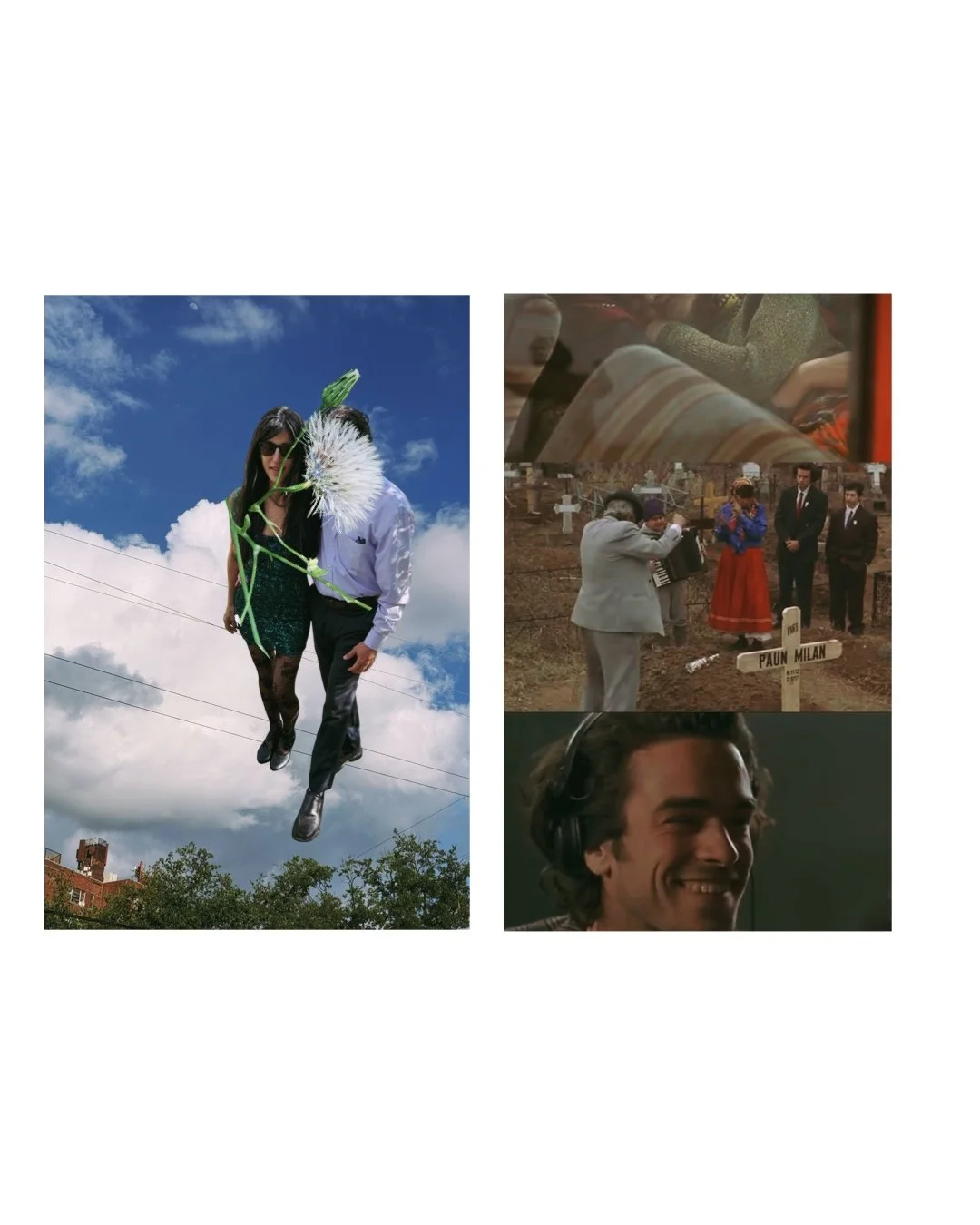
ABOVE: collage with weekend birds on wire and Gadjo Dilo (1997).
BELOW: a smattering of recently-typed notes on Frank O’Hara, and what his poems do.
Forgive me for diving straight in without a lure or an introduction.
Small motions, often visual . . . as if stanzas were paintings arranged on a gallery wall, interacting with one another relationally. I’m thinking of the tiny couplet-duo diptych O’Hara uses at the end of his page-long poem, “Clytemnestra”, and what he accomplishes by setting his brushstrokes of sadness and longing to the left margin of the page, visually distanced by an open field from the jocular goofiness of the couplet on the right:

It takes nothing less than a diptych to pull off the wide-open wound — “your time is my ” —- the statement left open, unfinished, expectant, eager to reach across the divide and attach itself to the definitional form granted by “ouch is the balloon.”
*
The staging and borrowing of theatrical effects, as in “Biotherm (for Bill Berkson)” where O’Hara indicates a decision to leave the page and return to hearing music by writing it as a stage direction:
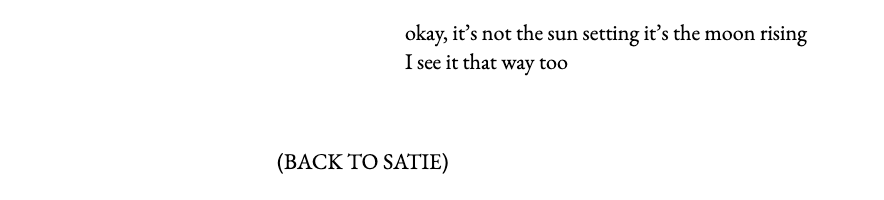
And the naming of plays that pass through the mind of the speaker or dawdle in conversations with Berkson, his alleged interlocuter:
ENDGAME WAITING FOR GODOT WATT HAPPY DAYS which means I love you
what is that hat doing on that table in my room where I am
*
This visual aspect again, in the second part of “Day and Night in 1952” where the end repeat of “of” flares outwards like a peacock tail or a perfect rose-colored fan swishing past a face at the opera:
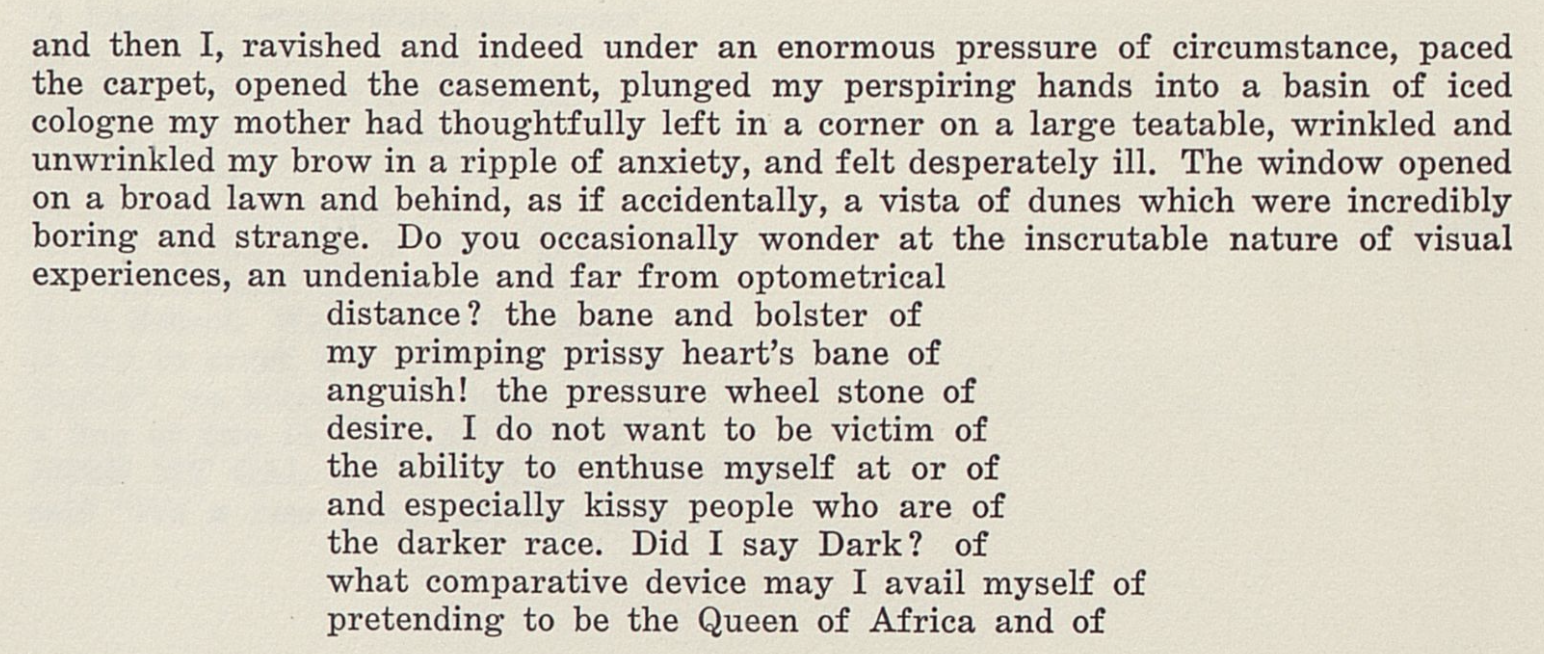
Given the constancy of his questions bouncing up and down like a nervy knee beneath the cafe table, you can’t really avoid feeling Frank’s ontological restlessness. The co-feeling of things is how he loops in the reader as a collaborator in the living and being of poetry. Any distance he imposes is flipped by self-deprecation.
*
[On that note, to aside a bit, I growl when the teens refer to someone as a “pick me,” partly because it’s a stupid little Tiktok-token greased by empowerment culture, but mostly because it truly erases what it means to be human, which is always always always an uncertain endeavor, a grappling with selfhood that balances the performances of the selves others demand against our interiorities etc. Some people will never feel sure of themselves; some people will always have a complicated relationship with sociality and visibility; some of these people will be poets who title their poems, “In Memory of My Feelings.” The premium we place on branding and marketing keeps us from distinguishing the significant difference between “authenticity” (which begins with the assumption of a stable personhood that can be metered) and “sincerity” (which eschews the idea of personhood for the complicated, often humiliating, expression of being). Look, I’m not questioning the market-value of confidence or self-assurance in a culture based on selling things— we are raised into the world bequeathed by self-help and Dale Carnegie — but poetry, of all literary forms, resists this sort of emboldened aloofness. And that is where Frank comes in…]
*
Again and again, O’Hara sucks us into his yearning for things, people, places, colors, auras, sunsets, all the aesthetic ornaments poets are told not to mention, or else mention very sparingly, lest language get too maudlin or sticky. We know O’Hara cannot help it. We know he misses things constantly, ravenously, like “drunken Magi,” and then uses those figurations to evoke that “you” which keeps moving through his poems, never entirely settling on one face for long. Or just long enough for “a larger faintheartedness like loving summer”.
Voici an “always” of it in “Biotherm (for Bill Berkson)”:
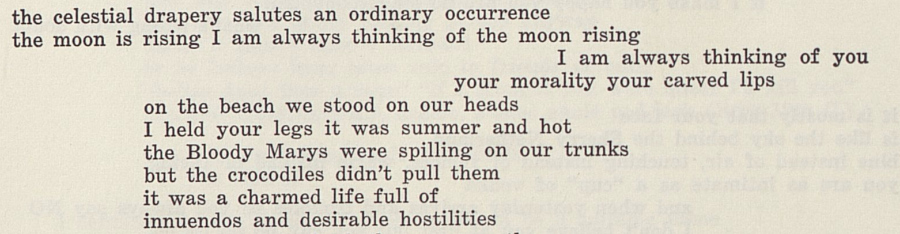
I am always thinking of the moon rising / I am always thinking of you / your morality your carved lips —-
and when we flip a few pages further, past the dishes and foods listed under “(MENU) / Déjeuner Bill Berkson / 30 August 1961”, past the “Hors-d'oeuvre abstrait-expressionistes,” and up to the next stage direction:

—-a stage direction which turns a play on repetition into an endearment, or a condition of being, before turning again, and moving into a more elliptical reference, an allusion to “moments” that remain inaccessible.
*
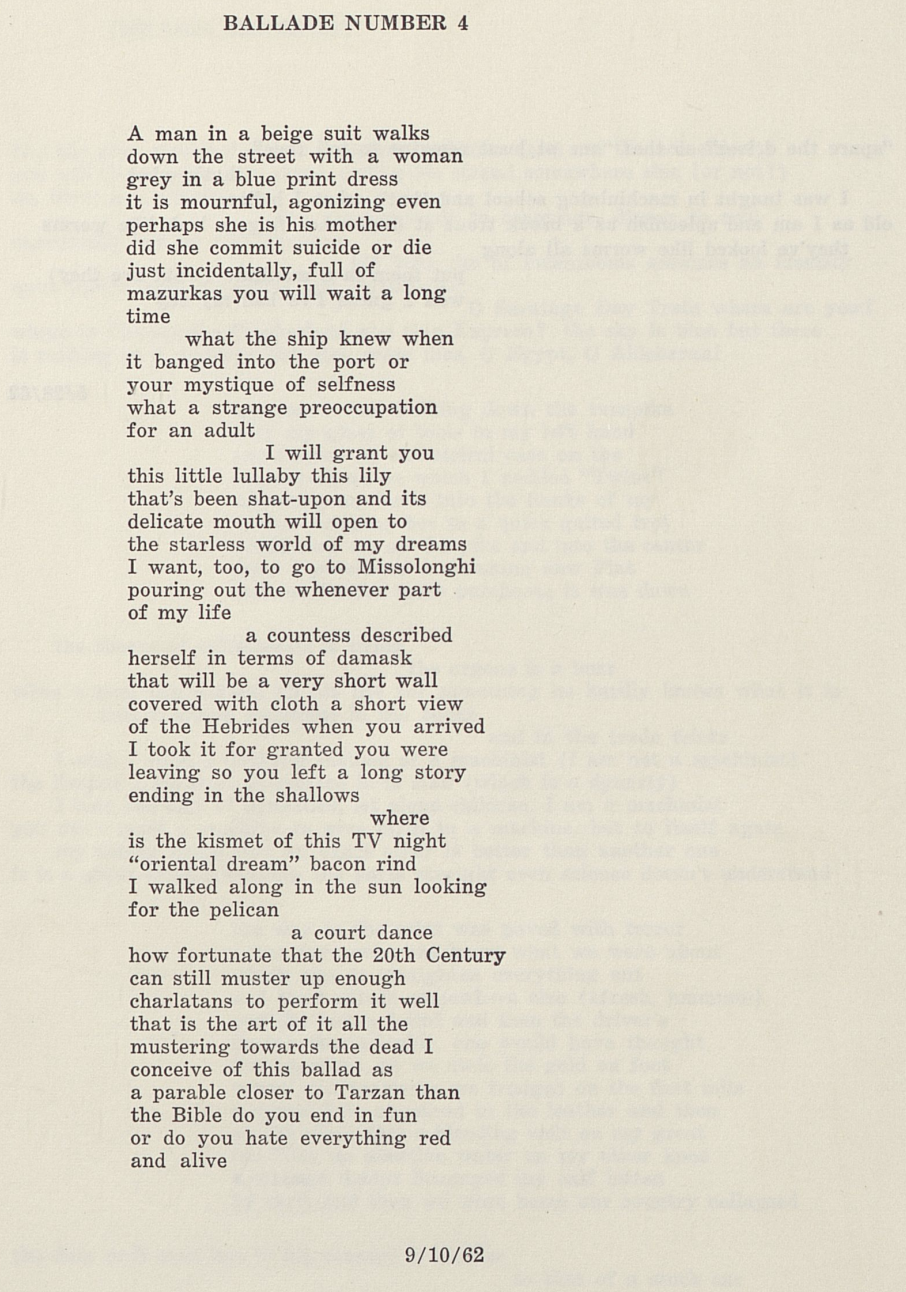
I’ll return to this, perhaps in longer form, on a day when other things don’t demand my immediate attention, but I leave you with the drizzle on my front porch, where the sidewalk offers a stream of humans who are walking their dogs in the rain, and this ballade:
O! And a few links related to my recent study of O’Hara’s “Second Avenue” …. and Gadjo
I remember the first time I met Frank O’Hara. He was walking down Second Avenue. It was a cool early Spring evening but he was wearing only a white shirt with the sleeves rolled up to his elbows. And blue jeans. And moccasins. I remember that he seemed very sissy to me. Very theatrical. Decadent. I remember that I liked him instantly.
— Joe Brainard, “I Remember”
*
An issue of Audit devoted to O’Hara in 1964
Andrew Epstein, Attention Equals Life: The Pursuit of The Everyday in Contemporary Poetry and Culture
Andrew Epstein, “‘I Want to Be at Least as Alive as the Vulgar’: Frank O’Hara’s Poetry and the Cinema”
Frank O’Hara, “Day and Night in 1952”
Frank O’Hara, “Poem” (the one referenced as epigraph and deserves laurels for its third stanza)
Frank O’Hara, “Personism: A Manifesto”
Frank O’Hara Papers in the MOMA Archives
Leonard Cohen, “Moving On”
Rachel Blau du Plessis, “On Frank O’Hara, ‘Second Avenue’”