Frolicking across the range of narrative voices, Marcel Proust’s novel, Jean Santeuil, does little to guise its autobiographical nature.
What intrigues me is the spectral nature of the magic lantern Proust depicted in Jean Santeuil.
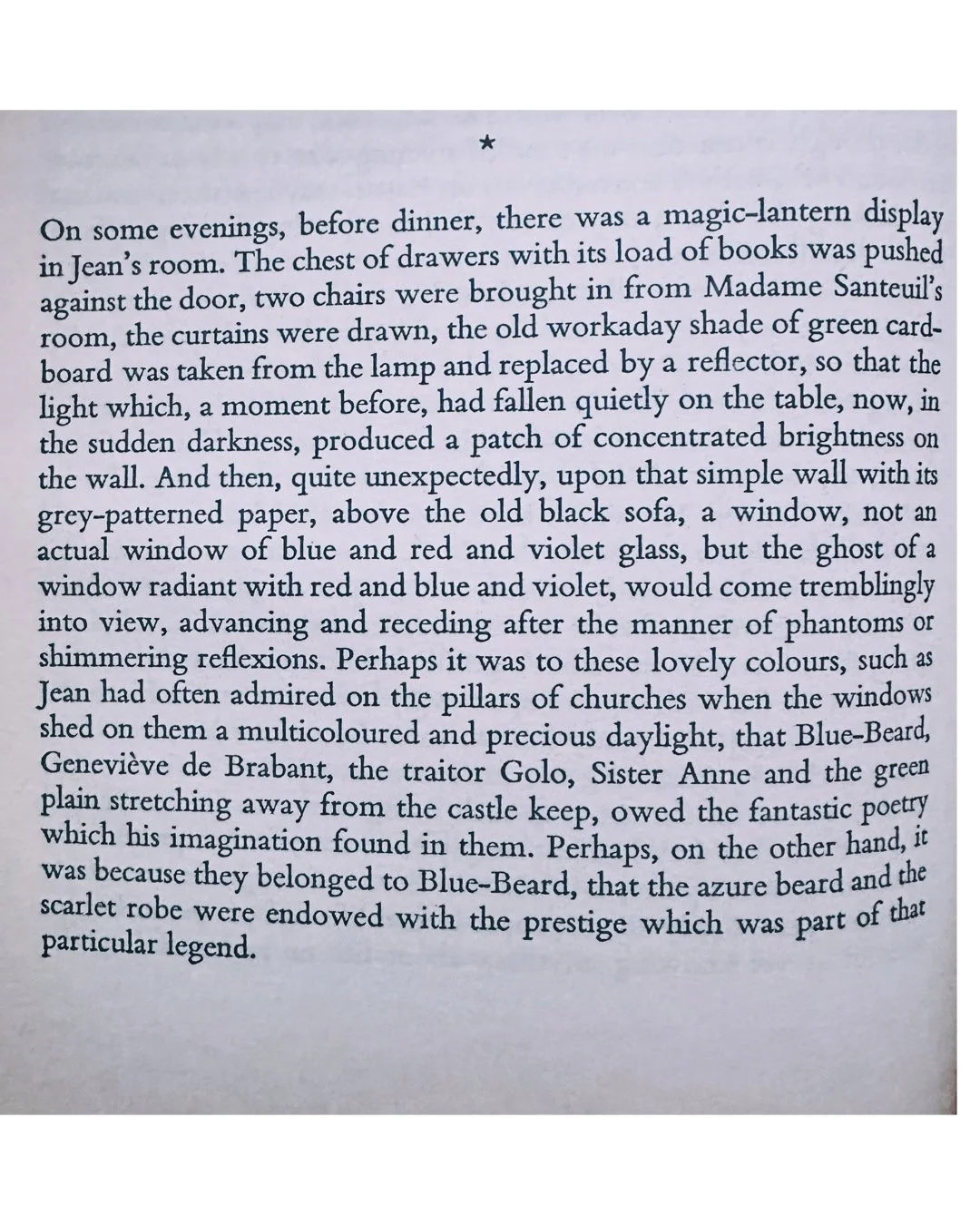
We are drawn into Jean’s room— which he has barricaded shut by pushing the chest of drawers against the door, and given to see “the light which, a moment before, had fallen quietly on the table, now, in the sudden darkness, produced a patch of concentrated brightness on the wall.” And then, suddenly, we are introduced to “the ghost of a window radiant with red and blue and violet” —- which is “not an actual window of blue and red and violet glass” which comes “tremblingly into view, advancing and receding after the manner of phantoms or shimmering reflexions.”
Here is the passage
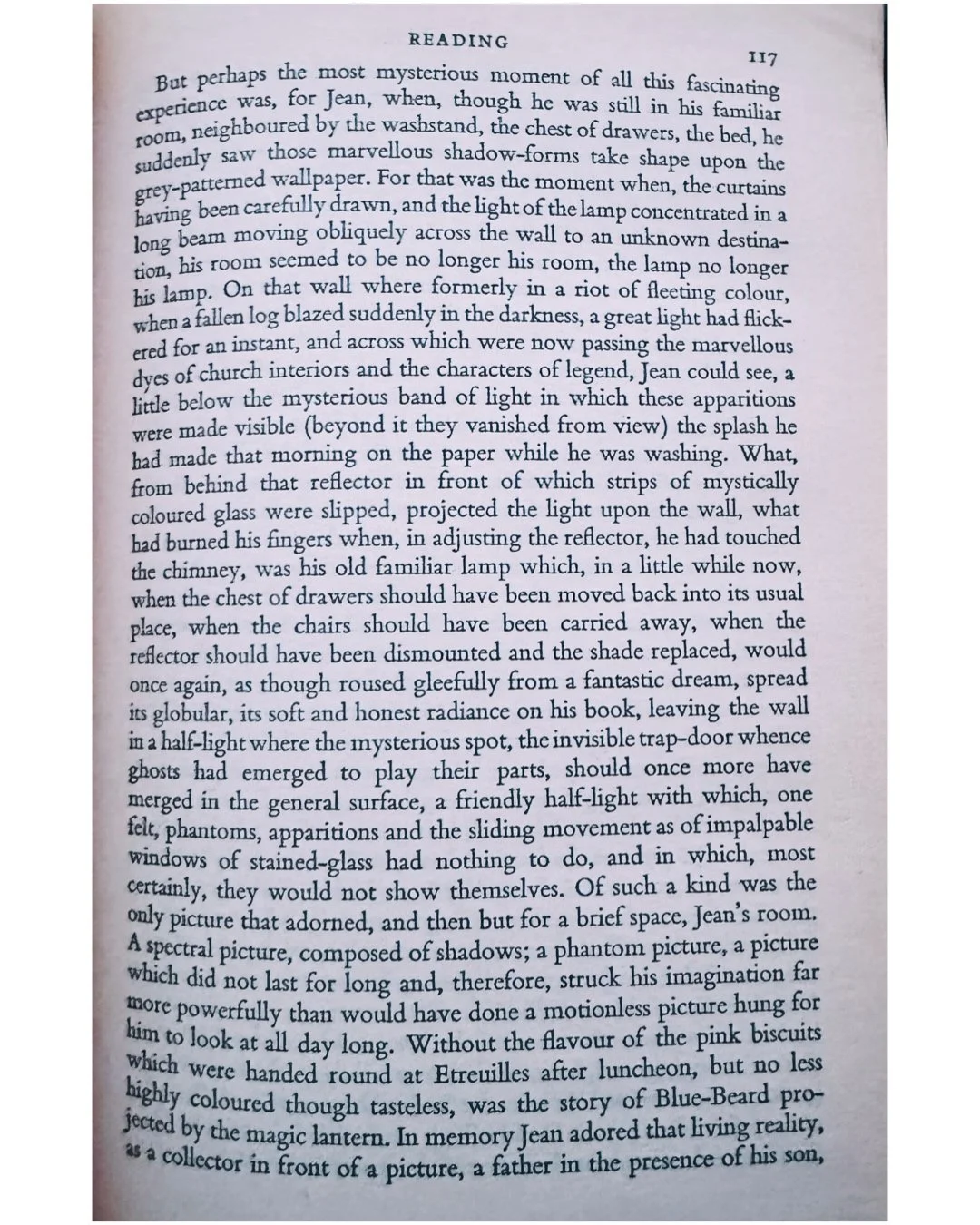
Proust tells us that “the most mysterious moment” for Jean occurs when “he was still in his familiar room” and he “suddenly” sees “those marvelous shadow-forms take shape upon the grey-patterned wallpaper.”
The motion of the light beam “moving obliquely across the wall to an unknown destination” defamiliarizes Jean’s room: it is “no longer his room, the lamp no longer his lamp.” Imaginary figures from books, paintings, and legends are “made visible” on the wall, just above “the splash” Jean “made that morning on the paper while he was washing.” But this condition only continues as long as Jean agrees to it— for it depends on his manipulation of the lamp’s reflector — just as the condition for the novel’s realization exists in our willingness to imagine it.
There is a spectral door, or a magic route between worlds. Proust calls “the mysterious spot, the invisible trap-door whence ghosts had emerged to play their parts, should once more have merged in the general surface, a friendly half-light with which, one felt, phantoms, apparitions and the sliding movement as of impalpable windows of stained-glass had nothing to do, and in which, most certainly, they would not show themselves.” The spot is what makes the spectral image — or “spectral picture” — possible.
“. . . a spectral picture, composed of shadows; a phantom picture, a picture which did not last for long and, therefore, struck his imagination far more powerfully than would have done a motionless picture hung for him to look at all day long.”