“Touch me! Touch me not! The existential work of portraiture lies in the inevitable exposure of the present absence and absent presence that portraits always overpromise but can never deliver: the Truth, am going away. Encapsulated in this phrase is the violence and separation of the image from its fleshy referent - the artist/sitter/beholder who loses himself or herself in the desire and fear, the love and envy engendered by the subject that looks back from the work. What remains is the portrait as irruption, as lacuna, as object of loss.”
— Maria Loh, Still Lives (2015)

The story of an M.
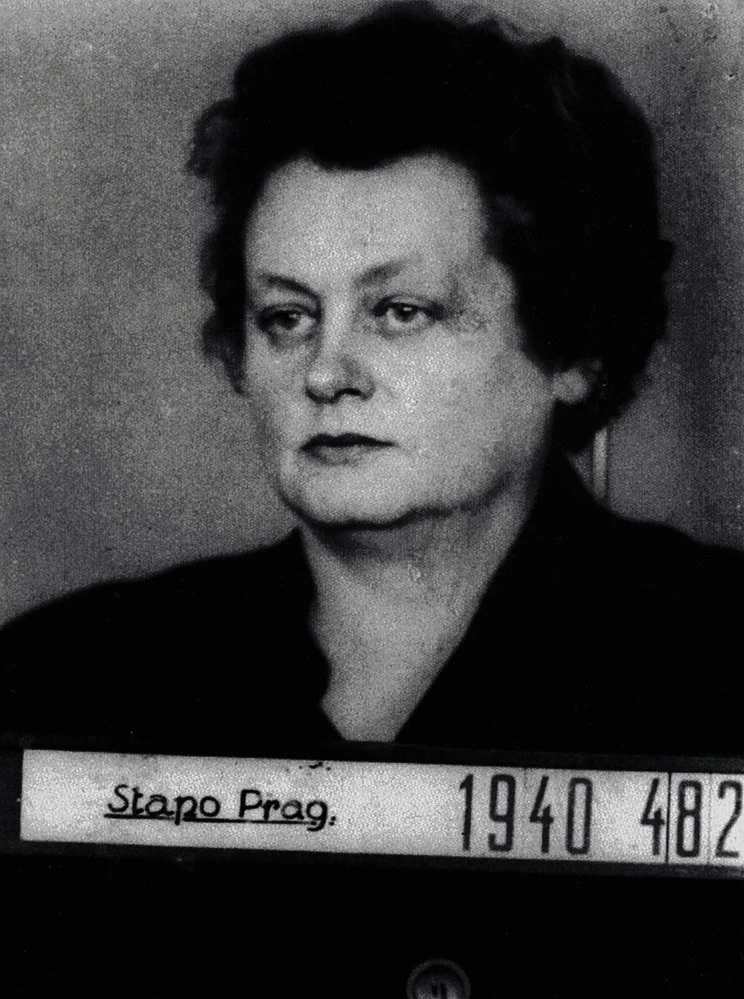
Her name was Milena Jesenská.
She was born in Czech and rendered motherless at the age of 13 (or 16, depending on the source). She described herself as a sentimental, rebellious, difficult teenager who found it difficult to respect her father‘s patriarchal control and competitive cruelty. Like other bourgeois bullies, he spanked her. He locked her in closets. He put a premium on social standing and obedience. He had a vicious temper. He was a moralist, a conservative, a dentist, a businessman, and an antisemite.
Once she began reading, her world opened. Milena read voraciously. Fyodor Dostoevsky, George Meredith, Lev Tolstoy, Knut Hamsun, Jens Peter Jacobsen, Thomas Mann were among her favorites. As a teen, she snuck out of her father’s house to sit on the wall of a nearby cemetery and watch over the dead in their dealings with their living. She loved beauty and giving gifts. She strolled through Prague like a pre-Raphaelite, loose hair, arms filled with flowers. What stood out was her intense fellow-feeling for others, her disregard for social state status or material wealth, her fascination with fallen humans. From an early age, she valued love and relationality above positional status and market-based success. Friends said she “glided through life” as if not entirely grounded in it.
There is a dress in this, and a hue of bright purple.
Crouched on the steps of the concert hall, Milena was studying the musical score when a man appeared behind her and began reading along. Ernst Pollak. The two of them fell in love over music. And it was in the name of love that he agreed to hike one of the hills near Prague to watch the sun rise, as she wished – though love did not prevent him from complaining about the cold and exertion as he made his way up the incline. That sunrise turned into a locus for friendship. A circle of friends grew around Ernst and Milena, and they would hike Prague’s hills and read poetry or recite poems from the hillsides. Since folk songs were one of the few art forms that had not been suppressed or excised from Bohemia, culture and poetry developed from its bones and conventions.
Milena means “loving one.” And this she did fiercely.
In 1917, as a result of her lax behaviour and moral misconduct, her father had her confined for nine months in the Veleslavín insane asylum on the grounds of ‘moral insanity’. At the time she was having an affair with Ernst Pollak, a bank clerk from the provincial town of Jičín, well-versed in music and literature, whom she married when she came of age at 21 and left with him for Vienna.
The first time she and Ernst had sex, she appeared in a friend‘s room afterwards. Her cheeks were flushed, eyes sparkling, childlike joy radiating from her heliotrope-colored dress. She didn’t think twice about leaving Prague and going with him to Vienna in 1918. She never thought twice about things she knew. Milena was enamored with his mind, his appetite, his culture, his intellect. He insisted on free love, and she obliged him. But she felt out of place among the cultivated Viennese women whose passion had never burned fingers or slammed doors. She was reckless in love, and generous in friendship. She taught Hermann Broch how to read and speak Czech for money. In conversations with friends, Milena complained of feeling limited by the ways Ernst beheld her. She suspected he didn’t desire her because she had only one dress. She did cocaine, published articles in Tribuna, and translated texts by Rosa Luxemburg, Hermann Broch, Franz Werfel, Guillaume Apollinaire, and Paul Claudel.
Then, in 1919, she read a short story by a minor writer named Franz Kafka and wrote him a letter seeking permission to translate from German into Czech. The following year, she went to meet Franz Kafka in a small town where he was being treated for tuberculosis. He described her as the “loving one” in their letters. There was no shame in her approach to love, no coquetry or manipulation. She told a friend, “You know nothing about a person until you’ve loved him.” Franz and Milena spent four blissful days together in Vienna. The chestnut trees burst into flowers around them.
The Nevertheless appears, as Kierkegaard hums in the margins.
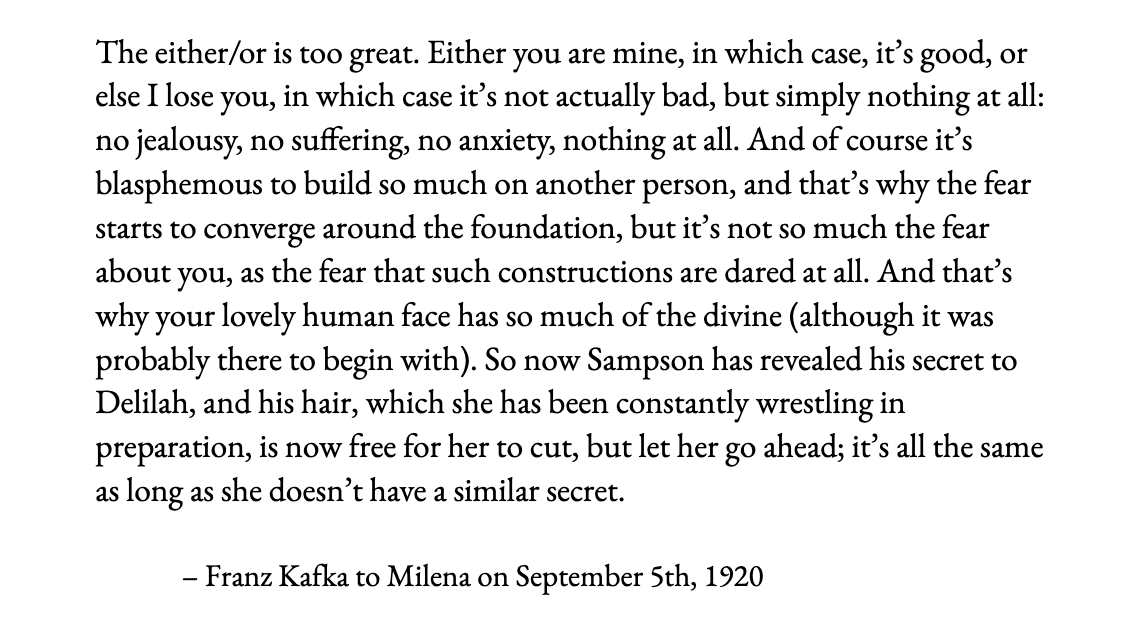
In a letter dated September 18th, 1920, Kafka condemns himself for making things too hard, acknowledges that his fear made it difficult to keep from catastrophizing - “I was living off your gaze,” he tells her. Milena sees him as he wants to be seen. There is no “solid ground” beneath a divine gaze. One cannot live on earth at the same time. They had Vienna, and then the failure of the next meeting. Kafka is ill. He lists sanatoriums. His syntax stutters and recuses itself. Exhaustion perfuses his letters; he indicates resignation towards death as well as loss.
Believing yourself to be loved is not the same as living or inhabiting the difficulty of love, Kafka suggests on the evening of Sept. 20, 1920, when he looks at the speech acts of lovers, adding: “But those aren’t really lovers, they’re just grammarians.” He dreams that she is on fire and he cannot save her — it takes a fireman. But the Milena that survives as a wan, lifeless, sort of shadow of the self.
The “nevertheless”: this is what Kafka craves in her marriage to Pollack, the nevertheless which she articulates in her essay as why happiness is a silly goal for marriage.
And the Neverthelessness gets published a few years later, in January 1923, as “The Devil at The Hearth” by Milena Jesenská. Marrying for happiness is selfish, frivolous, and stupid, Milena argues. It is the same as marrying for money, for title, for luxury goods. “The only good reason for two people to get married is if it is impossible for them not to. If they simply cannot live without each other. No remorse, sentimentality, tragedy: it happens.”
Although Pollack cheated on her constantly, she had given him her “nevertheless” - her partnership - and this unconditionality is what Kafka most craved and refused of the world. There is no way to know the person one is marrying, Milena says. The countless “risks of disappointment” exist from the nature of marriage, and accepting them is critical to relationships. Against “the modern hysteria a la Anna Karenina,” she says, we should see each human as a world unto themselves and accept each other in order to affirm “feeling justified in being” one’s truest, least performative self.
“Proof that he is loved ‘nevertheless’” is more ethical and precise than the vow of romantic love until death. Milena mocks the “miserable, shabby happiness” of the marriages in which partners sacrifice everything and have every good fortune and still can’t be happy. The vow itself amounts to the “accepting a promise that can’t be kept” and then acting victimized a year later. Variance in emotional needs (and some have “a talent for being happy") makes it impossible to form a baseline guarantee of conditions to produce this inexplicable state. Because there is “a talent for being happy,” and because some find happiness in less, there is no guarantee of conditions to produce this inexplicable state. “Longing for happiness” is the cupcake of a relationship, and the rot of all teeth.
Franz replied to her (and it) with a lengthy letter dated “January-February 1923” which ends: “The evil magic of letter writing is setting in and destroying my nights, even more than they are already destroying themselves. I have to stop, I can no longer write. Oh, your insomnia is different from mine. Please let’s not write anymore.” After this — and between his death in June 1924 — Kafka sent only two curt postcards (one mentioning his forthcoming death) and two about notes which seem to struggle for breath, for oxygen, for life.
By the time of Kafka’s death on June 3, 1924, Milena had broken up with Ernst Pollack. She returned to Prague, and married an architect, Jaromir Krejeor, a few years later. In 1928, she gave birth to a daughter named Jana. A few years later, she divorced Jaromir in order to live her life, and to continue writing and thinking. She joined the CP and wrote for them, addressing social issues like abortion and censorship in her articles. She did this despite the eye-rolls from men on the left. She wrote about socialization and gender at a time when social issues were considered irrelevant to the revolutionary economic issues at hand. In 1936, she stopped broke with the Party after the execution of Zinoviev and Kamenev. She worked to help Jews escape to Poland and was arrested in November 1939.
Milena’s final years were spent in Ravensbrück, the Nazi concentration camp. She never stopped writing and studying the world. One of Milena’s friends in the camp described a grotesque scene she had witnessed: a withered fellow prisoner made a pass at a “hardened criminal” and the two humans as if nothing could stop the dance of lust from surging between them. Milena smiled at her friend’s disgust and said, “Thank God love is indestructible. It’s stronger than any barbarian.”
* Heliotrope means “to move with the sun,” in reference to the flowers that follow the light of the sun throughout the day.