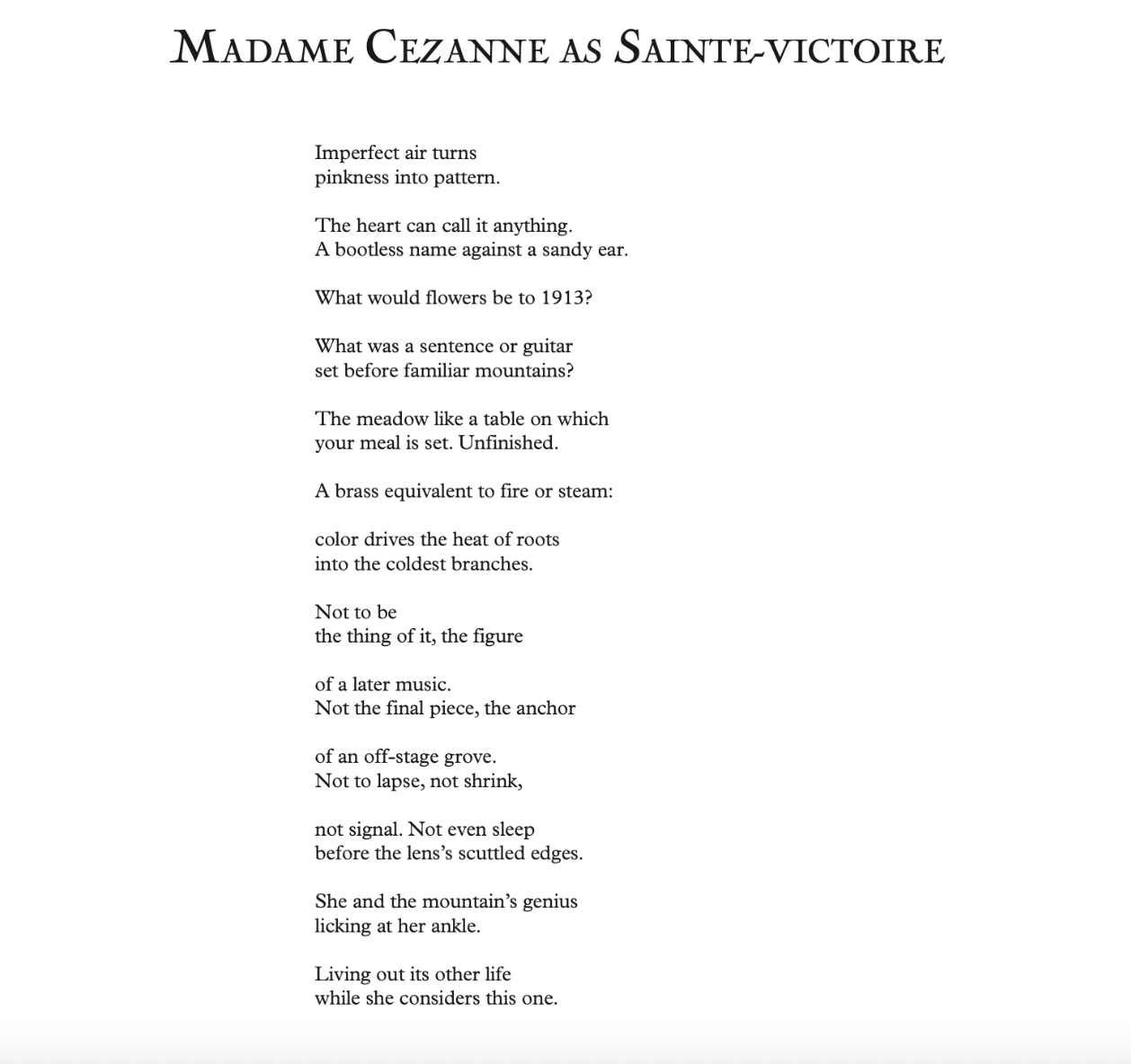
She and the mountain’s genius
licking at her ankle.
Living out its other life
while she considers this one.
— Elizabeth Willis, “Madame Cezanne as Saint-Victoire”
1
All firsts lead back to Paris. In Paris, the artist reckons with the work of others, and the hierarchies that anoint the new stars.
“I will astonish Paris with an apple,” declared Paul Cézanne, after leaving his childhood home in Aix-en-Provence for the capital city.
Cezanne’s early oils linger in a dingy, sober palette; the paint applied in thick layers of impasto; a focus on color and perfection of silhouettes and perspectives as emphasized by the French Academy and the jury of the annual Salon. The artist must prove himself to others. This proof occurs formally, in the adoption of dominant styles and motifs, but also takes us space in the subject as conventions get pulled into the work.
2
Louis-Auguste Cézanne, the Artist's father, Reading “L'Evenement” (1866) Cezanne includes his own still life in the background. Maybe he hopes to solicit recognition from his scornful, disapproving father, Louis-August, who is depicted reading a liberal newspaper even though he was annoyingly outspoke about his conservative politics. A sort of idealization . . . or a joke about the artist’s power to change the world?
3
Parisian artists and their patrons are talking, and the artist must paint something that is worth discussing. He can’t set the tone of the conversation, so he borrows the motif and plays with quotation.
A Modern Olympia (1869-70) Cézanne's adaptation of the theme of the demi-mondaine, or high-class prostitute suggested in Édouard Manet's scandalous Olympia of 1863. Notes of anxiety and unease in the expressive, abbreviated figures, their faces outlined as masks rather than flesh. A vacancy of the face while bodies are dynamic and contoured with curves. Unlike Manet, Cézanne portrays the prostitute recoiling awkwardly in her nudity, drawing apart the figure of her suitor (which Manet rendered completely invisible) as a stranger, an outside. Some assume that the suitor is Cézanne himself.
4
All Cezanne's submissions to the Academy’s Salon were refused. In between seasons, he returned home to Aix regularly to be shamed by his practical father. Despite rejection, everything kept happening in the city, in the family, in the art world, in the salons, on the canvas. Three years— from 1870 to 1873— a frame that emphasizes the horizon.
In 1870, Cezanne moved to L'Estaque in southern France to evade the military draft. There, he fell in with the Impressionist Camille Pissarro, who convinced him to experiment with a brighter palette and to leave behind the heavy impasto technique for smaller, more vibrant brushstrokes. The Mediterranean sunlight touched everything; the landscape of cliffs and water beckoned as did the blues of the sea.
Cézanne then returned to Paris, where his son Paul was born, to his mistress, Hortense Fiquet. Cézanne painted over forty portraits of Forquet, as well as several enigmatic portraits of their son.
In 1873, Cézanne exhibited in the Salon des Réfuses, the notorious show of artists who had been refused by the official Salon (he counted himself among a circle that included Édouard Manet, Claude Monet, and Camille Pissarro, among others). The critics slammed the avant-garde artists, which apparently hurt Cézanne deeply. In the next decade he mostly painted away from Paris, in either Aix or L'Estaque, and he no longer participated in unofficial group exhibitions.
5
Aix-en-Provence, the land of hidden ruins and ancient stones, windswept trees whispering to anise twigs, processions of stately cloud-shadows painting the hillsides of my memory. Cezanne moved to the countryside in Aix-en-Provence to paint “nature by means of the cylinder, the sphere and the cone,” in his own words. His dearest friend, Émile Zola, also hailed from Aix-en-Provence.

Paul Cezanne, Montagne Saint-victoire (n.d)
6
Never underestimate the power of a train window to focus the gaze. On April 24th, 1878, Cézanne wrote a letter to Émile Zola from the cabin of the newly inaugurated the Aix-Marseille train. The “beautiful motif” of Mont Sainte-Victoire struck the painter as the train crossed the Arc River Valley bridge. Cezanne wanted his friend to know he had seen something indescribable. After this letter, Cezanne commenced work on a series of paintings devoted to Mont Sainte-Victoire. This mountain would become the subject of almost eighty paintings and watercolors for Cezanne.
7
The artist composes himself from inspirations, longings, and desires that elocute possibility. The mountain he has studied for decades becomes a proxy for the self’s perception. Critic Joachim Gasquet said that Cézanne urged him to look at Ste.-Victoire, to note its spirit, its “imperious thirst for the sun,” and the “melancholy” that descends upon its slopes “in the evening, when all this weightiness falls back to earth..” The mountains cull favor with the eye. “These masses were made of fire,” Cézanne said. “Fire is in them still. Both darkness and daylight seem to recoil from them in fear, trembling. There above us is Plato's cave: see how, as large clouds pass by, the shadow that they ast shudders on the rocks, as if burned, suddenly swallowed by a mouth of fire.”
8
Cezanne treated the canvas as a sort of screen to register the artist's visual sensations and perceptions as he gazes intensely at a given subject. There is, I think, a sculptural dimension to his later works, visible in the way he applied pigments to canvas, using a series of separate, rhythmic brushstrokes to construct rather than paint a picture.
The Bay of Marseille, Seen from L'Estaque (1885), with its bright colors and architectonic houses defining the foreground; sky and sea concentrate the blues and complementary colors create illusion of pictorial depth.
9
In 1886, after the death of his father, Cezanne married Hortense, and she became the official Madame Cezanne. The title of his paintings begin to reflect this shift, as in Madame Cézanne in a Red Dress (1888-90), where the various tones of red in the dress seems like the subject more than Hortense. The sitter's figure is rigidly imposing, almost soldier-like, her face plain and asymmetrical with only one ear visible. Geometrical accents dissect the canvas in both horizontal and vertical directions, thus creating the impression of a carefully arranged, monumental still life, as opposed to a portrait of a lifelong companion or lover. There is something of Cezanne’s late mountains in this portrait? Something of that constructive impulse?
10
Towards the end of his life, Cezanne painted one of the last landscapes of his beloved Mont Sainte-Victoire, offering the view in an abstracted, elliptical vocabulary.

Paul Cezanne, Mont Sainte-Victoire c.1905
Rather than depicting rocks and trees in detail, Cezanne daubed them lightly, as if to soften and illume the representation. The mountain looms over the objects, its hues presenting the eye with a sort of assembled puzzle. Seams between colors are visible, loosening the grip on pictorial representation. Forms overlap; cool and warm hues interpenetrate; light is the story—- this relational light that burrows inside each object, bodies touched by light, surfaces altered by an earnest commitment to this two-dimensional aspect. (Egon Schiele was also driven by longing to relay what light does to each body. . .)
11
I mentioned Cezanne’s portrait of Hortense earlier —- there is an exquisite poem by Elizabeth Willis that treats “Madame Cezanne” as the mountain Cezanne adored:
And, of course, there is another “late” painting of the mountain, an painting that Cezanne left unfinished, a painting that might be more properly called the final brush with the mountain.
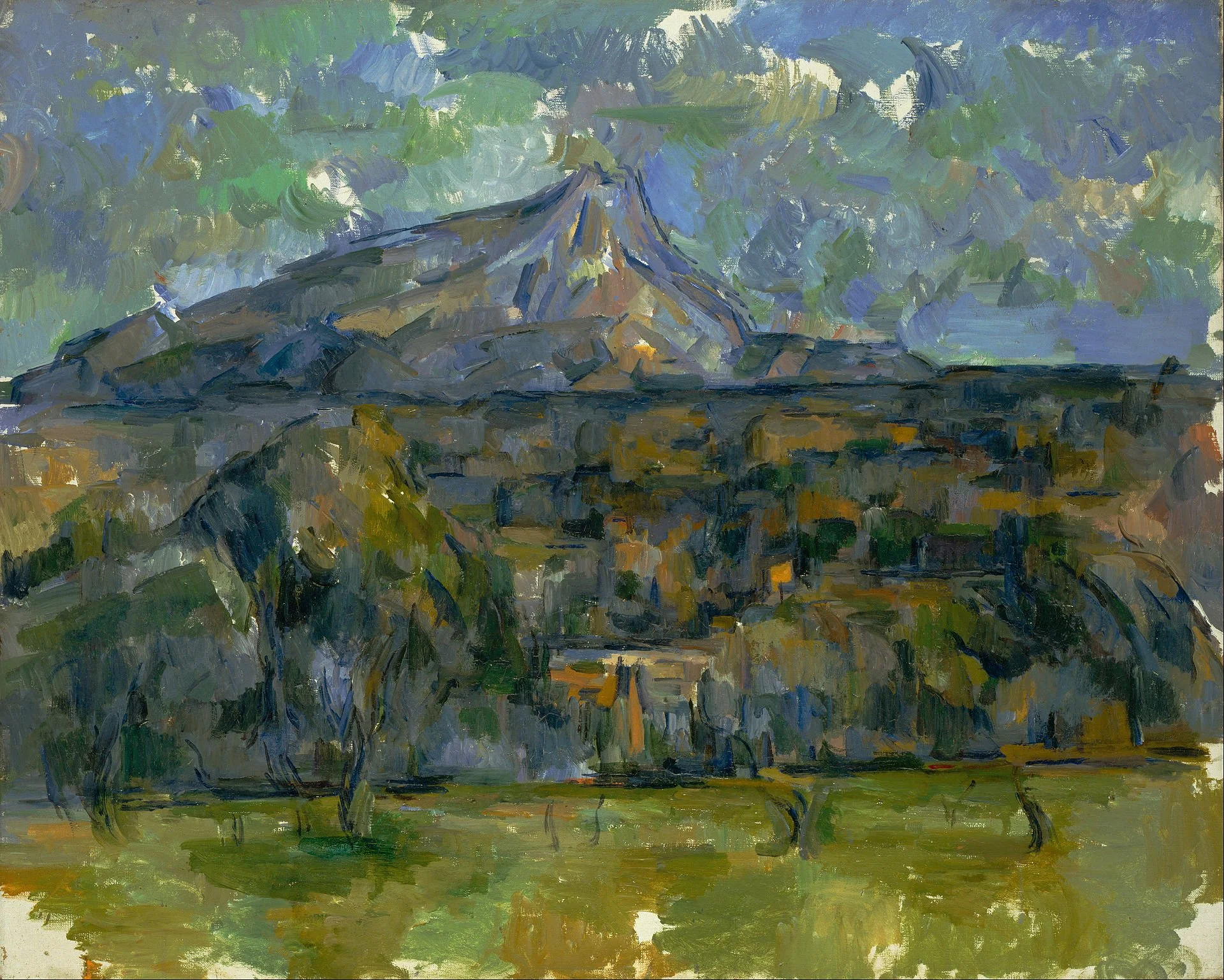
Paul Cezanne, Mont Sainte-Victoire Seen From Les Lauves, 1902-1906
Marginalia on the self’s “composition”
“Of what use is biography in assessing someone who made himself up?” wondered Peter Scherjahl in a piece on Arshile Gorky’s art and persona. “Gorky told people, including his wife, that he was Russian, a cousin of the writer Maxim Gorky (evidently unaware that Maxim Gorky was a pen name) born in the Caucasus in 1905 and educated in France,” Scherjahl noted. But that is a false story. A story that made Arshile legible to an American audience who knew very little about Armenia or the rest of the world.
As PS tells it: “Actually, [Arshile Gorkey] was an Ottoman Armenian, Vosdanig Adoian, born circa 1902, in a village near Van. He couldn't speak Russian and never saw France. His father emigrated to America in 1908. His mother died in Yerevan, perhaps of starvation, in 1919, four years after the remaining family had fled the Turkish massacres. In 1920, Adoian and a sister joined relatives in Watertown, Massachusetts. The first evidence of his new identity appears as the signature Gorky, Arshele, on Park Street Church, Boston, a skillful pastiche of Neo-Impressionism that he painted in 1924 while teaching at an art school in Boston. He admired the work of John Singer Sargent before latching on to Cézanne as a god of art second only, later, to Picasso. Early imitations of Cézanne, in the show, are astonishingly acute. Cézanne is the foremost of painters who unfold their majesty to close-up inspection. (Gorky stumbled in his tyro emulations of Matisse and de Chirico, artists more reliant on overall design.) With Gorky, influence is no incidental issue. I think he never ceased to regard his own creations vicariously, through the conjured eyes of heroes—he cited Uccello, Grünewald, Ingres, Seurat. He spoke with scorn of "originality" as a criterion of artistic value.”
Dark days the bright gods willed,
Wounds you bore there,
Argos old soldiery
On Troy beach teeming,
Charmed out of time we see.
No life on earth can be
Hid from our dreaming.
— The Sirens
*
Brenda Hillman, “Cezanne’s Colors”
Elizabeth Willis, “Madame Cezanne as Saint-Victoire”
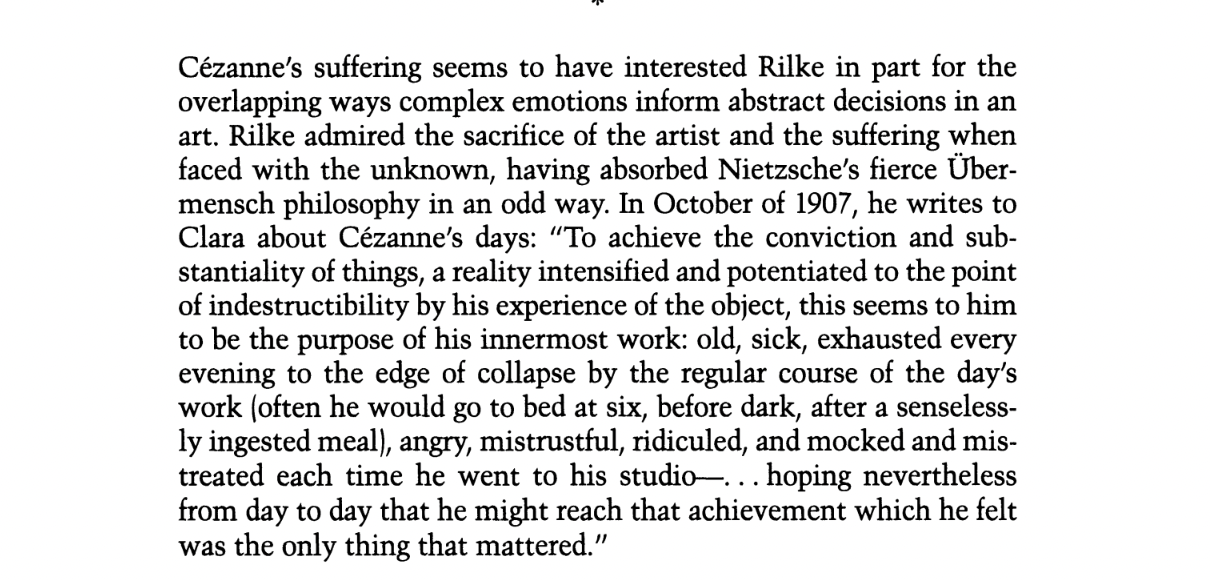
How Brenda Hillman describes the animating hope that Rainer Maria Rilke studied in Cezanne.