your lips are indeed a disaster of alienated star-knots
— Frank O'Hara, from Second Avenue
Also, he let language have its way with him.
—Frank O'Hara, talking at a Club panel, 1952, as quoted in Brad Gooch's City Poet
Lisztiana, Much Later
I sit in your T shirt
with its spots of paint
as a certain fierceness pours
outside, perhaps, too, on you.
I’m smoking a CAMEL now
and I have a big hole in my
shoulder from washing away
a lot of dirt. Are you there?
there, are you? I am here
and the storm is not enough,
it should crash in and wet,
there should be maelstrom where
a privileged host is smiling.
And naked in debris I there
should be, but, being here, should
bend to you, pick out of rubble
a scrap of painted shirt,
as if it were soiled ivory from
a grand piano, possessed of us
both, and ruined now by storms.
Frank O’Hara
A few letters and an O’Hara translation
John Latta is the only reason I was able to read these letters, and so any confetti must fall on him before going elsewhere. Latta translates a letter from Frank O'Hara to Fairfield Porter dated June 25, 1954, which turned out to be an interesting date, an asterisk date, so to speak, given Latta's thrilling asterisk (“According to a note in The Collected Poems of Frank O’Hara “Meditations in an Emergency” is “Dated June 25, 1954” with “the earlier title: ‘Meditations on Re-emergent Occasions.’”), all of which cannot diminish the fact that it was an unusually hot late June, as noted in the references to 'dog-days' peppered throughout O'Hara's letter. “I simply, in such a heat, cannot type you René Char’s great long and questionable lyric Exploit du Cylindre à Vapeur but I have collated the promised A*** and hasten to add another gem,” O'Hara writes, excerpting:
L’Amour
Etre
Le premier venu.
which he translates as:
To be
The first comer.
Char “is far more fun to do into English than the loquacious Mallarmé,” O’Hara writes, adding that when they meet again, he “will have a sumptuous divertissement by Jean Genet Un Chant d’Amour (it’s easy to see what’s on our minds these dog-days) which JA has pronounced one of my best works—I hope this doesn’t mean that it’s a terrible translation, but can’t figure out what else it could mean. There you are, he giveth with one hand and taketh with the other.”
His friends saw “an enchanting movie The Holiday of M. Hulot” which Frank has yet to watch, though it comes highly recommended. “I came rather late to the party (back from dinner) but it was fun at Grace’s ne’ertheless; I’m sorry you didn’t either come earlier or stay longer,” he says, spooning in one of those archaic contractions that indicates fondness or sentimentality to Frank, who suspects that John Ashbery will soon have to pass the title that Larry Rivers “assigned” him, namely, “Last of the Gay Blades”, to Frank himself, —”but then John should rest this summer anyway.”
Jesting, playing up that smirk of sadness, Frank says “Baudelaire had the funds to be a dandy but the most I can manage is to be a petit boulevardier.” He pokes Fairfield for impressions of Joan Mitchell, adding his own ambivalence: “I found her rather grumpy that night at Grace’s though she kept announcing how friendly she was feeling. At other times I have found her charming when she was terribly self-announced-depressed and had everyone else fleeing in droves. I guess it’s not her, then.” Maybe it's me, Frank intimates, ruffling the page with his chameleon-like slinkiness, changing his mind about dinner plans mid-sentence, shifting tenses as if in the middle of making plans— “Mike and I are having dinner tonight but it’s so hot I rather think we should forget it.” — and then swooping in with an affectless, casual delivery of the punchline: “Maybe we’ll just eat Ice Cream. I always eat that on Friday because of my upbringing.”
The word upbringing situates itself awkwardly, at the edge of a bed, one shoe on the floor, the other shoe in hand, like a photo I recall seeing of O'Hara himself, with a painting nearby. Speaking of seeing, since the eye often guides his pacing, the following paragraph dives into that space of expressive motion, moving from glimpsing an alumni bulletin and cringing, to firming himself by loosely identifying with a dandy or a cucumber or a cliche:
I saw a copy of the Harvard Alumni Bulletin which John has in the bathroom and I must say it is more disgusting almost than the McCarthy hearings, complete with a photo of Lyon Phelps at Hazens with two Radcliffe admirers. It must be wonderful to be an elder poet at 29, with all of the pretensions and none of the mistakes. (As you see, my spleen is fresh as a daisy and cool as a cucumber.)
He reports that Ashbery “received a note from Jimmy which was sweet and had that I-really-should-be-working tone common to all us pros so I guess he is digging in without much trouble.” And perhaps this digging calls to a mind a shovel, which is too heavy an instrument to lift or use in the insufferable heat, and so O'Hara returns to the raison at hand, signing off in one of his lofty self-debasements, that scent of Charlie Chaplin tap-dancing across the stage of the page, suited in that painstaking and excruciating earnesty that feels so out of step with the seriousness and insincerity of the surrounding world: “This letter started out of the vain desire to write you a letter, but I don’t dare keep it up having just reread it.” Yes and — “Call when you get in and give my love to Katy,” he adds, attaching “the promised A***”, which Latta notes that O'Hara “campily misattributed” as Franz Liszt, the casanova of composers and performers whose reputation raised flighty wrists and bourgeois fans across Europe.
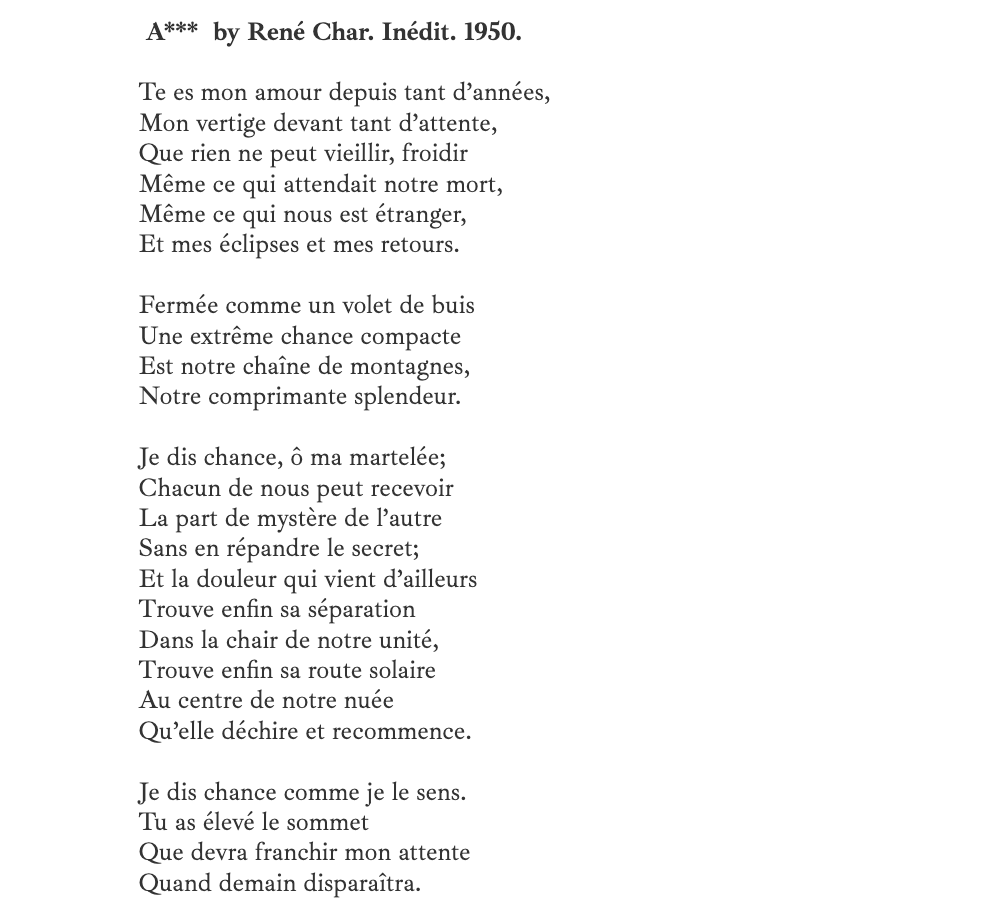
And Frank’s translation:
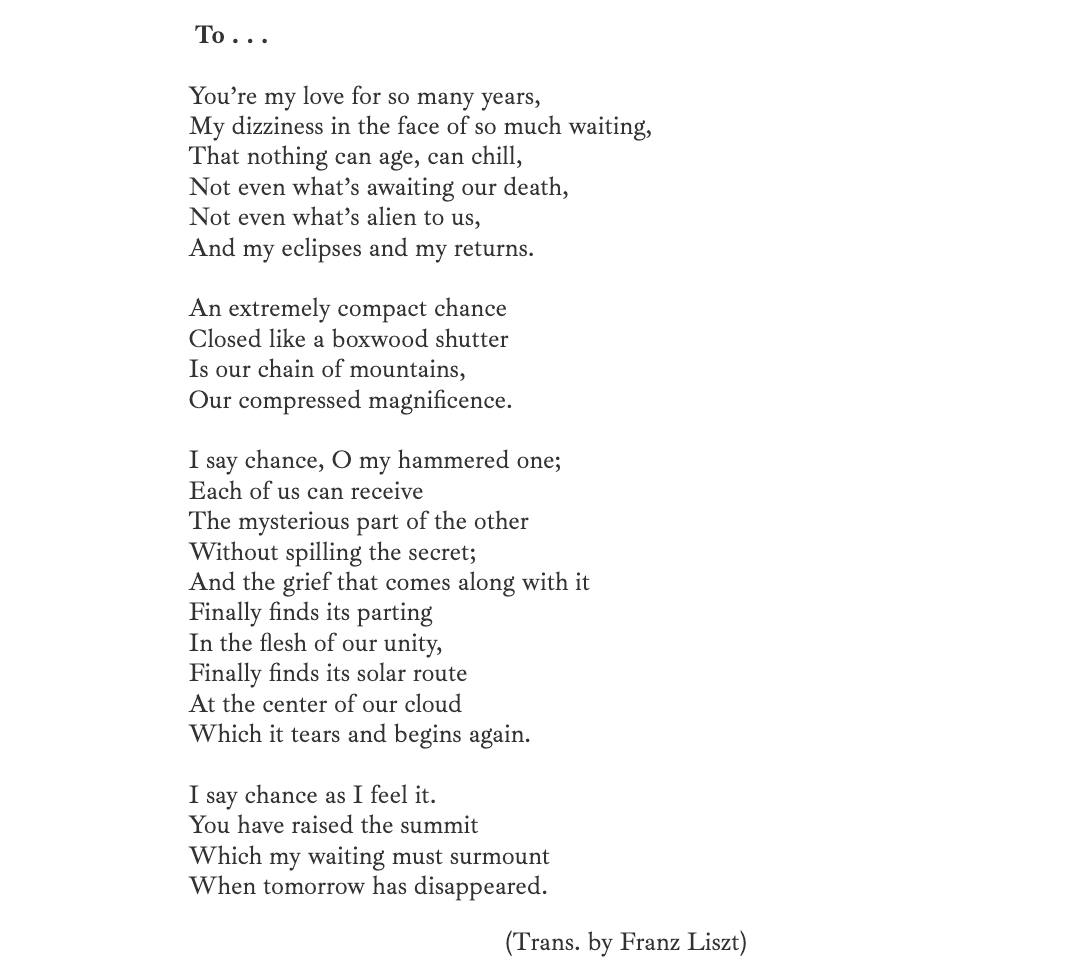
The generous John Latta also includes his translation of Fairfield Porter’s undated reply, acknowledging the receipt of Frank's letter, correcting (without making of a point of doing so) O'Hara's spelling of Katy's name which should be "Katie", whom Porter walked to the station while reading O'Hara's letter, noting that “At the station a drunk made friendly passes at Kate, showing me that there are always new problems and that little girls must be protected without causing them alarm.” After depositing “Kate” at the station, Porter returned and discovered “a sarcastic note from Anne in the typewriter about the cracker barrel touch system motto in the typewriter, 'It is work that gives flavor to life'.” As for O'Hara's query about Joan Mitchell, Porter responds in kind: “I felt as you did about Joan Mitchell. She seemed unfriendly to me, but then I expect painters often to be mad at me, so I mistakenly took it to myself alone.” He continues to move down O'Hara's letter, responding to his questions and comments, adding “It is typical of JA to give and take at once," and thanking O'Hara “for remembering To ****, which seems a perfect translation, but which I prefer in your English, I suppose that is a compliment to the strength of the original.” As for “L’Amour, it contains the open secret of my feared and attained failures,” Porter tells him, opening the door just wide enough for the air to whistle over the knob. Of course, beautiful notes abound, and thus Porter and Larry received a “beautiful note from Jimmy, whose sweetness follows from the fact that his politeness directly expresses his true feelings, and is never a cover but the outward expression of exactly what he thinks,” and there was a heart-warmer of a missive from Janice, and “the picture of Kitty is done.”
Porter mentions a slight dissatisfaction with John's portrait, which remains incomplete, unfinished. It’s a decent “likeness” but he hopes “it does not stiffen up. He has to pose again. He seems to have made up his mind to endure a certain amount of boredom. Maybe if he doesn’t come out next weekend, he will come under your chaperonage later.” Signing off professionally, politely, obliquely, like a gentleman dropping a ten dollar bill into the tramp's hat, Fairfield says he'll phone when he comes to Paris, in sum, “I did very much enjoy the other day with you.”
Fast forward 6 years —
O'Hara is no longer in Paris. Now he is in Boston, near the site of the alumni letter publishers, writing from Cambridge, Massachusetts on January 26, 1956, to Anne and Fairfield Porter, including them both in his greeting, and starting off on a complimentary note expressing happiness at receiving a letter from Kitty on the particular day when he received it, since that day coincided with span of time after O'Hara “had been reading her poems the day before and off and on since I got here and was wondering how the prettiest poet in America is.” He is surprised to be back, to “be here,” as he puts it, an experience that is both odd and familiar, so he turns to the weather without turning to the convention invoking the word weather, electing to slide over it instead with his eyes: “There has been snow on the ground and replenishing flurries ever since I arrived, which I like, and I have a room quite large with eaves, on the third floor of Molly Howe’s house.”
Of course my ears itched a bit upon reading this, since Molly Howe may be the mother of poet Marie Howe, and I have recently fallen into the whirlpool surrounding a possible dalliance between Molly and Samuel Beckett, who grew up in the same Irish small town, and who are rumored to have parented a child or else an abortion or perhaps both, unclearly, uncertainly, in a fashion worthy of literature that is rarely the entirety of a life. As for O'Hara, he says that Molly is in “the theatre des poètes and also is the one who adapted Finnegan's Wake for their production.” As a person, she is “nice and amusing and rather Irish and thinks I’m even Irisher than she is (which is doubtful since she acted in the Abbey Theatre and has a great appreciation of the mournful interpretation of trivial things—she compliments people in the following general form, for instance: “Isn’t it a shame! Bunny was so wonderful on stage last night, and she just doesn’t do anything serious with it, she doesn’t act enough!”).” At this point, I catch my breath at this gorgeous O'Hara-style parentheses that twirls so many batons at once and then looks up at us with exclamation points, realizing that hearsay is sure to follow, and when it does, the hearsay nevertheless is as giddying as receiving personal hearsay that makes poetry worthwhile for an instant, however brief, since O'Hara gave a reading with Roger Shattuck and Molly didn't say a thing to him about it even though they live in the same house, O'Hara tells Porter that Molly “told Bunny” … “Frank is the real thing, all right, but he has the terrible affliction of the Irish—he doesn’t trust his heart.” As if preparing to double one of his double-volts in a poem, O'Hara's speaker then mentions a worried response that Molly expresses about a play that hinges on a joke, and holds up this response to the Porters, asking, in jest, “Now don’t you think she’s more pessimistic and therefore more Irish, than I am?”, concluding, in seriousness, “She’s very nice anyhow.”
O'Hara nudges Anne to send her translation (if finished) of Supervielle’s La Belle Au Bois to The Poets’ Theatre for a staging or reading, at least, since the submitted scripts so far have been “heavily formalized, rhetorical, full of verse and empty of poetry, with an insight every 75 lines, as if most of the poets had just gobbled up a History of the English Drama that ended in 1850,” which is why the board of 8 humans would benefit from the Supervielle as both “a beautiful work and as a kind of play which is more poetry than those filled with verse that limps along about incest or the impossibility of communication.”
“Radio”
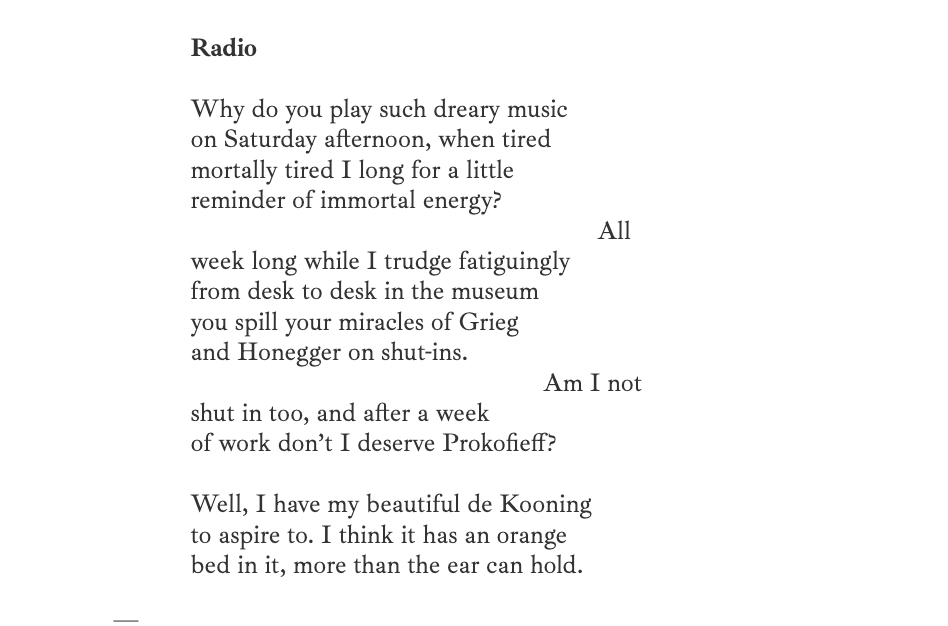
Frank O'Hara's “Radio” was first published in Poetry, March 1956. The commentary that follows was found in John Latta's exquisite “Stray Notes” . . . and I quote:
In Donald Allen’s note (fromThe Collected Poems of Frank O’Hara:)
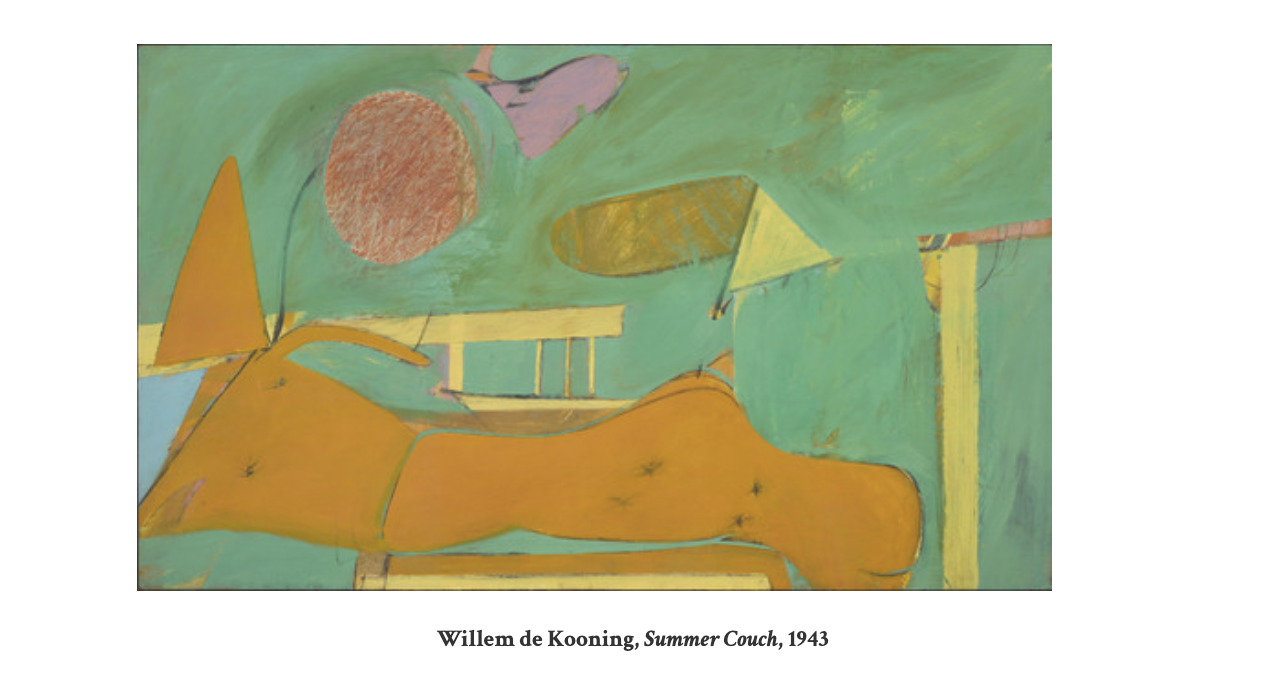
Dated December 3, 1955 . . . Kenneth Koch wrote: “RADIO is perfect. I was in the Cedar Tavern last night and Bill de Kooning was there, so I asked him if he’d seen your poem about his picture. He said, Yeah, is that right? He said, Yeah, but how can you be sure it’s about my picture, is it just about a picture? I quoted him ‘I have my beautiful de Kooning / to aspire to. I think it has an orange / bed in it . . .’ He said, ‘It’s a couch. But then it really is my picture, that’s wonderful.’ Then he told me how he had always been interested in mattresses because they were pulled together at certain points and puffed out at others, ‘like the earth.’” (KK to FOH, March 22, 1956.)
James Schuyler, in a letter dated 27 March 1956 (from The Letters of James Schuyler to Frank O’Hara):
This nonsense is only to tell you I love your poems in Poetry; as always, in that cutting garden of salmon pink gladioli, they’re as fresh as a Norway spruce. Your passion always makes me feel like a cloud the wind detaches (at last) from a mountain so I can finally go sailing over all those valleys with their crazy farms and towns. I always start bouncing up and down in my chair when I read a poem of yours like “Radio,” where you seem to say, “I know you won’t think this is much of a subject for a poem but I just can’t help it: I feel like this,” so that in the end you seem to be the only one who knows what the subject for a poem is.
Brad Gooch, in the O’Hara biography City Poet, quoting a 16 February 1956 letter to Michael Goldberg, seems (wrongly) to suggest that “Radio” was composed in Cambridge during O’Hara’s unhappy few months there with a playwright-in-residence fellowship at the Poets Theatre:
“Some times it seems to me that I’m operating myself by remote control from a broom closet in the Empire State Building but I guess I really am here . . . Before this there were a couple weeks of foul depression, gnashing teeth, pacing and boredom, when I felt that I would never, NEVER (like in those moves about concert pianists who’ve been in an accident) be able to play the typewriter again. But the presence of this Steinway you all gave me has finally asserted itself, and I now stagger from bed, stride to the desk, and begin my scales each morning, or almost each.” O’Hara’s sense of place was ameliorated by pasting to the wall a photograph of James Dean as well as by hanging a small de Kooning painting of a couch lent him by Fairfield Porter that had hung at East Forty-ninth Street. The painting appeared in “Radio,” published in Poetry in March . . .
Franz Liszt, Réminiscences de Don Juan, S.418 1849 played by Masaru Okada
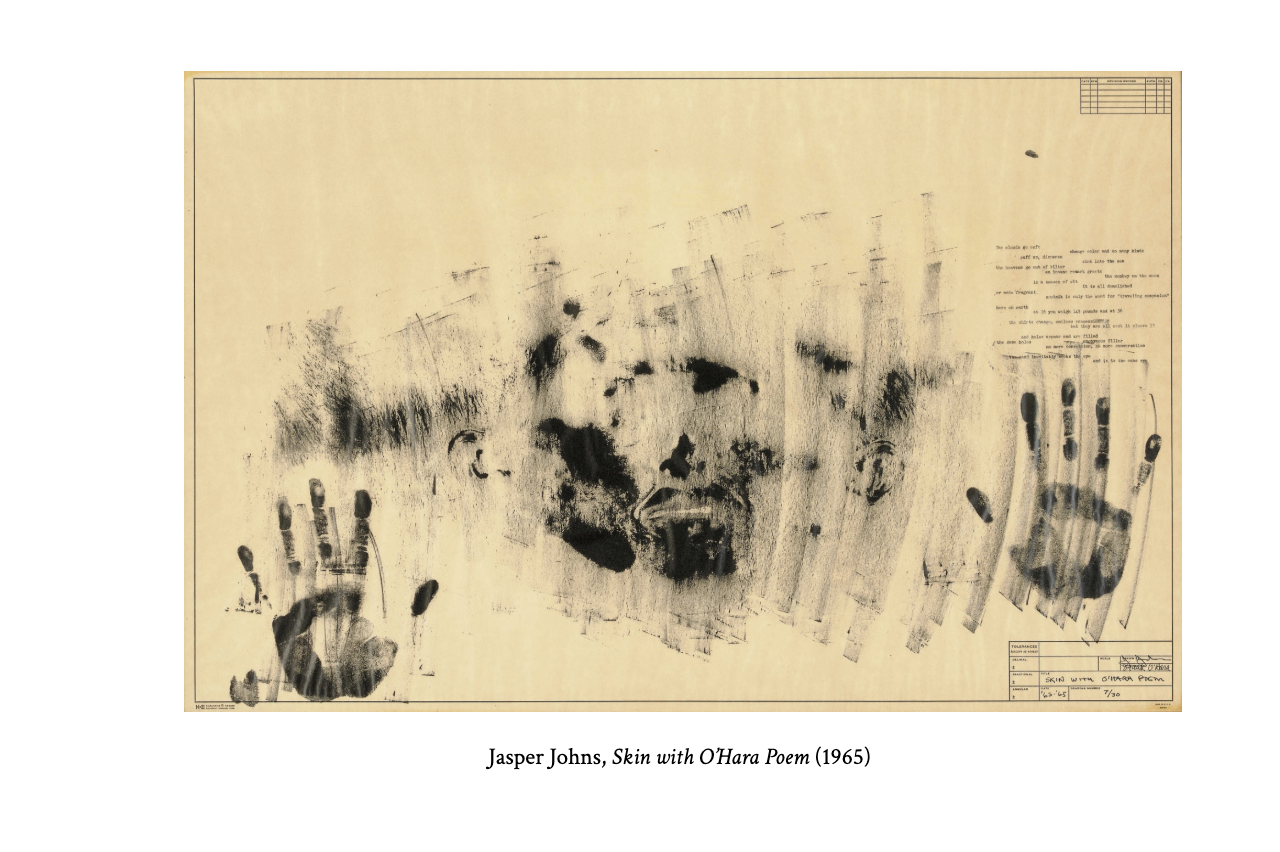
Jasper Johns, Skin with O'Hara Poem, 1965
John Latta, “Two O’Hara Letters and a Translation”
Richard Hell, Godlike. NYRB Classics.
Willem de Kooning, Summer Couch, 1943