it will not seem so strange or hard a thing
to learn how families unmake themselves,
for even cities have an end at last.
All things in your world have their death, as you
yourselves do, but in some it's hard to see,
for they last long, and human lives are short.
— Dante, Paradiso, Canto XVI (76-81)
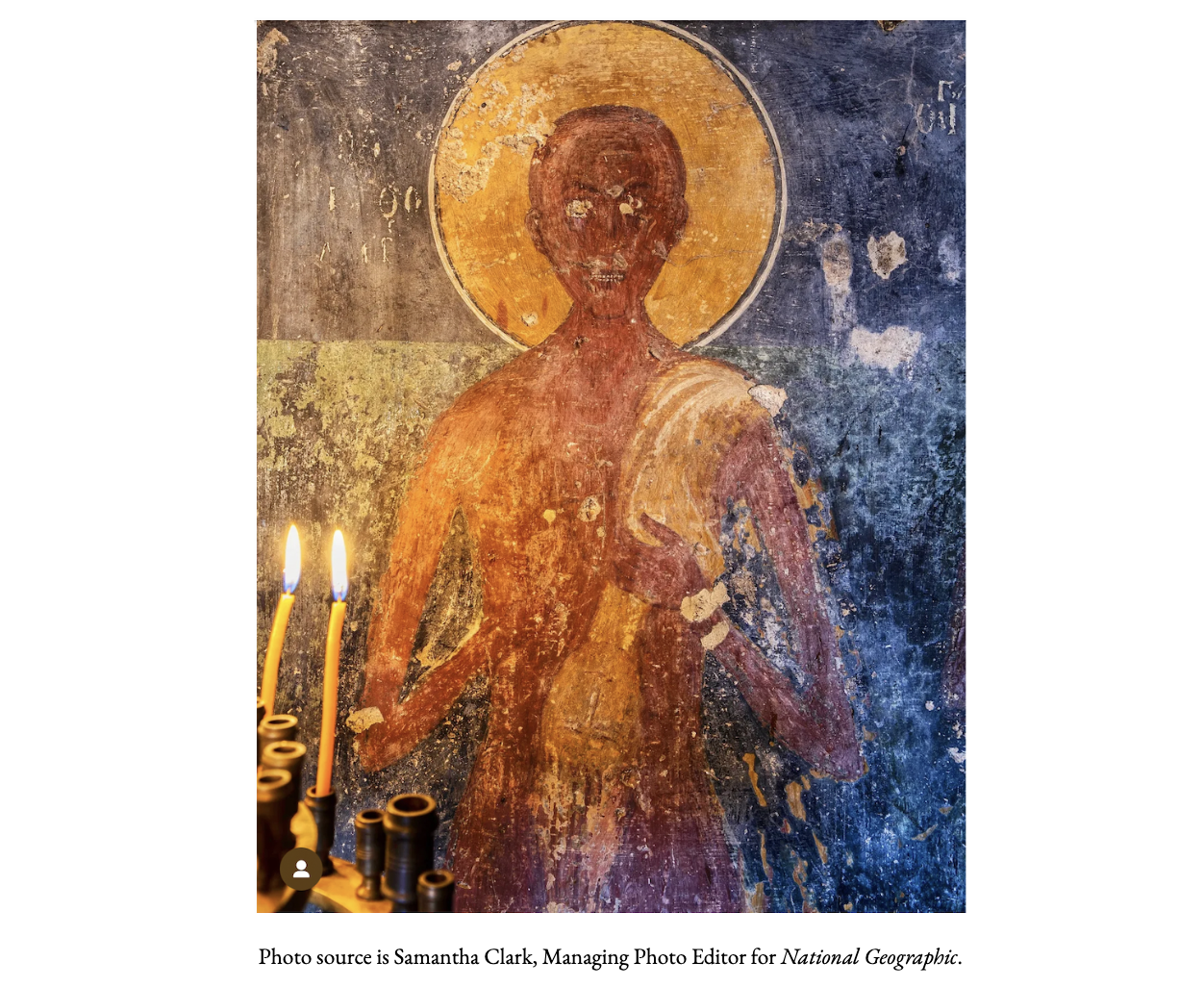
While wandering through the translator’s end-notes to Dante’s Paradiso, I found myself searching for a particular chapel in Crete, and then falling into a rabbit hole named Saint Bartholomew.
I blame it on this particular fresco on the wall of the one-room chapel of Agia Pelagia in Ano Viannos, Crete, with its byzantine figurations and dim interior.
The bright Grecian light is filtered, dimmed, enclosed; the sense is that of the cave-womb rather than the majesty and grandeur of the Roman empire and Catholic church. Bartholomew holds his flayed skin over his shoulder– his head still attached to his body, the aureole marking his status as a saint.
Flaying is the removal of skin from the body by a sharp object.
Saint Bartholomew supposedly preached in India and was martyred through torture, flayed, and eventually beheading. In the altarpiece from 1412 painted by Catalan Jaume Huguet (below), Bartholomew is offered in more detail, though the grotesque nature of the torture is impossible to depict.
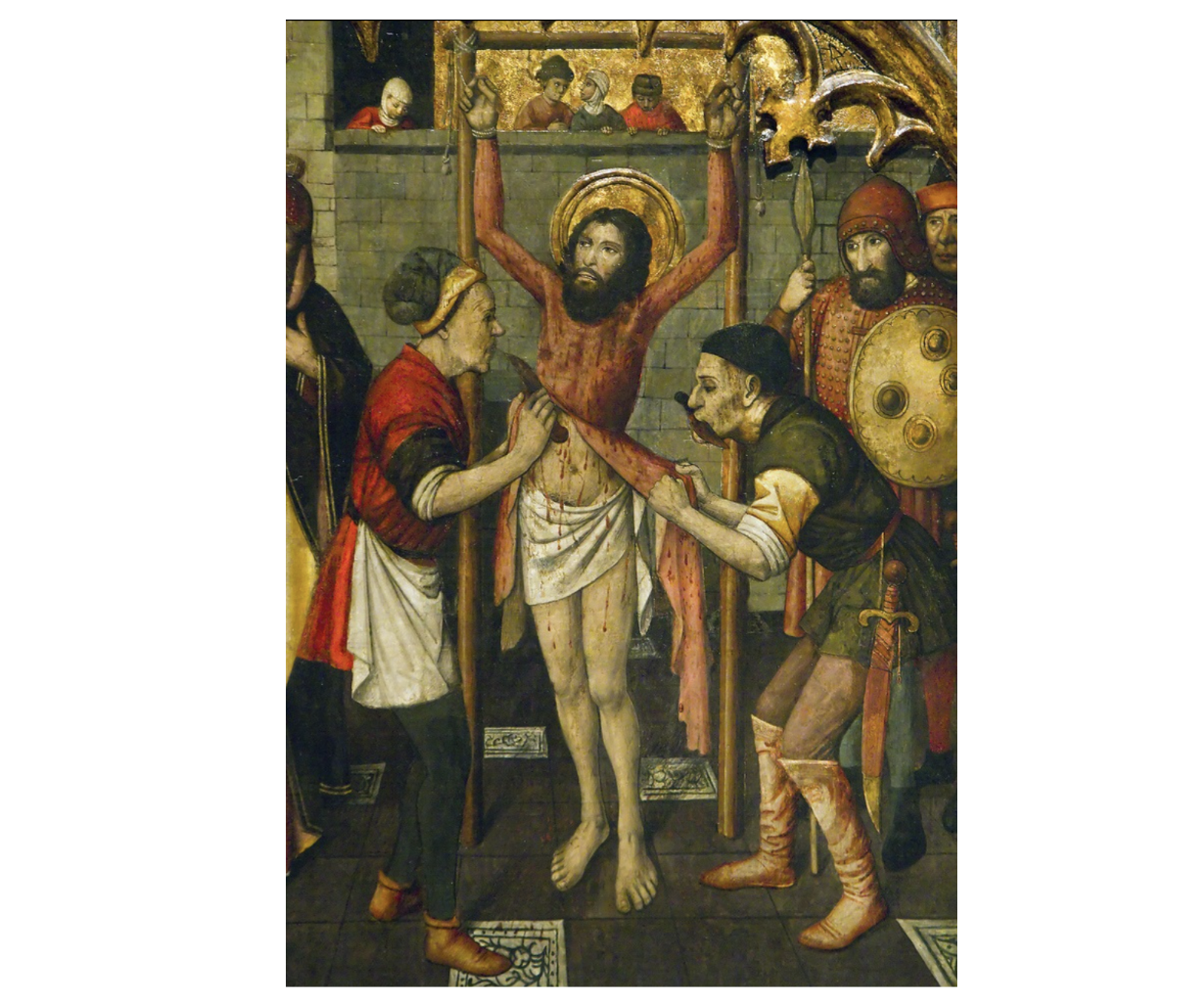
His wrists are bound, his arms raised in that vulnerable position often depicted across the iconology of Saint Sebastian— the axial pose, arms lashed to two poles— his flesh already flayed to the waist. Two executioners are present: one wearing an apron to protect his clothes and the other holding a spare knife in his mouth, concentrating on carefully removing the skin in one piece.
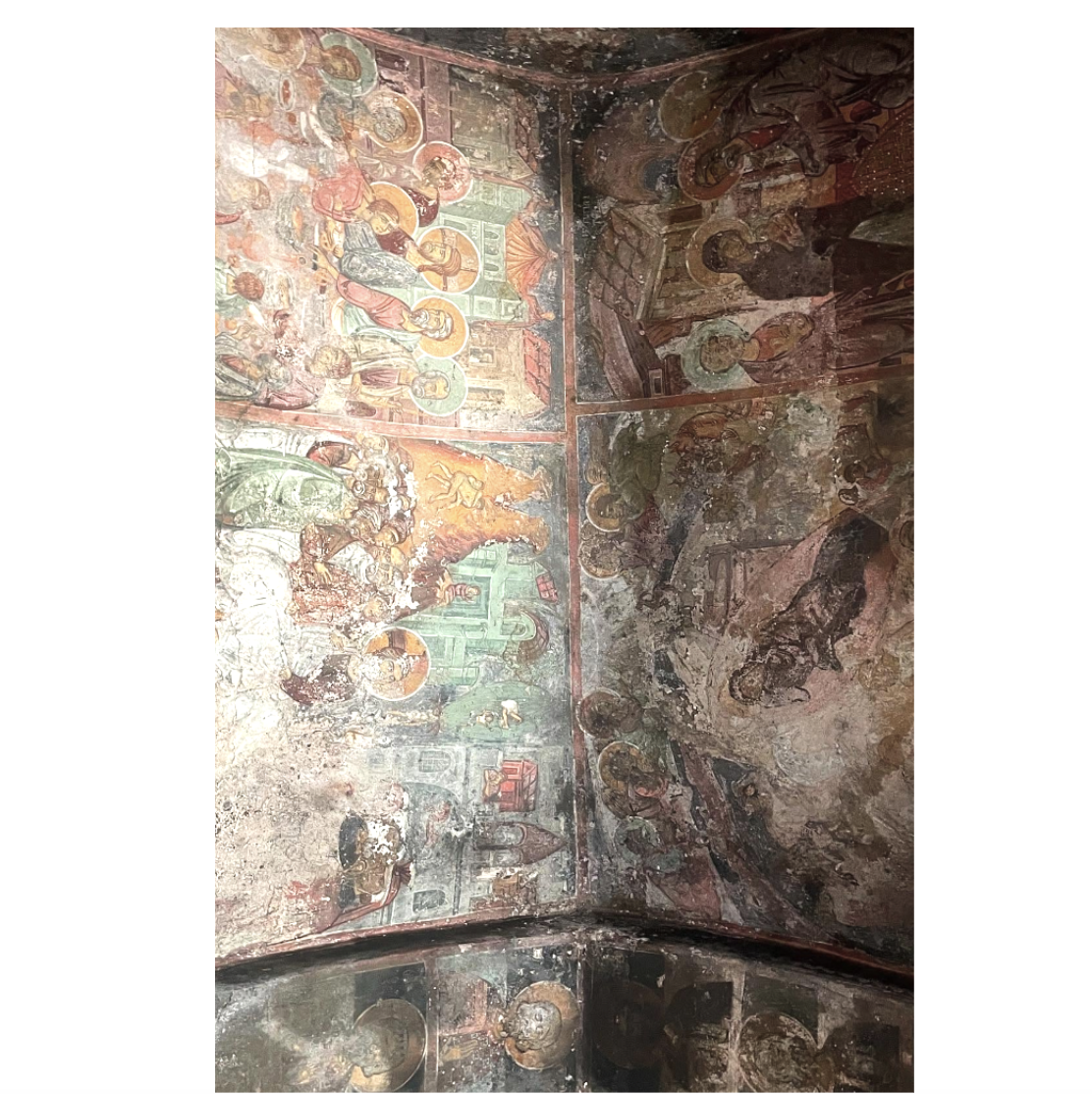
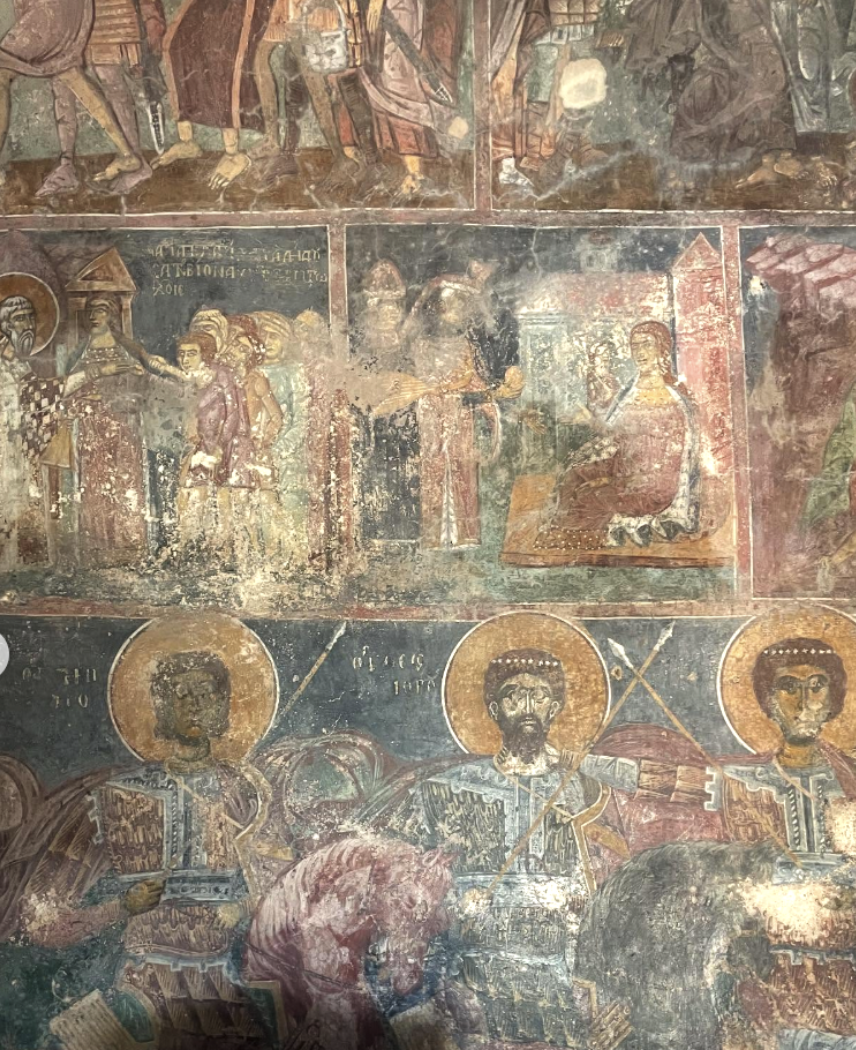
Agia Pelagia’s frescos date back to 1360, which may be coincidental with my reading of Dante. Among the various depictions in this tiny space, there is one representing the punishments of the hellbound/sinners, the betrayal of Jesus, and the Last Supper.
“Martyrdom, then, is a difference-obliterating mind-set that leaves death as the only thing to venerate,” writes Tom Bissell.
The dome of Agia Pelagia features three scenes of Saint Pelagia, and the lute player might reference her life as an actress?
And the rabbit hole deepens, landing me near the Menologion (or Menologium) of Basil II, a Greek illuminated manuscript designed as a church calendar or Eastern Orthodox Church service book (menologion) that was compiled c. 1000 AD for the Byzantine Emperor Basil II (r. 976–1025). It contains a synaxarion, a short collection of saints' lives, compiled at Constantinople for liturgical use and around 430 miniature paintings by eight different artists. It currently resides in the Vatican Library.
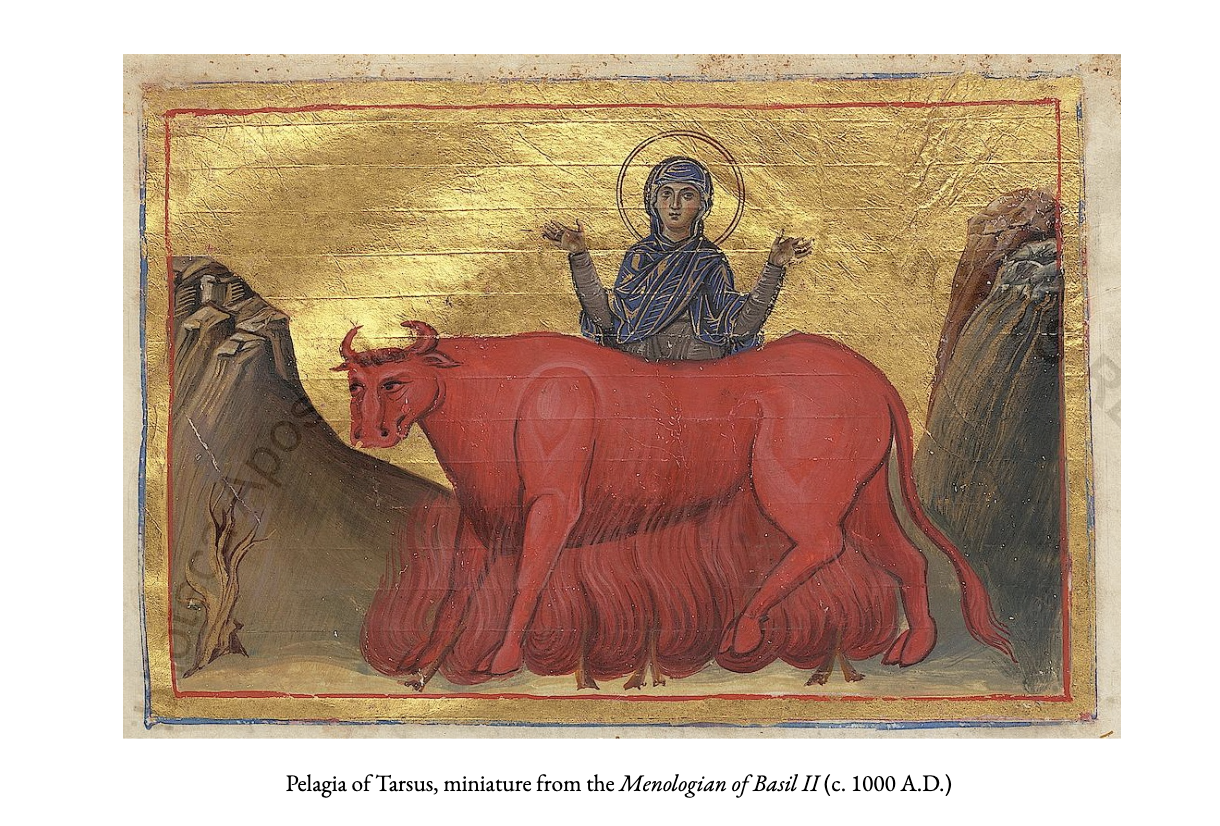
There are many Pelagias. There is Pelagia the Virgin of Antioch and Pelagia the Harlot of Antioch, both of whom are honored on October 8th, a feast day originally shared with Pelagia of Tarsus, who lived in southeastern Asia Minor during the reign of Roman emperor Diocletian. Notably, Diocletian had a daughter but no sons (and this makes part of Pelagia’s legend highly unlikely). Nevertheless, Diocletian did conduct the final intensive persecution of Christians in Roman history, many of whose victims were indeed burned alive.
Now for the legend. According to the Eastern Orthodox tradition, dreams are dangerous. For the wealthy Pelagia, daughter of a pagan mother, was visited by the Lord in a dream. The following day, Pelagia ran into Bishop Linus on the road and immediately recognized him as the person who had appeared to her in the dream. She fell at his feet, requesting Baptism. At the bishop’s prayer a spring of water flowed from the ground.
Linus made the Sign of the Cross over Pelagia, and angels appeared and covered the chosen one of God with a bright mantle when he baptized her. Linus gave her holy communion, said a few prayers, and then sent Pelagia to continue her journey. She exchanged her expensive clothing for a simple white garment, and distributed her possessions to the poor. Returning to her servants, Pelagia told them about Christ, and many of them were converted and believed.
Infuriated by her daughter’s defiant dalliance with a heretical cult, Pelagia’s mother sat on the patio and watched flies circle the carcass of a dead dog. The scent of cultivated roses drifted through the air as the mother composed her message to Diocletian’s son. Pelagia had fallen for this dead man named Jesus and it was impossible to distract her. Pelagia’s mother told the young man that his beloved refused to become his wife.
Realizing that he could not win a battle with a lover whose kingdom was out of this world, Diocletian’s broken-hearted son fell upon his sword and died by suicide.
Pelagia’s mother feared the emperor’s wrath, so she tied her daughter up and led her to Diocletian’s court as a Christian who was also responsible for the death of the heir to the throne. The emperor was captivated by the unusual beauty of the virgin and tried to turn her from her faith in Christ, promising her every earthly blessing if she would become his wife.
The holy virgin refused the emperor’s offer with contempt and said:
“You are insane, Emperor, saying such things to me. I will not do your bidding, and I loathe your vile marriage, since I have Christ, the King of Heaven, as my Bridegroom. I do not desire your worldly crowns which last only a short while. The Lord in His heavenly Kingdom has prepared three imperishable crowns for me. The first is for faith, since I have believed in the true God with all my heart; the second is for purity, because I have dedicated my virginity to Him; the third is for martyrdom, since I want to accept every suffering for Him and offer up my soul because of my love for Him.”
Diocletian sentenced Pelagia to be burned in a red-hot bronze bull. Not permitting the executioners to touch her body, the holy martyr signed herself with the Sign of the Cross, and went into the brazen bull and her flesh melted like myrrh, filling the whole city with fragrance. Saint Pelagia’s bones remained unharmed and were removed by the pagans to a place outside the city. Four lions then came out of the wilderness and sat around the bones letting neither bird nor wild beast get at them. The lions protected the relics of the saint until Bishop Linus came to that place. He gathered them up and buried them with honor. Later, a church was built over her holy relics.
The Orthodox church commemorates the holy Virgin Martyr Pelagia of Tarsus on October 7th, and a church was built at Pelagia’s burial place during the reign of Emperor Constantine, when the persecution of Christians had diminished. This is simply to say: Dante can lead a mind to the most uncanny places, and I keep thinking of lyres and virgins and harlots and hands making music on strings.
imposed a silence on that holy lyre
and brought to stillness all those lovely strings
that Heaven’s right hand makes looser or more tight.
– Paradiso, Canto XV, 4-6
*
Nicola Matteis Jr., Fantasia in C Minor, “con discretione” performed by Théotime Langlois de Swarte
Pelagia of Tarsus, miniature from the Menologian of Basil II (c. 1000 A.D.)
Tom Bissell, “A Most Violent Martyrdom” (Lapham’s Quarterly)