Could you say she did first what no one has ever done better and mention plump brown legs, flat belly, hard little breasts, well holding arms, quick searching tongue, the flat eyes, the good taste of mouth.., and hemlock needles stuck against your belly... Long time ago good. Now no good.
— Ernest Hemingway, “Fathers and Sons”
When Hemingway's bitches are Americans, they are hopeless and unmitigated bitches; symbols of Home and Mother as remembered by the boy who could never forgive Mama for having wantonly destroyed Papa's Indian collection!
— Leslie Fiedler, Love and Death in the American Novel
EXHBIT A: The Metaphysche of Scandal Goes Viral
“The Beecher-Tilton Affair” — as superbly narrated in Robert Shaplen’s Free Love: The Story of a Great American Scandal (McNally Editions)
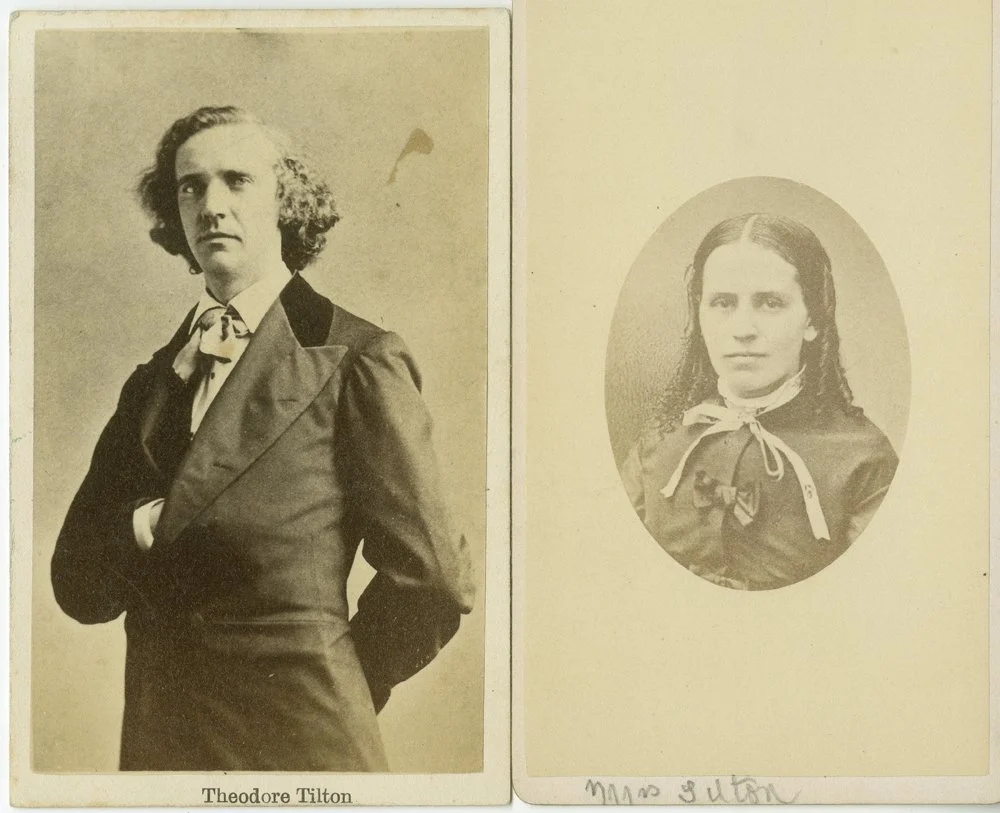
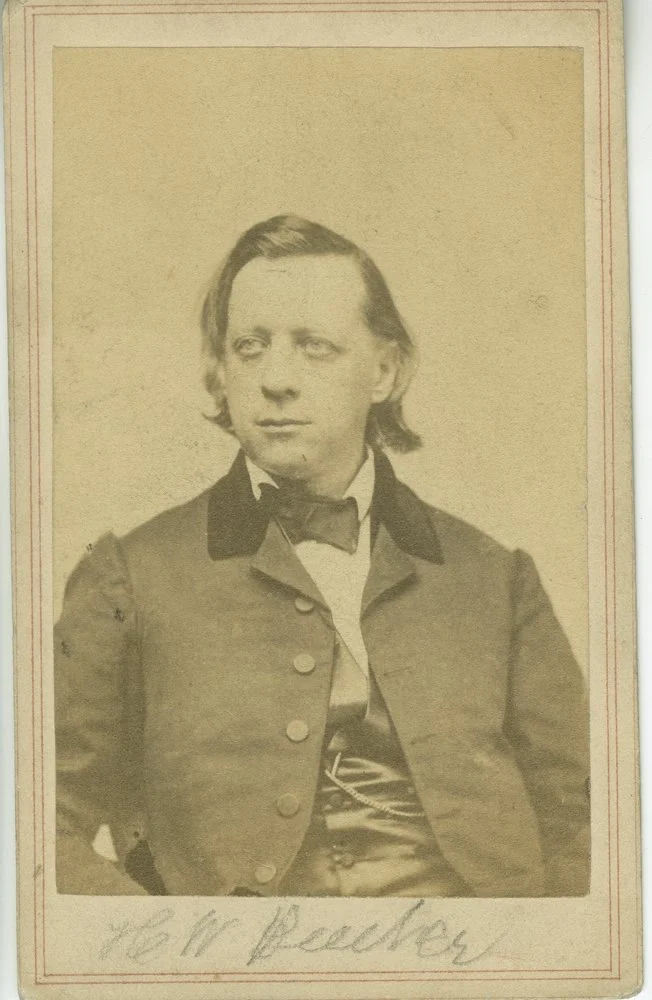
EXHIBIT B: No One Loves a Dead Bitch Like Her Author
The material in this exhibit comes from Leslie A. Fiedler’s extraordinary provocation, Love and Death in the American Novel, picking up midway through the book, just after Fiedler nominates F. Scott Fitzgerald to serve as laureate of “the American institution of coitus interruptus,” a writer who makes it possible for women to “move from the kiss to the kill with only the barest suggestion of copulation between.” Notably, Fiedler’s most biting commentary is reserved for the socialization of young literary women as accomplished “Papa Hemingway.”
Unlike Fitzgerald, Hemingway is “addicted to describing the sex act”, making it “the symbolic center of his work: a scene to which he recurs when nostalgically” whether evoking his boyhood, reflecting on the sturdiness of male friendship, or trotting back and forth between various heroic poses. What follows is an excerpt from Fiedler’s analysis of Hemingway (italics are mine):
There are, however, no women in his books! In his earlier fictions, Hemingway's descriptions of the sexual encounter are intentionally brutal, in his later ones unintentionally comic; for in no case, can he quite succeed in making his females human, and coitus performed with an animal, a thing, or a wet dream is either horrible or ridiculous. If in For Whom the Bell Tolls Hemingway has written the most absurd love scene in the history of the American novel, this is not because he lost momentarily his skill and authority; it is a giveaway—a moment which illuminates the whole erotic content of his fiction.
Hemingway is only really comfortable in dealing with “men without women.” The relations of father to son, of battle-companions, friends on a fishing trip, fellow inmates in a hospital, a couple of waiters preparing to close up shop, a bullighter and his manager, a boy and a gangster: these move him to simplicity and truth. Perhaps he is best of all with men who stand alone—in night-time scenes when the solitary individual sweats in his bed on the verge of nightmare, or arises to confront himself in the glass; though he is at home, too, with the Rip Van Winkle archetype, with men in flight from women. Certainly, he returns again and again to the fishing trip and the journey to the war—those two traditional evasions of domesticity and civil life. Yet he feels an obligation to introduce women into his more ambitious fictions, though he does not know what to do with them beyond taking them to bed.
All his life, he has been haunted by a sense of how simple it all was once, when he could take his Indian girl into the clean-smelling woods, stretch out beside her on the pine-needles (her brother standing guard), and rise to no obligations at all. […] In Hemingway the rejection of the sentimental happy ending of marriage involves the acceptance of the sentimental happy beginning of innocent and inconsequential sex, and camouflages the rejection of maturity and of fatherhood itself. [….] More typically he aspires to be not Father but “Papa,” the Old Man of the girl-child with whom he is temporarily sleeping; and surely there is no writer to whom childbirth more customarily presents itself as the essential catastrophe. At best he portrays it as a plaguey sort of accident which forces a man to leave his buddies behind at the moment of greatest pleasure as in “Cross Country Snow”; at worst, it becomes in his fiction that horror which drives the tender-hearted husband of “Indian Camp” to suicide, or which takes Catherine away from Lieutenant Henry in A Farewell to Arms.
Poor things, all they wanted was innocent orgasm after orgasm on an island of peace in a world at war, love-making without end in a scarcely real country to which neither owed life or allegiance. But such a relationship can, of course, never last, as Hemingway-Nick Adams-Lieutenant Henry has always known: “They all ended the same. Long time ago good. Now no good.” Only the dead woman becomes neither a bore nor a mother; and before Catherine can quite become either she must die, killed not by Hemingway, of course, but by childbirth! It is all quite sad and lovely at the end . . .
Had Catherine lived, she could only have turned into a bitch; for this is the fate in Hemingway's imagination of all Anglo-Saxon women. In him, the cliché of Dark Lady and Fair survives, but stood on its head, exactly reversed. The Dark Lady, who is neither wife nor mother, blends with the image of Fayaway, the exotic servant-consort reconstructed by Melville in Typee out of memories of an eight-year-old Polynesian girl-child. In Hemingway, such women are mindless, soft, subservient; painless devices for extracting seed without human engagement. The Fair Lady, on the offer hand, who gets pregnant and wants a wedding, or uses her sexual allure to assert her power, is seen as a threat and a destroyer of men.
Fiedler’s implication that men get to have sex with other men by screwing the same woman is as wild as it is loud in the present. Deep male chummery develops in the “communion” of the gang-bang, whether literary, metaphysical, or actual. Using the exoticized “anti-virgin” woman as a site of male solidarity, Hemingway’s men pass the towel— “a new lover enters into a blameless communion with the other uncommitted males who have possessed her and departed, as well as with those yet to come,” sublimating “the appeal of the whorehouse (Eden of the world of men without women) embodied in a single figure.” In this schemata, the so-called “American bitch” is ambitious, driven by success, forged from the new mythos of her independence.
Meanwhile, Hemingway’s “British bitch” can only amount to a “demi-bitch,” since the English are only “demi-Americans.” What sort of dreams can these inhuman bitches cobble together? Fiedler doesn’t ask the question. At his best, I think, he makes note of the emptiness to which Hemingway consigns Brett, despite allowing her to survive a romantic relationship:
Brett Ashley in The Sun Also Rises (1926) is permitted, once at least, the gesture of herself rejecting her mythical role. But it is quite a feat at that, and Brett cannot leave off congratulating herself: “You know it makes one feel rather good deciding not to be a bitch.” Yet Brett never becomes a woman really; she is mythicized rather than redeemed [*I’d substitute “realized” for Fiedler’s “redeemed” here]. And if she is the most satisfactory female character in all of Hemingway, this is because for once she is presented not as an animal or as a nightmare but quite audaciously as a goddess, the bitch-goddess with a boyish bob. Hemingway is rather fond of women who seem as much boy as girl, the Lilith of the '20's. No man embraces her without being in some sense castrated, except for Jake Barnes who is unmanned to begin with; no man approaches her without wanting to be castrated, except for Romero, who thinks naively that she is—or can easily become—a woman. Indeed, when Brett leaves that nineteen year-old bullfighter, one suspects that, though she avows it is because she will not be one of those bitches “who ruins children,” she is really running away because she thinks he might make her a woman. Certainly, Romero's insistence that she let her hair grow out has something to do with it: "He wanted me to grow my hair out. Me, with long hair.”
Like Hemingway, Fiedler applies the gendered script to the overly-signified gender question. Brett is actually “running away because she thinks he might make her a woman,” he tells us. And it is Romero's insistence that she let her hair grow out which indicates this to Fieldler, who then quotes Brett: “He wanted me to grow my hair out. Me, with long hair, I’d look so like hell.... He said it would make me more womanly. I'd look a fright.”
A fright, Brett says, loosely evoking the wretched associations of womanliness, where Medusa, Ophelia, Rapunzel, etc., the passivity of gender can be escaped by bobbing one’s hair. Fieldler dredges up the aspirational phallus-focus in Brett, often applied to women that want to identify as a “guy’s girl” etc.:
To yield up her cropped head would be to yield up her emancipation from female servitude, to become feminine rather than phallic; and this Brett cannot do. She thinks of herself as a flapper, though the word perhaps would not have occurred to her, as a member of the “Lost Generation”; but the Spaniards know her immediately as a terrible goddess, the avatar of an ancient archetype. She tries in vain to enter into the circle of Christian communion, but is always turned aside at the door; she changes her mind, she has forgotten her hat—the apparent reason never matters; she belongs to a world alien and prior to that of the Christian churches in which Jake finds a kind of peace.
If this reading feels as overly-gendered as Hemingway’s fiction, it is perhaps because it rides the gender binary without self-interrogation. Brett, after all, isn’t aiming for something uncategorizable like androgynyl Brett is aiming for a life outside the constructions of femininity.
Almost fifty years later, we still treat hair as a gender signifier— so there is the awkwardness of the buzzcut MAGA fellow yelling about being a “real man,” wearing his “Jesus-follower” on his t-shirt, talking smack about “pansies” and boys that “look like girls” without drawing any connection between the long hair worn by his Personal Savior. Gender socialization suffers from this incoherence, this mismatch between social scripts and representations, where hair plays a visual role in defining gender.
Once upon a time, I had a bob and then a car hit me and I never wanted to see a photo of myself with that bob again. My life changed irrevocably, and my long hair grew into a curtain that protected me from the feeling of people’s eyes. Watching more than 60% of my hair fall out in clumps this year has been traumatic— not because it makes me less feminine (my contempt for contemporary notions of femininity and the pageants of She-ness has long been a source of alienation for me among tradgender company) but rather because hair was the only part of my body that didn’t hurt, didn’t expose me, didn’t tame or control my way of being in the world. If I identified as a man, I’d still wear my hair long, as long hair is a story about this body rather than a story about gender.
Most women with bobs do not become ‘men’ for having them. Bobs are just as common among women as long hair. Buzzcuts have been co-opted by the New Right masculinity cult even though they often convey a deeply neutralizing (and beautifully statuesque) relation to hair and body. The buzzcut to me has always signified a radical openness; when the teens buzzed their friend last week, that was what their friend expressed as well… a desire to start afresh, to feel the world more intensely and closely, without an intervening mask.
What am I trying to express here? I don’t mean to sound conclusive. I have no rules or regulations to add to our overly-gendered conceptions of hair. If anything, I want to trouble Fiedler’s simple constructions of “bitch-goddess” that still expect femininity to absolve the man (i.e. Jake) of his spiritual misery.
EXHIBIT C: The American Liebestod
Catherine is delivered from her doom by death.
— Leslie A. Fiedler, ibid.
EXHIBIT D: A pimp-mobile.
“They were all chanting. Brett wanted to dance but they did not want her to. They wanted her as an image to dance around." Incapable of love except as a moment in bed, Brett can bestow on her worshipers nothing more than the brief joy of a drunken ecstasy— followed by suffering and deprivation and regret. In the end, not only are her physical lovers unmanned and degraded, but even Jake, who is her priest and is protected by his terrible wound, is humiliated. For her service is a betrayal not only of his Catholic faith but of his pure passion for bullighting and trout-fishing; and the priest of the bitch-goddess is, on the purely human level, a pimp.
— Leslie A. Fiedler, ibid.
EXHIBIT E: The American eye.
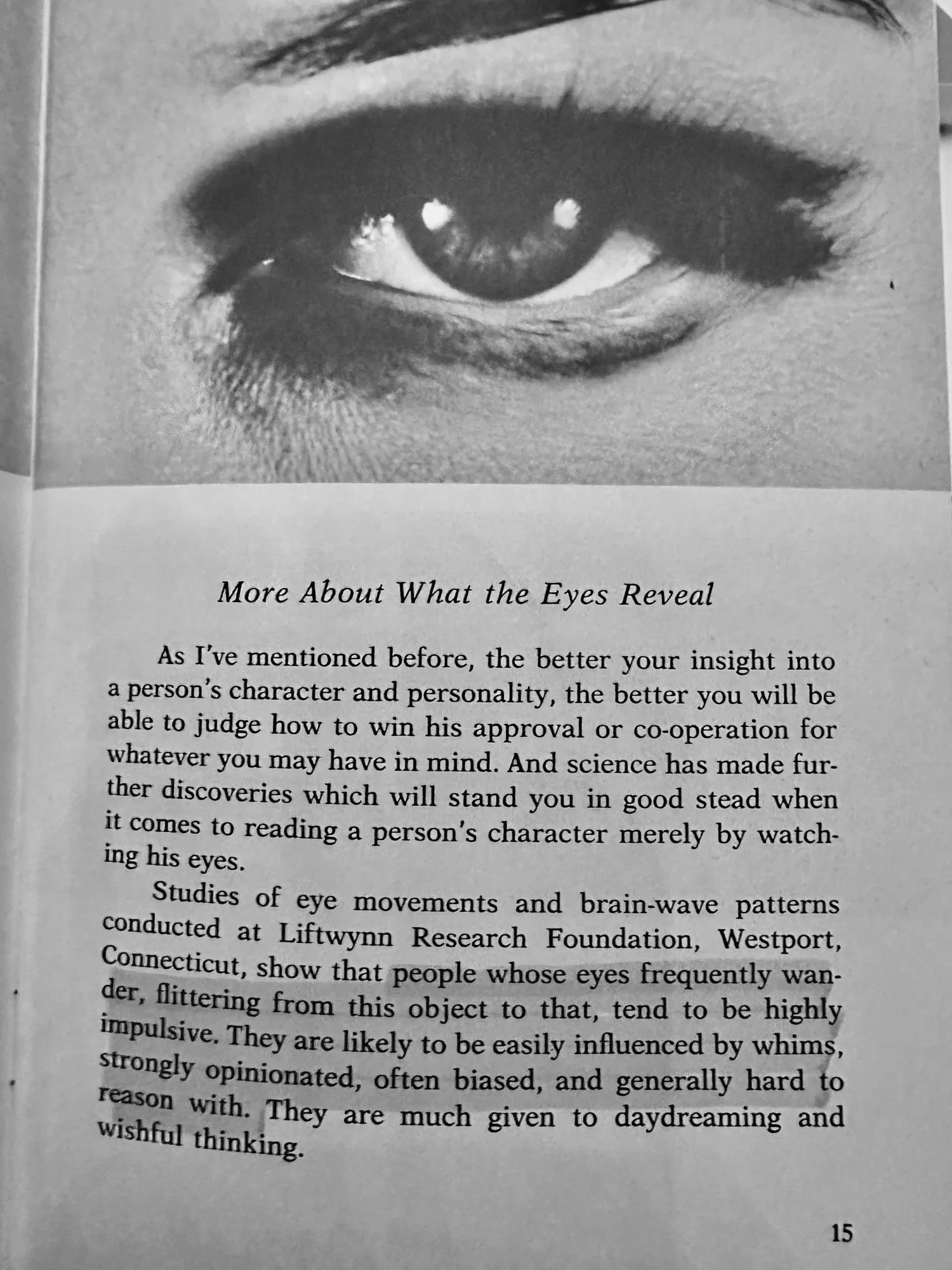
From a self-help pamphlet by Dr. Joyce Brothers, published in 1968.
EXHIBIT F: The reprieve of “shapeless caprices.”
“It was hard work. I had to replace the shapeless caprice of my atmospheres with 4 basic cloud types. I had to edit the indecipherably fluid filigree of my language into a dry-as-dust classificatory system replete with Latin terminology. And beyond that, I had to be flirtatious. If you bring a concept or category up close enough to the human mind to be very very attractive and then whisk it away so it stays out of reach, it becomes erotic. Flirting is not in my nature but who would be bothered doing science if it weren't erotic.”
— Anne Carson, The Wrong Norma

Anton Mauve, The Return of the Flock, Laren (1886-7)
*
Leslie Fiedler, Love and Death in the American Novel (NYRB Classics)