Above the cloud with its shadow is the star with its light.
— Pythagoras, as quoted by Bin Ramke in the poem titled “Lighthouse”
o crowd of my lived life
— Bin Ramke
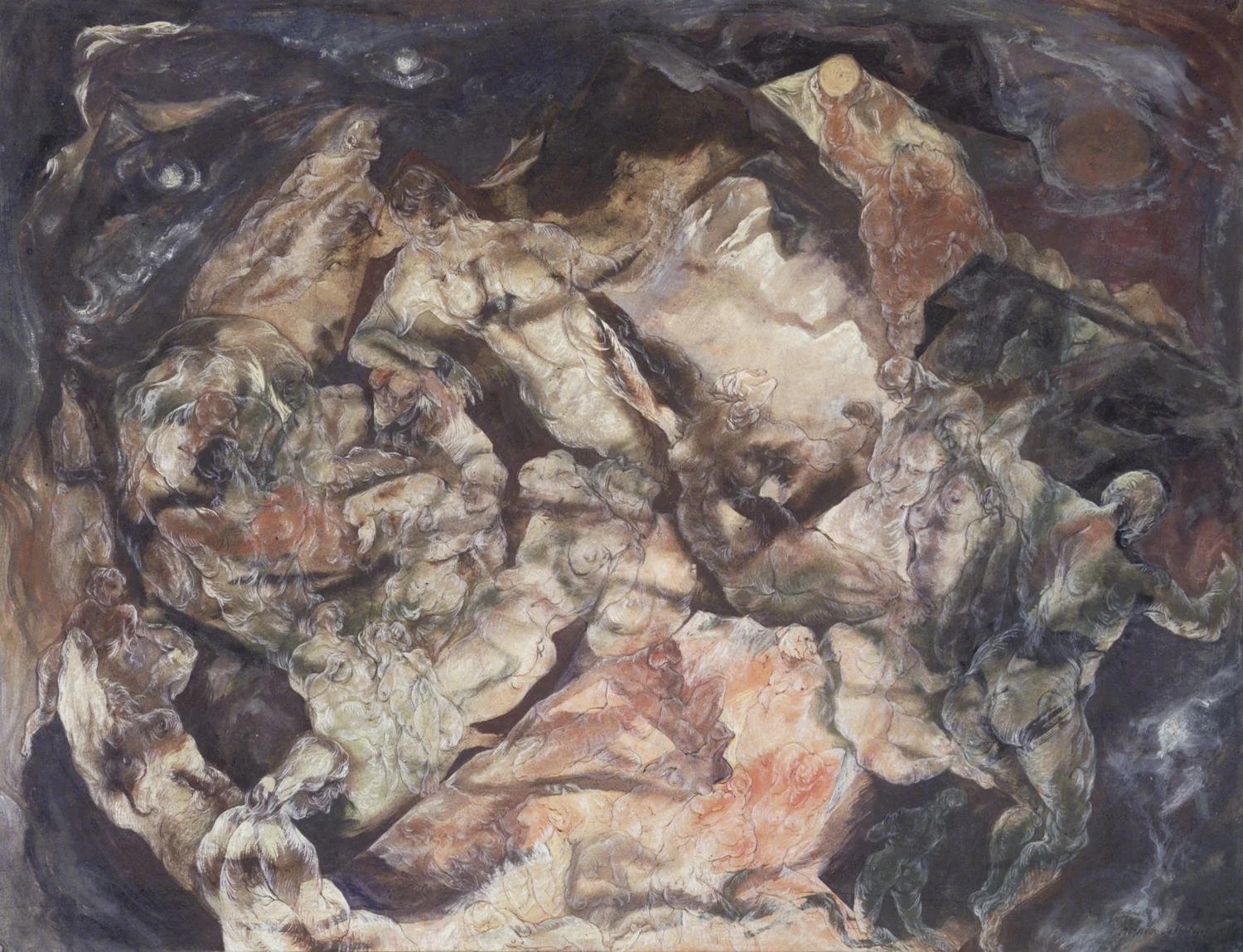
Kenneth L. Callahan, Conversation, ca. 1944–1945
In between airports and beds this week, I returned to Szilárd Borbély’s Berlin-Hamlet, as translated with eloquent tenderness by Ottilie Mulzet… Perhaps there is no better way to revisit Walter Benjamin’s arcades than from the alienated ghostscape of the present. Borbély’s arcades are haunted by what Benjamin’s strolls could not yet see; the past meets the unstable present in its lacunae and absences.
As mentioned on the book’s jacket, Berlin-Hamlet strolls through Berlin as if it were 19th-century Paris, filling the air with “disembodied scraps of written text, remnants as ghostly as their authors” —- including Franz Kafka, Walter Benjamin, Attila József, Erno Szép, Paul Celan (given to us as Anschel) and others. Images of post-1989 Berlin and its invisible guest-workers (Borbély mentions “Slavs and Romanians” at one point) are overlaid with paraphrases and repurposed quotations from a history haunted by the Shoah. The epistolary nature of these poems is fragmented, unfinished, en-route and yet somehow failing to be delivered.
39. [Fragment VIll]
I can no longer bear the aggressiveness of poetry,
and I do not wish my deeds to be investigated.
I would like to be an opened knife: the inscrutable.
A razor-wielding murderer. With a tongue oozing flattery,
who drips
poison into your ear. Who makes you mute, so you cannot
scream. As the guards turn into the corridor,
I count five steps. Now is the time to cry out. Before
they throw themselves on me. Then in the stillness, there
are no sounds.
43. [Allegory VIl]
The “heart which is free of all base thoughts,”
already having surpassed “the borders of beyond”
and gazing back upon language, upon that costume
which was its body, the tapestry of speech,
*
which, as now it seems, has already departed,
without bidding farewell, and without looking back,
in its tread the voice of all that is irrevocable,
perhaps the misapprehension of things uttered,
*
or perhaps, on the contrary, the certitude
of silence, that strength which destroys,
and that something which is withheld,
until now unperceived and unthought,
*
like everything which is infinity's antipode,
the disavowal, that is, of time and of space,
at once the boundary and the unbounded,
which exists in this very word,
*
but not even here, for there is no looking back, for
there is no backwards and there is no was, and not even
memory to disturb his attention,
no telling what will occupy it now.
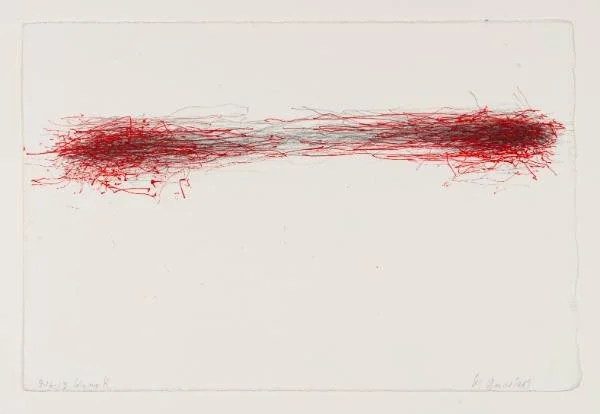
William Anastasi, Without Title (Bus Drawing) (recto); (Subway Drawing) (verso)
49. [Epilogue II]
[i]
For the dead are expected to know the path
above the precipice of the everyday. When
they leave the lands of despair, and depart
towards a kingdom far away and unknown,
which is like music. Swelling, a solitary
expectation everywhere present. This music
does not break through the walls. It taps gently.
It steals across the crevices. Silently it creeps,
and cracks open the nut hidden deep within the coffer.
It sets in motion the glass marble believed lost,
it plays with it. Suddenly, the cut crystal glasses
begin to crack in the china cabinet. And the chord
bursts apart.
[ii]
God's being is an open box, filled
with the dead. Thrown upon each other
they lie, and look far away
into the distance. They do not close their eyes, even
for a moment. God cowers and trembles
in a remote corner. Eyelashes convulsively
knotted together. In a thin
whimpering voice he cries.
[iii]
God's being is an open box, filled
with toys. Sometimes children sit around him,
they rummage through the box. Every toy is an
enigma. God sits among them, and
watches. He too is a child, who searches
through the toys. When he finds something,
he is happy. He turns it over a bit
in his hands. Then throws it back.
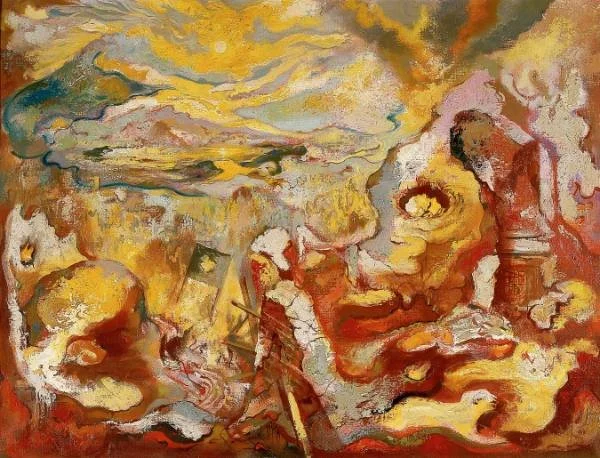
George Grosz, The Upheaval of Nothingness (1948)
In closing, I leave you with an excerpt from Bin Ramke’s poem, “What Is Memory A Name For, The Word”, which skims through the dust of this constellation for me, and asks (again) what temporality is given to us:
Putting back together the pieces
into a new shape the mind minds its own
business through the night the day
winds like a clock. Like what a clock
once was, a thing of parts clicking
into place time and time again.
Time and materials he called his book
his plumbing manual for leaks and
living with them. Sleeping to their
timing; clepsydra is a name for it.
Thief of time, thief of water, waste
of night the shape of an hour-
glass refracts the light of Venus
which is to say glass bends parts
of Venus the star the name of
(The remainder of Ramke’s poem can be found in the April 2025 issue of Conjunctions.)
*
Bin Ramke, “What Is Memory A Name For, The Word” (Conjunctions)
George Grosz, The Upheaval of Nothingness (1948)
Kenneth L. Callahan, Conversation, ca. 1944–1945
László Bedecs, “An interview with Szilárd Borbély” (Asymptote Journal)
Szilárd Borbély, Berlin-Hamlet t. by Ottilie Mulzet (NYRB Poets)