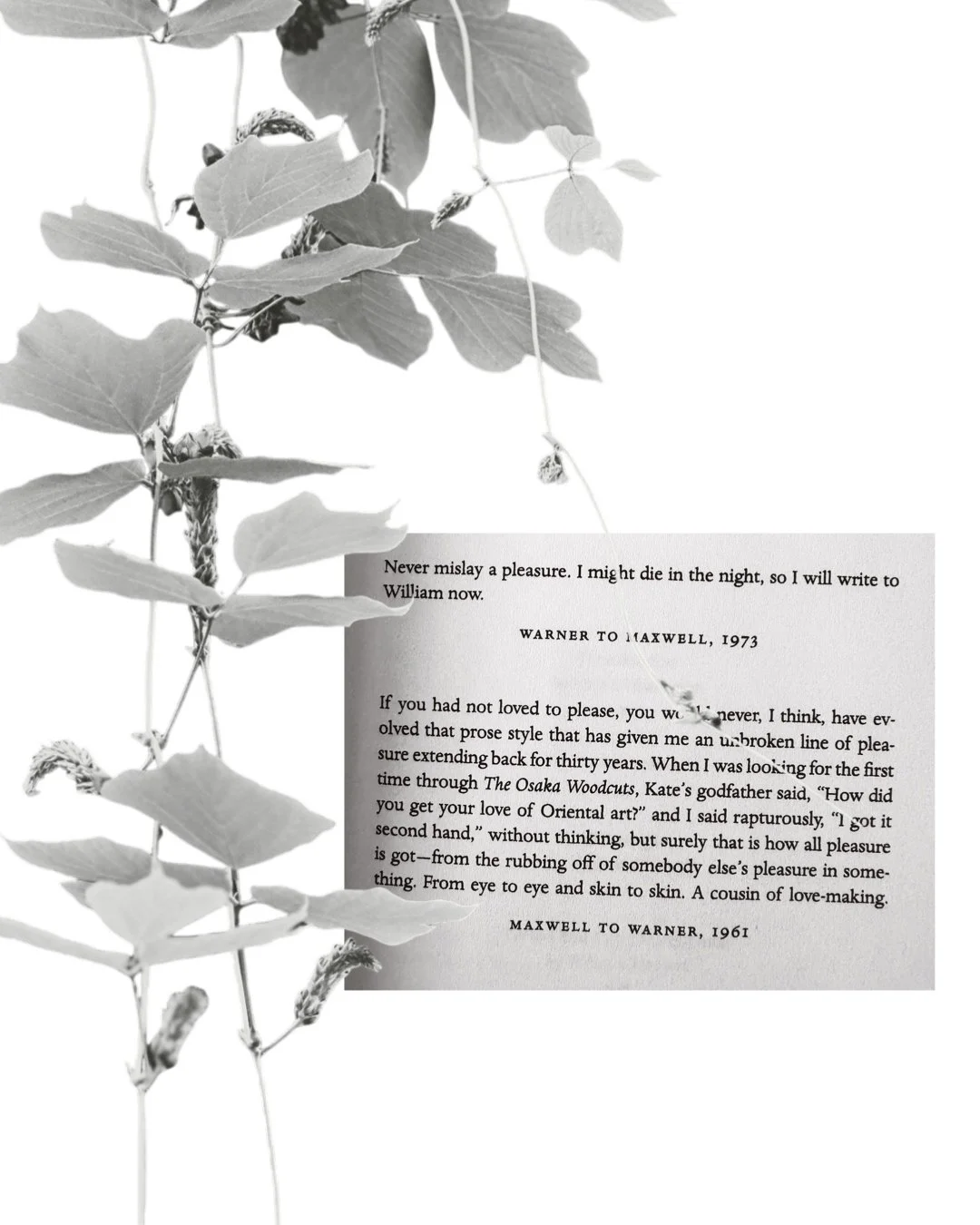
Earlier this summer, I snuck away from the house and sat on my favorite hill with a pen, my orange notebook, and The Element of Lavishness: Letters of William Maxwell and Sylvia Townsend Warner, 1938-1978. Warner and Maxwell are irresistible in their arguments, witticisms, and the passing back and forth of vignettes, but — as the epigraph below reveals — the overall tone is one of good faith, mutual admiration, and (for lack of a better word) trust.
Someone abandoned their red cardigan at the foot of my favorite oak. I haunt that tree religiously. What to do with the unplanned and unclaimed flustering red thing?
November 11, 1969
On the day of November 11th, 1969, in the century prior to the one wherein P. and I, between laughter and tears, would select this date to marry, Sylvia began her letter to William Maxwell with the announcement of her longtime partner’s death. “Valentine died on Sunday morning,” Sylvia wrote. “She was deeply under morphine. I was with her to the last and laid her out, helped by our kind Sibyl who had shared the nursing." No stranger's hand touched her fastidious reserve. This evening her coffin was carried out of the house and put in a forget-me-not blue van —which would have surprised her. I heard her spirit laughing beside me.”
After sharing this new way of relating to Valentine, Sylvia feels she has prepared him for what neither could truly know, namely, how she would deal with losing her lover and occasional muse: “I am passionately thankful that she is out and away, and that in a fashion we are back where we were, able to love freely and uncompromised by anxiety and doubtful hopes and miseries of frustration.”
I can hear the rustle of Sylvia’s shoulders turning slightly as she shifts her torso towards the large window and looks out upon the garden, seeking the familiar trees and scenes, noticing a broken birdfeeder, and— finally— failing in this effort to orient herself at home, where ‘home’ indicates the place she shared with Valentine.
(O window, you make her a stranger!)
Sylvia discovers herself molded queerly, rendered as the ghost of Valentine’s love.
On the desk below, the letter lies open. “One thinks one has foreseen every detail of heartbreak . . .” she tells William, “I hadn't. I had not allowed for the anguished compassion and shock of hearing her viola voice changed to a pretty, childish treble, the voice of a sick child.”
“Death transfigured her,” Sylvia says, using a religious word against its usual meaning, asserting the near-irreverence typical of her novels, perhaps even hoping to see what might happen if she can live this one out as text. Like the saints and mystics, Valentine became more beautiful after death: “In a matter of minutes I saw the beauty of her young days reassert itself on her blurred careworn face. It was like something in music, the reestablishment of the original key, the return of the theme. Don't think I am unhappy and alone, dear William. I am not. I am in a new country and she is the compass I travel by.”
November 26, 1969
A few weeks later, Sylvia ended a letter to William by mentioning that Valentine had bequeathed various smile items to William, among them, a clock: “She left you, as well as a folder of S. T. W. and her set of my books, her small table-clock. It chimes hours & half-hours with a pretty treble voice. It must wait to be professionally packed. And a small brooch apiece to Kate and Brookie. 'My two dearest' she says of them: both were given to her by me, love-tokens. These are so small that if you had a flying friend coming to or going from this country, they could be conveyed without adding an ounce to his luggage. Otherwise, they can travel with the clock.”
As for adjusting to the new absence, Sylvia refuses to admit the loss as complete. “No, I am not alone,” she tells him. Valentine is near—a muse to her hours and dreams: “She is more living, more real, than I am myself. She pervades my days. But I can't talk to her, tell her of this thought, that bird which flew by; I cannot consult her, nor ask her to put a new flint into my lighter. These trivia stab my heart. And I can no longer serve her. That is most annihilating of all.”
December 16, 1969
In her letters to William, Sylvia affixes traces of scents and shadows that testify to Valentine’s ongoing presence in the world of the living. But there are lapses, memories, places that conspire to disarm her, as she confides: “With a heart as normal as a stone I went to spend this last weekend with friends in Berkshire because they wanted to change my air. Their telephone rang. It was a telephone on which Valentine had often rung me. With an idiot intensity I thought, She will never telephone me again. And for a moment the whole of my grief was comprised in that deprivation. There is no armour against irrationality.”
They talk about Lord Byron and Proust, the horrifying war against Vietnam, mushrooms and fairies and travels.
March 1970
Less than a year after Valentine’s death, William mentions the clock that Valentine bequeathed to him, a tock that has woven itself into his life, in a lengthy letter to Sylvia. He tells the story with delight, for stories are what they do, these two writers, they imagine and read and study and write: “When I got home with the greatest delicacy I approached the clock, wound it a little, and waited —no, first I set it and was ravished by the little chime, then I wound it and nothing happened. And while I was looking for a lever that could be released and start things, the second hand began to move: it moved twice round the dial, just long enough for me to fall in love with the clock, and stopped. And would not, having captured my heart, do another thing. I went to the phone and called an opera singer who has a clock somewhat like it, which belonged to her Aunt Clara, and therefore it is always referred to as Aunt Clara's Clock, and she said to clasp it to me lovingly as if it were a child and then bend forward so that the child's head touched the floor. I did, and nothing happened. She used to take her clocks to a Swiss firm that was most dependable, but they sold out to a Pole who was not, she said, but if I would bring it to the country we would go together to a man in Croton who is very confident... If there is one thing that fills me with misgivings, it is a clock in the hands of a man who is very confident. So bright and early the next morning I put it in my briefcase and went to Tiffany's, thinking that any number of elegant women, friends of Edith Wharton, must have gone there with just such beautiful mechanisms; and was given a card with the address of a firm on grd Avenue that Tiffany's felt to be most reliable. By now quite late to work, I went back the went to Tiffany's, thinking that any number of elegant women, friends of Edith Wharton, must have gone there with just such beautiful mechanisms; and was given a card with the address of a firm on ard Avenue that Tiffany's felt to be most reliable. By now quite late to work, I went back the way I had come, found the shop, saw at a glance that there was not a timepiece in the place that didn't antedate the sinking of the Titanic, and put Valentine's clock on the counter and the man said ‘How charming!’ Then he turned it sideways once and said ‘I will get in touch with you in a couple of days.’ It is a long time to be separated from something you have just fallen in love with, but at least I have the key, in my left hand coat pocket.”
Something you have just fallen in love with: these words would be confetti to Sylvia. Vietnam enters the conversation, as does terrible policy and the prison-industrial complex. William laments the imbecility endemic to the American political class: “The Attorney General of the United States is asking for permission to take prints of the soles of the feet and specimens of the handwriting of people who might have criminal tendencies. I could have known that we were due for a revival of phrenology. We have had everything else. Pity this unfortunate country.”
Later in the same month, William sends a short note of despair to Sylvia, replying to her statement that she will never write another novel. Look Sylvia, he says: “When you say I feel pretty sure I shall never write another novel, I feel like what Thomas a Buile said in a pub (in the poem by James Stephens). I know that everything you wrote was directed toward Valentine, and that she was your climate, but please don't forget that I am here. If you stop writing you will hurt my feelings terribly.”
April 13, 1970
On my birthdate in April, before I was conceivable to the parties involved in my conception, Sylvia tells William that she is writing again. “I have begun to write again—” she says, before qualifying: “No, not a story, not a novel, and nothing for now. An archive. I found that Valentine had kept quantities of my letters, as I had kept quantities of hers. Reading through them, and putting them into sequence, I realised that it is a notable correspondence and the sort of thing that should be put away in a tin box for posterity. So now I am entirely absorbed in writing the narrative links and explanations and so forth. I am mid-way in the prologue. It is far the best thing I have ever written— and an engrossing agony. I am terrified that I should die before I have finished this. A month ago, it was the only thing I had the least inclination for. And you, dear William, must be the tin box, since it will count as my Literary REMAINS —absurd phrase. It can't be let out till there is a safe margin for every one to be dead in.”
August 2, 1970
The archive of correspondence between herself and Valentine becomes an obsession for Sylvia. In August, she admits this to William. “I am lost to the world in those letters”; and William imagines her face upon reading these words. He recognizes the goulash where ecstasy mingles with self-abandonment, where relinquishment resembles sacrifice, where flavors emerge from the mire of shared boiling.
Absorbed in this project, Sylvia is recognizable, busy, distracted, alive. “Annotations have always been my setting delight,” she tells William. “Some of them, I find, need to be extended into snatches of narrative.” And perhaps she drops a name in order to say what she wanted to say anyway: “David Garnett said to me long ago 'What you write best out is love.’”
November 1970
They joke about winter. William tells Sylvia how deeply touched him to read Valentine’s letters, to linger in the angles of light and resonances of the “supplemental narrative” Sylvia had written to contextualize her lover’s poetry: “The last cluster of letters set me to thinking how there are two fears and most people have one or the other and maybe they are the same fear: that they are afraid to call their soul their own, or that they are afraid it will be seen.”
Exposed souls make us blush. They resemble the curve where the human back meets the ass:
Maxwell wrote his own ghost stories in a manner that permitted him to maintain plausible deniability about his supernal beliefs. But here, on the page that will be read by an ailing Sylvia, William balances friendship’s tandem desires, conversation and kindredship, alongside the hope of comforting her. “The effect of Valentine's letters is of the soul unsheathed,” he writes, “in utter and final fearlessness. I have never read anything like them.” He wants to sound insistent. And his sentences are structured to realize this insistence as he moves from the true thing to the overly-affirming one. William moves quickly, hastily, in a manner that preserves intimacy; the momentum of his compliments doesn’t hesitate or falter. “Such style, and without a moment's thought to it,” he says ofValentine’s poems. “I will never again read the word happiness without thinking of them.” (This can be true and yet too much, as death and friendship tend to be.) “And in the supplemental narrative — what I started to say is that all my life I have been confidently watching you outdo yourself, and you have again, but by so far—the night ride, and the simple summation of all the aspects to her love, simply exceeds, as prose, anything you have ever written,” William tells Sylvia, before attaching the words she most wanted to hear from her dear editor-peer-fan: “It is as if you were possessed.” Amen.
*
Michael A. Steinman, ed., The Element of Lavishness: Letters of William Maxwell and Sylvia Townsend Warner, 1938-1978 (Internet Archive)