“A day is a leaf on the tree of your life.”
— Paul Valéry, notebook dated 1941 (t. by Nathaniel Raduvsky-Brody)
“But who is to strike off the monster's head, now that it has itself lain long, with its fair locks, under the linden tree?”
- Theodor Adorno, Minima Moralia
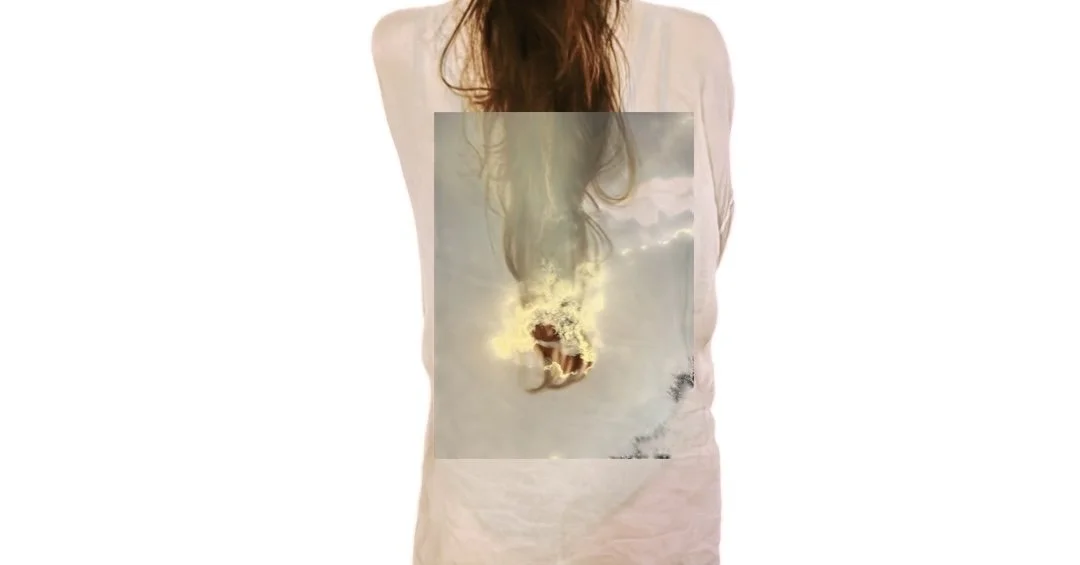
Morning on the balcony, the earsplitting din of shutters being opened; I create myself. I take my place in the day and I look out over all things. All— the unfolding of it all. The word and movement of Greetings!—
Salve, natura, come to mind. The birds speak and carve out their cries from untold silence. The angular nature of vision gathers, concentrates the gaze manipulates/ near and far. Everything in this presentation has its place, the palm trees, the smaller and smaller houses, the tops of the cypresses, the mountain, distinct, reserved, clear tall, and the sea, a band of pure color against which the Cap d’Antibes is painted in greenish black in geographical projection.
— Paul Valéry, notebooks dated 1924
There is a tall tulip tree in the little panes of my window.
My eyes come to rest there, imploring an idea
And a question makes its nest there among the leaves.
Paris is more or less behind those leaves.
This countryside crushes me- saddens me.
And every countryside.
No matter how beautiful they are, they cause me pain.
I feel like crying out from so much solitude and like writing.
I clearly feel that I converse, even with myself,
as one eats out of politeness,- being invited but having no appetite.
— Paul Valéry, Delta [X, 217], 1924
Here is the man of questions and combinations before his idols. But sometimes they are lifeless dolls in his eyes, the dead and wooden pawns of an abandoned game, just as on other days they were winged and luminous powers. Empty and vain are the same words that were living and deadly weapons, organs of knowledge, grasp and enjoyment, instruments and acts of possession, treasures and keys to treasures, fine vessels and the extraordinary brews they contain, lights and also eyes.. Who will recount the variations of my faith in my thoughts?
— Paul Valéry, “Psalm M” / notebook dated 1922
I only speak for the man who is alone— he who rises in medias nocte, in the nakedness of his existence—as if resurrected on the other side of his consciousness, where all things seem real and strange to him— as if he had come with a lamp to a dark place crowded with unfamiliar objects that are illuminated and transformed at every step. At an hour when he was not expected, in a place that could be any other...
— Paul Valéry, notebook dated 1930
The living water, to be running after something;
The sun, to be slowly seeking step by step
The point from which
It will see something.
Another
Suddenly the moon breaks through
The murkiness of evening
As a curious woman in a crowd
Finds herself in the front row.
— Paul Valéry, notebook dated 1937
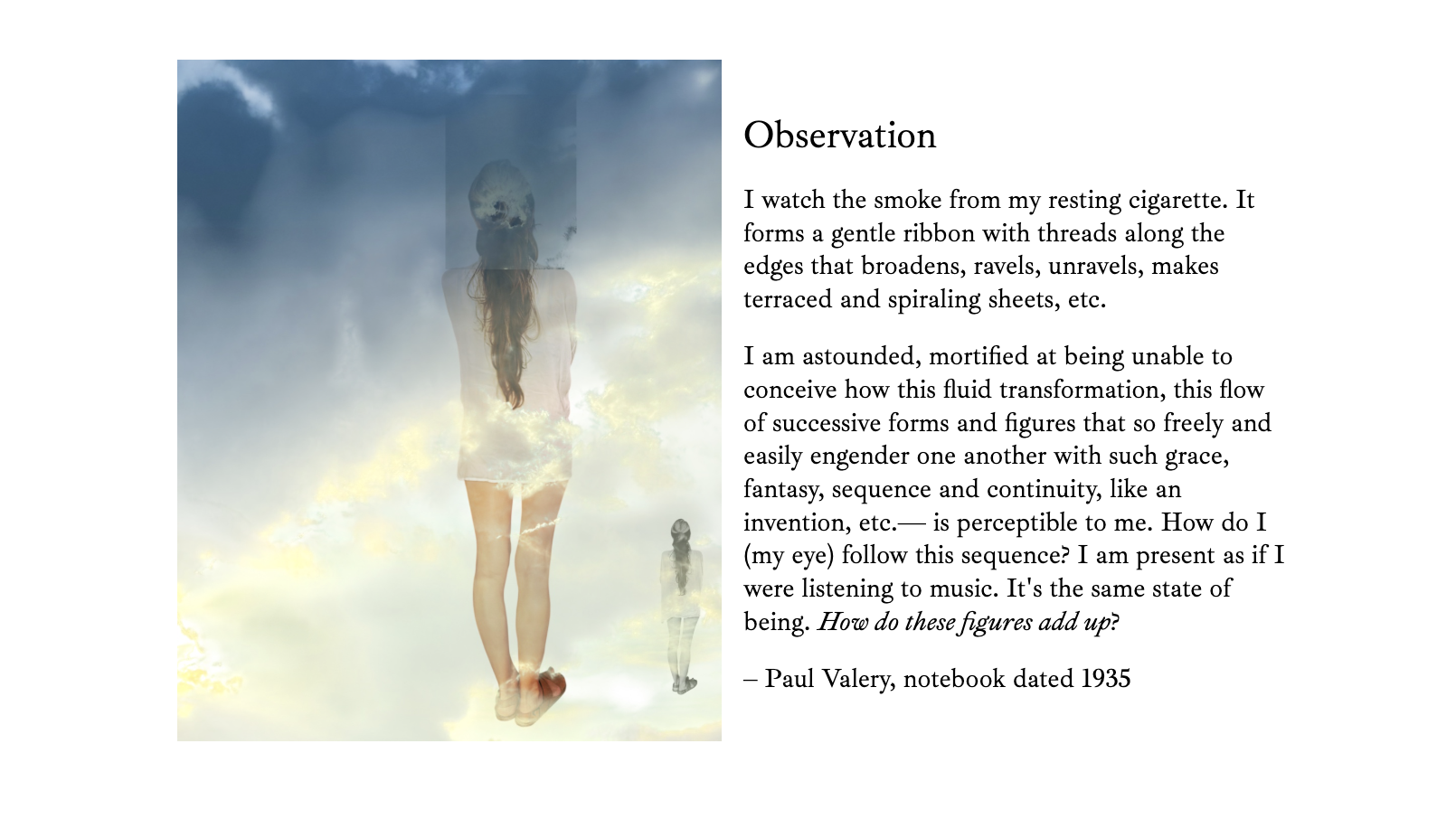
“How strange is what is good!” This fragrance— this creamy smoothness— the turn of this neck; and my hands moving downward over these shoulders to reach these breasts— to where they form the solidity of the bust with the continuous gentleness of touch, a series of modulations of the press of my fingers, of pressure and slipping at contact, which makes my soul the creator of what offers itself to this act from place to place and better and better. I make and remake you—I cannot abandon this ultimate act, lose this song of my hands.
— Paul Valéry, Untitled notebook [XX, 710], 1937
So many things you have never really seen, in this street where you pass 6 times a day, in your room where you live so many hours every day! —- Observe the angle the edge of that dresser makes with the windowpane. It must be reclaimed from the ordinary, from the visible and unseen,—- it must be saved,— and given whatever you give by mere imitation, from the insufficiency of your sensibility, to the most insignificant landscape, sunset, storm over the sea, or piece in a museum.
Those are ready-made gazes. But give to this man on the street, this corner, this prosaic hour and object —and you will be repaid a hundredfold . . .
— Paul Valéry, notebook [XXIII, 480), 1940
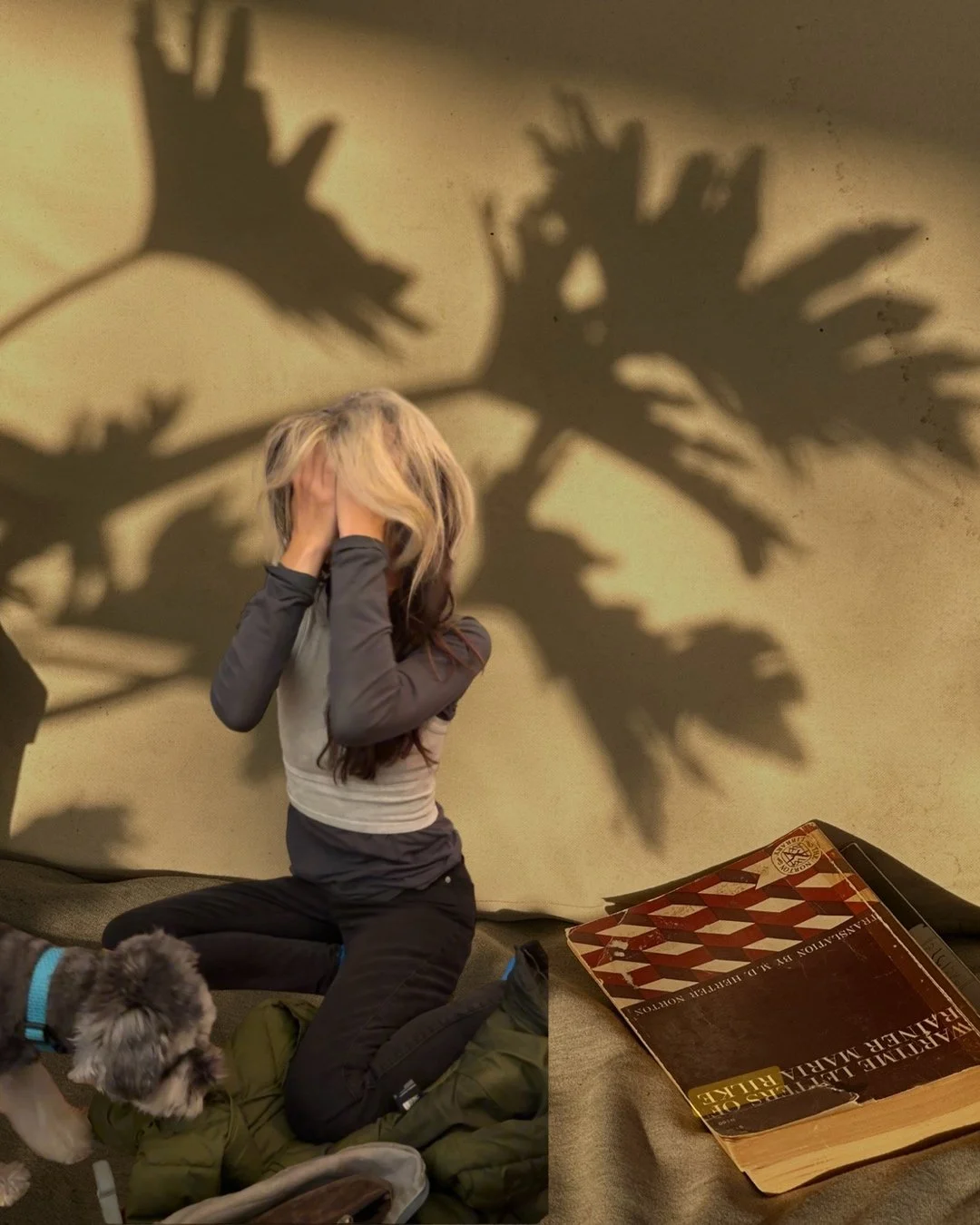
“...the saleable is itself subjectivity administrated by subjectivity.” (Adorno, MM)
“. . . if even the freest of spirits no longer write for an imaginary posterity…”
— Teddie, MM
*
Anna Calvi feat. David Byrne, “Strange Weather”
Angus & Julia Stone, “Nothing Else”
Paul Valéry, t. by Nathaniel Raduvsky-Brody, The Idea of Perfect: The Poetry of Paul Valery (Macmillan)