It was right in the middle of our tragedy
And she sat at her mirror for the longest of days
— Louis Aragon, “Elsa at the Mirror”
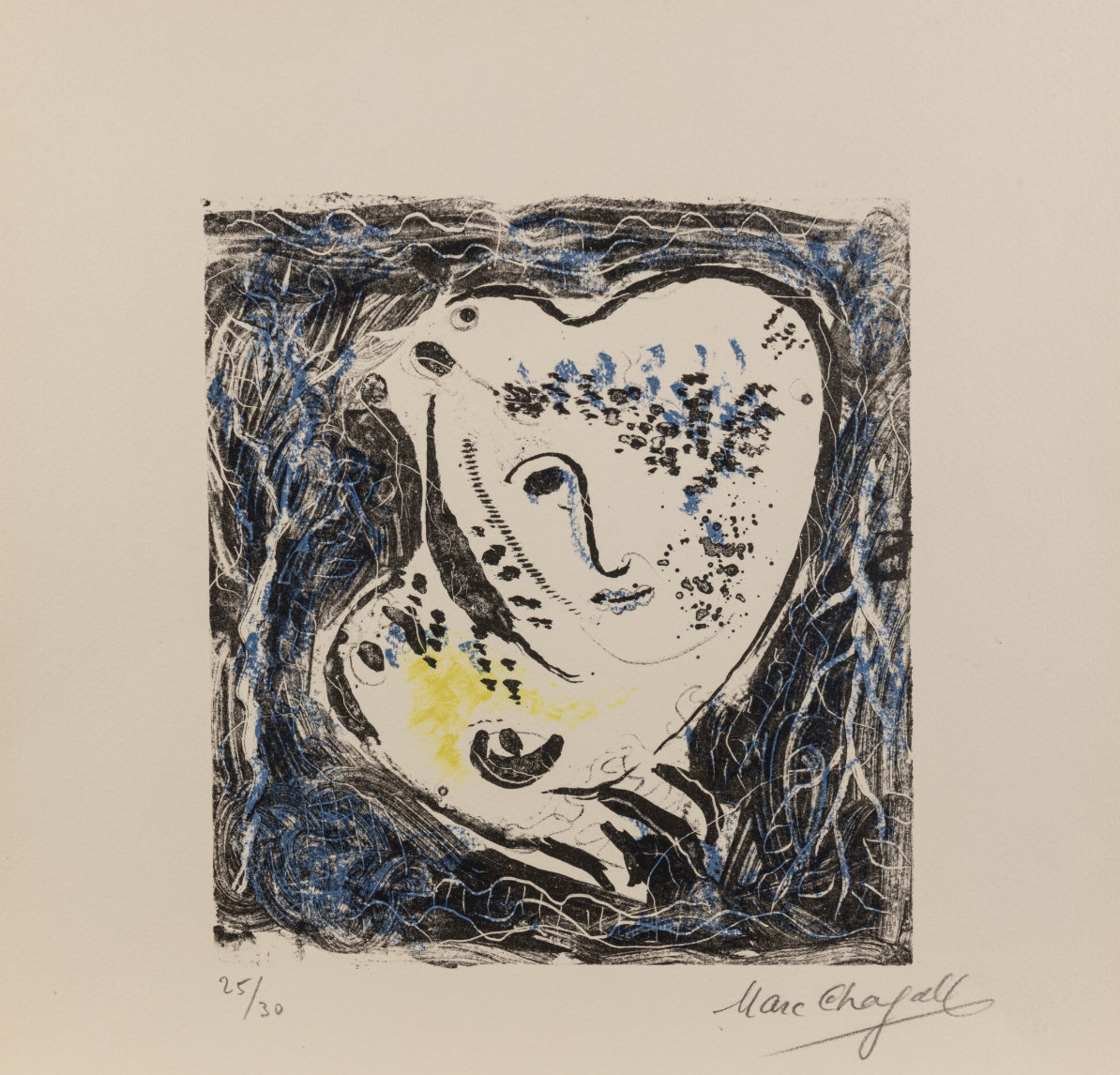
Marc Chagall. Hommage à Elsa Triolet. 1969-72.
LETTER 1: BERLIN / Viktor Shklovsky to Elsa Triolet
I love you a little more than yesterday.
I wish I could unlearn how to write, so I could learn to write again and only to you.
Unlearn how to speak, then learn again, and let my very first word be “Elsa.”
I love you beyond reason. I could just as well lie down and die.
Your kiss, Elsa, is rectangular and bottomless.
Your eyes are blue, and the curve from your cheeks to your chin is marvellous.
Your shoulders and neck are better than the whole world, and your head is more precious than the stars.
You have a pair of ears and auburn hair, Elsa, and I’m grateful to you even for buying yourself backless shoes.
Mistress, beloved.
You’ve opened my eyes to life.
Your head is like a sun-bright gemstone.
And if your head is like the sun then what can compare to your lips.
And yet, you’re a girl.
A girl named Elsa.
Irreplaceable. Lonely. More beloved than words can say.
Once again, I swear to love you till the grave.
Your Viktor.
LETTER 2: BERLIN / Viktor to Elsa
Shlovsky opens “Letter 2” with a declarative — I will go to Russia, or to a Russian prison — before taking a Slavophie-adjacent swipe at Europe and landing on his addressee’s hands —The Chekists will be merciful to me, they aren’t Europeans and won’t scold me if I scream in terror of death or moan as I do now, wounded by your hands that know how to touch. He reassures Elsa and plies the banter of distance — Little one, I’m not blackmailing you. They won’t actually kill me in Russia — and sandwiches love between the ideal and reality— I love you and believe that it’s your life that makes you cruel. Perhaps he shoots a little vodka in the pause between that line and the wager which follows — My father gave up vodka, I’ll forget love. Love is a bourgeois sickness, as we know, and Shlovsky leverages multiple forms of deniability in this letter, developing a range of cover stories from humor and terror. I don’t want to torment you, he says.Tell me “go away.” he adds, ordering her to be the one that ends things. — Give me the bite de grace. Then he pivots sharply; the tone changes from love to literature — My own letters have arrived. I need them for my book. The book will be good, and, the devil knows why, cheerful. He signs off as Viktor followed by a sort of postscript without a “p. s.” — Cheerful, that’s what I am, sisterling brotherling mine Elsa.
LETTER 44: MOSCOW / Viktor to Else
Dear Elsa.
It’s morning. Snow outside the window. Everyone’s asleep. You are flying away tomorrow. I kiss the wings of the plane that will protect you; I kiss them on their stars.
Twenty-two years ago, I left for Russia, my son was born; my son has been killed.
I’d tried to build a life without you and failed.
For twenty years, I’ve been writing about our separation.
[ . . .]
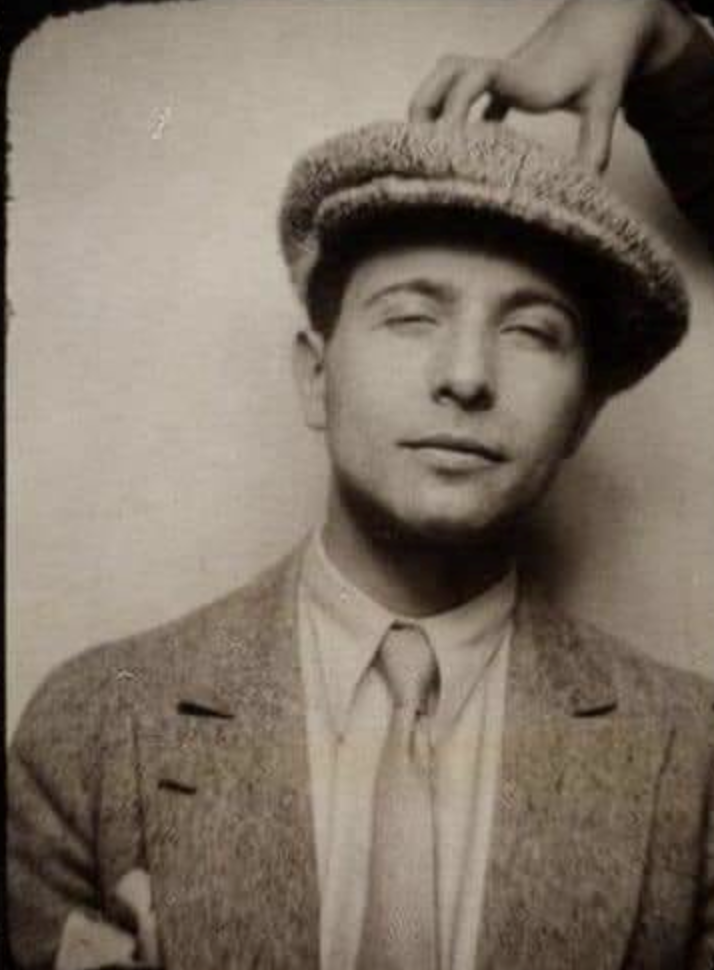
Louis Aragon in a camera booth, 1929. “The hand on his cap is probably Elsa’s…”
At this point, I would like to direct your attention to my source for this correspondence, an email from Tamizadat Project which offers excerpts from a book titled Viktor Shklovsky to Elsa Triolet: Letters about Love. The book features Shklovsky's original letters to Elsa Triolet, written between 1922 and 1970, during his exile in Berlin and later from Moscow, spanning nearly fifty years. These previously unpublished letters inspired Shklovsky's celebrated novel Zoo, or Letters Not about Love (1923).
And the word tamizdat refers to literature written under dictatorships that was banned or censored by the state, smuggled across the state borders, and published in democracies with press freedom. The word originated in the Soviet Union and Eastern bloc states whose residents were ‘guarded’ by the Iron Curtain. As a portmanteau word, tamizdat combines two Russian words: tam (meaning “over there” or “abroad”) and izdat (an abbreviation for “publishing house”).
While tamizdat crosses borders, samizdat (meaning “self-published”) referred to the practice of manually copying and circulating banned manuscripts underground within these dictatorships. Samizdat was for the drawer, if anything, and many writers preferred to share it orally through recitation or reading, rather than commit their words to paper and leave traces that could be surveilled and lead to prison.
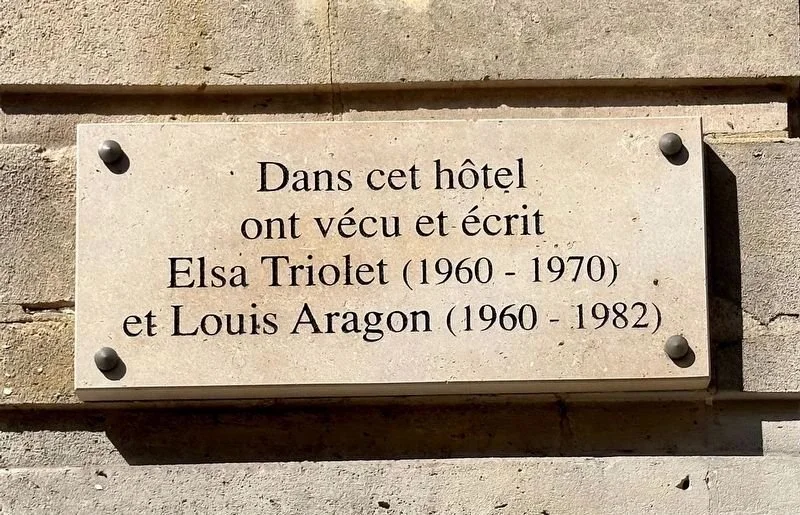
48° 51.282′ N, 2° 19.277′ E. Marker is in Paris, Île-de-France, in Département de Paris. It is in Saint-Thomas-d'Aquin. Rue de Varenne.
Elsa and Louis can be found in their posthumous residence at du Moulin de Villeneuve à Saint-Arnoult-en-Yvelines dans les Yvelines.
According to the Russian Ministry of Justice, Tamizdat Project is a “foreign agent.”
*
Louis Aragon. “Elsa at the Mirror.” TLS Poem of the Week, translated by Alan Jenkins; introduced by Andrew McCulloch.
Louis Aragon and others. “"Le bonheur existe, et j'y crois’ à la Maison Elsa Triolet-Aragon.” Radio-France. 26 July 2021.
Viktor Shklovsky, Viktor Shklovsky to Elsa Triolet. Letters about Love. Ed. Valerie Pozner. Translated by Alexandra Berlina. (forthcoming from Tamizdat)
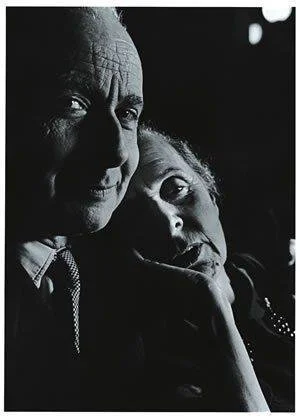
Louis and Elsa.