The spirit is most alive when it is lost.
— Guy Davenport
Sometimes I don’t know why we do it.
In these (and those) times, with Prelude 2 by Max Richter and Mari Samuelsen in the margins, I return to the words of others, seeking wine in their metaphors and similes.
Writing is wrestling, said Chinua Achebe. The writer sits in a room and wrestles with ideas in the struggle of story. It requires tremendous energy, Chinua Achebe said, but it is very exciting. “It is both difficult and easy. What you must accept is that your life is not going to be the same while you are writing. I have said in the kind of exaggerated manner of writers and prophets that writing, for me, is like receiving a term of imprisonment — you know that’s what you’re in for, for whatever time it takes.”
Writing is an addiction, said John Updike. “Writing … is an addiction, an illusory release, a presumptuous taming of reality, a way of expressing lightly, the unbearable,” said Updike. We are surrounded by death and conversant with our tiny little mortality. “That we age and leave behind this litter of dead, unrecoverable selves is both unbearable and the commonest thing in the world — it happens to everybody,” Updike continued, and sometimes we can forget this, or blunt the edges of it: “In the morning light one can write breezily, without the slight acceleration of one’s pulse, about what one cannot contemplate in the dark without turning in panic to God. In the dark one truly feels that immense sliding, that turning of the vast earth into darkness and eternal cold, taking with it all the furniture and scenery, and the bright distractions and warm touches, of our lives. Even the barest earthly facts are unbearably heavy, weighted as they are with our personal death. Writing, in making the world light — in codifying, distorting, prettifying, verbalizing it — approaches blasphemy.”
Writing is a kind of miracle, said David Foster Wallace. The challenges of self-reflexivity never diminish. The irony of failed escapism seems inherent to the medium. “The fact that you can now sustain the fun of writing only by confronting the very same unfun parts of yourself you’d first used writing to avoid or disguise is another paradox,” said David Foster Wallace,” but this particular paradox “isn’t any kind of bind at all.” This paradox that calls us to the brutality of the page is a gift, in Wallace’s reckoning: “What it is is a gift, a kind of miracle, and compared to it the rewards of strangers’ affection is as dust, lint.”
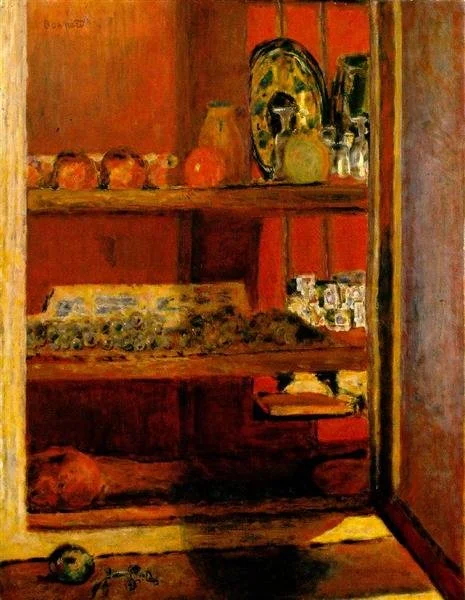
Pierre Bonnard, The Red Cupboard (1939)
Oil on canvas. Bonnard’s restless yellows pulling and pooling light.
A nervous melancholy in the red tones . . .color transfixing the objects.
Claustrophobia. Subtle chromaticism.
Spatial ambiguity, an insecurity of place . . . the cupboard’s fragile artifice.
The way shadows impose upon inanimate objects and shush them. Silencing as a facet of shadows.
Forget the reds.
Forget Bonnard’s elaboration of a shadow that doesn’t make sense.
Forget the mysteries which transfix you and pull you out of the ordinary.
“Forget the books you want to write,” said Henry Miller. “Think only of the book you are writing.”
If I knew where the good songs came from, I’d go there more often. It’s a mysterious condition. It’s much like the life of a Catholic nun. You’re married to a mystery.
— Leonard Cohen