His only exercise was pacing in front of a canvas, and his idea of dieting was to take large quantities of garlic pills and shun egg yolks, desserts, and coffee—while continuing to guzzle a half-dozen bottles of wine and eat two or more large restaurant meals a day.
— Mason Currey on Francis Bacon’s process, from Daily Rituals: How Artists Work

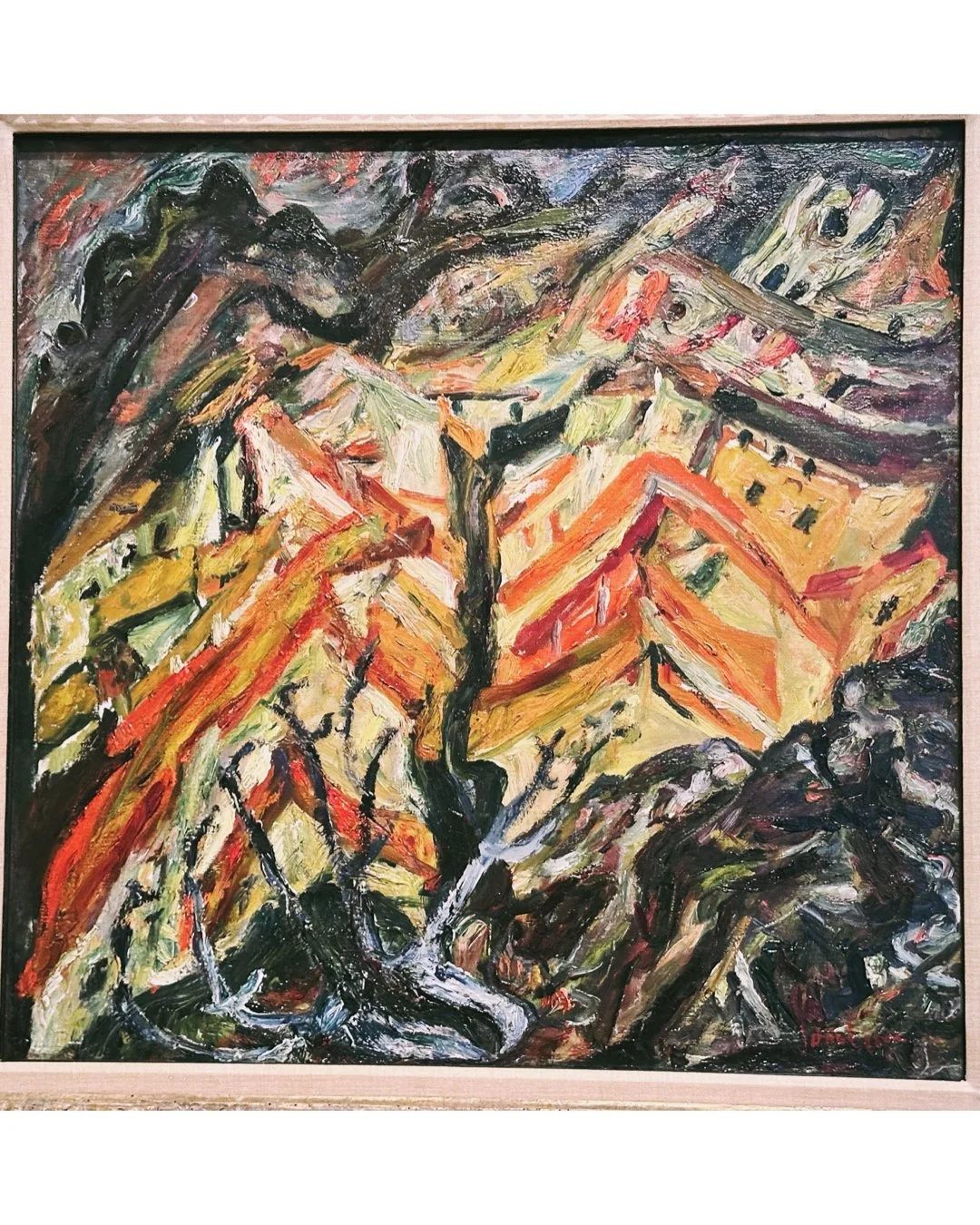
Baltimore last week presented me with the pleasure of encountering Chaim Soutine’s View Overlooking Céret (c. 1922) in the flesh, so to speak. Soutine left Paris and lived in Céret, a small town in the French Pyrenees near the Spanish border, for three years, a period that resulted in painting around 200 canvases, most of which are landscapes including boisterous rivers and energetic lines unrolling in rich ribbons of thickly applied color.
Rather than divulge the exchange between myself and Soutine’s painting, I will note a lovely coincidence that occurred a few nights later, as I sat in the hallway of a Baltimore hotel around 2 a.m., flipping through my AWP purchases, only to bump into a poem by Cole Swenson mentioning a different Céret-based painting, as if to insinuate that Baltimore would be my Soutine-Céret pipeline.
And why should I resist sharing this poem in its entirety?
“Chaïm Soutine: Reeling Trees” by Cole Swenson
The children are lost — is the central fact — and that —
is what holds on —- what factors in
and what losing is — and how its moving parts
come together with that clicking sound — how are
we a product of wind? Everything here is
four paintings by Chaïm Soutine
hanging in a single room —- though of only
two scenes — two large trees — and two of
two children running home — we see them at two
different points on their road where
the huge sky backs up - fills with trees - huge
trees full of wind that we can see — warm wind
along the road behind them curves
beyond the curve where a world — which he built — from paint
painted over paint — breaks
into a world just barely — out of sight
it opens out — into a broad valley — dotted with majestic trees
alone — in great fields of horses in a storm — the children are on
their way home. Clarisse Nicoïdski claimed
that Soutine was the painter who made the wind visible.
“In the curve of a feeling,” he once said
that feeling always curves
sharply toward
or from
having been raised in a tradition that prohibited representation (see Exodus
20:4) Or self-exile in which the line is drawn before it's formed.
He arrived in Paris in 1913 (though some sources say 1912) at the age of 20, or
perhaps 19 or 21, having the liberty of not knowing quite when he was born, and
went to stay with friends at La Ruche, with its affordable studio-housing built
from the ruins of the most recent Universal Exposition.
We're falling up a hill
are a man up a red hill will
a fallen green through climbing
branches that hold a house up to the sky
and that the house is then thrown farther
up as we pick our way down the red cliff
running in the sun.
Which he translated as:
Paysage avec Personage or The White Road 1918-1919
Still as the light shines
and they're walking away
as the road divides as the cliff falls
and climbs, the trees climb. As the
sky falls and the road flays and the world
tilts rather red where it isn't green walking
along a road falling off houses into the sky
and into the sky walking and into the sky
running into the sky.
Soutine was a great reader of Montaigne, who claimed that the world is
constantly churning, never achieving an equilibrium. This is what Soutine
painted and what allows his landscapes to avoid classical landscape's
implicit argument for a single legitimate point-of-view, which can only be
occupied by a single person at any one time, thus also avoiding its inevitable if
subtle support of rigidly hierarchical social and political systems. Instead,
Soutine's riotous slippages multiply, and the viewer, too, slips, skids, and the
trees reel overhead.
Or more slowly — wandering under light — sharpening — the light — making
color — come off on the hands- and- sometimes the hands- are larger than
life and — always the hands — and they live alone
“waiting for the wind to rise,” he said to a friend who, passing again hours later,
had found him sitting in exactly the same position.
that the wind had made his hands
the wind of his hands
and what the wind had made of his hands
was not said
it was not that the wind
was the face of his hands
nor that his hands were faced in wind
but that his hands made faces
of the wind and faced them.
To wit:
Paysage à Céret, 1920
if the house entered the wind or rather
if the wind is in fact or becomes the windows
or in what order wind and house arrange
themselves there is a shroud
to find or lace or veil at times the whole town
wearing out, wearing down
to the face of the animal beginning to show
the procession of white walking out of itself, not
at all as violent as one would have thought or
it was not the wind
Soutine painted some 200 landscapes around Céret in the three years he spent
there between 1919 and 1922. His first dealer, Zborowski, took him down to the
south to give him the time and means to paint. First to Cagnes, just west of Nice,
but Soutine was restless, and so moved on to Céret, a small town just above the
Spanish border and some 20 miles from the sea. Dr. Albert Barnes, who put
the Paris art world into a frenzy when he came in 1923 to buy contemporary
works to fill his new foundation, encountered Soutine's work and was instantly
struck, marking a permanent and positive change in the latter's fortunes. He
ended up acquiring 60 of the Céret landscapes, though another source puts the
number at 100. Many others Soutine cut up or burned in anxious fits in which
he couldn't stand his own work.
He went through these fits off and on all his life. His good friend Paulette Jourdain
once, hearing strange sounds from within, looked through the keyhole into his
room and saw him in a rage slashing canvases and ripping them to shreds. He
once commented to another painter, “One day, I'm going to assassinate my
paintings.” Zborowski routinely fished them out of the garbage, and gallerists
refused to sell his works back to him, knowing what he'd do to them. At other
times, he would stare at a painting for a while, and then go over to it, cut out a
particular part, and keep just that.
Many of the landscapes are houses, and many others are trees. Les modes de la
vie. The rooms into which. We move through rooms, whole in the air, which is
open, opening the doors, a house on a hill that spins on its own, undone. This is
the case with The Oak, c. 1939, which is mostly sun, and The Tree, c. 1939, with
houses the size of marbles somewhere down below.
Is a painting of a tree a landscape or a portrait? He painted so aggressively that
one day he dislocated his thumb.
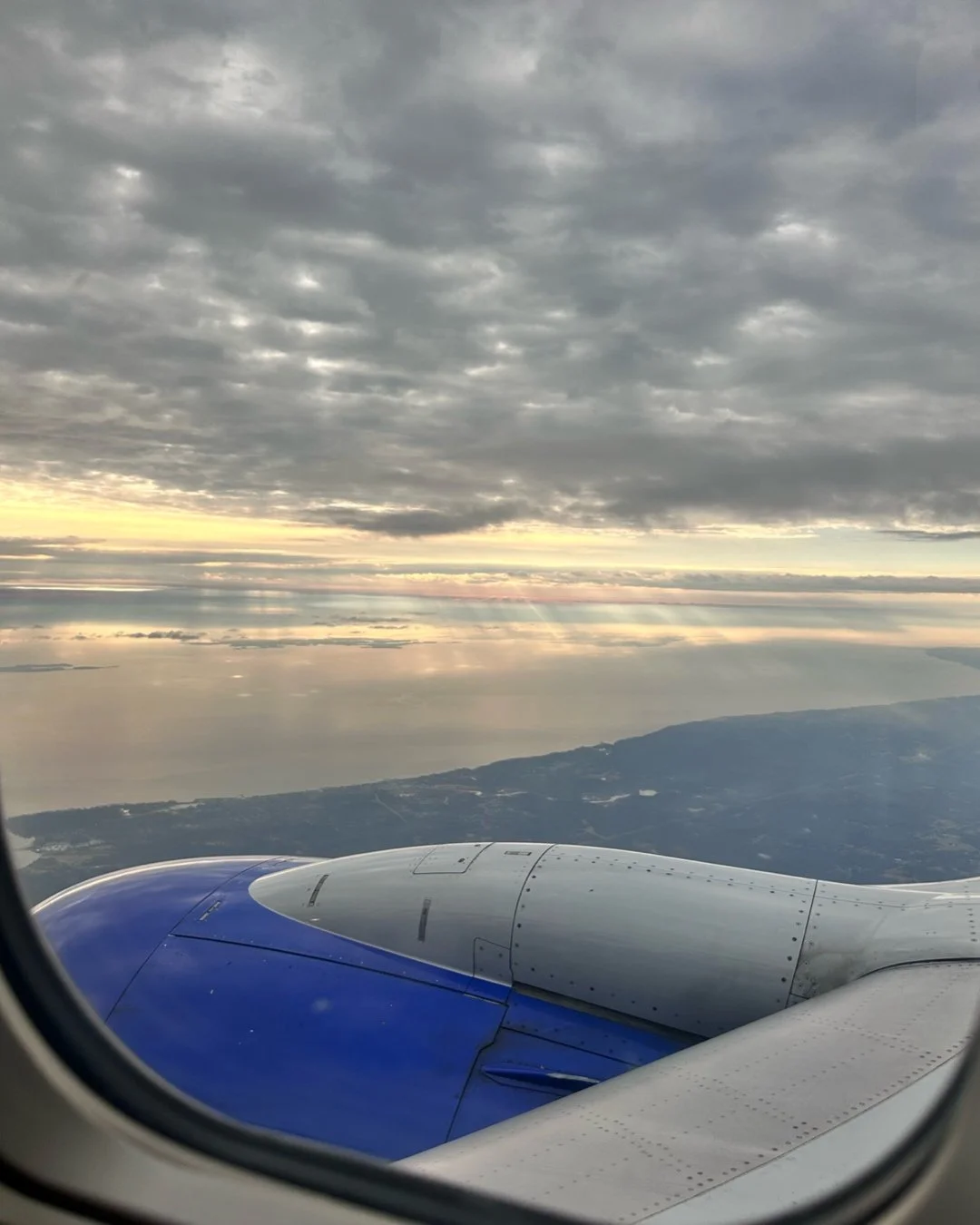
Lacking anything of significance to add, I offer you the music of my room, where Dinu Lipatti plays Mozart Sonata in A Minor, K310, at his last recital . . . and a view of the vertiginously-gilded sky from my flight to Maryland.
*
Celeste Marcus, Chaim Soutine: Genius, Obsession, and a Dramatic Life in Art (Hatchette)
Chaïm Soutine,View Overlooking Céret c. 1922 (Baltimore Museum of Art)
Cole Swenson, “Chaïm Soutine: Reeling Trees”
Giovanni Sollima, La Tempesta
Ignaz Brüll, Melodie in A minor, Op.53/2
Steve Tomasula, ed. Conceptualisms: The Anthology of Prose, Poetry, Visual, Found, E- & Hybrid Writing as Contemporary Art (University of Alabama Press)