Crush my calm you Cassavetes
I was sitting tight so quiet quiet
In the dark till the lights came up my heart
Beating like a riot riot
— Fugazi
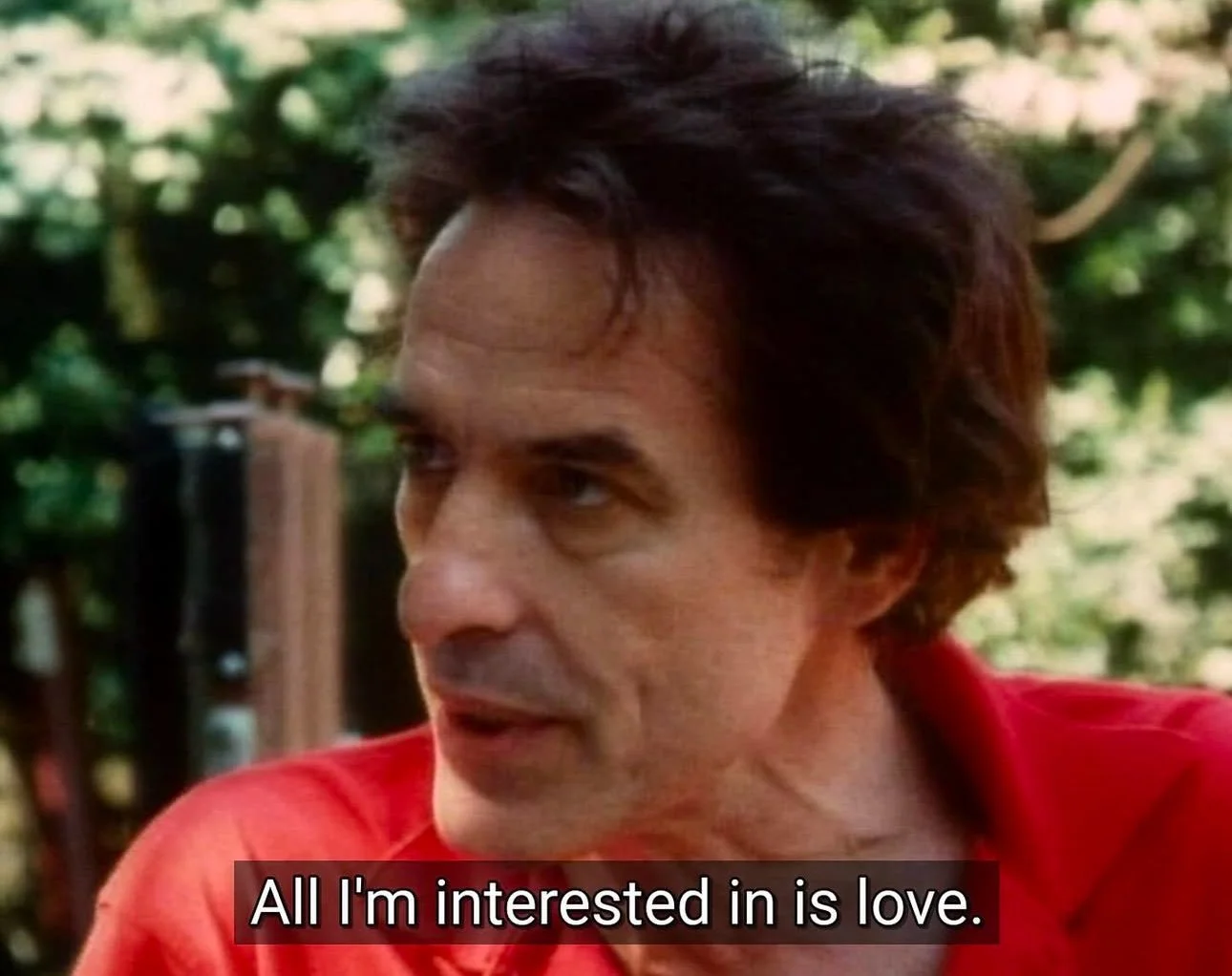
”I’m interested in love. And so, that’s why I have a need for the characters to really analyze love, discuss it, kill it, destroy it, hurt each other, do all the stuff in that war, in that word-polemic and film-polemic of what life is. And the rest of the stuff doesn’t really interest me. It may interest other people, but I have a one-track mind. That’s all I’m interested in – love. And the lack of it. When it stops. And the pain that’s caused by loss of things that are taken away from us that we really need.”
— John Cassavetes
“— love. And the lack of it.”
Love was the whole story for John Cassavetes. Cinema was a way of trying to tell it under varying conditions. As for personal character, Cassavetes never downplayed his penchant for drama, whether throwing his temper through rooms and meetings, hanging up abruptly, cancelling dates at the last minute. Intimate meetings collapsed into performances. Privately, Cassavetes maintained that his extreme emotional displays were a way of studying and learning the range of human responses. Social scenes gave rise to plays and possibilities; he could game them. “I love the fight!” he said in an interview. “Making a scene. Yelling. Hanging up on someone. How many times, when I was just getting started, I slammed the phone down, then played with my chess pieces, knowing it would ring in a few minutes. They always call back!” Cassavetes owned up to things. He called himself “difficult”; “a bigmouth”; “a troublemaker”; “temperamental.” Owning up wasn’t separate from the questions of ownership, autonomy, masculinity, and emptiness that drove his thematic interests. “It’s a question of manhood,” he added. Being an asshole was a way of announcing his refusal to be owned or controlled. He learned from his bad experiences. Hollywood and Kramer taught him that he would no longer be capable of “compromise” in filmmaking. No more “making a film where we didn’t say something real.” Only the real and raw, as visible in his excruciating close-ups.
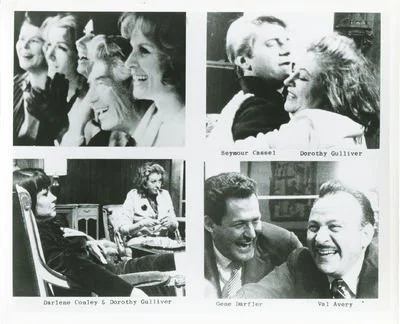
“You kill me.”
“You kill me,” Richard says to Maria in Cassavetes’ Faces (1968). Then he says it to Jeannie. He gets ice for drinks and turns on the music. The same Mad Men-style language carries the emotional palette that develops between Richard, his wife, and his mistress. Blues and jazz. All the music in Faces is diegetic, or heard live from source within the film [rather than an overlaid edit unheard by the characters.] Scenes are marked by intentional pauses when characters put the needle on the record, but no scene is carried by the music. No scene gets lost in it. No scene offers us a whole song that feels out the shape of music itself. A gruesome absence of ecstasy and astonishment. Music cuts in to cue sex; jokes cut in to cue relief from anxiety. Laughter feels diabolical, unmoored from context, based on a sort of repeated explosion of canned feeling, as steady as the click of cue stick to ball. A constant recitation of jokes and limericks. At one point, the laughter becomes so unbearable that we pause the film, leash Radu, and escape into a night-walk. Our shadows form a triangle shape that precedes us on the sidewalk. “Two small people scared of each other,” He says softly, hand on my waist like the ghost of a favorite fanny-pack. “It’s so dark,” I tell him. The sound of people trying to have fun. Radu perches in P’s arms as I pay for ice cream and sour straws. A strange energy in our shared silence. We stand near the streetlamp and share the sweetness, divided into licks, mine then his, the dance of the ice cream cone. Radu finds a baby blue sock in a bush. He carries it back to the house. We return to Faces and its desperate loops of self-helpy cheerfulness . . .
“I have been seduced.”
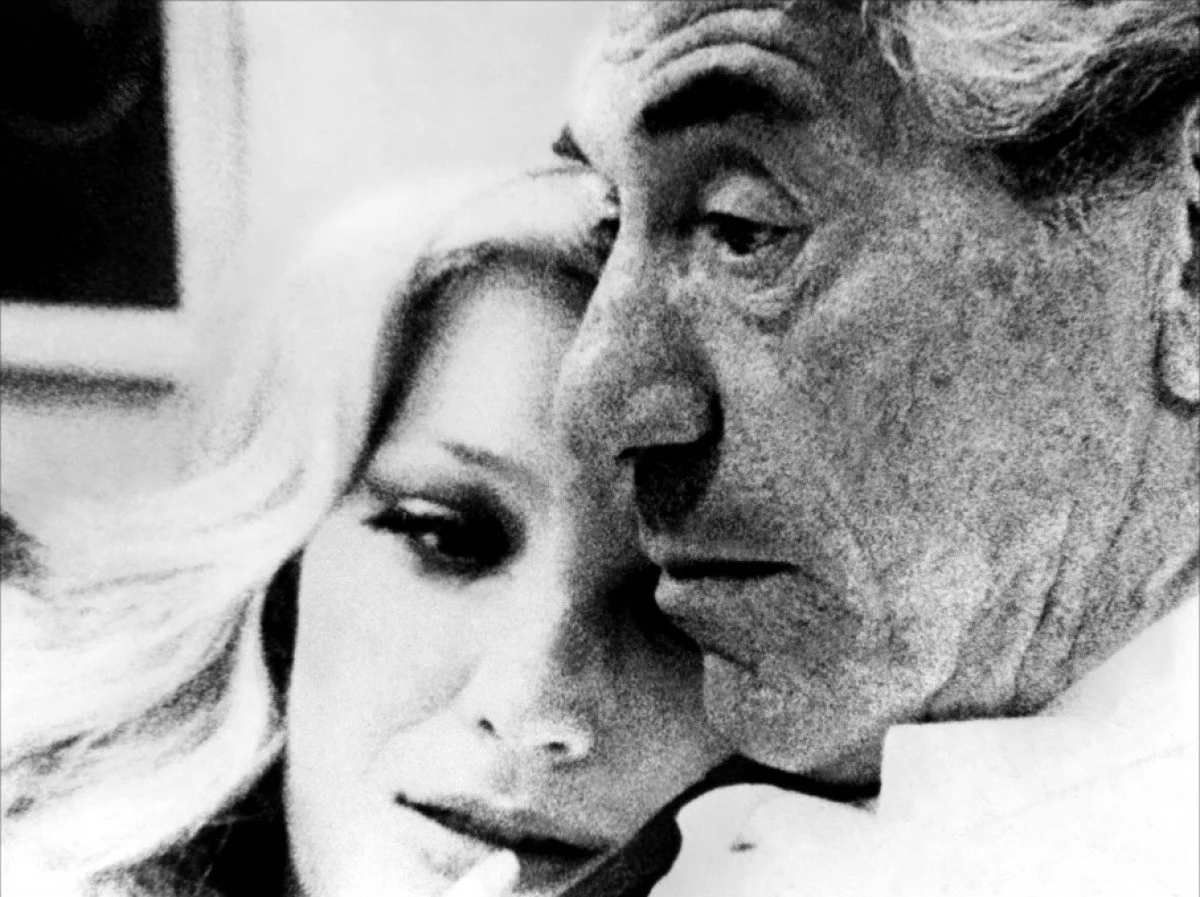
Convivial vigor. All-American social rigor. Uneasy, the faces barely touching each other. The laughter like cheap cologne. At Jeannie’s apartment, the two johns and her friend parry jokes; the room is vapid, overworked, exhausted by the men’s resentment. Like boys at a frat party wearing tailored suits. The men bicker about women and memory and how tough they are. It’s business. Everyone is nervous and batty. Only the transactional relation to the sex workers puts the businessmen at ease: they know how to navigate this. The only thing the working woman can expect or demand is money. Like the secretaries in the opening scene, the women exist to make the man comfortable—- to service them with a smile. (Not really to serve them but to service them, to provide the particularity of agreed-upon services.) To meet their needs. A one-way street. The women are reflective surfaces upon which the men apprehend themselves. “A startlingly immediate and vivid vision of mid-life insecurity and hysteria,” Ross Birks said of the film. “The death of an undeveloped eros,” I tell P. We are thrown into Maria’s excruciating desire to be touched. Her loneliness rolls over us when Chet kisses her; the sequence of actions is framed for maximum impact, tracking Chet as he carries Maria across the room. A camera shot delivers their melded bodies: his black turtleneck mixed with her black dress. Fade out. New scene. “I have been seduced,” Dickie announces as he strolls into Jeannie’s bedroom in a towel. She serves him eggs on a silver tray; he laughs maniacally. (“He has never been seduced,” says P.) Dickie criticizes her eggs as “lousy”, notices she wears false eyelashes and then announces: “So help me god, you’re stupid.” Jeannie (Gena Rowlands is amazing, as usual) calls him a son of a gun and asks, “So how come you hate me, now?” Dickie replies: “Jeannie, do me a favor. Don’t be silly now. Just be yourself.” But she knows he doesn’t mean it. She leaves and sings happy ditties in the kitchen while crying quietly, knowing that there is no world in which she can be ‘herself’, since a self is simply whatever role the man desires. That is her job. That is the business she transacts.
Gibberish, gobbledy-gook, inane utterances, sports-related shit: the structure of communication preferred by the men in Cassavetes Faces. The film is all about making the men feel safe. And it’s a short crawl from meaninglessness to madness; Maria goes from joking about cunnilingus at the dinner to table to determining death as the best alternative for a life of continued, constant silence. Not once does she express hurt or pain. Chet says he prayed to God for her life and that he almost killed her. “No one has time to be vulnerable to each other,” Chet says, it’s ludicrous “how mechanical we can be.” Faces makes cheerfulness seem like the worst lie we perform for one another. The cheeriness of withholding the real in order to tender the transaction.
Simon Hsu nails it:
The routine performed by the two males not only reinforces the notion that we’re watching a film within a film, but also the theatricality of the characters within the reality of the film’s world. Cassavetes’s goal to reinstate realism into acting is lead by the belief that “the artificiality of expression of emotion was more than a dramatic problem. It was a problem in life.” His argument, having been a young actor and a young man, was that most lived experiences were as artificially staged as most dramatic experiences—the real problem “for modern man” was to “[break] free from conventions and learning how to really feel again.” The routine scene is a sublime fusion of these ideas—performance in film and artifice in life separated by a thin line.
A few sites in John Cassavetes’ psychogeography
THE SAND-PITS ON LONG ISLAND
. . . out in Port Washington near the small town where John grew up. He and the guys would go to the sand pits to hang out. This is the place that gave rise to the realization that other young men “were afraid” — and fear defined them. Other boys had curfews. Other boys “didn’t want to go near the edge.” They didn’t want to risk the possibility of falling into the sandpit. Their parents packed the same lunches for them. “I saw the kids having their lives planned…Their whole lives were mapped out before they began.” They would go to Ivy League schools and inherit their parents’ biases, their parents’ politics, their religion and taste and preferences. Avoiding the question of asking, What do I want to be?
A scene in Women Under the Influence, when the husband who has lost control of his wife and family, lost the script of masculine success, goes to work with his crew in the sand pits. Surrounded by bulldozers and sand and large tools, the husband loses his shit completely with co-workers. At the edge of the sand pit, a man slides down it during an altercation, the body lifting small clouds of sand as it moves down the slope. And nothing happens. He returns to work. No being is transformed, enlightened, or resolved by this fall.
HEIGHT
Cassavetes was 5 ft tall at fourteen. He only grew to 5’7” (which he flubbed as 5’10” in interviews, due to the boots he wore to make him look taller). Being short made the strictures of masculinity legible to him at an early age; he invested in being charming. As he phrased it, he learned to work for attention.
ROUTE ONE
John failed out of Champlain after his first semester. Only desire was to leave or escape his hometown. Hitch-hiked down Route One in search of difference. In St. Petersburg, he saw all the same faces, the same loneliness in the elders, the same cavernous silences. John picked up a pay phone and called home; his dad wired him money for a bus fare back to Port Washington, the score of his failure and disgrace. He had no dream, no ambition, no skills–basketball, girls, and fear of work. Fear of the cult of work ethic. Fear of the world of the fathers. Loathing for the world he inherited.
TALKING GAME
… and selling the self as a business, selling life for the next opportunity to score a desired role in a film. As an actor, John saw how Hollywood’s careerism killed the art of performance. “The greatest danger for actors is this success drive” that leads them to sacrifice their visions and beliefs for celebrity, he said in an interview. The greatest death is to give up on one’s defiance and drive for material safety or gains. Actors learn their way from “that first flash of enthusiasm, that first first flash of wanting to be something more” — the seed of desire in relation to the script. John lost “that crazy enthusiasm” and so he quit.
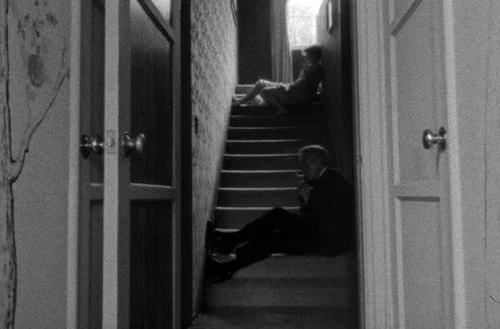
THE STAIRS . . . where Maria and Richard sit smoking cigarettes at the end of Faces. A motif gets set in the first shot — and early in the film, when Maria and Richard are fighting and she cries, “I am not a sex machine.” Richard leaves and heads for this dark hallway of ascending stairs, a way out of nowhere.
DINING ROOM TABLE
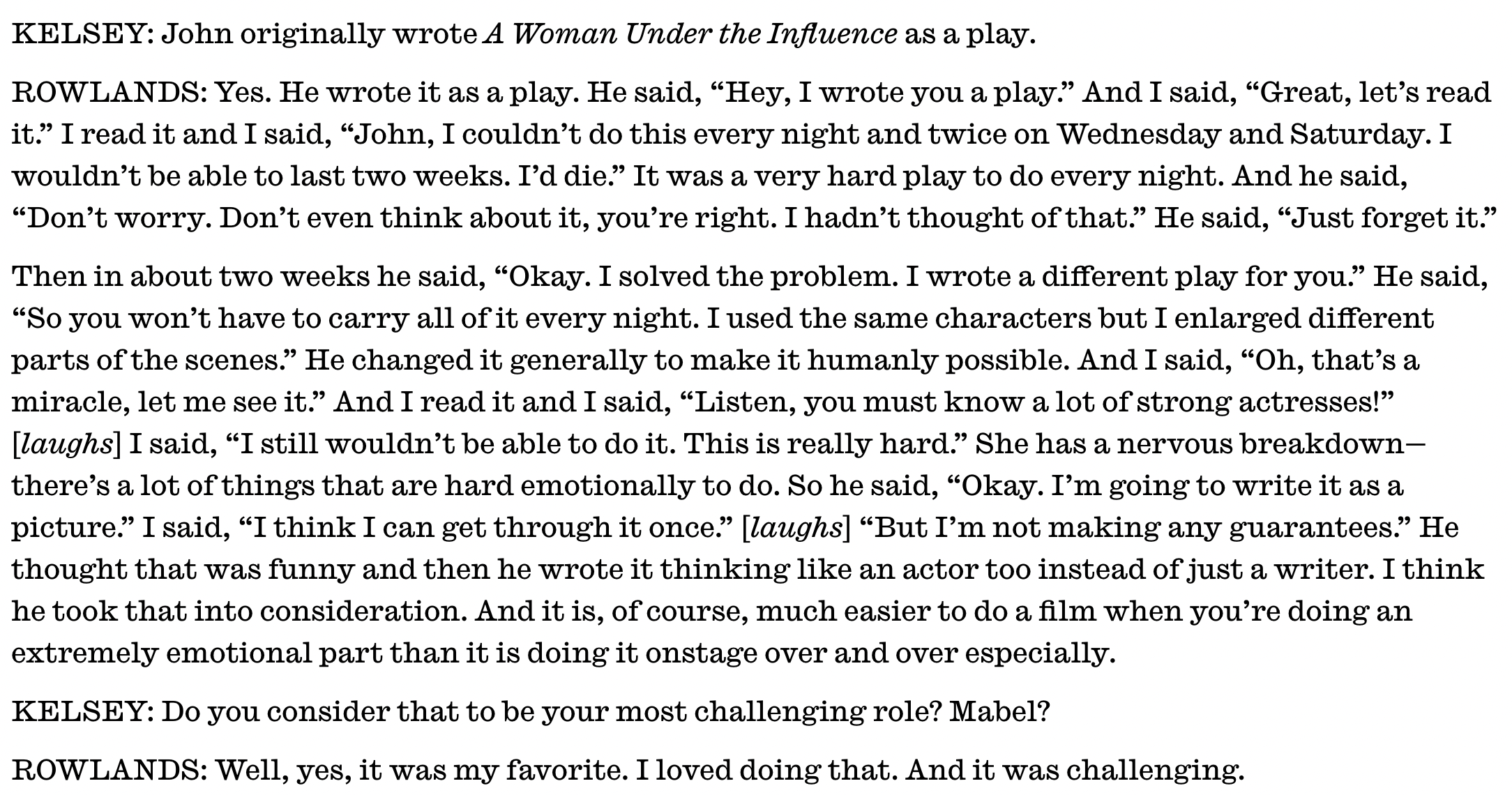
. . . where Gena Rowlands’ performs the role of wife for husband and his work crew. The idea of the family table and its head–but the female wobbling, lovely, her role unscripted, her pedestal learning to pimp itself.
We know ourselves imperfectly, Cassavetes insists across films, plays, and interviews. He mentions an ex-girlfriend who thought he was “the funniest man alive.” The two would go on dates and when Cassavetes would make a romantic gesture, she would respond by roaring with laughter. “At everything I said and did,” C. said. The lesson being “that we really aren’t ourselves, and the impression we make on people is often the direct opposite of the one intended.” The performance of love undercut by our mis-readings or scripts that cannot be inhabited. John later compares the role of lover to actor…
Lover as “profession” rather than dream. Actor as “careerist” rather than dreamer. The visions of others draft our own and make roles of them. Husband can’t act the role of the lover anymore, and couples dance in the cauldron of these role-based restrictions. In the unfreedom of social designations that define the nature of relationships.
DRIVEWAY
The opening scene of Woman packing the children off to her mom’s for the weekend, the frantic gestures, the toys and small faces in car windows. And the driveway at the end of Husbands, when the father returns home from hisoung business to find the young daughter weeping in the driveway. The absent fathers and husbands whose charm entices the world, variations on the good guy, the all-American fellow talking game, winning the pot, hacking the satisfaction of winning. Disappointment morphing into resentment that resembles what Cassavates said about NY acting school–how much they despised Hollywood because they could never aspire to it. The beat of midlife restlessness is all-American, shorn of Godard’s aesthetic lure. Grit, grime, and staging: we suffocate in the wallpaper. There is no elegance.
And so, that’s why I have a need for the characters to really analyze love, discuss it, kill it, destroy it, hurt each other, do all the stuff in that war, in that word-polemic and film-polemic of what life is.
*
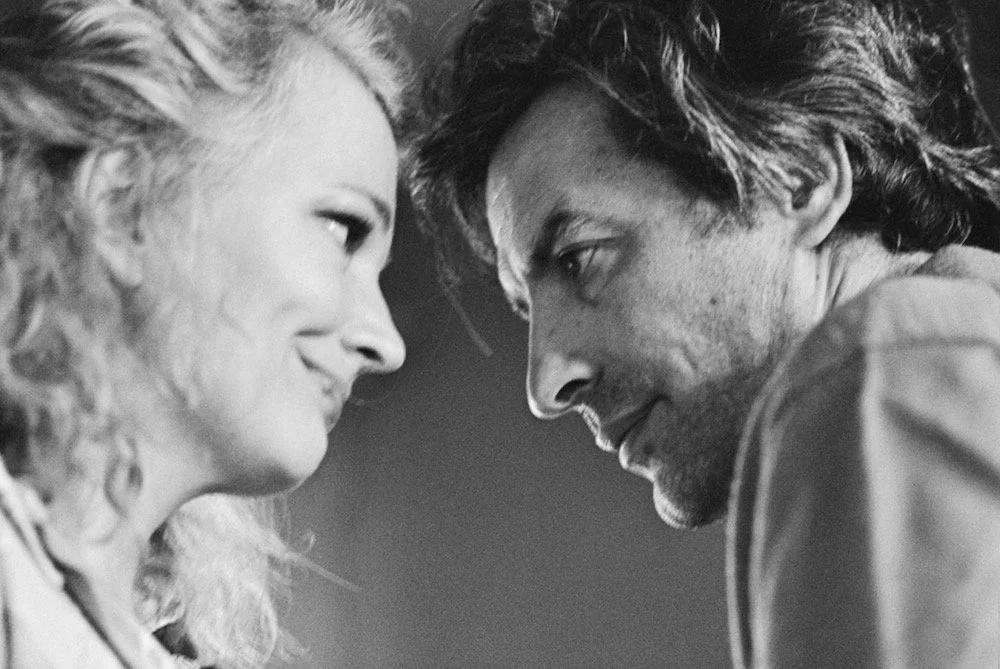
Gena Rowlands and John Cassavetes
*
Fugazi, “And the Same”
Fugazi, “Blueprint”
Fugazi, “Cassavetes”
John Cassavetes, Faces (1968) and/or Film trailer
John Cassavetes, Woman Under the Influence
Simon Hsu, “Emotion Through Bodily Motion: Acting and the Frame in John Cassavetes’s Faces” (Slant)
Stuart Klawans, “Masks and Faces” (Criterion)