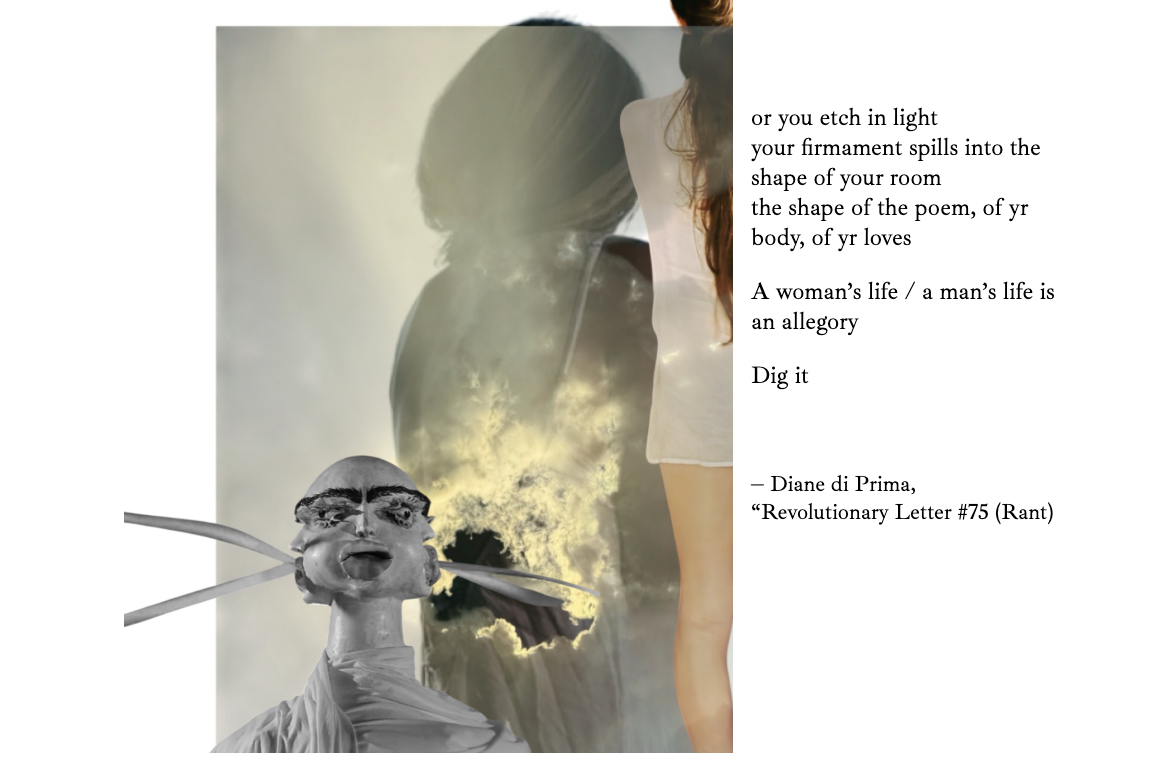
You cannot write a single line w/out a cosmology
a cosmogony
laid out, before all eyes
— Diane di Prima, “Revolutionary Letter #75 (Rant)”
And so we watch the sun come up
From the edge of the deep green sea
And she listens like her head's on fire
— The Cure
Greens again.
Saplings and offshoots.
Absinthe and boots.
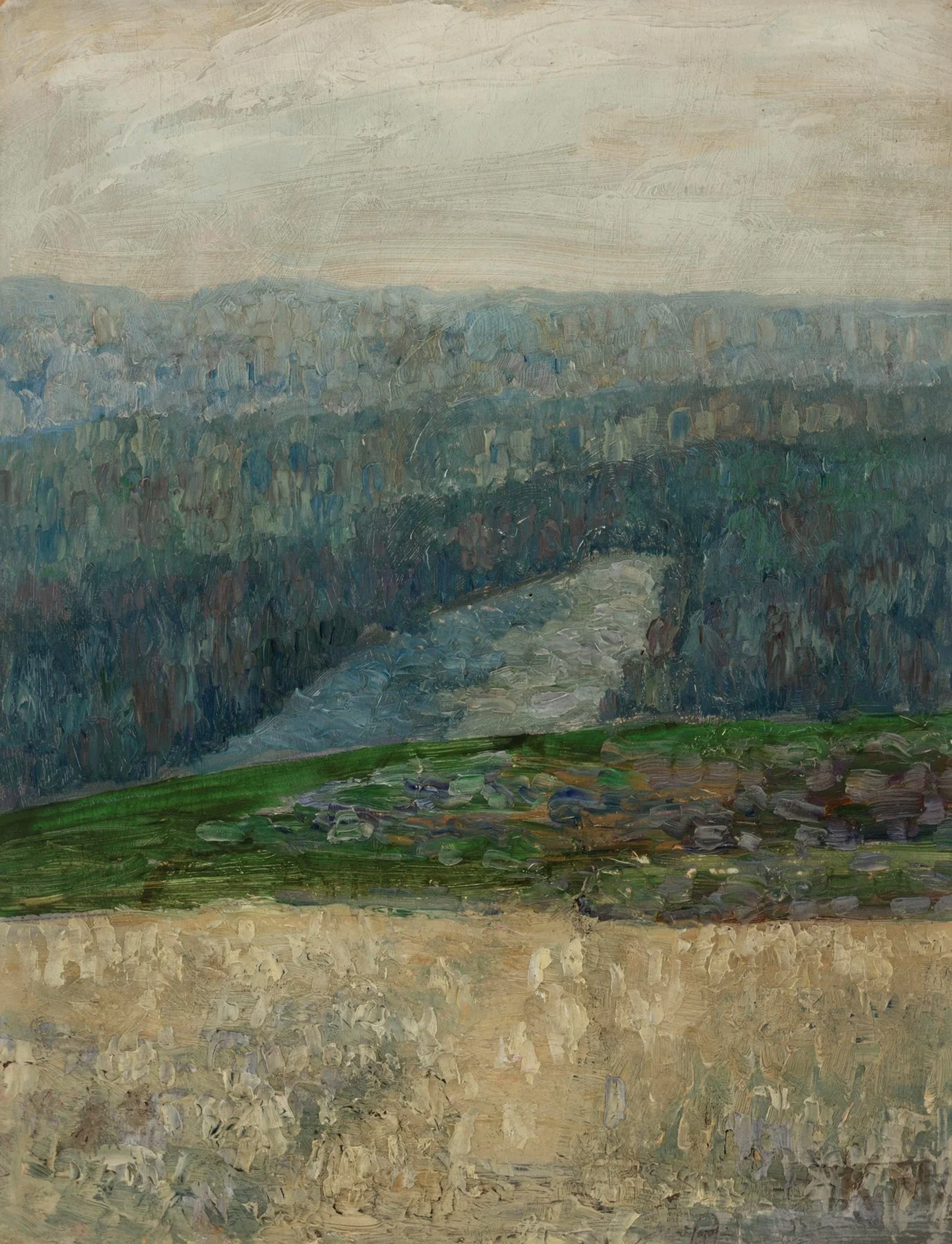
The layer of green in Konrad Magi’s Maasik, painted between 1908 and 1910.
The hue where green angles towards blue, or the navy of star-rich midnights, the terrain Diane di Prima touched in “Revolutionary Letter #75 (Rant)”:
it is whole, it is a whole, it always was whole
you do not ‘make’ it so
there is nothing to integrate, you are a presence
you are an appendage of the work, the work stems from
hangs from the heaven you create
every man / every woman carries a firmament inside
& the stars in it are not the stars in the sky
w/out imagination there is no memory
w/out imagination there is no sensation
w/out imagination there is no will, desire
The timbre of green of Haydn in Tomas Transtromer’s “Allegro” (translated by Ingar Palmlund):
I play Haydn after a dark day
and sense an honest warmth in my hands.
The keys are willing. Mild hammers strike.
The tone is green, lively and still.
The tone says that freedom exists
and that someone does not pay the emperor tribute.
I push the hands deep into my haydnpockets,
mimicking one who quietly watches the world.
The green zone of Transtromer’s “Prelude” (translated by Rika Lesser):
Waking up is a jump, a skydive from the dream.
Free of the smothering whirl the traveler
sinks toward morning’s green zone.
The exhortation towards imagining green, as in Elizabeth Alexander’s “Fugue”:
Picture everyone’s edges
smudged. Picture everyone
a green as delicate
as a Ming celadon.
The way green gushes towards an absolute turquoise in Thomas Wilmer Dewing’s The White Birch (circa 1899):
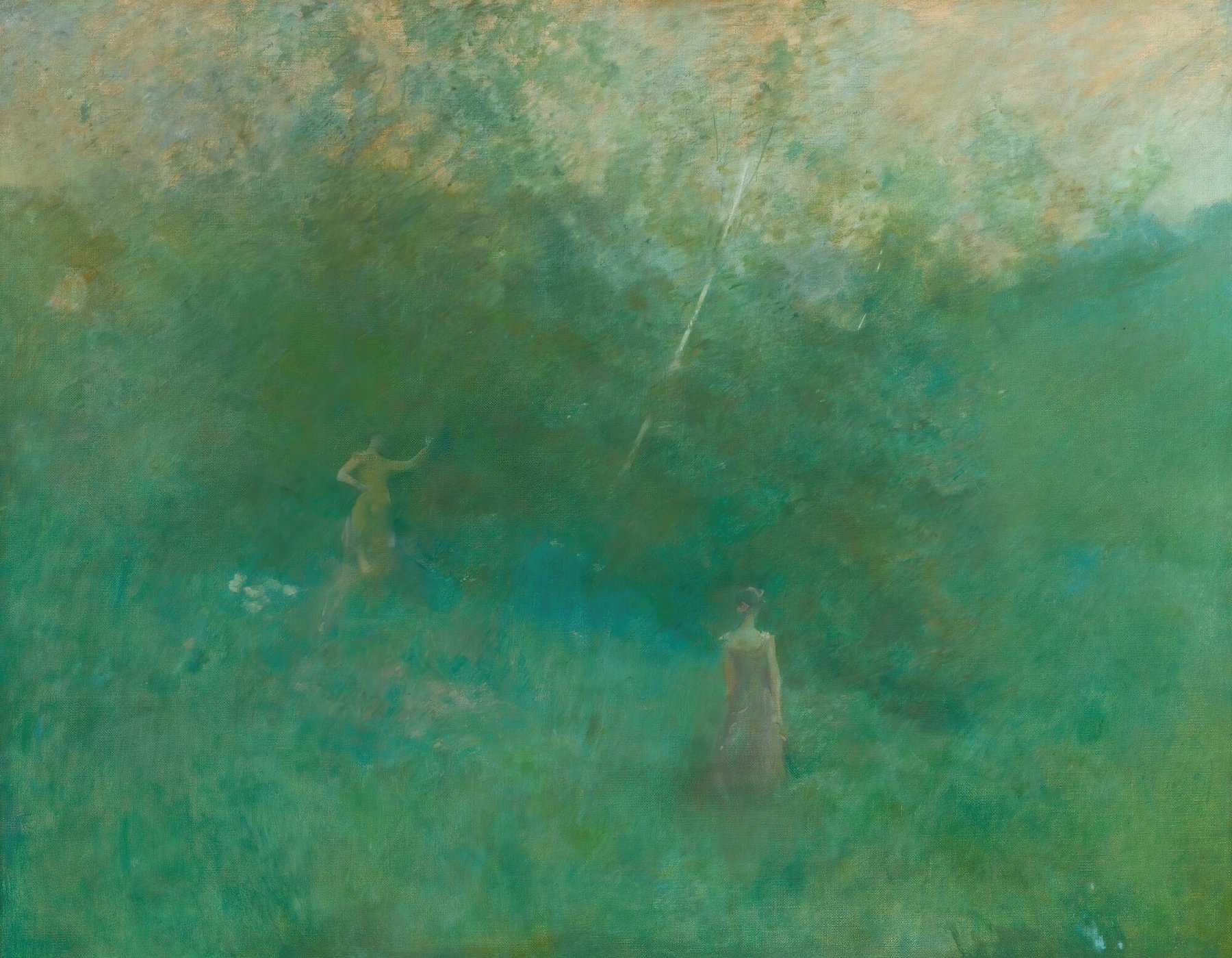
Thomas Wilmer Dewing, The White Birch (circa 1899)
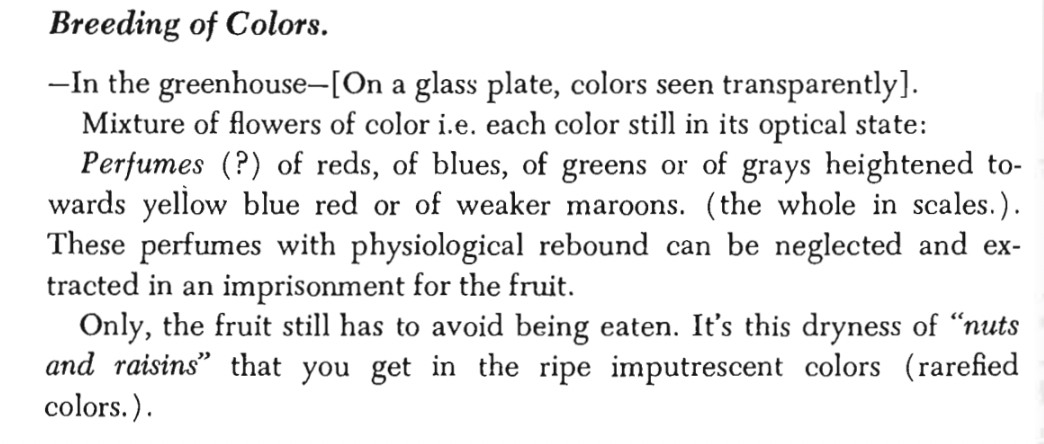
The way even the most absolute hue does not absolve— cannot absolve — as Marcel Duchamp surely knew in his Bride — and the corresponding texts he wrote to make “sense” of it, including The Green Box — whose title only depicts the surface of the work, or its container. Duchamp used the word “green” less than five times whose container named its color as green…

The green that light picks out of a moonlit scene by the ocean, or a moment imagined by Ralph Waldo Emerson when he asked: “Was it Boscovich who found out that bodies never come in contact?Well, souls never touch their objects. An unnavigable sea washes with silent waves between us and the things we aim at and converse with.”
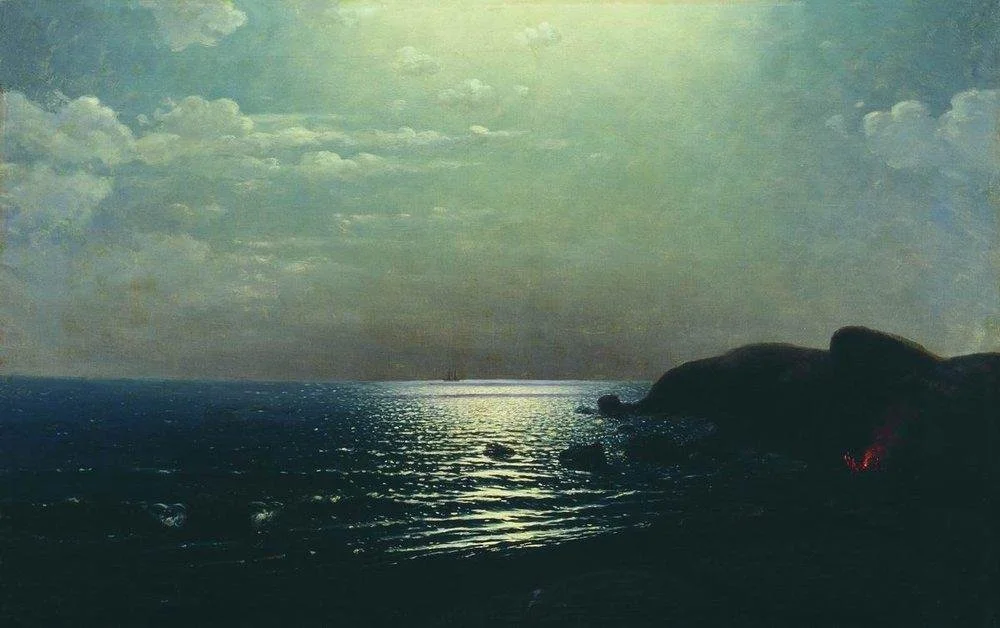
Arkhip Kuindzhi, Fishing at the Black Sea (1900)
And Di Prima’s rant (again):
the taste in all our mouths is the taste of our power
and it is bitter as death
bring yr self home to yrself, enter the garden
the guy at the gate w/the flaming sword is yrself
G is for grass, green, glue, gawd, and good.
Green as the grotesque slimeballs of horror films.
Green as part of the structures of belief, as expressed in Gerald Stern’s “Blue Skies, White Breasts, Green Trees”:
I used to believe the brain did its work
through faithful charges and I lived in sweet surroundings for the brain,
I thought it needed blue skies, white breasts, green trees,
to excite and absorb it,
and I wandered through the golf courses dreaming of pleasure
and struggled through the pool dreaming of happiness.
One of the primary hues of my childhood: the evergreen kudzu-green that grew near the houses and hide-outs and imaginary wolds that felt like home to me.
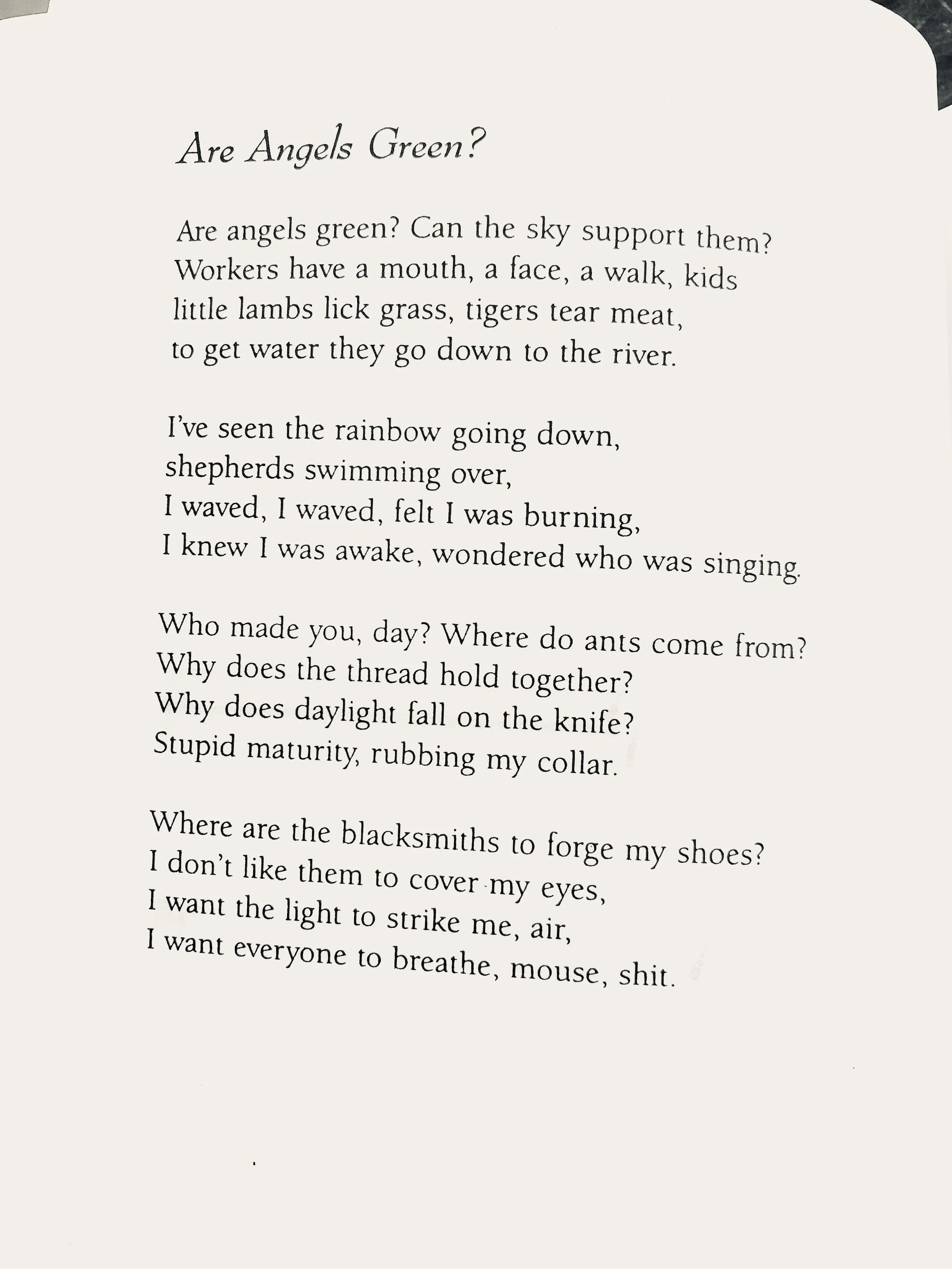
There is a poem by Tomaz Salamun titled “Are Angels Green?”
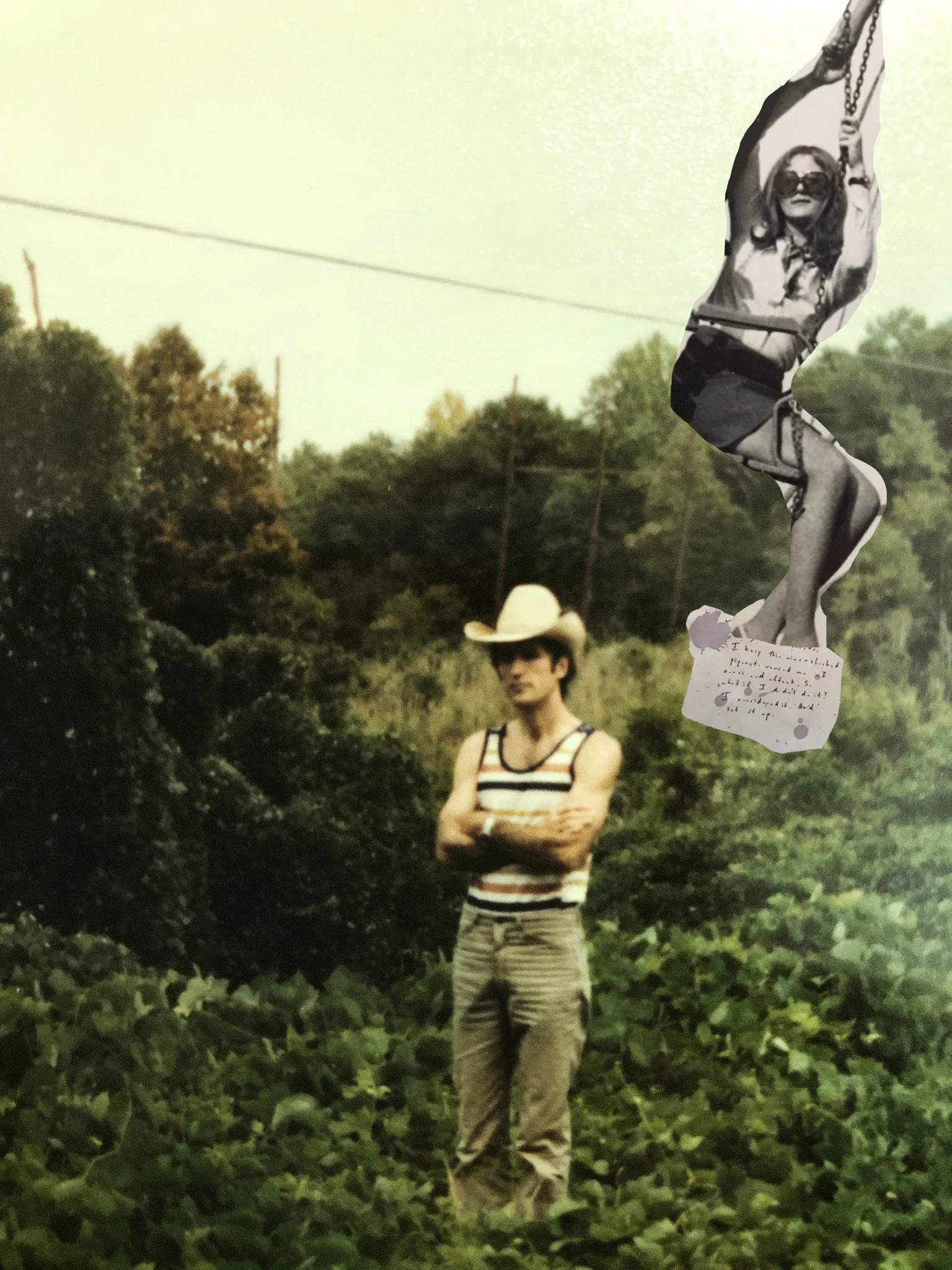
There is a my father wearing a cowboy hat amid the kudzu while my mother swings above his head in Bucharest.
There is a meadow across from our subdivision which does not belong to anyone. There are no lawnmowers on this meadow where a coterie of crows conduct their general assembly each morning. There is a four-way stop sign but the stop looks ashamed and some say there is a ghost that haunts the meadow and what the stop sign feels is akin to dread. There is a crow whom the other crows caw around and he is likely the lead crow likely his name is Frank. There are parents who will not let their children play in the meadow because it is full of weeds and buttercups and fire ant mound.s The parents want someone to own the meadow and develop it. There are many ways to say develop without meaning to but there are no ways to say develop that do not involve the destruction of something else. There is a child developing their interpersonal skills which means she learns to stop imagining the crows conversing in the meadow. The child will develop beyond freeze-tag, and when she has developed appropriately this child-part will be dead. There is a distinct tinge of ache she will feel when passing the meadow but the pain will be located in a phantom limb. There is no way to discuss the pain we feel in parts of us that don’t exist anymore. There is a meadow and crows and fire ants. There is a place waiting to die. There will be cupcakes and ribbon-cutting ceremonies. There are people who will call the cupcakes an improvement.
There is “the war that matters is the war against the imagination all other wars are subsumed in it,” to quote Di Prima again.
And further down the street, there is a poem by Michael Palmer addressed to the reader; one stanza eyeing a figure and trying to make sense of its birds and berries and “her hair alight and so on,” a mesmerizing meadow with its photograph of “nothing but pigeons” “by the shadow of a fountain” which I offer to you in its entirety:
Dearest Reader
He painted the mountain over and over again
from his place in the cave, agape
at the light, its absence, the mantled
skull with blue-tinted hollows, wren-
like bird plucking berries from the fire
her hair alight and so on lemon grass in cafe in clear glass.
Dearest reader there were trees
formed of wire, broad entryways
beneath balconies beneath spires
youthful head come to rest in meadow
beside bend in gravel road, still
body of milky liquid her hair alight and so on
successive halls, flowered carpets and doors
or the photograph of nothing but pigeons
and grackles by the shadow of a fountain.
Michael Palmer
I want the light to strike me, air
I want everyone to breathe, mouse, shit.
— Salamun, ibid.
*
Arkhip Kuindzhi, Fishing at the Black Sea (1900)
Diane di Prima, “Rant, From a Cool Place”
Diane di Prima, “Revolutionary Letter #75 (Rant)”
Dorothea Lasky, “On Poetry, Peership, and Imagination: A Love Letter to Diane di Prima”
Michael Palmer, “Dearest Reader”
”Revolutionary Letter #75 (Rant)” read by Diane di Prima, April 28, 1988 (Binghamton University)
The Cure, “From the Edge of the Deep Green Sea”