At that moment I realized that I was still clinging to my old, shabby, unmodern velvet or plush hat - at any rate, it was a sort of artist's hat. I blamed my hat for the frustrating outcome of my adventure, and awoke.
— Adorno
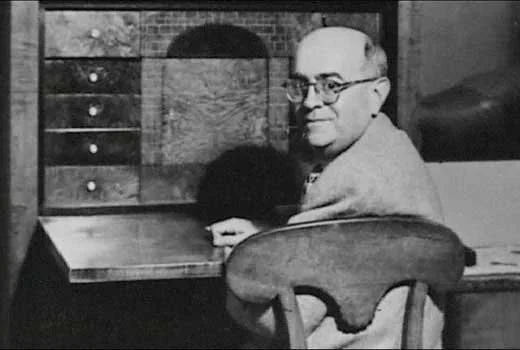
Los Angeles, end of May 1942
I dreamt I was to be crucified. The crucifixion was to take place at the Bockenheimer Warte, just by the university. I felt no fear throughout the entire process. Bockenheim resembled a village on Sunday, deathly quiet, as if under glass. I observed it closely on my way to the place of execution. I imagined that the appearance of things on this, my last day, would enable me to glean some definite knowledge of the next world. At the same time, however, I declared that one should beware of arriving at premature conclusions. One should not let oneself be seduced into ascribing objective truth to the religion practised there simply because Bockenheim was still at the stage of simple commodity production. That aside, I was worried about whether I would obtain leave from the crucifixion to attend a large, extremely elegant dinner to which I had been invited, though I was confidently looking forward to it.
Los Angeles, early July 1942
The dream was - or seemed to me in retrospect - one long, unusually complicated detective story in which I was personally involved. I have forgotten what it was about. I only remember the end. I was with Agathe, who was in possession of the three most important pieces of evidence in the case. These were a clasp, a diamond ring and a cheap little reproduction - perhaps a medallion - of a well-known picture (by Gainsborough or Reynolds?) portraying a small child dressed in light blue and with a white wig. It may have had something to do with soap bubbles. I felt reassured by the sight of these three pieces of evidence: they would prove my innocence at the trial. I then looked more closely at the picture of the child and realized to my inexpressible horror that it was a picture of me as a child.
This was proof of my guilt, which consisted in the fact that I was that child - or simply a child? I wasted no time with denials but said at once to Agathe that only two possibilities remained: either immediate flight and concealment, or suicide. She said very firmly that only the latter came into consideration. Overcome by fear and horror, I awoke.
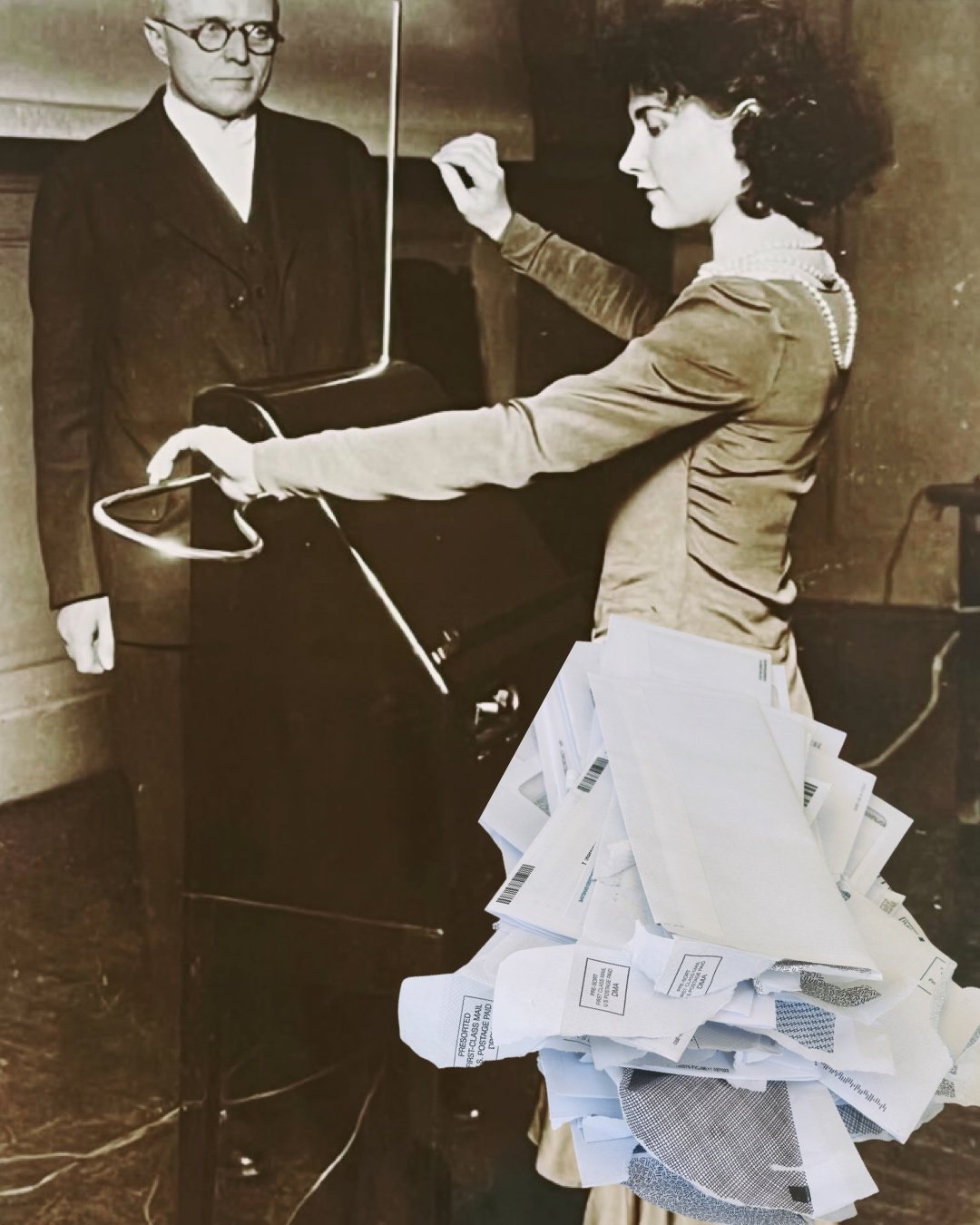
Music in a skirt made from April’s medical bills, a document self-portrait with Alexandra Stepanoff’s “Drawing Music From the Air” (c. 1928), a press photo of one of Léon Théremin's first theremin students in the US.
Aside with Theremin, circa 1928/2026
Today I found the press photo by Alexandra Stepanoff (used in self-portrait above) at the Instagram of Eldritch Oculum Antiquarian. The description on the photo’s reverse reads as follows:
Stepanov, a trained musician, draws music from the air by means of the theremin, new musical instrument developed by Leon Theremin, While Dr. Paul R. Heyl (left) explains the phenomenon before the science forum of the New York Electrical Society. The electrical charge of the hand actuates a series of vacuum tubes through the upright antenna, thus creating what is equivalent to the preliminary howl of a radio set, save that the sound is musical. The tone produced is similar to a cello, the movement of the hands determines the pitch and volume of the sounds.
Stepanoff v. Stepanov makes me think of the ongoing Rachmaninoff v. Rachmaninov. And now, back to Adorno’s dreams, particularly the one featuring a double-bass. Dreams, too, are self-portraits of a sort.
Los Angeles, 21 October 1942
My friend told me that he had but one musical passion: playing the double-bass. But he added that this was not a hobby he could pursue. For one thing the existing solo repertoire for the instrument was far too small. For another, his wife would not stand for his having such a large instrument in the house; it would spoil the appearance of the home.
Another night
I was talking with my girl-friend X about the erotic arts with which I thought her conversant. I asked her whether she had ever done it par le cul. She responded very frankly, saying that she could do it on some days, but not on others. Today was a day when it was quite impossible. This seemed quite plausible to me, but I wondered whether she was speaking the truth or whether this wasn't just a prostitute's pretext for refusing me. Then she said that she could do quite different things, more beautiful, Hungarian ones, of which I had never heard. In reply to my eager question-ing, she said, 'Well, there was Babamüll, for example.' She started to explain it to me. It soon turned out that this supposed perversion was in reality a highly complicated, to me entirely opaque, but evidently illegal finance operation, something like a safe way of passing worthless cheques. I pointed out to her that this had nothing to do with the erotic techniques she had promised me. However, she stuck to her view and replied in a supercilious tone that I should pay close attention and be patient - the rest would come of its own accord. But since I had completely lost track of the connection, I despaired of ever finding out what Babamüll was.
*
A Moog theremin!
Cihan Gulbudak, “Polozhenie”, theremin version (see also * and * and *)
Leon Theremin playing his own instrument
Leon Theremin, “Deep Night” (1930)
Scriabin, Etude op.2 n°1 for theremin, cello and piano
Theodor W. Adorno, Dream Notes, translated by Rodney Livingstone (Polity Books)