Horațiu Rădulescu invented the spectral technique of composition (as a synthesis of Byzantine and Hindu music, sound itself and nature) even before he left Romania in 1969. He disliked the term spectral music. His music was incantatory, ritualistic, he believed in beauty as a salvation for society, he wrote for posterity. He was mathematical, poetic, magical. He was occult, he was Pythagoras. From what I can gather, he was - as other Romanian composers of his generation - a man of the world with a cosmic approach and ego.
— Victor Stutz
The four historical musical paradigms, monody, polyphony, homophony, and heterophony, are actually quite impossible to distinguish from one another within this sound plasma— living sound that can only be comprehended from a global perspective, resembling the blue image of earth as viewed from outer space.
— Horațiu Rădulescu
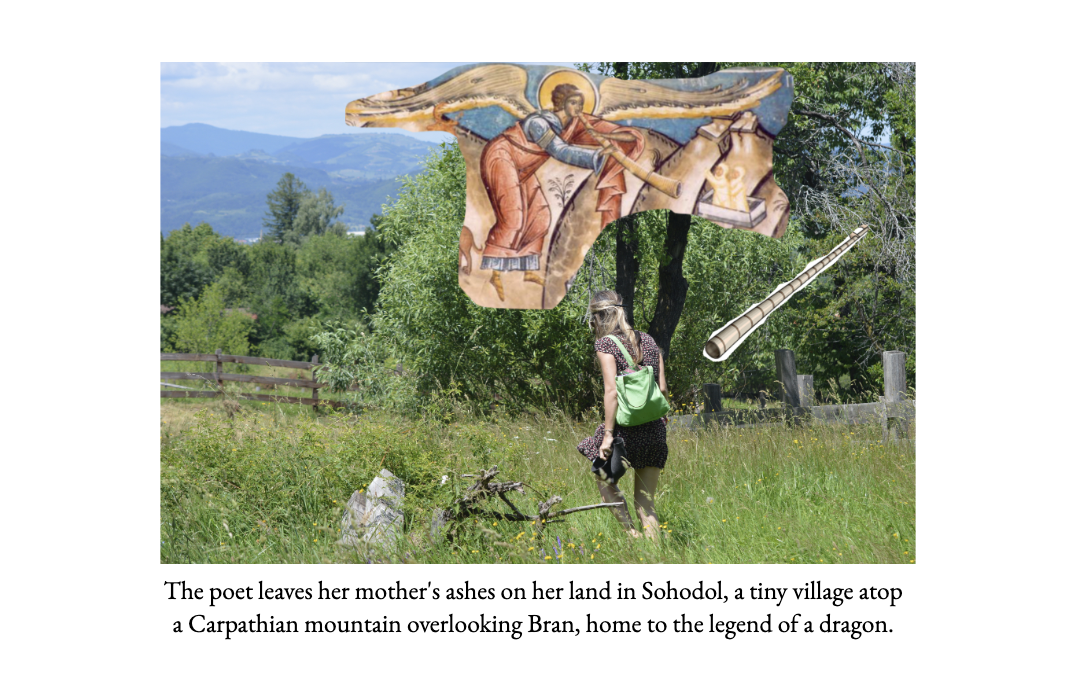
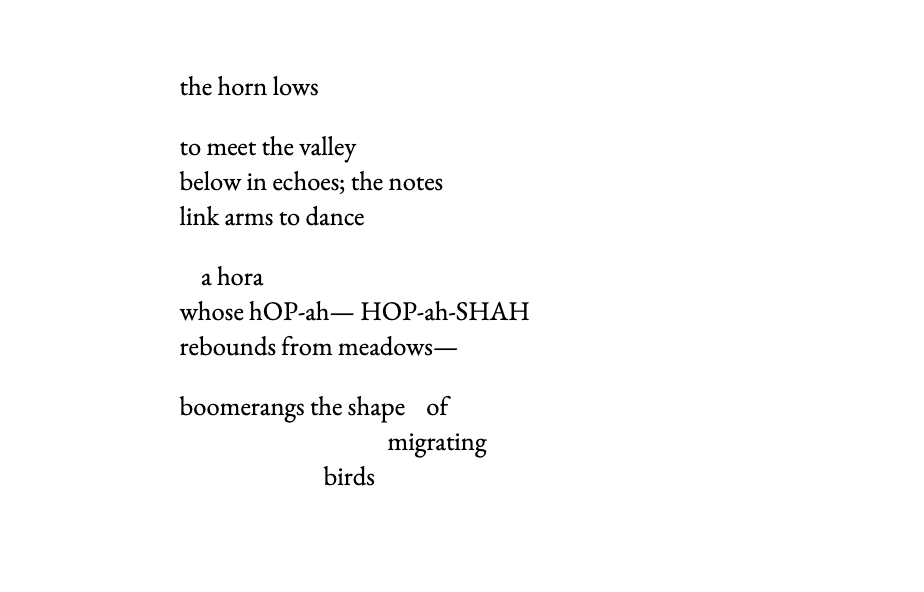
A tulnic, or bicium, is a type of alpine horn used by shepherds and those who live in Romanian mountain villages. The word comes from the Latin bucinum, an ancient instrument used by the Romans.
*
At the Voroneţ Monastery, there is a painted mural that reveals an angel playing a bucium to announce the onset of the Last Judgment.
*
Romanian-French composer Horațiu Rădulescu wrote his Piano Sonata no. 1 for unaltered piano while living and studying in Bucharest. From it, he later developed a version synthesized performance titled Piano Sonata No. 1: Cradle to Abysses, Op. 5 (1968). It was to be one of his few non-spectral works.
*
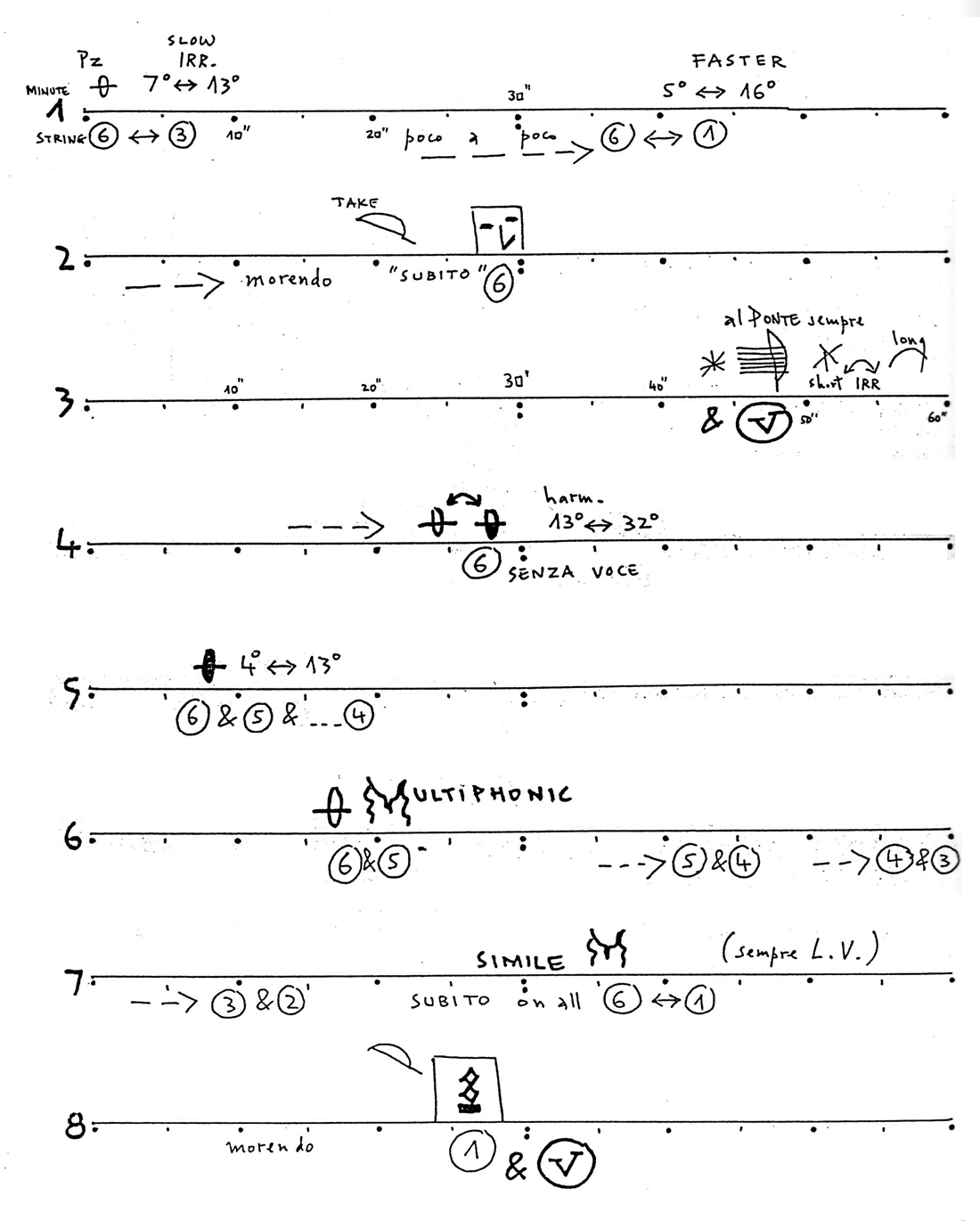
We owe the SOUND ICON to Rădulescu. Essentially, a sound icon is a grand piano turned on its sides and stripped of its mechanics before being retuned and played like a giant resonant harp. The sound icon is played by bowing the strings.
*
*
The BUCIUM, often played by women, announces the return of shepherds, but it also serves to notify villages of death. It tells the community who is coming— and who has gone.
*
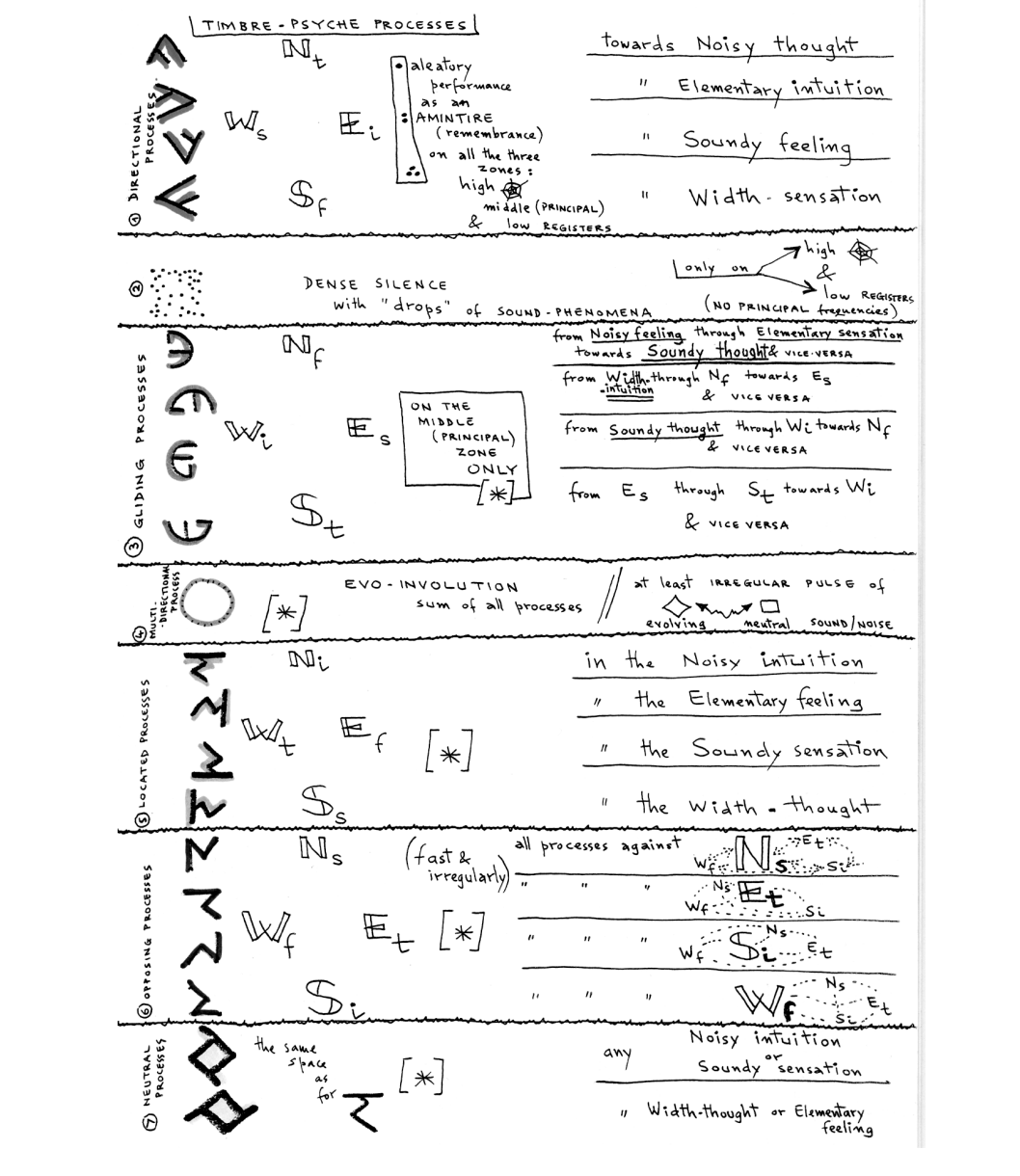
Many scholars and musicians credit Radulescu with devising SPECTRALISM, though his focus remained on what he called “self-generative functions.” SPECTRAL MUSIC involves dispensing with all other parts of music and focusing entirely on the constant fluctuation of sounds based on the natural overtones of any given note. Radulescu’s spectral music required retuning of string instruments so each sting was a specific very high partial of an underlying tone. The result is simply a complex overtone series in line with Pythagorean logic.
*
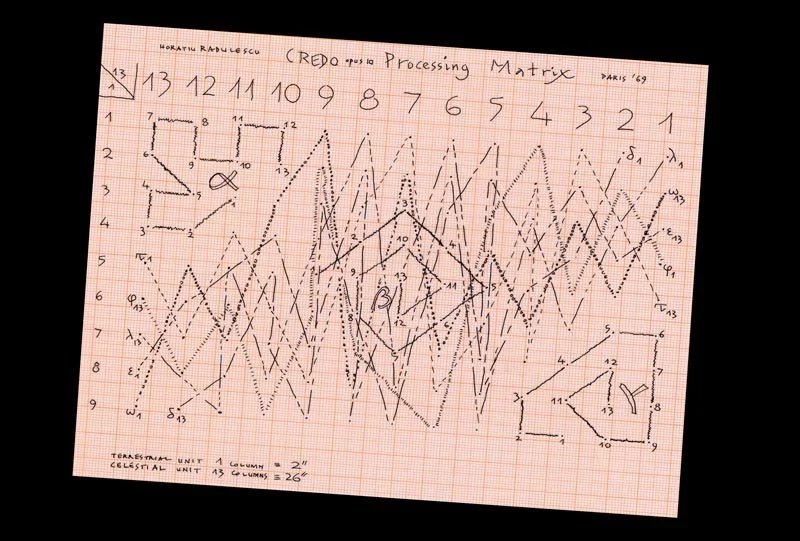
Radulescu graduated from the Bucharest Music Academy in 1969 with a focus on violin and composition. In this same year, he composed his first spectral score, Credo for nine cellos, based on the first 45 harmonics of the cello’s lowest C.
*
Messiaen loved Radulescu for his mysticism, a counterpart to the violence and glorification of ugliness that came from the world wars.
*
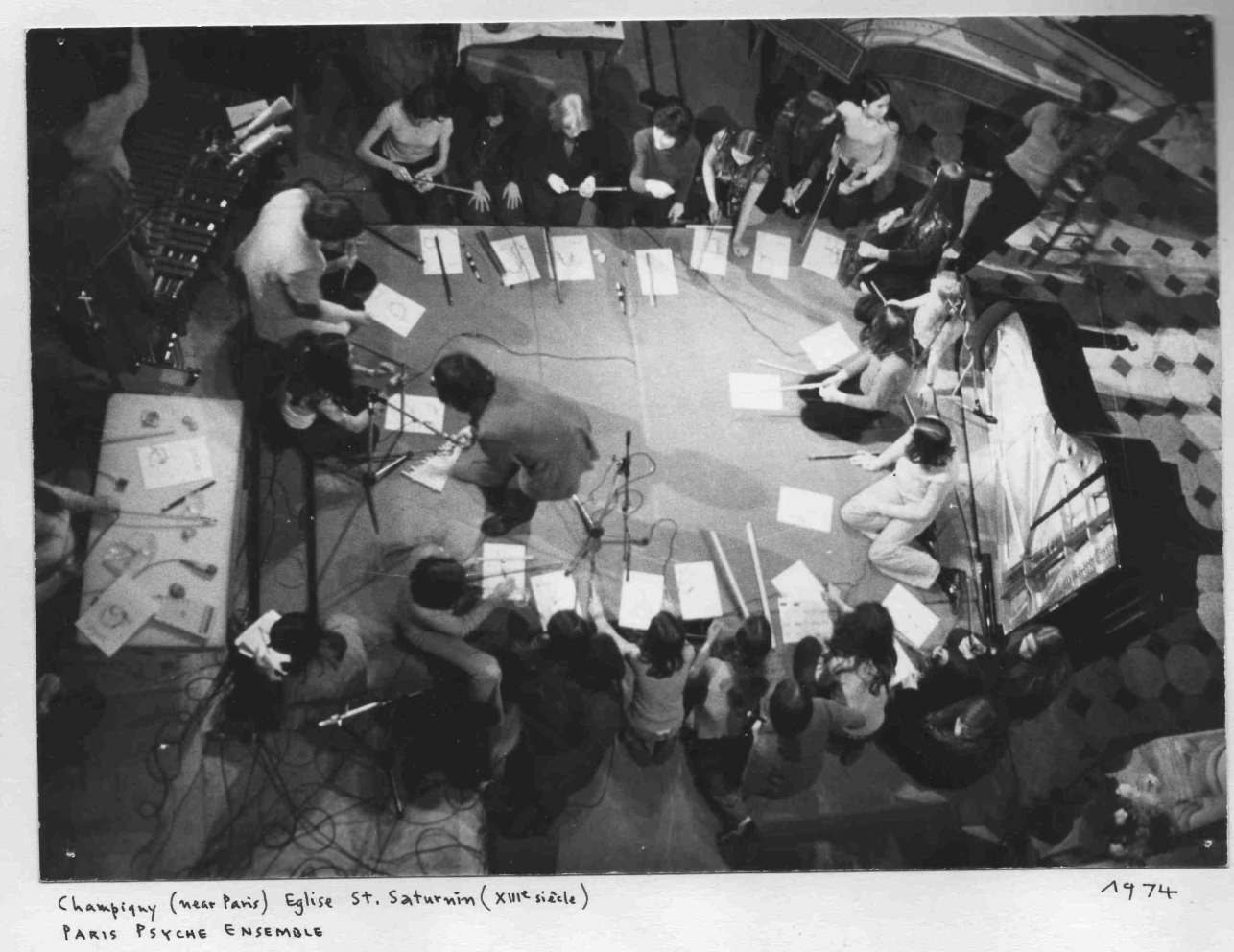
Radulescu’s fascination with sacred spaces began in his Romanian youth and extended through the cathedrals of his western European days. After moving from his hometown in Bucharest to Paris in the early 1970s, Radulescu turned to the Catholic Church of Saint-Saturnin in Champigny-sur-Marne as a site for rehearsing his highly experimental music with the Psyche Ensemble.
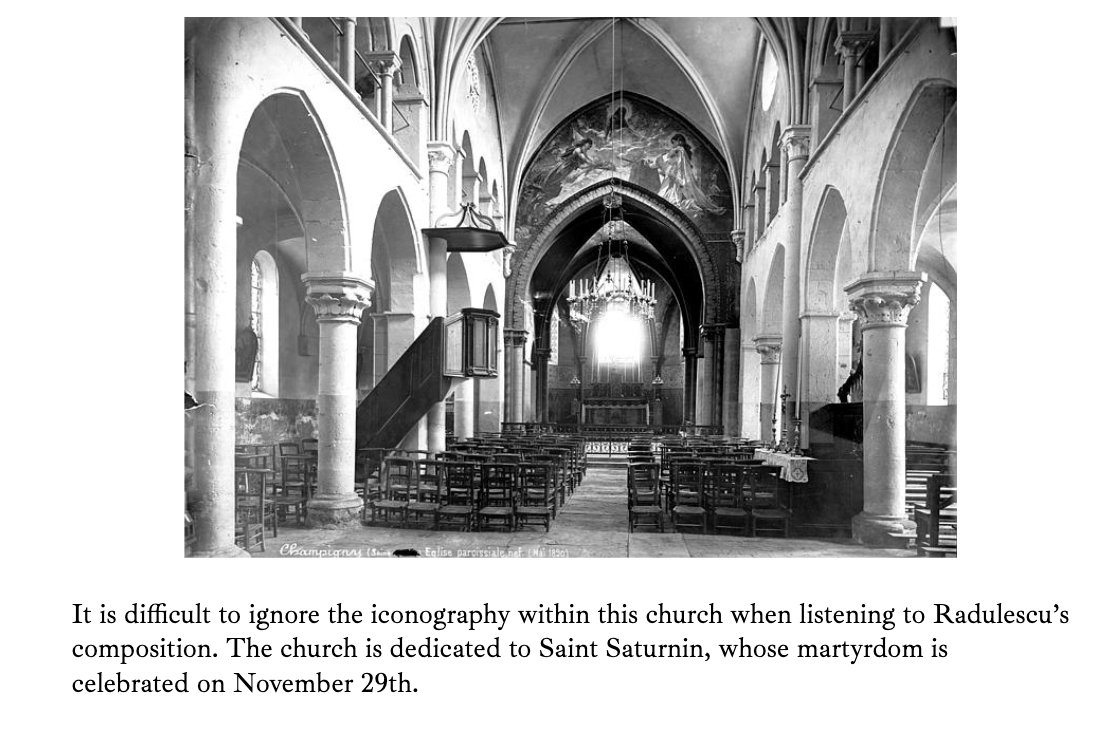
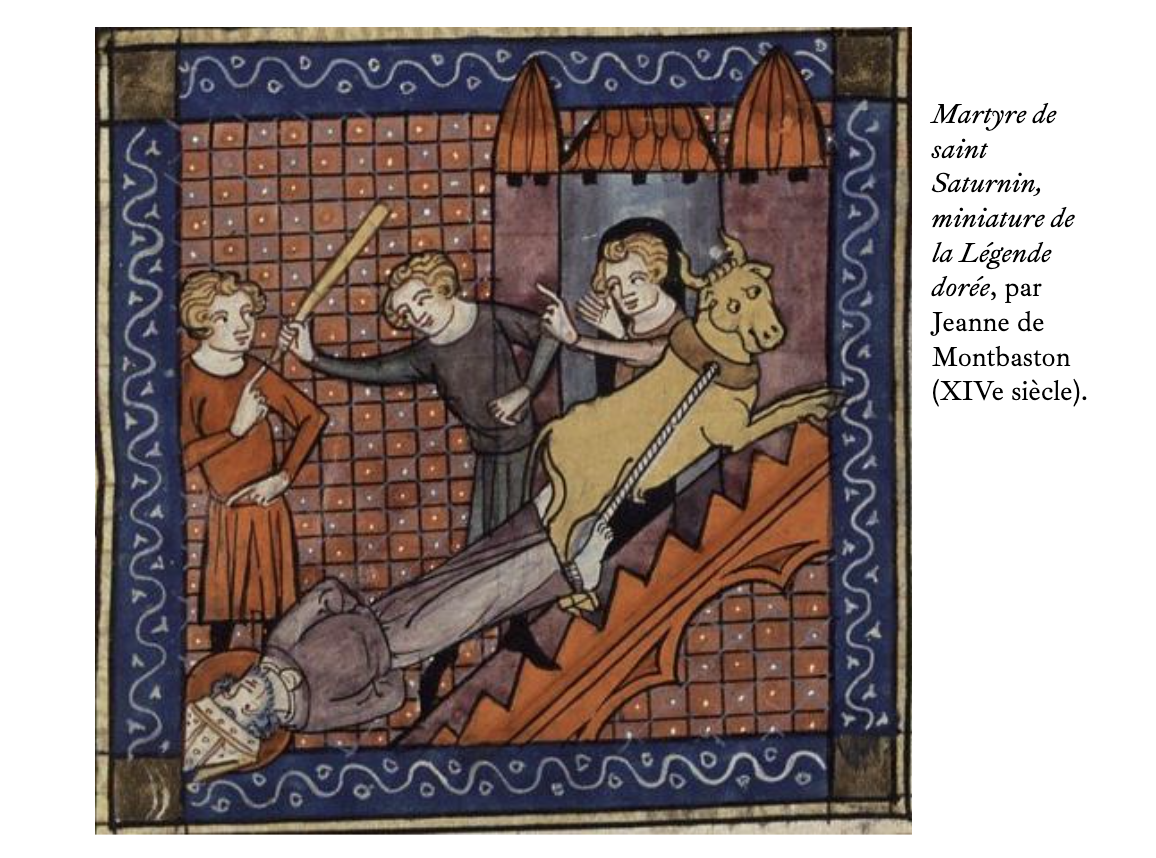
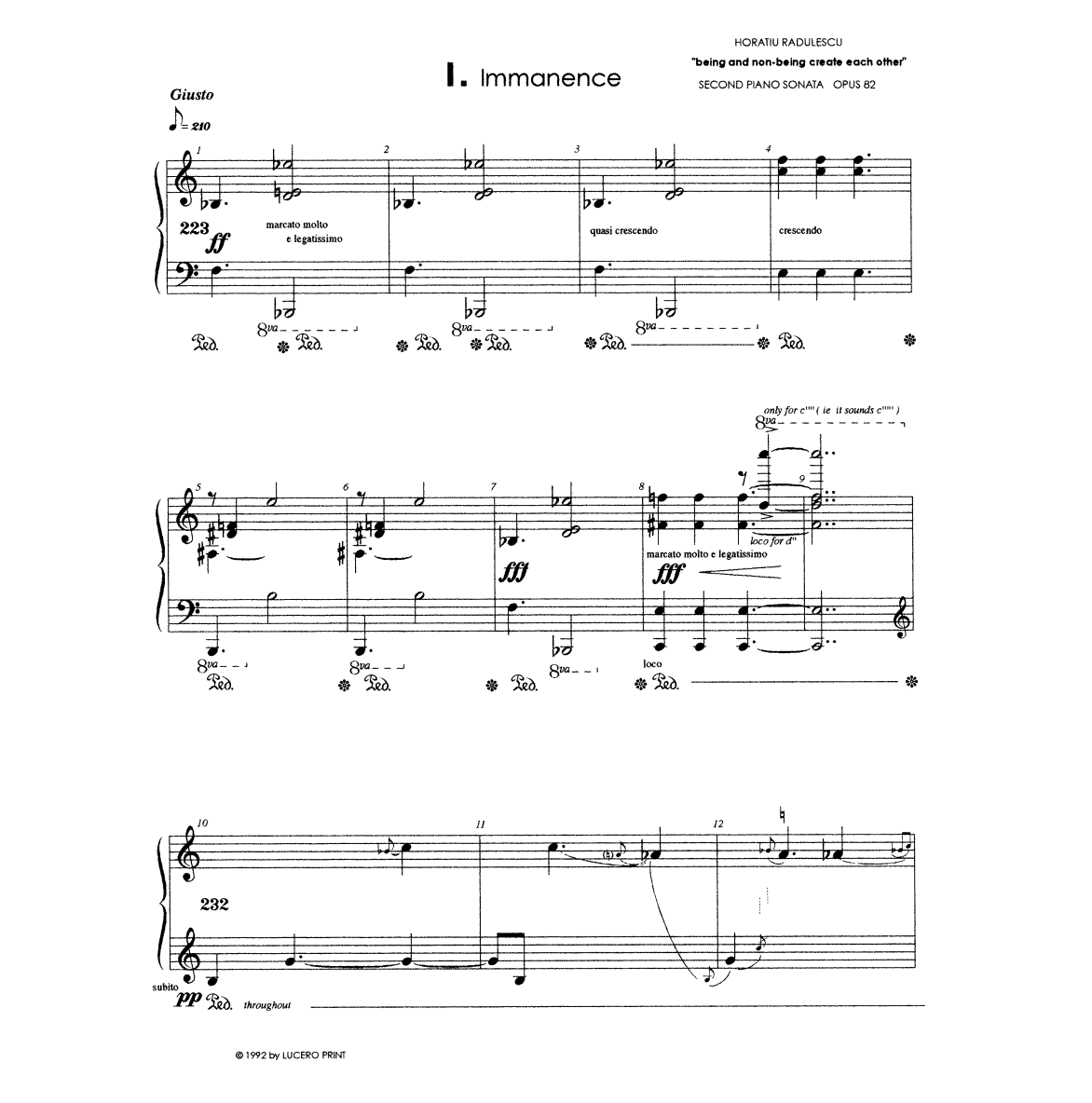
Many decades passed before Radulescu returned to the piano sonata form. Written on commission for the equal-tempered, unaltered piano rather than a modified one, Radulescu’s Piano Sonata No. 2 – being and non-being create each other was composed in 1991, two years after the fall of Ceausescu’s dictatorship. The sonata was written on commission for the equal-tempered, unaltered piano rather than a modified one. This would his first work for the unaltered piano since his days as a student in Bucharest.
*
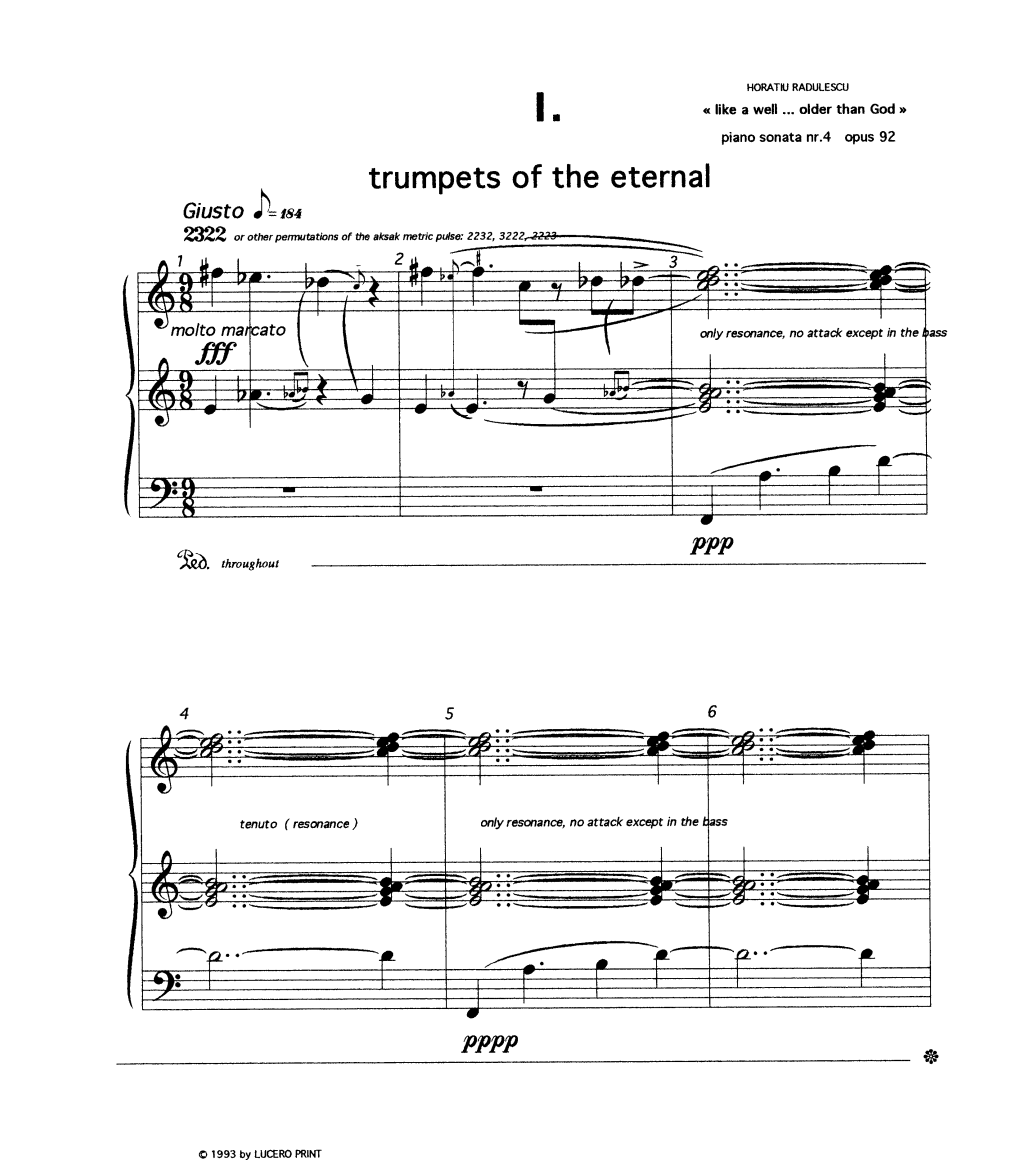
In 1993, Radulescu composed yet another sonata, this one titled Piano Sonata No. 4, Op. 92.
*
A fragment may be a site of return, a bench beneath a tree in the imaginary homeland’s cartography.
*
Horaţiu Rădulescu’s The Quest, for piano and orchestra (1996) quotes a particular morsel of a Romanian folk song in its first and third movement. But he also quotes it in “Movement III: Doina” of his Piano Sonata No. 3, “you will endure forever” (1992/1999). . . . . And perhaps in Doriund (1975/1976) as well, perhaps Doriund is where it began, though I am stretching my ears a bit here.
*
Rădulescu’s sense of temporality and coexistence pushed the hybrid form beyond its dialectic underpinnings and collapsed linear time and melody into the spectral and ancestral, the prehistory of stones speaking. Unlike most Romanians, he did not change the “escu” to an “esco” when he became a French citizen. He also spoke in multiple languages, mixing metaphors and idioms, dragging German into French and then whipping both with a Balkan expression, thus refusing to stay in the indicated linguistic lane. Being and sound were not separable for him.
*
“The nature of acoustical phenomena lives in the folklore,” Radulescu told a friend.
*
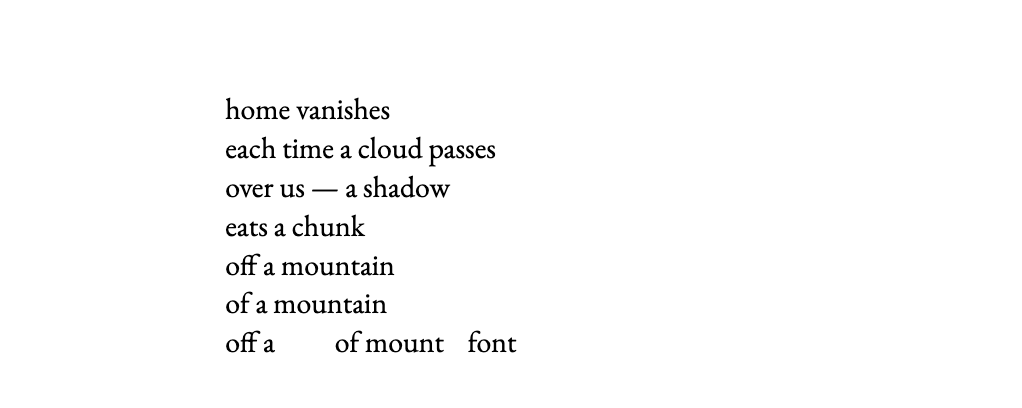
Between 1993 and 1994, Radulescu composed Angolo Divino, op. 87.
*
In 1984, Radulescu composed a choral piece for the voices of 34 children in spectral accord. The title, Do Emerge Ultimate Silence, is an acronym: D-E-U-S. When I read as an amalgam of languages, in accordance with Radulescu’s penchant for mixing languages, I see “De Us” in that acronym.
*
For the performance of Do Emerge Ultimate Silence, Radulescu returned to the Church of Sacré-Cœur in the small town Villeneuve-dʼAscq in northern France, where his piece Sensual sky was also performed. The church is small — nothing like its grandiose sister in Montmartre — and looks almost out of place with its red brick exterior. He dedicated this work to his “spiritual father” Giacinto Scelsi, and imagined it being performed in the most famous circular temple in ancient Rome, namely, the Parthenon. Radulescu’s efforts to perform music outside the official concert halls of prestige was linked to his belief music’s “single aim and reason to exist” involved putting the listener in an alternate state of mind.
*
CLEPSYDRA op. 47 for 16 Sound Icons (1982) takes its title from a temporal instrument. In ancient times, the clepsydra refers a contrivance that measuring time by the flow of water, a water-clock — but also may allude to intermittent fountain or ebbing wells. Most of us tend to think of the ancient time-telling piece known as the hourglass, or clepsammia, whereby time is measured by the flow of sand in a glass, but not Radulescu. In the 16-part for this composition, the shape of a horizontal clepsydra emerges and gradually filters a single pitch from a rich sound spectrum. The music then “passes through” this pitch to develop into a new spectrum, becoming richer and more expansive. Each spectral element is activated by different bowing techniques on the Sound Icons, thus playing, once again, into Radulescu’s fascination with the “spectral heterophony” of sound sources.
*
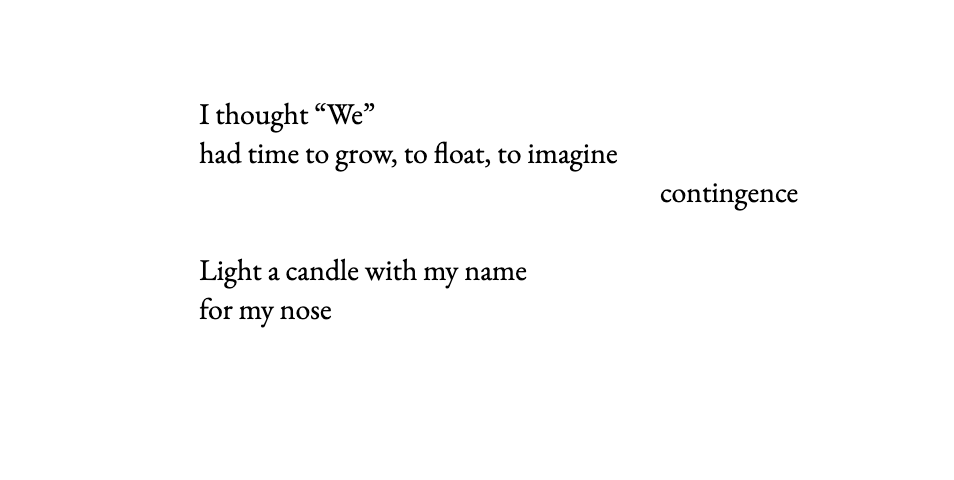
Frenetico il longing di amare, for bass voice, octobass or double-bass flute and sound icon (1984-87) was performed by the Orchestre Français de Flûtes with Pierre-Yves Artaud on flute and Horațiu Rădulescu as conductor. Now I quote from the recording’s description: “The score describes a figurated choral based on the theorical components of an E-spectrum, in between the 6th and the 53rd harmonic. The sound icon, a concert grand piano vertically placed and played with bows, is offering and sustaining - as to its spectral scordatura - the strict pitches of non-equal intervals on which the voice and the flute are meeting themselves. The sound icon remembers the role of a tampura in the indian rags. The flute and the voice are coloring these pitches by means of special sound-production techniques. Thus on the spectral components which became now fundamental pitches these techniques are producing an enriched and unstable “micro-spectrality” - “émanation de I'émanation”: —micro-rhythm and phase-shifting, and other aural informations capable of captivating other perception with that intrinsic life of the sound-matter.”
*
It is commonly called the Radulescu’s Fourth Quartet. The Ardetti Quartet performed it — Streichquartett Nr. 4, Opus 33: “Infinite to be cannot be infinite, infinite anti-be could be infinite” for nine string quartets or a string quartet surrounded by an imaginary 128 string-"viola da gamba." The CD liner includes the following note written by Robert Reigle: “Horatiu Radulescu's Fourth Quartet illuminates a new spectral sound world by juxtaposing a 128-pitch, "viola da gamba" scordatura (using a'= 433 hertz) with 29 orbiting spectra based around a'= 431. Fifteen years have elapsed between the Quartet's premiere and the availability of this beautiful work's first recording. Ironically, despite our instant communications, recording, and reproduction technologies, some things happen more slowly now than in the past.”
*
In Sound Plasma – Music of the Future Sign, first performed in Munich in 1975, Radulescu expressed his belief that music should place the listener in contact with an alternate reality or way of being. Like Scelsi and Karlheinz Stockhausen, Radulescu understood the performances of his works as a kind of religious rituals. According to Radulescu, music is a “ritual of all senses & of the beyond senses”.
*
Written in commemoration of Giancinto Scelsi’s death, Radulescu’s Byzantine Prayer for 40 flautists was composed for the harmonic spectra of a low A, the same A that Scelsi used in his Quattro Pezzi una nota sola (1959).
*
*
As I walk through the cemetery of Bellu, futile sibyls drag their wings over our faithless echoes—all the sounds are sorcerer-ed from sepulchres whose laments escort each enigma closer.
*
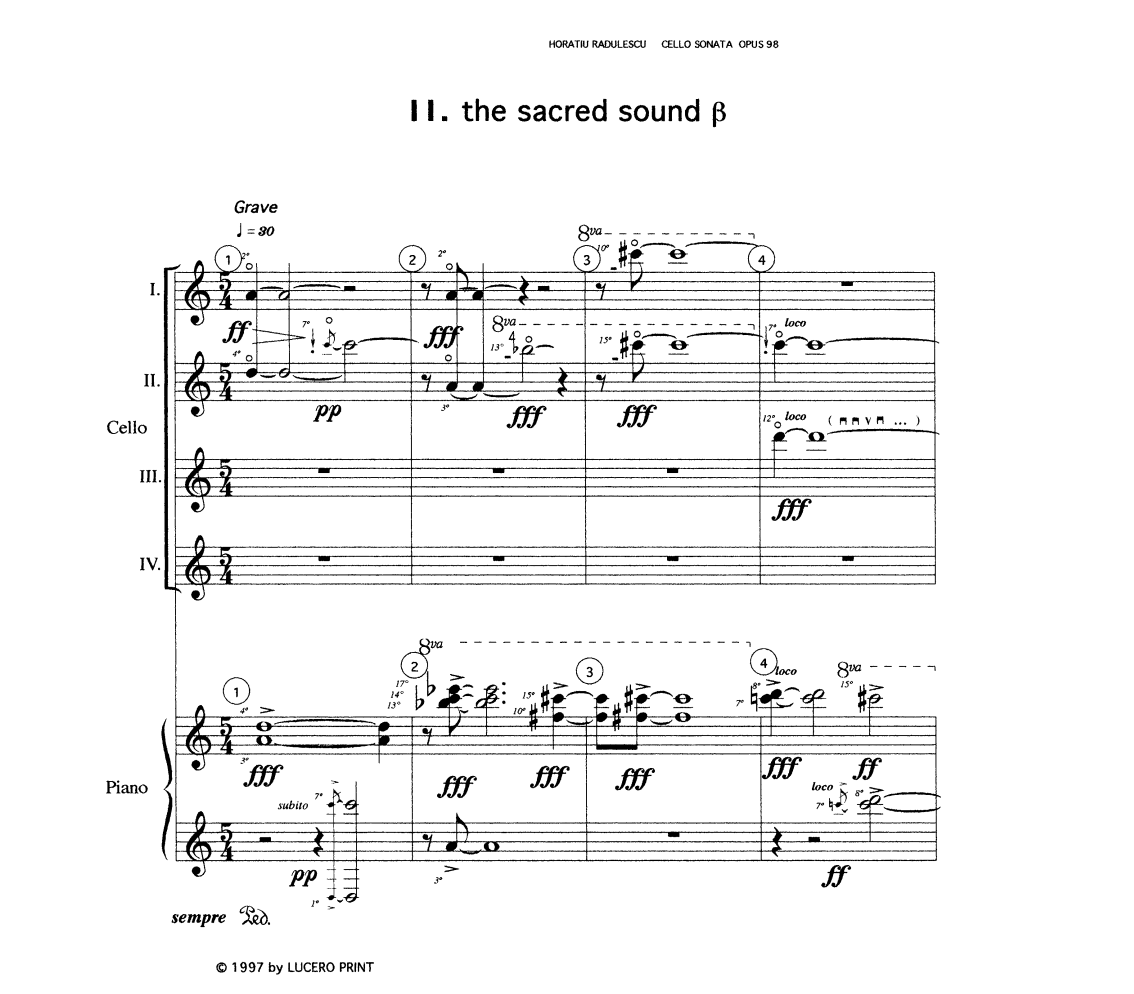
Immersed in the wonder II op. 96 (1996) for cello and trombone takes its title from the sixteenth chapter of Tao te Ching: “Immersed in the wonder of the Tao, / you can deal with whatever life brings you, / and when death comes, you are ready”. Shushan Hyusnunts describes it as “an intimate dialogue between a trombone and a cello" in simple ABA form, written in memory of Toru Takemitsu and dedicated to Robert Aitken and Catherine Marie Tunnel. “The culmination of the work (its middle part) consists only of the natural harmonics of a fundamental note, with a use of spectral cello scordatura,” writes Hyusnunts, noting the “Renaissance-like arpeggios of cello.” The work takes its leave of the audience with a sense of unfinishedness, as if occupying a cyclic time that could very well begin again, and turn to its own repetition.
*
Return is the movement of Tao.
*
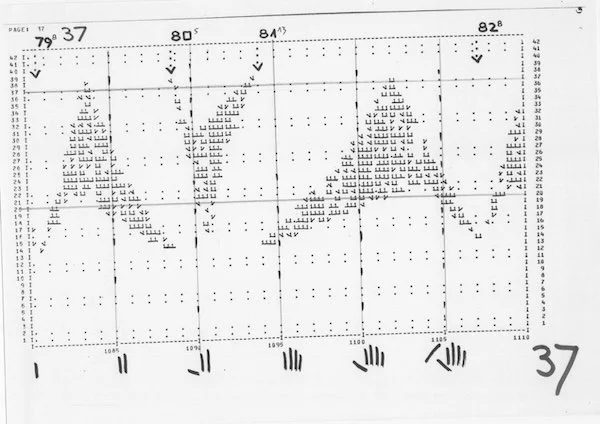
Radulescu, Outer time (Versailles, 1980)
*
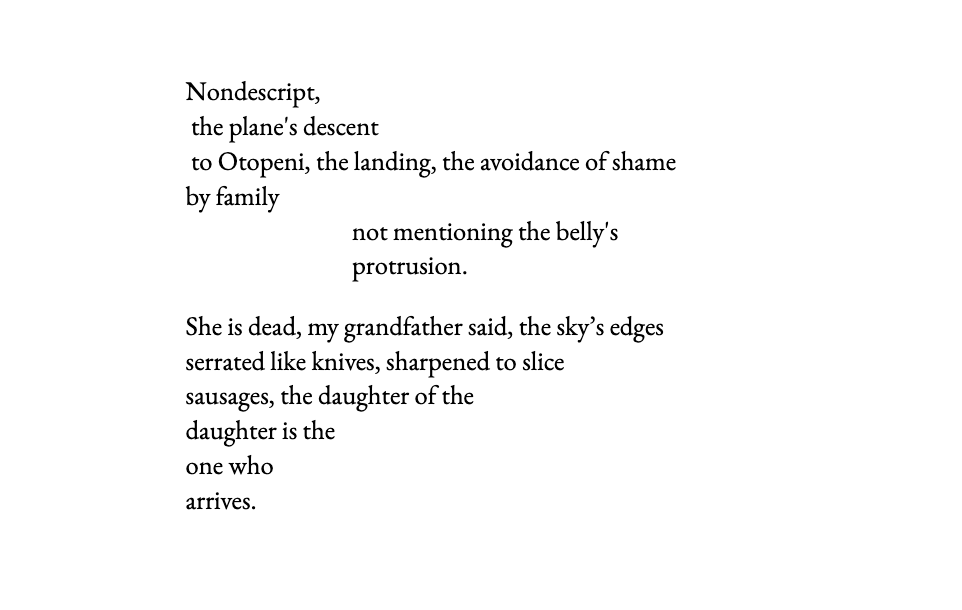
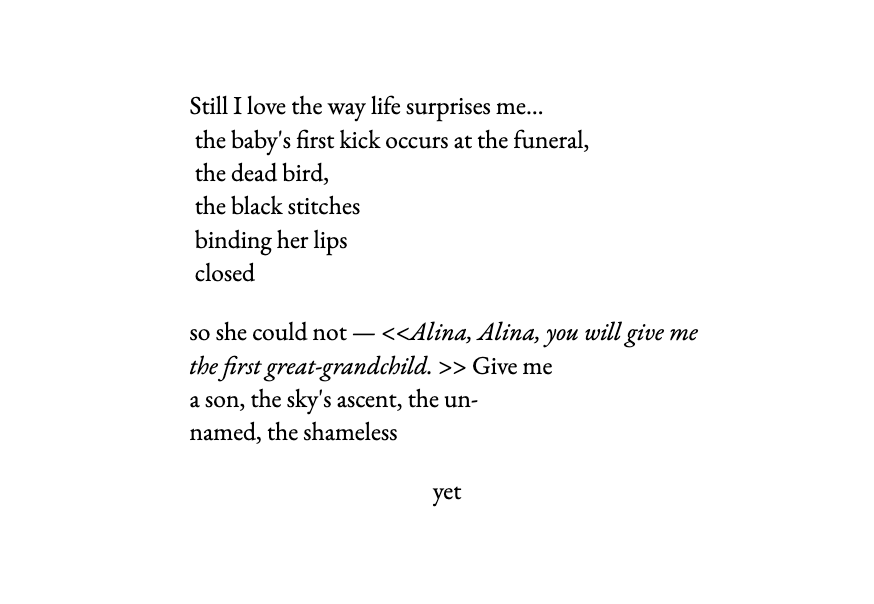
Alone when I learned Bunica had hip surgery after slipping on ice in a Bucharest park. She is fine, a little bored and dehydrated, my grandfather said. I borrowed money for the ticket, packed IV fluids in a suitcase, prepared to tell her of my betrothal to none except the infant in me — the one
she raised must be the one my parents left in Romania. The child I was
met the child I was
carrying.
*
Radulescu’s The Origin
*
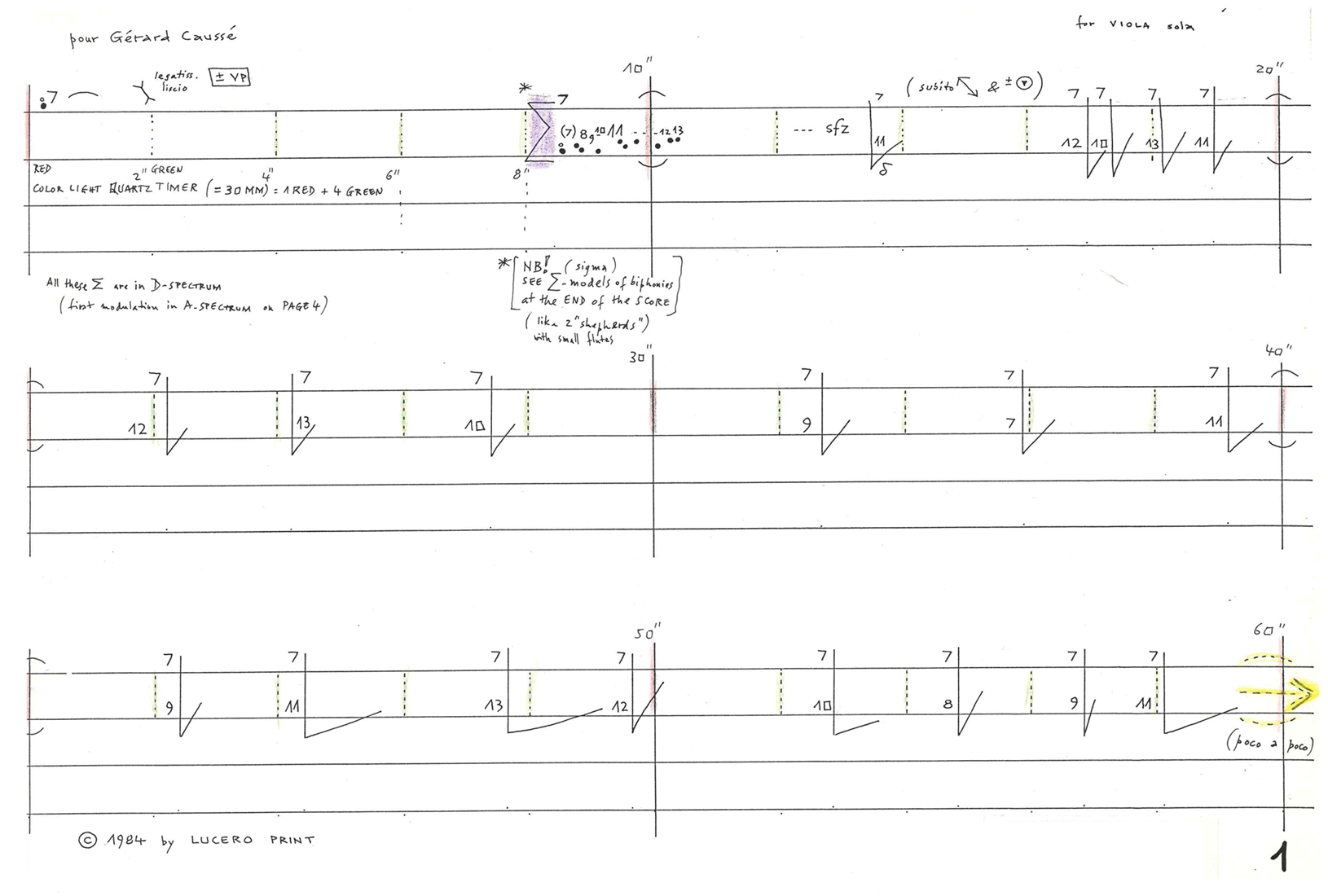
2003 brought Radulescu’s Intimate Rituals XI (for one or two violas) into the world, as performed by Vincent Royer, Gérard Caussé, Horatio Radulescu and Petra Junken. The composer defined the subject as “private, maybe even erotic situations.”
*
Intimate Rituals was released a short time before the death of its author.
*
In a statement given in Amsterdam, Radulescu said that he composed Intimate Rituals XI (a work for viola) “using the tape of the pre-recorded sound icons with a viola in a spectral scordatura, a very special tuning-chord; the open strings simulate the 3rd, 4th, 13 th and 20 th harmonics of an F monesis, giving C half-sharp, F half-sharp, a slightly lower D, and A half-sharp. He continued:
With this scordatura you also have the presence of the 7th harmonic in the air; the 3rd and 4th harmonics in sum give 7, and the 13th and 20th harmonics in difference also give 7. So the 7 th is there too, in the subconscious, even though it is not directly present. The piece is dedicated to Vincent Royer; it was composed in Clarens / Montreux, in 2003 and premiered by him in Chicago. The timing is very strict; the techniques are those already known from Das Andere and Lux Animae but otherwise activated; the macro-form is also directed by the Fibonacci proportions. The viola is in constant dialogue with the sound icons (I don't like to think of the piece as viola and tape; ideally the sound icons would be live). The viola and the sound icons are dependent on each other, sometimes crossing, sometimes not. There are very intense moments as the sound icons describe a high register climax at the Golden Section; the viola attains its highest sounds there too and then decays, very strangely, reaching again in the low the richest timbres.
*
Radulescu again, elsewhere: “Intimate Rituals are very private, maybe even erotic, situations. From the original recording of the sound icons in the Lucero studio in Versailles in 1986 to the premiere of Intimate Rituals XI with the viola in 2003 is a big span of 17 years, but the same atmosphere should be achieved, a sort of spiritual intimacy.”
*
In 1985, Radulescu and Petra Junken recorded two improvisations on different sound icons. By alternating the rapid and slow pressure of the strings, they created an inexhaustible amount of harmonics. The tape of Intimate Rituals came together through a superimposition of these two improvisations, turning into a sort of “sound carpet used as a burden.” Although the work is usually performed with tape rather than live sound icons, Radulescu said it was critical for the performance to reach an atmosphere of spiritual intimacy in correspondence to the intimacy of the original improvisations.
*
“Iubiri for 16 instrumentalists (2 flutes, 2 clarinets, 2 bassoons, horn, trumpet, trombone, percussion and string quintet) and sound icon” (1980-1981). “To my mother,” Radulescu wrote, in the dedication.
*
Liner notes: Franck Mallet, July 1994, translated by Mary Dibbern. The paragraph below is a direct quotation from these liner notes, as well as Dibbern’s translation:
Iubiri is the Rumanian plural of “iubire” (love). The word iubire is a Latinization of the Russian word «lioubovi», just as the words «Liebe» or «love» are derived from Sanskrit. The work consists of 343 unique «iubiri» («loves»), 343 unique «micromusic/orchestrations» that during forty-seven minutes integrate seven acoustical spectrums in the style of seven large historical tonal regions. «The fundamentals of these seven acoustical «solar» systems, are themselves the seven first new harmonics of the initial C: C, G, E, B flat, D, F monesis, G triesis. This progressive macro-formal modulation gives a sentiment of continual ascension even if the global evolution of the registers is written in a «sleeping hourglass»> of seven octaves -, focal unison with «halo» -, and progressively reopens to seven octaves. The 343 unique «micro-musics» («loves») arrive like explosions/implosions, «illuminations» issuing from a <musical sphere», a sphere with equidistant meridians by which these 343 < musics » pulse with a «< divinely diabolical » periodicity. The seven macro-speeds of this periodicity themselves describe an irregular curve: 6-5-4-2-7-1- 3. The pitches used by the musicians are spectral components with an intense «<life-timber », spectrality of spectrum, « emanation of the emanation ». The formants/chords (zero degree of this music) describe zones: explicit compact spectrums; inverted spectral regions - secondary functions, tertiary in low pitches, primary functions in the high pitches; spectral functions, auto-generating spectrums, p.E. « ring functions ». By very complex and often complimentary dynamic profiles, these spectral functions - «frequency plateaus» with intense life (timber, dynamics, micro-rhythms, etc.) - acquire the perceptive qualities of monody, polyphony or homophony that change at high speed.» From this extremely detailed writing, a sonorous plasma arises, rich with various kinds of information. The listener can perceive melodies that are not played directly by the interpreters, but whose origin is found in the harmonics.
*
After Radulescu moved from France to Germany in the 1980s, the Speyer Cathedral animated his musical imagination. Apart from the architectural grandeur and the glorious history of this Romanesque basilica, Radulescu was drawn to its unique acoustics. The Speyer led him to compose his first piece for solo organ, Christe Eleison op. 69 (1986).
*
Christe Eleison was also Radulescu’s first work for an equal-tempered instrument after a long break of eighteen years (his piano sonata Cradle to Abyss was composed in 1968). The fact that he avoided the equal-temperament follows the journey he started in 1969 with Credo for nine cellos, his first piece that systematically relied on the proportions of the harmonic series.
*
“I am more and more attracted from ancient sources,” Radulescu said, in conversation with a friend. “They [ancient sources] are archetypes, sounding genetics. Certain melodies, which are "verified" by millions of people and by the history, are so beautiful... Like a stone that has been cared for by the sea for ten thousand years. Its surface is smooth, perfect.”
*
In Amen, Radulescu used the monodic line as a base of a canon, in which the same melody is to be performed with time shift in five different tempi according to five voices of the heterophonic texture. This phase shifting coaxed new melodic textures to the surface.
*
“The creative path of the Romanian composer Horatiu Radulescu can be seen as a multifaceted exploration of space – understood as sound space (the sound spectrum with his infinite harmonic series), as transcendental space, as inner space of the listeners mind as well as performing space,” said Shushan Hyusnunts.
*
*
“Horatiu Radulescu was a man who stayed in the centre. He was totally unconcerned with fashions in the arts, with opportunism, with career-building. He was prepared to work hard to secure good performances of his music by interpreters he trusted. He could be pushy at times, and probably seemed arrogant to some; but what concerned him was making music, making art, of the highest integrity, and sometimes that effort involved a little pushing. In a composing lifetime of over forty years, and through 110 opus numbers – his total catalogue is much larger as many works exist in multiple versions – he created a body of music that is among the most courageous, most beautiful and most inspiring of the modern era.”
— Bob Gilmore, on his dear friend, Radulescu
*
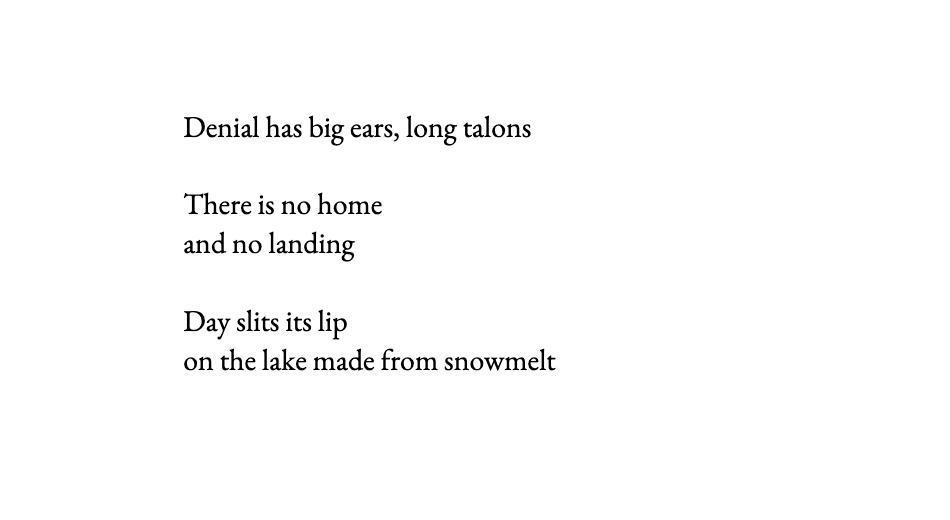
Raise your horns
tell the sky
there is no home
and no final land
ing.
*
All the texts superimposed on the videos of Radulescu’s pieces come from the pen of yours truly, and the collages from my hands or screens.
Bob Gilmore, “Remembering Horatiu.” Journal of Music, 1 October 2009.
Bob Gilmore, “‘Wild Ocean’: An Interview with Horatiu Radulescu.” Contemporary Music Review 22, nos. 1-2. March–June 2003: 105–22.
Bob Gilmore, “Spectral Techniques in Horatiu Radulescu’s Second Piano Sonata.” Tempo, 62.
Horatiu Radulescu, “Brain and Sound Resonance: The World of Self-Generative Functions as a Basis of the Spectral Language of Music.” International Lucero Academy.
Horatiu Radulescu, String quartet no. 1 op. 4 (1966-1967)
Horatiu Radulescu, DO EMERGE ULTIMATE SILENCE (1984)
Robert Reigle, “Radulescu’s Streichquartett Nr. 4. Op. 33.” Liner notes to CD with 16-page booklet in German, English, and French.
Richard Toop, “Radulescu, Horatiu.” The New Grove Dictionary of Music and Musicians, edited by Stanley Sadie and John Tyrrell. London: Macmillan, 2001.
The Classical Nerd. “Great Composers: Horatiu Radulescu”. Accessed on February 27, 2026 via Youtube.
William Dougherty, “Horatiu Radulescu's Piano Sonatas & String Quartets, Vol. 1.” Music and Literature, July 26, 2016.