Over 5,400 immigrant children have been separated from their families and placed in detention camps or foster care for the crime of crossing a border. And the sun continues to freckle my daughter’s nose, and loosen the shoulders of my son.
A plaster Virgin Mary with her arms outstretched sits near a bird bath across the street. Every day I seek the poem in her gaze. Today I find nothing. No poem in any of this. I can’t find words unaccompanied by the knowledge of not doing enough.
I sink into Zagakewski’s “Try to Praise the Mutilated World”.
“You've seen the refugees going nowhere,
you've heard the executioners sing joyfully.”“You must praise the mutilated world,” Zagajewski says. I praise the ordinary dignities, the bits of life I’ve been given to live—”the gentle light that strays and vanishes / and returns.”
There is Matthew Zapruder: “I’m not sure I would say that poets have failed. For better and worse, we have been forced by horrifying and terrifying circumstance into feeling as if the only things that “matter” and are “worth writing about” have to do with generally agreed upon issues of importance. Of course we feel that way: just look at the world.”
I look at the world.
I look at the world in my head and how it differs from the world others experience.
I study the mutilations. The intimately-mutilated include those moments when my son’s rage at the world unmelts entire glaciers, the color of unpoured concrete, the apple core on the nightstand, an aubade for the calm of last week and that long night in bed with Audre Lorde, the look in his eyes across the room and the swell of desire, the fact that the look is still a hinge, a door he knows is open, a crack in the cosmos he recognizes.
A tear in the fabric of everything we know is re-cognizing of each other.
Try to find the beloved in a gun show stocking up on ammo. This is the most difficult space.
But there are other spaces as well. There is Shaindel Beers trying to help local pets find homes and bring comfort to those who are alone. There is Pidgeonholes, providing free online workshops for writers (and I’m so grateful to get to share one), and you won’t believe some of the generosity that is to come in that space. There are free online ebooks from Verso asking questions of the present moment. There are online literary happy hours with incredible readings. There is Reginald Dwayne Betts speaking directly into the silence of US prisons, where countless human beings are trapped in a vector where viruses thrive. There is unbelievable injustice alongside fear and desolation and hope. There is rumor and gossip and cruelty. There is humankind, for better or worse.
"Six Gravel Roads", a CNF from an online journal that expired
Because online journals don’t last forever, and sometimes you want to keep the stories they housed somewhere in the pixel-dust cosmos, here is a flash CNF that was published in boink back in October 2017.
Six Gravel Roads
for Alabama
A gravel road. His voice weak from bronchitis. We divide a Lucky Strike between breaths. He pushes words into the sunset's silence.
"I went to homecoming with a girl that wore black combat boots and an orange polyester housedress that wasn't a costume. Just before I got into drugs. Unrelated. But I can't get over how she smelled like detergent, the brittle bleach of her hair, the kiss she refused to give back in the Waffle House parking lot."
My toe itches, distinct pulse and throb of a fire ant bite. Smoke, then scratch.
I like her name, the way he says it. But I'm not sure the way we say things matters in the dark.
The sun is down. The bracelet on my wrist is made from the base of an antler. I imagine the mammal's name, the first noun in a story.
*
Gravel road with the boy who mud-rides on Sundays. He calls me "a guy's girl." Later I will realize this is like being "a writer's writer" only even worse. Even more lonely. I had to hurt someone to get to this girl whose pocket-knife cuts hair in graveyards.
Each bump in the red dirt road sprawls like a Jimmy Page solo.
"You're a sport," he assures me.
*
Gravel road with a bottle of Jack. My father remarries an American woman, trained not to raise her voice, not to leave vulgar lipstick marks. She goes into bedrooms and closes the door. A locked click. A house swept clean, dishes ordered-- "I'd do anything for a scream sometimes", anything to loosen the oppressive expanse of well-kept silence.
My father descends the stairs of his wine cellar. He knows what to find. "It's Brazilian".
His wife manages the house with her silence. Because she doesn't say mean things, there is nothing to hold against her. No defense against the implications.
"Don't call me a sport."
Does loving never risk the limits of a mansion?
I look for boys in the magic of mud splattered across a windshield.
*
Gravel road, my eyes on the derrick. Moving and stopping. This boy and I trying to discern a pattern to the up-down motion, a soluble rhythm.
His mother picks tomatoes four months of the year. One summer equals seasonal labor. She believes in the value of education.
"I'm not a book person," he admits. "I get caught between the borders of private and public. I'm smart in the house and shy near the blackboard. Have I told you how it feels to see colors that other people are missing? I see colors. The most important things happen in Spanish."
He asks if he might kiss me. I taste leather and brimstone in the instant before our lips meet on the border of murmurs, si, si.
*
Gravel road with the quarterback who likes European history. Trying things on for a season: sports, hobbies, political bumper-stickers. I'm reading Marcel Pagnol and rollerblading. Three months from now, our high school will named state football champion.
But not yet. In the earnest-to-gravel moment, he needs to know why I date mostly nerds.
"You're too smart for that," he leans back into the truck seat, laughing.
He laughs when he talks like nobody's business. "You're the smartest person I know, period. Why date below your looks?"
I think of Sartre and who could be uglier. I think of Sartre's brain as I unbutton my blouse and show him my breasts.
*
Gravel road after road after road. The way nipples harden at high speed. The way a bump chimes like a warning bell inside the willing body. The way you shouldn't. No him. Not here. Not so far from the safe zones of civilization. Not forsaking protection of playgrounds and well-lit condos.
The highway billboard: We have limits for a reason.
You crave the sharp prick of a turning season. You junk the postcards, the worthy landscapes. You live for the pebbles in your socks, secret rocks, tender cringes, portraits of women that never made it to sepia.
You keep a collection. Relish each boy, their awkward hands, insatiable hungers. But it's those roads you can't get over. It’s the ache of old gravel you can't give up.
Image source: The Thornfield Review
3 poems by Wislawa Szymborska
Maria Wisława Anna Szymborska (2 July 1923 – 1 February 2012) was a Polish poet, essayist, translator and recipient of the 1996 Nobel Prize in Literature.
“I wouldn't want what happened to me to happen to anybody, because it is something that destroys the spirit and the soul, totally, there is no comparison. To talk about it is hard for me, because it all comes back at once...all that terror, that horror.”
“It's over 25 years now since I was arrested and tortured for treating a wounded revolutionary, but the memories of the pain in torture, the terror and the utter desolation of weeks in solitary confinement, are still with me. I believe it is the same for all of us, the men and women who have been imprisoned, stripped naked, hurt and humiliated. We are left with only a thin veneer over our pain, and the outraged question: how could one human being do this to another, and how could others stand by and watch it happen? What are we doing, when we turn away from other people's suffering? What is that happens in the human heart to block the natural flow of compassion that is an intrinsic part of us?”
Wislawa Szymborska’s words provide a context for her thoughts on torture, for the way she seems to play with the absurdity (and meaninglessness) of fate, placing prison next to romantic love in the context of follies.
Tortures
Nothing has changed.
The body is susceptible to pain;
it has to eat and breathe the air, and sleep;
it has thin skin, and the blood is just beneath it;
an adequate supply of teeth and fingernails;
its bones can be broken; its joints can be stretched.
In tortures, all this is taken into account.
Nothing has changed.
The body shudders as it shuddered
before the founding of Rome and after,
in the twentieth century before and after Christ.
Tortures are just as they were, only the earth has grown smaller,
and what happens sounds as if it's happening in the next room.
Nothing has changed.
It's just that there are more people,
and beside the old offences new ones have sprung--
real, make-believe, short-lived, and non-existent.
But the howl with which the body answers to them,
was, is and ever will be a cry of innocence
according to the age-old scale and pitch.
Nothing has changed.
Except perhaps the manners, ceremonies, dances.
Yet the movement of hands to shield the head remains the same.
The body writhes, jerks and tries to pull away,
its legs fail, it falls, its knees jack-knife,
it bruises, swells, dribbles and bleeds.
Nothing has changed.
Except for the course of rivers,
the lines of forests, coasts, deserts and glaciers.
Amid those landscapes roams the soul,
disappears, returns, draws nearer, moves away,
a stranger to itself, elusive,
now sure, now uncertain of its own existence,
while the body is and is and is
and has nowhere to go.
A Opinion on the Question of Pornography
There's nothing more debauched than thinking.
This sort of wantonness runs wild like a wind-borne weed
on a plot laid out for daisies.
Nothing's sacred for those who think.
Calling things brazenly by name,
risqué analyses, salacious syntheses,
frenzied, rakish chases after the bare facts,
the filthy fingering of touchy subjects,
discussion in heat--it's music to their ears.
In broad daylight or under cover of night
they form circles, triangles, or pairs.
The partners' age or sex is unimportant.
Their eyes glitter, their cheeks are flushed.
Friend leads friend astray.
Degenerate daughters corrupt their fathers.
A brother pimps for his little sister.
They prefer the fruits
from the forbidden tree of knowledge
to the pink buttocks found in glossy magazines--
all that ultimately simple-hearted smut.
The books they relish have no pictures.
What variety they have lies in certain phrases
marked with a thumbnail or a crayon.
It's shocking, the positions,
the unchecked simplicity with which
one mind contrives to fertilize another!
Such positions the Kama Sutra itself doesn't know.
During these trysts of theirs, the only thing that's steamy is the tea.
People sit on their chairs and move their lips.
Everyone crosses only his own legs
so that one foot is resting on the floor
while the other dangles freely in midair.
Only now and then does somebody get up,
go to the window,
and through a crack in the curtains
take a peep out at the street.
[ From View with a Grain of Sand by Wislawa Szymborska, Translated by Stanislaw Baranczak and Clare Cavanagh ,”A Harvest Original" Harcourt & Brace & Co. New York 1993 ]
Any Case
It could have happened.
It had to happen.
It happened earlier. Later.
Closer. Farther away.
It happened, but not to you.
You survived because you were first.
You survived because you were last.
Because alone. Because the others.
Because on the left. Because on the right.
Because it was raining. Because it was sunny.
Because a shadow fell.
Luckily there was a forest.
Luckily there were no trees.
Luckily a rail, a hook, a beam, a brake,
A frame, a turn, an inch, a second.
Luckily a straw was floating on the water.
Thanks to, thus, in spite of, and yet.
What would have happened if a hand, a leg,
One step, a hair away?
So you are here? Straight from that moment still suspended?
The net's mesh was tight, but you? through the mesh?
I can't stop wondering at it, can't be silent enough.
Listen,
How quickly your heart is beating in me.
Translated from the Polish by Grazyna Drabik and Sharon Olds ]
My mom with me in Romania, before they defected. While they were secretly plotting their defection, a plan they shared with no family or friends until the night before they ran.
Love letter to life
When you read a poem by "Alex Dimitrov” titled, simply, “Love”—and discover exactly what you want to carry forward into the new year. An ode to the loved and the loving. An ode, somehow, to life. A model more exquisite than a mantra.
If you haven’t read this poem yet, it’s available on the American Poetry Review website. And you should read it.
You should print it.
You should sit with it in a park and read portions aloud and share the crumbs you love most with pigeons.
Then (then, o then) you should use it as a model for your own ode to love. You should bring your free-range love gaze to bear on life and poem it. Everything you love is worthy of this exercise, I think. And what a way INto a poem-space…. On that note, here’s mine. With gratitude to Alex…
Love
after Alex Dimitrov, unequivocally
I love the way water feels deeper in darkness.
I love the arousing expectation of a green light--and the unfulfillment blister that follows.
I love how no green is sufficient. How no green can be enough for what we want from a meadow.
I love the intense pelt of hair on his chest, the rug it makes for my face, a soft place after stubble-kissed exfoliation.
I love people who love opera and sing their favorite arias while doing no-count things in a yard.
I love the rancor of grocery-store lines, the simmering human cauldron.
I love hiding, being hidden, knowing less.
I love bark that takes the shape of canyon to court rivulets of rain down a tree trunk.
I love all the humans I've kissed.
I love the humans I've kissed who still can't forgive me for being less than they imagined.
I love the kindness of being lesser, still least, never best.
I love the way romanian words unclench the knots in my shoulders. The way my name in a native tongue sounds like a silk dress rather than its business-casual, american version. I need someone to speak the soft vowels in me. Often.
I love the bold lonely cold of the massive magnolia, its towering dankness.
I love the psalmed quiet in a room after the rude house-guest leaves. After the rude house-guest packs their complaints and keen criticisms into a tiny knapsack that you hope they will leave on a park bench where squirrels stay busying bury such tidy parcels of violence.
I love apologies, tears, forgiveness. I love the reckless audacity of earnest apology. I love the humans who love the world enough to admit when they have wronged it. I love the music this makes of a difficult face.
I love movies with subtitles and saxophones posing as streetlamps. I love the lie we tell a lover to help him sleep. I love pressing my ear against his ear and trying to hear his dreams.
I love the musk ox who approaches its possible mate with overwrought anguish, sniffing the vagina, resting its chin on female buttocks, nosing her neck, scraping her flanks with a foreleg, bellowing.
I love people who have never played Spite and Malice. I love people who walk away from games in the name of violins.
I love loosestrife, daisy crowns, dishonest violets.
I love this whole incarnation, the sensual glut of it.
I love the accidental clumps of confetti that pass for trash after rain.
I love the resolute energy of thunder--how it leaves us with no one to blame.
I love Rilke and Judas and Georges Sand and Maria Tanase and every fool love betrays with penultimate softness.
I love the bullet that never leaves the gun, never makes its home inside the end of a human, never busts its bored bravado into a mailbox. I love the bulletin against bullets. I love people who love people enough to say so.
I love the woman who is leaving the man who does not deserve her. I love the moment when she knows this irrevocably and not even Sodom tempts her to look back.
I love George Oppen for saying: Relevant thinking begins with the distrust of language, and speaking of poetry. I love how Oppen was always speaking of poetry, or an entryway to ethics, an opportunity to cross the threshold of convention into hard questions.
I love two-faced words that embody the tension of the turn. The verb cleave, which means to split, divide and to remain faithful to. I love cleaving and what it keeps of leaving.
I love rubbing opposite things against each other to start a small fire. I love rubbing Alabama against Romania and seeing what friction this brings to the poem.
I love intense defamiliarization. I love what it wants from the dead.
I love sentiments, their slow tempest, an education. In a time when our emotions have been conscripted into self-help regimens of passive-aggressive positivity poses, sentimentality is the black leather jacket, the bad girl, the beast. I love how she wears her torn leather to the kiddie birthday party. I love how she feels all the wrong and wonder-full things.
I love listening to my kids decipher the world without me. I love overhearing new verbs that change their relation to the room.
I love words. I love words. I love watching old couples tango into fury.
I love mountains. And molehills. And I am some.
I love how my mother loved life--with fanaticism and shamelessness. I love how she was never afraid to show it. Never afraid to raise her arms to the sky and say, Look at this! Breath it in! Can you feel the air living inside you?
I love a joy so sober and direct than no god or drug or drink could claim credit for its presence.
I love friends who love me when I'm crying. I love friends who cry. I love people who aren't afraid of tears or wet towels or broken sinks.
I love knowing that the good we do for each other exists even in the silence of ingratitude. I love that pride has no actual muscle, only the flicker of a flex in the mirror.
I love the silver mermaid necklace and Coney Island and the things I have done to keep myself free of the the guilt of the fathers, the burdens of the sons.
I love the undevastated sanctus I am writing, living, thinking while a cockroach does his thing on the porch.
I love that Czeslaw Milosz ends his “Ars Poetica” with an injunction: "as poems should be written rarely and reluctantly, / under unbearable duress and only with the hope / that good spirits, not evil ones, choose us for their instrument."
I love knowing that what is possible will not redeem us. I love knowing that what we choose may be held against us. I love knowing that the poem, in its Great Hopingness, wants a dinner from the ghost.
I love the fact that history is not a robot and anything could happen, including kindness.
I love mystics and monks who live in tiny towers like princesses of the lo-fi fabulous.
I love lingering on the threshold of a reminiscence bump and rediscovering my favorite jeans.
I love words. I love words. I love diacritics and all little ornaments of unamerican accents.
I love hiding, being hidden, knowing less.
A handful of poems that fascinate me
This is not a list.
What resembles a list and walks like a list and talks like a list is actually a small, knotted knapsack that I need to imagine. Or a child’s hand.
My child’s hand or a knapsack I need to carry alongside the heavier baggage of adulting.
A mudpie-baker or a knapsack packed with a few poems I’m sneaking into the new year as both inspiration and a source of fascination.
Just a few of the poems I’ve been re-reading recently…. among so many bright, bright things, and not enough time or memory to share them all.
Not a list. Not the child itself. Not a constellation.
-
“World Parent” by Gboyega Odubanjo (Wildness)
For its entry-point, and the way stories of origin are always woven into stories of exile or immigration or displacement. For the profound and breathtaking alienation that is rooted, somehow—and still.
“All the Nigerian aunties and uncles are holidaying in Dubai.
They’re eating only Nigerian food and talking only to their drivers.
They’re posing as they give thanks, WhatsApp’ing everybody.”
“Altar Call” by Khaty Xiong (The Spectacle)
Because the way Khaty uses language toes the borderlands of sacred and profane and captivates me like an ash print on a child’s forehead, the mark left by others to give meaning to loss we still can’t inhabit. Which also bumps against the absence of homelands, Southeast Asian diasporas, and Hmong peoples.
“On Faith” by Shara Lessly (The Gettysburg Review)
For the soft pitch of the rhyme scheme & repetition…and the awe. “There is no map for how.”
“Polaroids of God From My Eleventh Summer” by Emily Borgmann (Waxwing)
”finally oh finally I prayed without assignment,
that morning the first time my head felt fit for my body,
what was done to it, the answer to prayer is
when you first know the size of your own pain, stop asking.”
“Moral Inventory” by Ruth Awad (Wildness)
” I once had a body
that wasn’t a body—it was a voice
in a god’s mouth. It was the holy vowel.
Oh, animal, I thank you.”
“Mixtape for My Twenties” by Phillip Metres (American Poetry Review)
Because who isn’t missing a cento of song lyrics from their 20’s as part of their corpus? And who else to give us such perfect permission to do it?
“Border Control Agent Will Not Complete His Shift” by Roy G. Guzmán (Hayden’s Ferry Review)
Because it broke things.
“The Poets Are Dying” by Brenda Shaughnessy (The New Yorker)
A model from seam to seam.
“Terms of Agreement” by Mary Biddinger (Sugarhouse Review)
”None of them knew I was surrounded by couch
cushions, regarding a sepia portrait of a cherished ex like it was newfound
// currency.”
“Indictment With Icarus” by Emily Skaja (Vinyl)
“ Hello you
are a vessel of vessels.
Hold your wings like the oars of a boat.”
“Science and Industry” by Randi Clemens (Pidgeonholes)
”In this exhibit, these walls,
this body: the unborn curl.
I trace my fingers along
them, the unspined, unheld,
unseeing behind viewing glass.”
“Origins of Violence” by Jenny George (from The Dream of Reason)
Because it is raw and pure in the most devastating way.
“Whiteness” by Michael Metiever (Sugarhouse Review)
For the challenge and its attendant complicity in the turn at the end. Powerful.
“this is a trans poem about swans” by Danielle Rose (Pidgeonholes)
“this is a trans poem about swans & i desperately wish for it to be beautiful / but beauty does not escape & become a silent parking lot / in an emergency it cannot be trusted to shuffle quickly toward the nearest exit”
And last but not least, I have been flummoxed over which poem to include from Sara Borjas’ formidable poetry collection, Heart Like A Window, Mouth Like A Cliff (Noemi Press). The whole book is a wonder of poeming, a beautiful beautiful unbidden glory. If you purchase a copy, you will not regret it. Not for a minute. I do not know the poet personally, and I’ve never met her, but if you purchase this book and decide to use it to teach a class, please find Sara on twitter and let her know. My opinion (and my fascination with this book) is rooted in nothing more extravagant than my life as a reader, lover of language, admirer of Pocha-Xicana poems. But if I have to choose a poem, I will choose the one that speaks for so many of us who cannot yet write this poem—and for the countless humans who will need to write this poem, or its sister, or its cousin.— “I See My Rapist’s Daughter” by Sara Borjas. From the aforementioned collection.
Questions for poetry revision
Inauthenticity appears in the belief that one can attend a costume party disguised as one's self.
This is the thought I measure myself against when entering the room of revisions. When straddling the multiverse between poet and persona, or the mask adopted by the author that offers a public version of the author's self, a distorted version of that self, or a fictional character.
To some degree, persona protects you by creating a distance between the voice on the page and the person living a life, failing. Ideally, revision is where the interaction between persona and poet sharpens into voice. But it’s still gruesome and difficult for me, still the most disorienting part of process. I need prodding, prompting, and encouragement when it comes to paring down and deciding what I want from the poem—or what the poem wants from the world. And how. .
So I’m sharing a few questions I give myself in revising, followed by revision resources crafted by others.
Questions for the Poet
Does the metaphor carry its weight? Does it feel accidental or sloppy?
Have you followed your fascination like a monk into the soul's monstrosity?
Are you skimming a pretty surface?
Are you writing what haunts you, even if it makes you look bad?
Are you writing to look good? How is that interesting or relevant to others?
Do the words link arms like drunks on a city street, their song tangling, rising suddenly like an accident that absolves us of money for the damned?
Are you wearing a costume or taking one off?
Did you drop freedom fries on the floorboard and hope to get away with the untouched cliche?
Are you all-in on glibness? Why?
Does your anger at the world include your role in its sustenance?
Is your gaze ableist or boutique-hearted?
Does dependency seek to present itself as the poem's golden glove?
Why are you whispering?
Why are you shouting?
Where do you stand in relation to the stadium?
Are you writing in hopes of rousing or arousing the audience? (If your mind immediately grabbed to the sexual connotation of “arousing'“, that might be a separate thing worth poeming.)
Would the poem still matter if you walked past a magnificent mural that said the same thing?
Did you get what you wanted from the endnote? If so, did you brocade a complicated lie just to get there?
Is there a sequel?
Is there a statement when what you meant was less stable, more querulous, closer to the marvel of a question?
Are you subverting a form effectively? If so, why? If not, why are you clinging to the idea of form for this poem? At what point does changing the rules become a different game? What is the significance?
Did you remove an adverb because someone told you that good poems don’t have adverbs? Why did you believe them when so many poems you admire suffer from allegation of adverbing? If you are Catholic about adverbs, consider being a lapsed Catholic for the poem.
If the poem is a room, what is the background music? Is it distracting?
Is it a prose poem? What are you getting from its lineation? What is the poetic line in this poem—and why?
What makes it feel finished? It is connected to another poem? Is it the start of a series or something that stands alone?
Ultimately, I don’t believe in finished “products”—I believe in the process of poeming. Consumerism conditions us to think in terms of products, to write for a market, to manage expectations with an eye to sales. But the poem doesn’t give a damn about sales. The poem may be published in one form only to reappear in a collected works with different line breaks, syntax, white space.
The question of when a poem is “finished” is the most difficult question for me as both a writer and a reader. I think Danish poet and writer Inger Christensen lays the stakes out best with a simple question:
"Is it at all possible to learn to write poems in a way that will make them seem important to read out loud to a cockroach?"
I leave you with peace, love, life—and a few more wanton butterflies to chase down the road….
The Condition of Secrecy by Inger Christensen (New Directions Books)
“Trust Poetry: An interview with Ada Limon” (BOMB Magazine)
Nick Ripatrazone’s “In Praise of Poems That End With Questions” (The Millions)
Excerpt from Hadestown by Kim Triedman (Talking Writing)
“The Art of Negotiation” by Meghan Privitello (The Volta)
Sometimes I kiss my idols
Like this poem by Czeslaw Milosz, written in Warsaw, 1944. One of those poems that walks with me.
And today I was fumbling through another project, needing a breath, a step back from it, and what better way to stroll than to copy Milosz’s stride? It’s one of my favorite ways to stretch into spaces I don’t know how to write. To try on a voice and see and what happens.
And now back to the page….
For Laura, Who Is Too Hard On Herself
And for all my poet friends who struggle with loving themselves in a world that sells us self-hatred under the guise of self-help, that prices us out of love, in a song we internalize as self-blame, in a guilt that is both useless and irrelevant.
The third day of nightmares with mom
We talk about how to love
the dead without killing them
again, and again in our
minds, with our mouths.
I swear we will love you
as you were, and not as we
made you in our wishes
for the average
accommodation, that
american sitcom mom.
We will love you without
erasing the unpopular
hysteria of your embrace
or the final foaming
followed by silence—
and those sirens
we couldn’t hear
across an ocean.
That nothing
did not spare us.
Pierre Bonnard’s “Salome”
Poems I've been re-reading like lost religion
“Sonnet 31” by Katie Ford, selected by Ilya Kaminsky for Poetry Daily.
“The Laws of Motion” by Nikki Giovanni in Poetry. “The problem with love is not what we feel but what we / wish we felt when we began to feel we should feel / something. Just as publicity is not production: seduction / is not seductive”
“Pathology of Violence” by TJ Sandella in The Rupture. “it's what makes us human / isn't it”
“Wipe That Smile Off Your Aphasia” by Harryette Mullen. “as fax machine as one can imagine”
“Width of a Witch” by CA Conrad in The Volta. “the kind of children we deserve who rob us in our sleep / we never need to believe in anything again / they take our car and money and head for the beach”
“Indiscretion” by Ewa Lipska, translated by Robin Davidson and by Ewa Elżbieta Nowakowska for Words Without Borders.
“I Do Have A Seam” by Jamaal May.
“Would You Come Back?” by Nadia Tueni. “like a throat seized by cattle who devour a sunray”
“Work Boots: Still Life” by Jim Daniels in Poetry. “laces droop / like the arms of a new-hire / waiting to punch out.”
“The Minnesota Goodbye” by Ralph Pennel in Elm Leaves Journal. “You know what you’d say about black holes, how you don’t believe in dark matter, how what we’re not seeing is God, how God is always a choice we’re close to making.”
“Highbury Park” by Liz Berry. “I envy them, these lovers, dark pines between their knees”
“Dream Duets” by Matt Reeck in Conjunctions. “All manners of disguise failed to conceal the badger at the costume ball.”
“Hair” by Emily Jungmin Yoon in Evening Will Come. “like I have a reason / for being a color at some place & at some time / and there is a straight line between bad and goodness / on which I lay my unbeautiful body precariously.”
“Elegy in Translation” by Meg Day in Poetry. “Forgive me my deafness now for your name on others’ lips: / each mouth gathers then opens & I search for the wave”
“Jonathan Franzen Freedom” by Mark Baumer.
“Then” by Stephanie Ford in They Will Sew the Blue Sail. “our borrowed / stars go by and why,”
“Poem About Alabama” by Kirby Johnson in Gone Lawn. “I was asked if I liked Alabama and I said, yes I've masturbated everyday. I've danced alone in the dark heat of my room.”
“Instructions for Banishment” by Jon Sibley Williams in Figure 1. “I know regret is just another form of lust.”
Open Letter to the Trustees of the "Amy Lowell Scholarship for American Poets Travelling Abroad"
William A. Lowell, Esq.
Charles A. Cheever, Esq.
Choate, Hall & Stewart
Two International Place
Boston, Massachusetts 02110
October 10, 2019
Dear Mr. Lowell and Mr. Cheever,
One of the greatest things about America is the fact that, as citizens, we pledge our allegiance not just to a flag but to a hope of a better future, to building that future over this country’s history of racism, enslavement of Black persons, and native erasure. Since recent years have demonstrated reactionary regress inspired by xenophobia and America-First mentalities, I am writing this letter in the hope that you will consider the legacy that the Amy Lowell Scholarship leaves by basing it's application criteria so intensely (and profusely) around defining "Americans" as those citizens who were "born here."
As a child of defectors who was born in Romania, my experience growing up in Alabama was that of being told no matter how much I learned, no matter how passionate my academic and intellectual engagement, I could not be President of this country. My thoughts on leadership didn’t matter. My citizenship, itself, reflected my second-class status. Meanwhile, my neo-Confederate friends could lead the Chambers of Commerce and state governments with an eye to the Presidency.
I've been inspired by the poetry community's dedication to human rights, equality, and justice, and I am concerned about the way that huge funding is still off-limits to poets who were not born here and yet have paid their lives, their tax dollars, and their dreams to this country.
The "Amy Lowell Scholarship for American Poets Travelling Abroad" seems, on its surface, to be driven by considerations of merit. It asks for a poetry submission without focus on byline or academic background. It also states, clearly, "preference" will be "given to those of progressive literary tendencies".
At no point does it ask about financial disability or previous travel (which would be appropriate questions if the intent of the scholarship was to reward untraveled Americans citizens without means to go abroad).
The application process is free and simple. All that is required is:
Two copies of the completed application. You may also, but need not, submit a 2 to 3 page curriculum vitae (again, two copies).
A sample of your poetry, consisting of either up to 40 typed pages (two copies) or two copies of a printed volume of your poetry and two copies of no more than 20 additional typed pages.
I don’t understand how a traveling scholarship intended to benefit underprivileged American poets doesn’t require any of the following: 1) a listing of their prior travels outside the country 2) a statement of their economic need 3) any evidence that they are better qualified to represent “Americans” than the sheer luck of being born here.
When I downloaded the application, I discovered that it asked for a birth certificate and that the primary information culled on that one sheet of paper had to do with where a citizen was born. As stated in your FAQ:
"Any poet of American birth who is able and willing to spend one year outside the continent of North America. There is no age requirement, and there is no requirement that applicants be enrolled in a university or other education program. While many recent winners have been published poets, there is no requirement that applicants have previously published their work."
Past recipients of this fellowship include several of my favorite poets--writers whose work I cherish deeply. But past recipients reflect a very narrow view of “American”.
I believe that Amy Lowell would not be on the side of human beings who currently agitate to diminish the value and rights of naturalized US citizens and immigrants.
I believe that Amy Lowell would be disgusted by the Birther conspiracy around President Obama and its resonance in our popular culture. If I am wrong in these beliefs, Amy Lowell's poetic excellence would not be enough to enable me to overlook a definition of "American citizen" that excludes naturalized citizens.
At first, I considered suggesting a more appropriate title for this fellowship. Maybe it’s the title that feels jarring. For example, "The Amy Lowell Travelling Scholarship for Native-Born Americans"--but that's the rub, isn't it? See, those who are actually native to America are not centered in this Fellowship. (I could be wrong, but it seems that fewer than 5% of awardees have a tribal affiliation.)
This Scholarship is not about First Peoples--it's about the people who replaced them. It's about the stories we tell about the country we can only honor through progress, restitution, and acknowledgement. Amy Lowell's efforts to portray the lives of First Americans in her posthumously-published Ballades for Sale reveals the way in which primitivist stereotypes can underlie even the most progressive intentions.
As a naturalized US citizen whose parents risked their lives (and me) to flee Ceausescu's dictatorship, I cannot accept the sort of nativism which makes that citizenship somehow inferior to that of those who did nothing to gain citizenship. Being born in the USA is enough of a privilege without institutionalizing this privilege in a poetry scholarship intended to preserve the legacy of a powerful female poet whose struggled to be accepted in a country that rejected her sexuality.
I don't believe that any law or wrong is immutable.
I don’t believe that any foundation cannot change. I don’t believe a will or a trust housed in a law firm cannot evolve or develop under changing social conditions.
I don't believe that we are hostage to bad ideas from the past unless we deliberately choose to replicate and extend those ideas into the future.
I understand--and was reminded when protesting President's Bush's war in Iraq with a son incubating in my womb--that standing for the GOOD in one's country, as opposed to the bad, may render one "un-American" in the mouths of those whose institutions depend on historic preservation. If we spent as much money caring as we do bombing, this world would be so different. So very, very different.
What I believe conspires with what I understand in hope.
I hope more for the legacy of the "Amy Lowell Scholarship for American Poets Travelling Abroad". I hope more for how this “America” extends itself into the world. And I hope more--so much more--for this country.
Yours in poetry and hope,
Alina Stefanescu, minor writer
P. S. If this fellowship is modified to include all US citizens, I promise that I will not apply for it at any point in time. I want to be clear about my intentions—though I discovered this fellowship when looking for assistance, my hope is that fellow “second-class citizens'“ do not discover this and experience the nativist rejection (which already leaves deep scars in most naturalized citizens). I don’t want this for myself—I want it for what it means to be “American” at a time when that meaning is associated with anti-immigrant sentiment, racism, xenophobia, and committed disregard for human rights. I want it, also, for Amy Lowell’s legacy, which I know can be revised to include what we know now rather that to perpetuate ad-infinitum the cruelties and inequalities of the past.
Flashback on flash from what I was thinking in 2016
Flash, depending on the definer, can set its upper word limit anywhere between 500 words and 1,750 words. Usually any ceiling below this is classified as microfiction. Regardless-- and given that I'm in position to debate genre with those who know better-- here are the flash fictions I've been looping lately.
"A Lack of Order in the Floating Object Room" by George Saunders (Hunger Mountain)
"Break It Down" by Lydia Davis (The Paris Review Book for Planes, Trains, and Elevators)
"Cutting Edge" by James Purdy (The Complete Short Stories of James Purdy, Liverwright, 2013)
"On the Edge of the Sidewalk" by Dumitru Tsepeneag (Waiting, Dalkey Archive, 2013)
"The Mariner: A Static Drama in One Scene" by Fernando Pessoa (The Brooklyn Rail)
"The School" by Donald Barthelme (Sixty Stories)
"This Person" by Miranda July (No one belongs here more than you: Stories)
"Tweet" by Sabrina Orah Mark (The Collagist)
"X unequals Y" by Susan Daitch (Storytown, Dalkey)
Also enchanted with Deb Olin Unferth's Minor Robberies published by McSweeney's. This book is my Mobius strip at the moment.
Now for the super shorties, some of which might be classified as "micros", others which exist as just really excellent compressed fiction:
"Crazy" by Ron Hansen (She Loves Me Not, Simon & Schuster)
"Death and Life in the City of N." by Ron Gibson, Jr. (Noble Gas Quarterly)
"Exercises" by Bruce Taylor (Vestal Review)
"Marriage" by Anna Lea Jancewicz (Matchbook Lit)
"Wants" by Grace Paley (Electric Literature)
"When I Lose Track of the Children, 5 & 7, Near the Magazine Section at Costco" by Christopher Mercer (Smokelong Quarterly)
It's difficult to convey my gratitude to every daring, innovative, lyrical, difficult, and fascinating writer I discover on Twitter or in literary magazines which span the globe. Gratitude is abstract and heavy as Hallmark card stock paper.
On the other hand, it's not difficult to say this: You are my MFA. You are my teachers, my guides, my prods, and (sometimes) my provocations. I am so grateful for you. I am also beholden to my sweet wi-fi connection. Imagine all the writers that might exist given a laptop and a little wi-fi.
The sonic art of sentence-making: Why I love Garielle Lutz
1.
Or what I learned about honoring the sentence from Garielle Lutz.
I adore the The Paris Review. And I’ve never loved it more than I do now, under the keen eye editorial eyeof Emily Nemens. —So when it showed up on my doorstep the other day, of course I couldn’t not read Mona Simpson’s “Art of Fiction” interview with Alice McDermott.
Enter the trifling art of disclaimer required by the rise of literal Bible readings that allow people to strip a statement out of context and invent an evidence for whatever they’re claiming to know for fact. Enter, specifically, the disclaimer that says I admire Alice McDermott’s beautiful novels —and her treatment of sentence as a facet of each novel’s voice—but I’m not convinced by her disdain for “a sentence that seeks to dazzle,” a position that walks that like a stylistic preference but talks like a Sunday school ethics. To be fair and quote McDermott herself:
“As a writer, I also see sentence-making as the ultimate test of authorial ego. As soon as a sentence calls attention to itself, demonstrates how clever the author is, how astute, how talented, I know something’s gone wrong. The writer is no longer at the service of her words, the words are serving the writer. Each sentence needs to be entirely necessary to the work as a whole, and yet each sentence needs to be full of humility. A sentence that seeks to dazzle is merely annoying. A sentence that dazzles even as it deflects our amazement, graciously leading us to the next, is a sentence worth keeping.”
But it is really this easy? A good sentence is not always gracious. A good sentence may be a terrible house-guest. A good sentence may demand all the breath in one’s lungs to survive it. I’ve come to believe that a good sentence, like any invention, asks for mercy in surprising ways.
Good short stories demand sentences that exist outside the perpetuation of ambiance. I’m not sure if McDermott’s statement bothers me more as a “female” (who has learned the fine art of setting tables and whispering to be heard) or as a writer (who hopes that we risk the shitty falsetto high notes in an effort to deepen the stakes of the page). Given how Proust changed the frame as well as the syntax, I can’t even be sure “humility” describes sentence in a meaningful, continuous way.
More than any other living writer, it was Garielle Lutz who showed me how to grab a sentence’s arm and twist it until the sentence said mercy.
Enter their canonical-for-me lecture, “The Sentence Is A Lonely Place.” Note how Lutz frames the writer’s responsibility at the sentence-level:
“The sentence, with its narrow typographical confines, is a lonely place, the loneliest place for a writer, and the temptation for the writer to get out of one sentence as soon as possible and get going on the next sentence is entirely understandable. In fact, the conditions in just about any sentence soon enough become (shall we admit it?) claustrophobic, inhospitable, even hellish. But too often our habitual and hasty breaking away from one sentence to another results in sentences that remain undeveloped parcels of literary real estate, sentences that do not feel fully inhabitated and settled in by language. So many of the sentences we confront in books and magazines look unfinished and provisional, and start to go to pieces as soon as we gawk at and stare into them. They don’t hold up. Their diction is often not just spare and stark but bare and miserly.”
And again, a few paragraphs of heaven later:
“…the words inside the sentence must behave as if they were destined to belong together—as if their separation from each other would deprive the parent story or novel, as well as the readerly world, of something life-bearing and essential. These writers recognize that there needs to be an intimacy between the words, a togetherness that has nothing to do with grammar or syntax but instead has to do with the very shapes and sounds, the forms and contours, of the gathered words. This intimacy is what we mean when we say of a piece of writing that it has a felicity—a fitness, an aptness, a rightness about the phrasing. The words in the sentence must bear some physical and sonic resemblance to each other—the way people and their dogs are said to come to resemble each other, the way children take after their parents, the way pairs and groups of friends evolve their own manner of dress and gesture and speech….The impression to be given is that the words in the sentence have lived with each other for quite some time, decisive time, and have deepened and grown and matured in each other’s company—and that they cannot live without each other.”
Every single sentence should earn its right to exist on the page.
And “humble” sentences can oversell plot, and bring as much of the author into the sentence as an extravagant sentence. Is someone revealing less of their own “style” when they invite us into a minimalist bedroom rather than a baroque one?
Is it really the case that an author reveals their vanity by writing in a way that resembles a red velvet bedspread? And where would McDermott’s position leave Diane Williams or Grace Paley or Silvina Ocampo?
2.
Destabilized punctuation allows us to apply leverage at the micro-level, the half-breath, the precarious.
Lutz taught me to love the hyphen. Or, rather, they wrote a few sentences on this subject that made my embrace of the hyphen feel both natural and humanitarian in the baroquest way:
The hyphen, though, is the sweetest of punctuation marks, because it unites words into couples (and sometimes threesomes and foursomes). It’s an embracer. It does most of its most important business in front of nouns, and its business is to make things clearer. If somebody were teaching a workshop devoted to short fiction, for instance, too many people would describe it as a “short fiction workshop.” But that would mean it was a fiction workshop of brief duration. A hyphen between “short” and “fiction” would formalize the union of the two words, and they would together serve, in conjugal fashion, as a single adjective. But not all of the words in adjectival compounds preceding nouns should be hitched together with hyphens. You should never force a hyphen into the space between an adverb ending in “ly” and an adjective or a participle (“a nicely-turned phrase” is always wrong), but if the word ending in “ly” is an adjective, a hyphen is required (“a sickly-looking dog”). Things get very, very complicated when a noun is preceded by an adjectival compound whose first word is an adverb not ending in “ly.” Do you write “a once popular singer” or “a once-popular singer”? A few years ago, trying to recover from a traumatic breakup, I made a study of hyphenation patterns in the New Yorker magazine back when William Shawn was in charge. I made the hyphen my lifeline, and I put my trust in William Shawn and his grammar genius, Eleanor Gould Packard. I noticed that the New Yorker would publish a formation like “a not too pleasant afternoon” but also “a not-quite-pleasant afternoon.” A phrase like “a once-happy child” would sport a hyphen, but “a once promising student” would not, so I concluded that you put a hyphen after “once” if it’s followed by an adjective, but you leave the phrase unhyphenated if “once” is followed by a participle. I tried my best to suss out all of the underlying patterns (I was really, really grieving, and may have been missing all the obvious points), and I compiled a biggish list. But I started finding inconsistencies: something like “an ever so delicate girl” would show up in one issue and “an ever-so-prissy girl” in another; something like “a much recorded song” in one article and “a much-visited city” in another. A further source of big trouble for me was whether to hyphenate an adjectival compound that follows a linking verb. Do you write “She is well thought of” or “She is well-thought-of”? None of the manuals addressed this matter to my satisfaction, so I again turned to the New Yorker for guidance. I eventually fell in love with somebody else and slept deeply for a while.
I think the hyphen is scary, heavy, unwieldily, prone to burlesque. I think Lutz offers us a way of learning to “handle” the tools that appear off-putting or dangerous. I think he deserves a hyphen-garland for that.
3.
Verbal frottage gives rise to “acoustical daisy chains”.
I read Lutz's short fiction, “Nothing Clarion Came of Her Either,” again and again, trying to understand its strange subject-verb juxtapositions and rattling language. How do you make words rub together like that? And why do I re-read Lutz in a way I’ve never considered re-reading McDermott?
In an interview with Ross Simonini, Lutz described the process of verbal frottage that happens inside a sentence as “largely intuitive and probably unnatural”:
“….a lot of what I seem to be doing when I try to get from one end of a sentence to the other—a crossing that can take hours, days, weeks—is introducing words to each other that in ordinary circumstance would never meet. I might pair them off because they share a throbbing interior vowel or the same consonantal shell, or because I have some other hunch that they belong together, even though anyone else might write them off as entirely incompatible. I guess I work my way through a sentence by instigating these relationships—a perverse sort of matchmaking, apparently—and then to keep the words from getting too cozy, I might reach for an uncustomary preposition that plunges the sentence into some queasy depths.“
Part of this is rooted in the discovery of “acoustical daisy chains”, which Lutz attributes to Gordon Lish. Here’s how Lutz describes an acoustical daisy chain:
“..in the most favorable of circumstances, a sentence-starting word at long last presents itself, and the language at large gets wind of this little instigation, and then whichever word in particular is feeling itself to be the most acoustically sympathetic to the first word will eventually throw itself at it, and then a third word arrives on the scene and senses an affinity with what the first two are doing and figures itself into the emerging pattern. If you can keep this up, if every word has such deep attraction to its neighbors to the left and to the right, the prose coheres and takes on a distinct character or tonality.”
This jostles the syntax, so you might find an intransitive verb being given a direct object, as Fiona Maazel does here, where the s-sounds call out for each other in that final section, the addicts begging for a strong verb like “collides” to make noise at the molecular level:
“I’ll note the odds of these people finding each other in this group; our sundry pasts and principles; the entropy that collides addicts like so many molecules".”
Natural acoustical adhesives include alliteration, assonance, a predominance of stressed syllables within each sentence, and associative linkages that mine the subterranean level of connotation and sonic charge.
4.
Sam Lipsyte’s does Lutzish things.
Justin Taylor’s “Craft Talk Nobody Asked For” which excavates Sam Lipsyte’s novels for Lutzian sentence-making, bowled right up my alley of preferences. It’s an attentive, detailed breakdown of Lipsyte’s fiction that deserves a close read by novelists.
And I’d like to include a Lipsyte-Lutz observation of my home, taken from Lipsyte’s novel, Homeland:
“Some nights,” I said, “I picture myself naked, covered in napalm, running down the street. But then it’s not napalm. It’s apple butter. And it’s not a street. It’s my mother.”
Breaking the lines in this short segment could easily create a poem. Notice that nothing quite follows—the motion is associative but held together tightly by syllabic rhythm and beat.
5.
Plot isn’t the only way to tell a story.
Lutz challenges the role of plot by borrowing from the eye of the camera:
“I think that movies are the ideal medium for getting characters from one place to another without making a big deal out of routine movement, and at the same time you can get the colors of the rooms or the neighborhoods, the weather, and emotionally convenient music on the soundtrack. Nobody has to come out with dulling declarations of “Then she got into the car” or “There he goes to the bathroom again.” How-to books on the short story instruct writers to block out scenes as plays in miniature. Something in me wants to counter: Then why not just write a play or movie script instead? Why not try to do in a sentence or paragraph what can’t be done in a shot or filmic sequence? Anyway, I am not one for plots—I think I recall somebody having remarked that the word “plot” itself gives off a whiff of burial dirt—and I find the concept of “cause and effect” to be tediously overrated.”
I can’t imagine reading anything by Denis Johnson and failing to notice he brings the same wandering lens to the page.
6.
Poetic prose isn’t always purple isn’t always poetry.
Lutz observes that the border erected between poetry and fiction “seems less secure than ever.”
“A lot of writing passes back and forth without anyone summoning the authorities. Some people have told me that what I write is poetry, that it could be laid out as such. But I am a sucker for the old notions of poetry and would never think of my paragraphic jitter in that light. Besides, regarding my stuff as prose is a much more cost-efficient use of paper. The reader gets a full page.”
Though Lutz refuses to grant a genre-switch, they acknowledges their sentences’ sonic relationship to poetry. And I think the incredible sonic spasm of sentences, including those of Lucia Berlin and Deb Olen Unferth and many others, often set apart the interesting from the fascinating.
Sven Bikerts compares Lutz to poet John Ashbery in an interesting way:
The overall effect of a Lutz piece is not unlike what we experience reading a John Ashbery poem, and for a similar reason. For Ashbery uses the heightened expectancy that attends the poetic event to intensify our awareness of his dreamy non-sequences, their language and their a-logical shifts. Looking for a poem, we give the words on the page extra weight, and in the resulting disequilibrium we encounter the peculiar and deeply familiar sensations of our ambient late-modernity. Lutz makes comparably cunning use of the expectations we bring to the story form and the movement of narrative to crisis and resolution. His is a similarly deflationary aesthetic.
A “deflationary aesthetic.” Though I see more similarity between Lutz and Albert Goldbarth than John Ashbery, Bikerts’ comparison identities the tonality of unmooredness that results from syntactical reversals of expectation doing the work of plot.
7.
Hug Mark Yakich.
And I would be lying through my unbrushed teeth if I didn’t admit that I cried a little when Mark Yakich blurbed my fiction collection with a special eye to my sentence-making and a nod to Lutz. I would be lying and crying.
Instead, I’m encouraging you to check out this new collection by an incredible poet and human being. Thanking the stars and seahorses for him.
Among the things poems have taught me: Yarn and the eternal life of chopsticks
1.
There are paintings I don’t need to see after reading an ekphrastic poem. Even though the analogy to film versions of books will not allow me to touch it, I am certain that the poem is all I need of the painting, the picture in my head so rich that any image would ruin it.
See Dan Ferrara’s “Shack, Peaked Hill Bars, Edwin Dickinson, 1955” in Cream City Review:
“the sun shines through a half pint of beer
throwing an amber shadow on a back rug where
a couple fucks to the wash of the Prussian blue sea.”
2.
Every half century, the “synchronous flowering of bamboo causes famine in parts of India.”
What plants do together can kill us. I learned this from Karen An-Hwei Lee’s poem, “Prayer for a Bamboo-Flowering Famine.”
3.
“The houses are haunted
By white nightgowns.”
Per Wallace Stevens. Forever.
4.
After a cremation ceremony in Japan, ashes are removed from the incinerators so the family can take turns “feeding” ashes to the urn with chopsticks.
How can I abandon this image offered in Derek Sheffield’s poem, “The World’s Other Side,” which thickens my understanding of the chopstick as a life-sustaining implement?
5.
Certain structures have stayed the same. See the first line of Anne Sexton’s poem, “Housewife”:
“Some women marry houses.”
Imagine Anne looking at the market for womanly home-making right now. I’ll be damned if there aren’t so many ways to become a house, to obsess over the details of organizing or tidiness, to poem the whole consumerist wreck.
6.
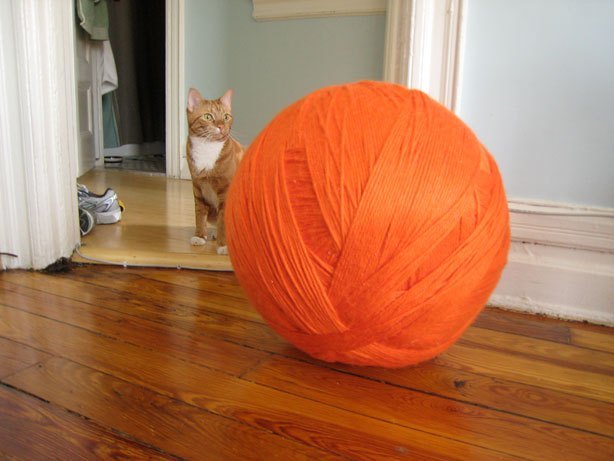
The thickest fascinations need to be studied. But first, they need to be rolled across the floor and admired like a ball of yarn in a cat’s paw to see which way the thickness unfurls. To discover the start of the string.
Alan Feldman assigns poets to write a poem that is all one long sentence, an experiment in stretched-out syntax. That’s how he wrote “In November”, published in Best American Poetry 2011.
For the long string, see also “Greed and Aggression” by Sharon Olds and “Apology to the Muse” by Alan Dugan.
What looks like the start of a poem might actually be the end once the ball stops rolling.
7.
“Crip poetics” opens an awareness to the body’s use and abuse in human space. By claiming the term “crip”—and defining it on her own terms—Barbara Hershey challenges ableism in poetic language and community. See Hershey’s poem, “etc.”, written after attending a lecture in which bell hooks listed an expansive, inclusive array of women intended to be representative, none of which was crippled. Hershey’s poem unfurls as a commentary on hooks’ lecture; the poet writes herself into the text.
“i am the etc. we are the etc.”
A lesson in the poetry of seeing one another whole.
8.
Everything we can imagine has an afterlife. I realized this after reading Michelle Bonezek’s “The Afterlife of Pennies.”
Why not write a poem titled “The Afterlife of [whatever you want here]”? Pick something you loved as a child or a teenager. Give it back a life.
9.
True love offers to hold the beloved’s scythe. See Erica Dawson’s “In Black and White”:
“A spade’s a spade. A plan
Can change. I love your pivot, covet
Your line, pin, point, arbor, and shaft:
And I can dig it. Feel that draft?
Come close. Now tell me how you love it.”
Wow.
10.
“Revealing a racial marker in a poem is like revealing a gun in a story or like revealing a nipple in a dance.”
Monica Youn’s poem, “Study of Two Figures: Pasiphaë/Sudo”, layers these markers in a slow monotone that destabilizes the foreground and empties all solid containers constructed to hold identity.
11.
Poetry taught me how to speak to a god. To say, as with Louise Gluck’s “Vespers”:
To imagine a god as "someone “who is immune to foreshadowing”.
12.
The secret life of dolls resembles our own. See Denise Duhamel’s “Kinky”:
“The night had begun with Barbie getting angry
at finding Ken’s blow up doll, folded and stuffed
under the couch.”
I’ve watched my daughters work through daily problems in their doll play. I’ve admired how Duhamel sustains this energy and potential through the entire Kinky collection—and how she infuses the secret life of our toys with hope and aspiration. How she renders them in our image.
18 ways to start a poem or talk to birds
1.
With an assertive statement or sweeping claim, a gauntlet you want to drop for the sake of circling it.
Tomaz Salamun begins “Totems On Back Roads” with the statement:
“There is no difference between a murderer
and a sip of wine.”
Then he proceeds to circle the gauntlet (and poke or enjamb) the next line:
“Delight in stopping
the flow of blood.”
And the reader circles it with the poet until finding one’s self encircled is the turn.
2.
In the middle of an interesting action, all senses wired to it.
Like Alice Bolin begins “Why Not Me” with:
”When I close my ears with cotton balls
all I hear is my weird brain rustling.”
3.
In an orgy of sonorous syntax that sets the beat and readies the breath.
Like Sasha West in “How To Abandon Ship”:
“Cows calve, horses foal, goats kid, but women do not child.”
West jimmies verb against adverb straight through the poem.
4.
In an epistolary entreaty to a surprising object.
Dear bird, dear branch, dear ringworm that ruined my life in second grade…
See Carmen Giminez Smith’s opening to “First Coda”:
“Dear poem. do no justice”
Or Sarah Burke’s “Dear Desert”, addressed to an improper noun made intimate:
“I expected a wasteland of dead rock
whittled to dust. Instead I found you.”
5.
With a strange memory that frames the poem and sets the stage.
Megan Peak’s poem “Sex Ed” starts straight puts the reader in the chair right away:
“I remember wondering whether hips were like cake.”
6.
With a negative assertion, on the X-is-not foot.
Like Megan Peak’s “Suburban Requiem” launches into a litany of what is buried, or what must not be the case:
“No girl-tongue in the mouth. No street of magnolias.”
None of the props integral to the place.
7.
In the middle of a memoir or diary you’ve been reading, in a space with no past and no future.
I can’t stop thinking about what Sylvia Plath journaled on July 17, 1955:
“I cannot live for life itself: but for the words which stay the flux. My life, I feel, will not be lived until there are books and stories which relive it perpetually in time. I forget too easily how it was, and shrink to the horror of the here and now, with no past and no future. Writing breaks open the vaults of the dead and the skies behind which the prophesying angels hide. The mind makes & makes, spinning its web.”
I feel like you could pinch any small fragment from this entry and wind up face-first in a poem.
8.
As a completion or modification of the title.
Claire Wahmonholm begins her poem, “In the Land Where Everything Is Already Trying to Kill Me, I Enter A New Phase of My Life In Which It Would Be Very Bad If I Died”, with:
“because now there is a child and its mother is burning
with rapture and terror and has my eyes and teeth.”
Note that the poet doesn’t capitalize the first letter of the first line.
9.
With an “if” statement or hypothetical that lays down the terms of the image debate.
As in “Beyond Love” by Emma Bolden, which begins so perfectly:
“If the saints are to be believed..”
10.
In the middle of emotional sparseness, with only the bones, the rawness, the statement of facts.
See Jenny George’s exquisite “I Love You.”
11.
In the accusatory tone, with finger pointed, drawing reader into complicity.
See how Rae Armantrout does this in “Distribution”:
“You think category
isn’t sexy, isn’t
sex. Seems you’re wrong.”
Notice how the lack of question sets the tone and prepares the reader.
12.
By quoting lines from another poem.
Like Matthew Olzmann does in “Letter Beginning With Two Lines by Czeslaw Milosz”:
“You who I could not save,
Listen to me.”
13.
With a sensory ambiance that will be rubbed to elicit a refrain or a restatement.
Kwame Dawes begins “On Blindness”:
“These may be the edges of a long gloom—”
And then spends the poem filling out this long gloom, using the word again in different places so that it feels both ordinary and extraordinary. Thickening this ambiance with repetitive use of a kinned word like “shadows”. Layering the surface with a sort of blending technique that reminds me of pastel painting.
Note how the title helps the reader “see” the coming darkness.
14.
With an abstract statement that lifts the eye from the page.
Like Carl Phillips in his impeccable poem, “Civilization”:
“There’s an art
to everything. How
the rain means
April and ongoingness like
that of song until at last”
Elizabeth Bishop comes to mind— losing as an art form. Note how Phillips repeats the first line at the end of the poem only to turn it. Take note of how he does this.
15.
With a bad pun.
Like Jeffrey McDaniel’s line in “Play It Again, Salmonella”:
“I’m a card-carrying member of a canceled party.”
McDaniels doesn’t start with the pun. But he could. And you can.
16.
With a matter of fact that isn’t, quite.
Like Anne Carson in “Wildly Constant”:
“Sky before dawn is blackish green.”
Carson veers back and forth between what she experiences/perceives and what something means while querying the act of signing or signaling at its root.
17.
With a title that involves a list or lays out the list a poem will attempt to provide.
Dick Allen’s “What You Have To Get Over” starts:
“Stumps. Railroad tracks. Early sicknesses,
the blue one, especially.”
The reader knows what Allen will do even as he switches into providing context and then going back to listing, back and forth, the movement.
18.
With an off scientific fact or statistic.
I can’t think of the title off the top of my head, but Brandon D’Amico does this in his recent collection from Gold Wake Press. …And there’s always a plentiful array of random data on the last page of Harper’s magazine.
sources & additional re/sources
Random notebook entries + this amazing list by Mike Young + Elisa Gabbert’s blog (and anything you can find by her on poetry) + Six awesome poets on how they begin a poem + “Best opening lines in poetry” +
Fugues as form in poetry
I’m fascinated, haunted, and provoked by the fugue form, and how it enables us to work around (and through) a poem’s texture.
Simply, a fugue is a piece of music that uses interwoven melodies based on a single musical idea. To compose a fugue is to involve a contrapuntal compositional technique in two or more voices, built on a subject (a musical theme) that is introduced at the beginning in imitation (repetition at different pitches) and which recurs frequently in the course of the composition.
There’s some wicked, beautiful friction that develops between a traditional form like the fugue when used to carry nontraditional subject matter—a capacity to stir and jar the reader by overlaying sounds, musical effects, and impressions. There is the shadow of a whispered chorus, the power of subtle moves, the undertow of implications.
Music and lyric develop in tandem if you bring the breath of them into the same space, if you encourage them to converse with each other. I have a few ideas that only begin to scratch the surface of all possible poemings in this marvel…
1. Work the background baroque.
Fugues rose to prominence during the Baroque Period, ca. 1600-1750. They were based on an earlier idea from the Renaissance Period called imitative polyphony, where multiple singers would sing the same melody at different times. The melody of the first voice is replicated by subsequent voices.
The most strict form of this type of imitation is the canon. In a canon, the original melody is emulated precisely and without variant in every voice. "Row, Row, Row Your Boat" is a simple and well-known canon. I love thinking of nursery rhymes with all the bravado and established dignity of canonical forms.
The fugue is a more complicated version version of the imitative polyphonic form. It is less rigid and strict than the canon: different voices begin by imitating each other, but gradually diverge and become unique.
Another word for polyphony is counterpoint, meaning a style and method of writing polyphony that was used during the Baroque. When someone talks about counterpoint, they are talking about a specific type of polyphony. Often counterpoint and polyphony are used like synonyms (i.e. contrapuntal texture = polyphonic texture).
In a fugue, this idea that is passed around is called a subject.
Experiment with a baroque texture and language that juggles temporal spacing of a subject through repetition and homonymy. Don’t be afraid to occupy the margins or alter the white space by playing with diptych or triptych to amplify or juxtapose voices.
2. Develop episodic movements.
An alternate type of polyphony is non-imitative or free polyphony, which features distinct melodic lines overlapping. In a fugue, this is called an episode, and is used to transition to a new section and modulate keys. Free polyphony is common in traditional New Orleans jazz and in the early polyphony of the late Medieval and early Renaissance periods.
In the non-imitative polyphonic texture, independent voices are each unique and do not copy each other. "Hotter Than That" performed by Louis Armstrong and His Hot Five, is an example of New Orleans jazz that begins with a section of free polyphony followed by improvised solos (trumpet, clarinet, voice, then trombone).
Listen to this organ version of Bach’s Fugue in G Minor. Note the short episode that pops up around 1:10. Note how the sense of polyphony is also created through the usage of a countermelody laid over subject—you can hear this at almost any point in the piece where there are two overlapping parts.
3. Excavate the etymology.
There are so many layers to a word, beginning in origins and thickening into contemporary connotation. Fugue, for example, is borrowed from French fugue, from Italian fuga (“flight, ardor”), from Latin fuga (“ act of fleeing”), from fugere (“to flee”); compare Ancient Greek φυγή (phugḗ).
I used this juxtapositioning to build pressure into “Proper Fugue”, which flirted with the Romanian meaning of fugue, proximate to the Latin and Italian one. Consider the connotations of words like flying, running, wing in a fugue—and spend time in that word space to see what emerges.
4. Listen to a Bach piano fugue obsessively.
Listen to a piano fugue by Bach (preferable performed by Glenn Gould). Now listen to it again. Listen to this fugue on repeat while writing a poem about a room that three people just left. Create a sense of those persons still in the room—the relationships, the energy between them, their dissonances. Let the music alter your tonal range.
Alternately, edit a limp poem while listening to your Bach fugue on repeat. The repetitive listening is critical—it brings things up from the surface somehow, and expands the musical progression of the poem.
5. Study Paul Celan’s “Todesfugue”.
"Todesfuge" (translated into English as Death Fugue) is a German language poem written by the Romanian-born poet Paul Celan around 1945 and first published in 1948. It is "among [Celan's] most well-known and often-anthologized poems". When Celan published it, he was criticized for its cadence and lyrical finesse by some who believed its beauty undercut the cruelty of the Shoah.
Read Paul Celan’s “Death Fugue” and study how he works with the form. Write a Todesfugue on a topic that bears witness to contemporary horrors.
6. Explore the cognitive science of fugue states.
Dissociative fugue usually involves unplanned travel or wandering and is sometimes accompanied by the establishment of a new identity. It can be a facet of disassociative amnesia.
Borrowing from the psychiatric condition of fugue state, free-write a poem in which loss of memory tangles with loss of selfhood and identity to produce multi-tonal dynamics and unmoored voices in a poem. Aim to make it one long stanza (to challenge yourself to focus on your use of language rather than white space) or go the prose poem route.
7. Fugue through the fabulous.
Lewis Lapham: “To describe a woman as fabulous is to say she is nowhere to be seen.”
In this sense, fabulousness functions as an eraser—like black or white, it gives us little to imagine apart from personal connotation. It builds no tactics tension into description. Touch is notable for the difference it reveals—the surprise of wind lipping your nape. One could argue that someone who doesn’t feel the touch wasn’t touched in a meaningful or poetic sense.
A fugue about the fabulous—a “Fabulous X Fugue”—would use the polyphony of the fugue form and its flexibility to render something fabulous (and complex) without once whispering the F word.
8. Score the poem.
The line between a melody and a lyric depends on the presence of certain symbols, or musical notation. Familiarize yourself with the musical notations below. Learn how to hear them, see them, say them. Imagine how they take up space in a poem. Work them into slant rhymes.
Write a poem that uses the musical notations as a key. For example, a line could read:
I left him in > streetlights, the dim fold of dusk.
where “>” reads “diminuendo”. The challenge is to use these notations in a way that allows the poem to be read in two voices, where one reading corresponds with a blank for each symbol (assuming the reader lacks musical knowledge) and the other reading inserts the symbolized word.
If you’ve never wasted a weekend poring through Italian musical terms and matching them to pieces you love, make time. Sempre staccato, for example, means “always detached”. Isn’t that incredible? Can’t you feel its solemnity in the stanza, in the repetitions of a word or a syllable, in the frisklessness of it?
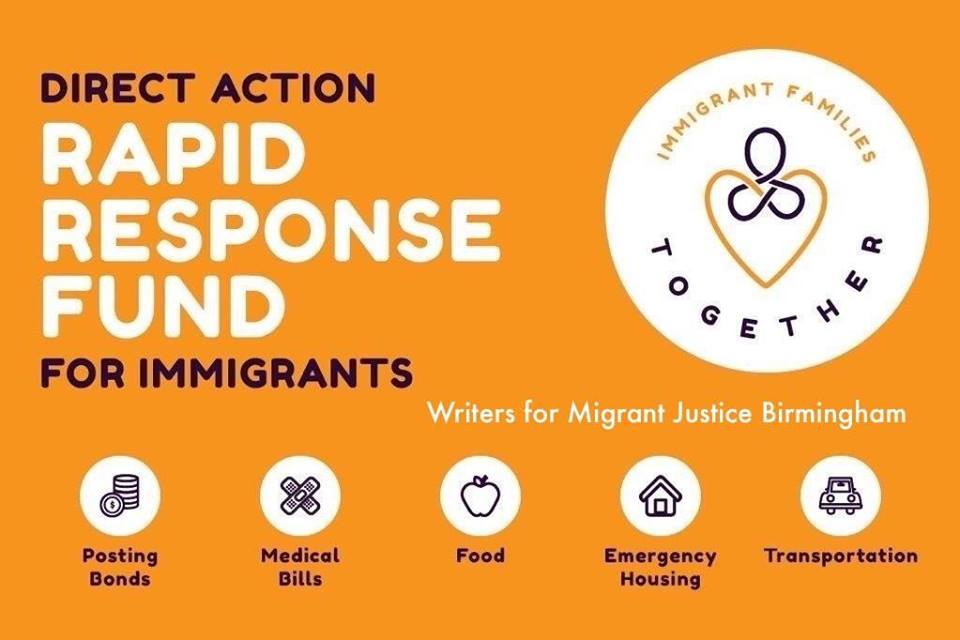
Writers for Migrant Justice, Birmingham
On September 4th, writers throughout the country will host readings to raise money for Immigrant Families Together.
Poet Emma Bolden and I are organizing the Writers for Migrant Justice reading in Birmingham, which will take place on September 4th from 5:00-6:30 pm at @discobirmingham.
We want to make sure that Birmingham shows up and makes an impact in this devastation and dehumanization launched against immigrant bodies whose crime is derived from the fact of their foreignness. And from the xenophobia and racism that makes such criminalization possible.
How This Works: Donate Online or At the Reading
We're asking readers to sign up and either ask sponsors to make donations or make a donation to sponsor themselves. A sponsor who donates $50 or more can choose a poem to be read at the reading.
Sponsors can donate online using the Writers for Migrant Justice page. Please ask your sponsor to write "Birmingham" in the comments section so that we can track donations.
We will also collect donations at the reading in the form of cash or checks made out to "Immigrant Families Together." You'll also be able to donate electronically via Venmo and the Writers for Migrant Justice GoFundMe page.
Until then, here’s the Facebook page which remains far more interesting and important than any cute kitten meme currently doing the rounds. (Peace kittens, I love you—but migrant lives matter more to me than the multiple feel-good vessels we use to ignore them.)
Thoughts on Bread Loaf from the least popular parts of me.
1.
Any word spoken is inauthentic, dishonest, incredible when compared to what I have given the page.
And yet, I didn’t start writing for publication until the age of 35, when the barriers I’d put between myself and the fascination seemed tiny next to the mountain of poems, stories, and fragments lodged in my throat.
I came to marriage, motherhood, and writing on a “nontraditional path”. My experiences and thoughts should be considered in light of that MFA-lacking path. I am the black sheep on the boulevard and I am so lucky. I am lucky to write and read and publish and edit; lucky to find an audience in a literary community where publication is one smidgen of talent, another smidgen of hard work + discipline, but mostly a shit-ton of inexplicable good fortune.
2.
Bread Loaf Writer’s Conference is a unique community that exists to support, encourage, and build bridges between writers.
I learned so much in those ten days, and so much of this learning came from reading, hearing, studying, and absorbing the work of my brilliant peers.
The food is delicious. The coffee is constant. The showers are clean. The staff is generous. The grounds are tended like the body of a beloved.
There are morning yoga sessions and AA meetings to support the challenges of life as we know it. There is a newspaper, The Daily Crumb, produced with all the diligence and hard work of editors who prepare it regardless and always.
There are countless generosities—from the kindness of the Innkeeper to the sudden dragonfly that preens overhead long enough for you to write her and thank her and kiss the cosmos that made her.
There is a sense of magic in the tiniest details—from the selection of room-mates (can you tell how I adore Alicia?) to the surprise thunderstorms and the readings that relocate quietly when electricity dies, the way writing demands this lip-biting perseverance from us, this galling, obscene persistence, this relentless motion forward despite what the world erects to slow (or even undo) us.
3.
Stephen Dunn: “The secret life begins early and is kept alive by all that is unpopular in you.”
Introverts need not fear—there is space for those of us who insist on nourishing the unpopular parts of ourselves.
There is a secret blackberry bush behind the library where you can disappear and indulge stained fingers. There is a hidden creek near the horse barn with a small wooden bridge, and a fire circle two leaps away. There is a lush green glen where you can sink your face in the grass and no one can find you. There is a cordon of undemanding silence that rims the outer lips of the meadow. There is a library filled with books and couches, a refuge that stays open all night and all day. And there are others (countless others) for whom such a library feels like heaven.
4.
There are moments when you cultivate the courage to approach a writer you admire, to launch yourself like a bathos-carrying missile in order to say something awkward, something irrelevant, something like: “I covet your words, your mind, your wonder, your daring…”
There is an ambiance of safe awkwardness in which that is acceptable, or not the end of anyone’s world.
5.
Since the world we want to live in does not exist yet, there are human beings.
There are hierarchies.
There is a space you make for yourself in the space created by others.
I can’t speak to the experience of waiters or work-study scholars or writing fellows—that experience is best explained and described by those to whom it applies. I know people who could not attend without a work study or waiter scholarship. I know people who did not attend when financial aid was not forthcoming. I know people who could not attend for lack of assistance with caregiving (and yes all those people were women). I know people (like myself) who maxed out a credit card and relied on an overtaxed partner in order to attend.
In a capitalist system where value rises in relation to scarcity (both actual and perceived), competition, exclusivity, and prestige are part of the game we play in order to do what we love. Which is, always, above all, absolutely: to write.
To suggest there are no “winners” and “losers” is to deny the game itself, or to erase the institutions that both sustain, nurture, and develop us. I won’t diminish the experience of writers who applied to Bread Loaf and didn’t get in by trivializing their disappointment or offering dull platitudes. It makes sense to be sad or frustrated by a system that anoints winners. And maybe we should talk about that.
Maybe it’s better to address than deny the challenge of navigating a literary world that aspires to meritocracy and justice in a country where no one agrees on what those words mean.
In an industry where rising to the top makes it easier to rationalize why we deserve it.
Now I’ll say the thing no one wants to hear—the unfortunate truth, namely, that there is no such thing as a meritocratic literary conference or MFA program in the United States of America.
There is only the fluctuating, market-drive meaning of “merit” in subjective assessment protocols used to evaluate applications and to predict what a writer may or may not contribute to the literary community. There are so many generous writers and program directors trying to make this world more just, deserving, and genuine bt we are still operating in a system ruled by profit. We need money to live, survive, and thrive. It amuses me when these facts are treated as controversial or open to debate.
I know too many talented writers have never attended Bread Loaf. Or Tin House. Or Sewanee. Or Barrelhouse. Or any conference that acknowledges and develops their gifts and unique voices. You know these writers too. Hell, we all know the writers that are missing. And saying otherwise reveals a talent for self-hypnosis or an uncanny ability to make dicta of personal myth.
Each one of us benefits from privilege when we attend a writing conference or residency when we attend a writing conference that doesn’t include everyone who should be there. “Should” is a large word that includes people we don’t know about, mammals who lack exposure or access in ways we can’t EVEN IMAGINE.
Acknowledging this should not be construed as an indictment of Bread Loaf or writing conferences and/or residencies. It should not be construed as an indictment of scholarships or work-study or financial assistance based on something other than financial need. It should be construed in the spirit of self-interrogation and complicity that writing demands of us as humans who live in country that excels in global destruction.
A clear-eyed gaze helps us realize we don’t “deserve” something just because we benefit from the good fortune of having it. The un-American in me feels that humility is the appropriate mental and emotional response. The un-American continues to be unpopular on every topic from football to war. But the un-American in me won’t make our lives easier by shutting up.
“Whatever you want to hold against Bread Loaf should be held against every major conference or organization. That is the system we live in—and Jennifer Grotz clearly made a strong, unrelenting effort to undermine inequality and injustice in every way possible at this year’s BLWC.”
6.
Jericho Brown: “Writing the poem is how we face the terror.”
I want to share some things you can from Bread Loaf without attending the conference, and this mesmerizing audio collection of lectures and readings is a start.
Jericho Brown’s “Faith In the Now: Some Notes on Poetry and Immortality” changed something in me, and I can’t imagine a writer watching this video and not feeling the ground quiver beneath their feet.
Jericho juxtaposes happiness, which is cheaper, quicker, immediate, and consumable, with the longer arm of joy which lacks a “logical root”. Joy, whose value is wonder, whose origin escapes us, whose power shakes everything it touches. The poet describes the experience of leaving organized religion and church because “there was shame in sadness” and the joy he discovered there was a defiant response to slavery.
But does joy have to be experienced as a response to white supremacy? To quote Jericho, “In literature, black people don’t need white people to enjoy the scent of the earth.” And we all know “American ideals never existed in practice”—if they had, Trumpists wouldn’t be trying to turn back the clock.
“I do not romanticize the struggle,” Jericho says. Nor does he want to live for a life (or an afterlife) he can’t experience. Etched in my mind, this ars poetica: “I am more interested in learning about why we’d be interested in immortality than I am in immortality itself.”
Hasn’t poetry also resided in this liminal space between litany, song, and prayer? I love his analogy between writing poetry and the process of prayer wherein a line-break delineates doubt, waiting for the next line, an unbidden faith that it will come, that something has yet to be spoken, that something in the revelation will save us.
7.
But I’m not saying what I mean, exactly.
In the barn one night, Jennifer Grotz read a poem that uses Simone Weil’s “attention is a form of prayer” as scaffold. Her poem was a prayer with an eye to the mosquitos and tendrils of corn on the night when rain “attended” her, when rain was made complicit in this relationship of rapt attention. Bread Loaf cultivates this rapture. And so we wait in the tangles of each Other, in this complex attention ecology.
8.
Ultimately, finally, always—there is the fascination.
And the Kim Addonizio quote in my notebooks: “This is your genius: your own profound desire to write…If you are meant to be a writer, you will serve your genius as well as you can.” With humility, trepidation, terror, and maybe something kin to reverence.
It’s not a question of how good you are but how far you’re willing to go in fascination.
How much intensity and self-discipline you can bear.
How much rejection you can bracket.
How you honor creation in a product-driven economy.
How much loneliness turns to fear on your tongue.
—And there is the knowledge that you do not deserve this.
That no one really deserves this because everyone deserves this.
That Bread Loaf and writing conferences and publication are things we can’t earn, dreams to which we can’t secure a right.
There is privilege. And what you do with it. What you make, share, give back, and build into the future. Perhaps the poem you offer the page.
9 figures of speech which are not
1.
There is a moth that feeds on the tears of small birds. The moth visits the birds as they sleep. The moth lands on the sleeping bird’s head ever so gently before unfurling its proboscis and laying the tip just beneath the bird’s eyelid. But “to drink without waking the birds” is not yet a common expression or cliche. Is it a figure of speech?
And what do they dream, these birds whose tears are stolen?
2.
In September 2018, a biologist actually spotted the Gorgone macarea moth sitting on the neck of a black-chinned antbird in Brazil poised to drink the bird's tears. It was “the first time this behavior was reported in the country and only the third known case worldwide.”
Something we’ve never seen may be a miracle.
3.
“What do poets do? Slip
a wobbly syllable under
a microscope
so close to the lens
it cracks.”
- Martha Silano, “It was how a sentence” (AGNI)
4.
The difference between writing and willing isn’t always clear to me. Right now, for instance, I’m laying these thoughts down in my notebook for one reason, namely, to provide context for an event I want to see in the world. This event involves drawing attention to the first stanza of a poem by Rosmarie Waldrop:
“If, close to morning, you see the physical fact of language you may take a prophylactic
attitude. A figure of skating or speech. The scale is heavy flesh.”
5.
The heart cannot break. No matter how often we compare the heart to a breakable object, the human heart remains a quivering fist of pink jelly, a mass of pulsing tissue that is not quite machine.
Believe me when I tell you my heart busted wide as a cactus piñata after my mom’s sudden death. My heart was bat-broke open.
6.
The poem’s job is to make you believe it. If the heart can’t be broken, the poem’s job is to break the heart anyway.
There is nothing less forgivable than the poem who assumes it can speak of heartbreak without hurting anyone.
Or breaking things.
7.
I don’t know why hearts lie about breaking, but I read that moths and butterflies have also been observed feeding on the tears of crocodiles and turtles. They do this to obtain the salt which isn’t naturally available in nectar.
A moth drinking crocodile tears is a marvelous event in my head.
8.
In the poem that is an event, Rosmarie Waldrop lassos the dedication into the title: “The Material World (for Johanna Drucker)”. The poet is continuing a conversation with her friend and she wants to be sure we understand Johanna is not an afterthought but a part of the poem’s flesh.
Here’s what I can’t forget: the final phrase of the third stanza.
Which also happens to be the exact middle of the poem, something like it’s centerfold:
“Pressure just below the phrase level.”
9.
The bird dreamt of her single, unbreakable nest.